Complex PTSD and Psilocybin
22 PTSD participants, phase 2
The first formal safety trial of single-dose psilocybin in PTSD (McGowan et al., 2025) enrolled 22 participants and reported 117 treatment-emergent adverse events, with 91.4% of dosing-day events resolving by the end of the next day, and clinically meaningful CAPS-5 reductions from baseline.
McGowan et al., phase 2 open-label trial, 2025
Dissociation as exclusion
most trials exclude dissociative disorders
Trauma ≠ classic PTSD
cPTSD phenomenology differs in structural ways
Preparation > dose
integration-and-preparation burden is higher
McGowan et al., phase 2 open-label trial, 2025
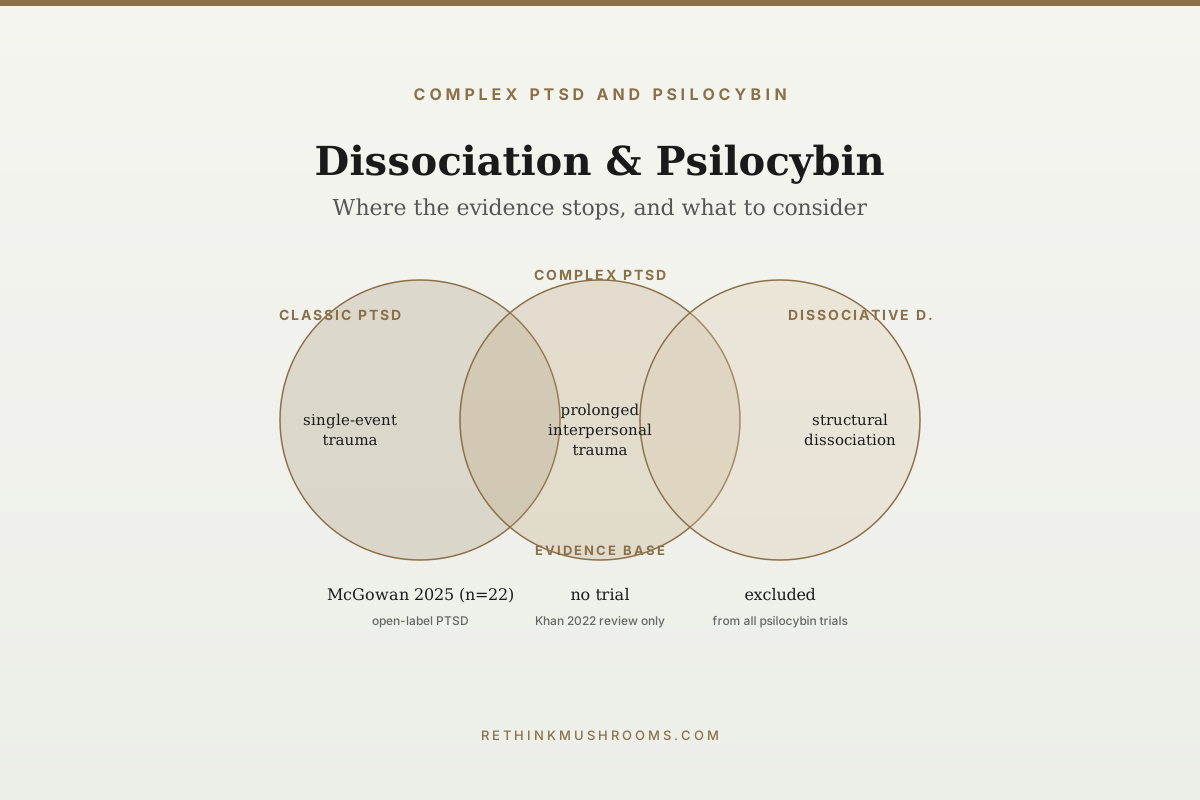 View as image ↗
Complex post-traumatic stress disorder (cPTSD) and dissociative disorders sit at the edge of the current psilocybin evidence base rather than inside it. No randomised controlled trial to date has enrolled cPTSD as a specified indication, and dissociative identity disorder and related diagnoses are typically formal exclusion criteria in psilocybin research protocols. This article covers what the evidence actually establishes, why the exclusion patterns exist, and what considerations specifically apply when a clinician or a client is thinking about psilocybin in the context of complex trauma and dissociation.
For related context, see complex PTSD and psilocybin: can it reach developmental trauma?, psilocybin and childhood trauma: emerging research and considerations, psilocybin for complex PTSD: is it different from standard PTSD?, and psychedelic therapy for developmental trauma.
Before You Read On
CriticalThis article is not medical advice, and complex trauma is not a self-directed use case
Concern
Complex PTSD and dissociative disorders are the two populations most consistently excluded from psilocybin trials, which means the safety profile reported in those trials was measured in people who are not in this group. The largest survey to test the question found that childhood adversity was associated with roughly 2.2 to 2.8 times higher adjusted odds of psychedelic-related difficulties, and the risk rose with the number of adverse experiences.
What the research says
Nothing in this article establishes that psilocybin is safe or effective for complex PTSD or dissociative disorders, and nothing here is a protocol. It is a description of what has and has not been studied, written for clinicians weighing an evidence gap and for readers who want to understand why that gap exists.
Particularly relevant for: Adults with complex PTSD, prominent dissociative symptoms, or a diagnosed dissociative disorder
What to do
Decisions in this space belong with a trauma-specialty clinician who knows your history — not with an article, a facilitator without dissociation training, or a retreat. If you are in crisis or thinking about harming yourself, contact local emergency services now; in the US, call or text 988.
Olofsson et al. 2026, International Journal on Drug Policy; exclusion criteria across the published psilocybin trial landscape
Key Takeaways
- No completed randomised trial has evaluated psilocybin specifically in complex PTSD; the first dedicated PTSD trial (McGowan et al., 2025) enrolled 22 participants in an open-label safety study and did not stratify by cPTSD vs classic PTSD phenotypes
- Dissociative disorders are typically formal exclusion criteria in psilocybin trials, reflecting concern that acute ego-dissolution and perceptual dysregulation may destabilise patients with structural dissociation
- Khan and colleagues (2022) reviewed the psilocybin-in-PTSD literature and converged on "preliminary and promising, but highly uncertain," with no mechanistic or clinical basis yet to extend trial findings to cPTSD populations
- The strongest population-level signal specific to this group is indirect: Olofsson and colleagues (2026), surveying 3,168 adults, found adverse childhood experiences associated with higher adjusted odds of psychedelic-related difficulties in a dose-dependent pattern (2 ACEs aOR 2.24; 3 ACEs aOR 2.27; 4 or more aOR 2.84), though this measured naturalistic rather than clinical use
- Simon and colleagues (2025) described what happens when early trauma resurfaces during a psychedelic experience: among 18 people interviewed after lasting difficulties, fragmentation and confusion was the most common mode (50%), and outcomes ranged from positive integration (50%) to re-traumatisation (22%)
- Mechanistic work in healthy and depressed populations (Carhart-Harris 2017; Daws 2022; Madsen 2019, 2020; Barrett 2020; Raval 2021) identifies 5-HT2A agonism, amygdala modulation, synaptogenesis, default-mode network disruption and claustrum connectivity changes as candidate mechanisms; relevance to cPTSD-specific circuitry is extrapolated, not established
- Ellis and colleagues (2025) reported 60% response and 53% remission at week 3 in 15 US veterans with severe TRD given 25 mg psilocybin, with co-morbid PTSD not significantly influencing outcome
- Catlow and colleagues (2013) found that low-dose psilocybin accelerated extinction of fear conditioning in mice; notably, psilocybin decreased hippocampal neurogenesis in a dose-dependent way, and the low doses that improved extinction were the ones that spared it
- The principal considerations for cPTSD populations are screening (dissociative symptoms, suicidality, structural dissociation), preparation (longer and more protocol-heavy), set and setting control, and integration (substantially more intensive than standard TRD protocols)
What Complex PTSD Is, And Why It Matters Here
Complex PTSD was added to ICD-11 as a distinct diagnosis from PTSD when that revision was released in 2018, and it remains under active debate for DSM classification. The diagnostic criteria extend the three PTSD symptom clusters (re-experiencing, avoidance, hyperarousal) with three disturbances of self-organisation: affect dysregulation, negative self-concept, and disturbances in relationships. The prototypical cPTSD presentation follows prolonged, repeated, interpersonal trauma, often in developmental contexts (childhood abuse, captivity, trafficking, prolonged intimate partner violence), rather than a single discrete event.
Two features of this phenotype matter for psilocybin considerations. First, cPTSD patients more frequently carry structural dissociative symptoms than classic PTSD patients, including derealisation, depersonalisation, emotional numbing and in some cases dissociative identity phenomena. Second, the affective and relational dysregulation component makes therapeutic alliance and integration work a larger share of the treatment than it is in single-incident PTSD or in TRD.
Psilocybin trials to date have not stratified populations this way. The PTSD studies in the peer-reviewed literature (and ongoing clinical trials) typically enrol a mixed population using standard PTSD criteria, and often exclude dissociative disorders outright. This leaves a significant clinical population, adults with cPTSD and prominent dissociation, without direct trial evidence.
The Current PTSD Evidence Base
Khan and colleagues (2022) provided the most comprehensive review of psilocybin and trauma to date.[1] Their conclusion was that converging preliminary evidence supports theoretical and mechanistic interest in psilocybin for PTSD, but that no study had yet investigated psilocybin or psilocybin-assisted psychotherapy as a treatment for PTSD. The strongest data they could point to was an open-label study in traumatised AIDS survivors, in which psilocybin-assisted psychotherapy reduced PTSD symptoms, attachment anxiety and demoralisation. The review flagged the intersection of PTSD phenomenology with the acute psychedelic experience as a specific area requiring careful screening and preparation.
McGowan and colleagues (2025) reported the first formal safety and tolerability trial of single-dose psilocybin in PTSD, a phase 2 open-label, nonrandomised, multicentre study of 22 participants.[2] The primary outcome was safety. Of 117 treatment-emergent adverse events across the cohort, 70 (59.8%) were reported on administration day and 64 of those (91.4%) resolved by the end of the next day. Common adverse events were headache (50%), nausea (36.4%), crying (27.3%) and fatigue (27.3%). No serious adverse events or study withdrawals occurred. Secondary outcomes showed clinically meaningful mean reductions in CAPS-5 total score at Week 4 (-29.9) and Week 12 (-29.5), with PCL-5 scores showing rapid and sustained symptom reduction. Interpretation is limited by the open-label design and the absence of any control arm.
McGowan et al. (2025) · Journal of Psychopharmacology
- Population
- 22 adults with PTSD (63.6% female; mean age 39.0). Dissociative disorders excluded.
- Intervention
- Single 25 mg dose of psilocybin with psychological support
- Comparator
- None — open-label, nonrandomised, no control arm
- Finding
- 117 treatment-emergent adverse events, none serious and none causing withdrawal; 91.4% of dosing-day events resolved by the end of the next day. Mean CAPS-5 reduction of -29.9 at Week 4 and -29.5 at Week 12.
preliminary A safety and tolerability trial, not an efficacy trial. With 22 participants, no blinding and no placebo arm, the symptom reductions cannot be separated from expectancy, regression to the mean, or the psychological support delivered alongside the dose. It establishes that the protocol was tolerated — not that it works, and not that it generalises to complex PTSD.
McGowan et al. 2025, Journal of Psychopharmacology; ClinicalTrials.gov NCT05312151
Ellis and colleagues (2025) reported an adjacent dataset: 15 US veterans with severe treatment-resistant depression given 25 mg psilocybin, with 60% response and 53% remission at week 3 on MADRS.[3] At 12 weeks, 47% maintained response and 40% remission. A key observation for trauma considerations was that co-morbid PTSD did not significantly influence outcomes in the TRD primary endpoint, suggesting at least that the presence of PTSD is not a categorical barrier to response in this veteran population. The study did not include cPTSD as a separate stratum, and the degree of psychedelic experience reported did not correlate with response.
The 25 mg dose that recurs across these studies traces back to Goodwin and colleagues (2022), the phase 2 double-blind COMP360 trial in treatment-resistant depression.[4] That trial randomised 233 adults to 25 mg (n=79), 10 mg (n=75) or 1 mg as control (n=79), and found that 25 mg — but not 10 mg — reduced MADRS scores significantly more than the 1 mg dose over three weeks (least-squares mean difference -6.6; 95% CI -10.2 to -2.9; P<0.001), while also being associated with adverse effects. It is worth being precise about what this means for the present topic: the randomised evidence anchoring the 25 mg dose is evidence in depression, not in PTSD, and certainly not in complex trauma.
These are the empirical anchors. Neither the PTSD trial nor the TRD trials are sufficient to ground a clinical claim about psilocybin in cPTSD, and none of them included participants with prominent structural dissociation.
Where the Evidence Stops
How Far the Psilocybin Trial Evidence Actually Reaches
Each rung is a population, ordered by how much psilocybin evidence exists for it. The question this article is about — complex PTSD, and dissociation — sits on the bottom two rungs, where the evidence runs out entirely.
PTSD, mixed phenotype
Direct evidenceOne phase 2 open-label safety trial, 22 participants, single 25 mg dose. Meaningful CAPS-5 reduction, no serious adverse events — but no control arm, and dissociative disorders were excluded.
McGowan 2025 · NCT05312151
Treatment-resistant depression with co-morbid PTSD
Adjacent evidenceCo-morbid PTSD did not significantly influence depression outcomes in 15 veterans. The randomised evidence at this dose (n = 233) is in depression, not PTSD.
Ellis 2025 · Goodwin 2022
Prolonged interpersonal trauma (partner violence, sexual assault)
In progressNo results yet. Trials are now recruiting populations in which complex PTSD is heavily over-represented — the closest proxy the field will have.
NCT06885996 · NCT06902974
Complex PTSD as a named indication
No evidenceNo completed randomised trial has enrolled complex PTSD as a specified indication. Nothing here has been measured.
No trial
Dissociative disorders (DID, OSDD-1)
ExcludedA formal exclusion criterion across the trial landscape. No published controlled data exists for this population, and the exclusion is what prevents it from accumulating.
Excluded by protocol
How to read it: moving down the ladder does not mean psilocybin becomes more dangerous — it means less is known. The bottom rung is a statement about missing data, not a demonstrated harm. Note also that the exclusion on the bottom rung is self-reinforcing: dissociative disorders are excluded because there is no safety data, and no safety data accumulates because they are excluded.
Sources: McGowan et al. 2025 [2]; Ellis et al. 2025 [3]; Goodwin et al. 2022 [4]. Trial registrations verified against ClinicalTrials.gov, which lists 26 registered studies for psilocybin in PTSD; none names complex PTSD as its indication.
What Trauma History Predicts About Risk
The trial literature cannot answer the question this article is about, because it excluded the relevant population. There is, however, a body of survey research that samples the people trials leave out — and it is the most directly relevant evidence available.
Olofsson and colleagues (2026) surveyed 3,168 US adults with lifetime psychedelic use, measuring both the difficulties that followed and the respondents' adverse childhood experience (ACE) count.[5] Most participants (87.9%) reported no difficulties at all. Among the remainder, 6.4% reported post-acute difficulties lasting more than a day and 1.3% lasting more than a year, most commonly general anxiety (33.9%), negative changes in self-concept (25.9%) and social disconnection (23.0%). In covariate-adjusted models, the odds of reporting difficulties rose with ACE count: 2 ACEs (aOR 2.24), 3 ACEs (aOR 2.27) and four or more ACEs (aOR 2.84) all carried significantly higher odds than no ACEs. Four or more ACEs was also associated with difficulties that persisted beyond a day (aOR 2.37) and beyond a week (aOR 2.89).
Childhood Adversity & Risk · Olofsson 2026 (n = 3,168)
More Childhood Adversity, Higher Odds of a Difficult Aftermath
Complex PTSD is the clinical picture that follows prolonged developmental adversity, so the adverse childhood experience (ACE) count is the closest available proxy for this population. In the largest survey to test the question, the odds of experiencing psychedelic-related difficulties rose with ACE count — and stayed elevated after adjustment for other factors.
0 ACEsReference group
aOR 1.00 · reference2 ACEsvs 0 ACEs
aOR 2.24 · p = 0.0073 ACEsvs 0 ACEs
aOR 2.27 · p = 0.0064 or more ACEsvs 0 ACEs
aOR 2.84 · p < 0.0012.37aOR
Odds of difficulty lasting more than 1 day
4+ ACEs, p = 0.015
2.89aOR
Odds of difficulty lasting more than 1 week
4+ ACEs, p = 0.042
87.9%
Reported no difficulties at all
6.4%
Difficulties lasting more than a day
1.3%
Difficulties lasting more than a year
How to read it: an adjusted odds ratio (aOR) of 2.84 means the odds of reporting a difficulty were about 2.8 times higher than in people with no ACEs — not that 2.8 times as many people were harmed. Because the underlying rate is low, a near-tripling of the odds still leaves most people in every group reporting no difficulties. This was a cross-sectional survey of naturalistic (non-clinical, largely unsupervised) use, so it does not measure risk under a screened, prepared and supported clinical protocol, and it cannot establish that adversity causes the difficulties. The 1-ACE contrast is not reported in the source and is deliberately omitted here.
Source: Olofsson et al. 2026, International Journal on Drug Policy [5]. Covariate-adjusted odds ratios for psychedelic-related difficulties by ACE count among 3,168 U.S. adults with lifetime psychedelic use. Bar length is proportional to the reported adjusted odds ratio.
Simon and colleagues (2025) went further into the phenomenology.[6] Surveying 608 people who had experienced post-psychedelic difficulties outlasting the acute effects, they found 41.8% attributed those difficulties to early trauma; that subgroup was older, more often female, more likely to carry a prior mental-health diagnosis, and — notably — more likely to have used psychedelics in guided settings. They reported more emotional difficulties but fewer perceptual ones. In-depth interviews with 18 of them identified how the trauma surfaced: fragmentation and confusion (50%), direct trauma re-experiencing (39%, including some participants with no prior memory of the events), and symbolic or somatic re-embodiment (22%). Post-experience trajectories ran from predominantly positive integration (50%) through mixed effects (28%) to re-traumatisation (22%).
When Trauma Surfaces · Simon 2025 (n = 608 survey, 18 interviews)
How Early Trauma Resurfaced — and Where People Ended Up
Among 608 people who had post-psychedelic difficulties that outlasted the acute effects, 41.8% said those difficulties seemed connected to early trauma. Eighteen were interviewed in depth. The upper panel shows how the trauma surfaced; the lower panel shows where they ended up afterwards.
How the trauma surfaced
Fragmentation and confusiondissociation-adjacent
50%Direct trauma re-experiencingsome with no prior memory
39%Symbolic / somatic re-embodimentfelt in the body
22%Where they ended up
50% Predominantly positive integration
28% Mixed effects
22% Re-traumatisation
How to read it — carefully: everyone in this study was recruited because they had lasting post-psychedelic difficulties. These percentages are shares of that difficulty-selected group, not population risks. “22% re-traumatisation” means roughly a fifth of the 18 people interviewed about their difficulties — it does not mean 22% of people who take psilocybin are re-traumatised. The themes overlap and do not sum to 100%. With 18 interviewees, a single person moves a category by about six points. The value of this study is the description of what happens, not the frequency of it.
Source: Simon et al. 2025, Scientific Reports [6]. Phase 1 survey n = 608; Phase 2 reflexive thematic analysis of 18 semi-structured interviews. Bar length is the reported percentage within the interviewed subgroup.
Two things in that study deserve emphasis. The first is that "fragmentation and confusion" was the single most common mode of trauma surfacing — a description that sits uncomfortably close to the dissociative phenomena that trials exclude for. The second is that the authors flagged uncertainty about memory veridicality as an ongoing source of distress, which is a specific and underappreciated hazard when trauma content surfaces in an altered state without a framework for holding it. Their conclusion was a call for trauma-informed approaches with adequate preparation, supportive settings and robust integration — the same three variables this article keeps returning to.
Why Dissociative Disorders Are Typically Excluded
Across the psilocybin trial landscape, dissociative identity disorder and related dissociative disorders have been formal exclusion criteria. The rationale, articulated across trial protocols and ethics-review documentation, rests on three concerns.
First, the acute psilocybin experience produces perceptual and cognitive dysregulation (ego-dissolution, altered body schema, derealisation-like phenomena) that overlaps phenomenologically with chronic dissociative symptoms. The concern is that induction of these states could reinforce, destabilise or fragment existing dissociative structures rather than resolve them.
Second, dissociative identity phenomena involve distinct self-states with potentially different capacity for informed consent, psychological resilience and integration. Standard trial consent, dose-response and integration protocols assume a unified agent capable of sustained engagement with the material, which is not the clinical reality in dissociative identity disorder.
Third, evidence is sparse. The same reason dissociative disorders are excluded, lack of data, creates a self-reinforcing exclusion pattern. Until small, carefully-designed trials establish safety signals, larger protocols cannot responsibly enrol this population.
Fact Check
What the exclusion criterion actually means
The claim
“Dissociative disorders are excluded from psilocybin trials because psilocybin has been shown to be dangerous in dissociative patients.”
A reasonable inference from the fact that the exclusion is near-universal across protocols.
What research shows
Context DependentThe exclusion reflects an absence of data, not a demonstrated harm. No controlled trial has enrolled this population, which means no trial has found a harm signal in it either. There is no prior pharmacological reason to think 5-HT2A agonism is inherently more dangerous in dissociative disorders.
This cuts both ways, and the second edge is the sharper one. 'No demonstrated harm' is not reassurance — it is the same absence of evidence, read from the other side. The theoretical concern that acute ego-dissolution may destabilise structural dissociation remains entirely untested, and the exclusion is self-reinforcing: no data means exclusion, and exclusion means no data accumulates.
Exclusion criteria across published psilocybin trial protocols; Khan et al. 2022
The exclusion is a statement about evidence, not about mechanism. There is no prior reason to believe 5-HT2A agonism would be inherently dangerous in dissociative disorders. The exclusion reflects that we do not know, and the stakes of finding out the hard way are high.
Mechanism Considerations
Mechanistic work on psilocybin has accumulated across healthy and depressed populations and identifies candidate mechanisms that are relevant to trauma biology in principle, even if they have not been tested in cPTSD.
Carhart-Harris and colleagues (2017) reported that psilocybin with psychological support produced decreased cerebral blood flow in the temporal cortex including the amygdala, alongside increased resting-state functional connectivity within the default-mode network, in patients with treatment-resistant depression; decreased amygdala CBF correlated with reduced depressive symptoms.[7] The amygdala is central to PTSD circuitry, so amygdala modulation is a plausible mechanistic bridge, though trauma-specific functional effects remain untested and the sample was 19 patients.
Daws and colleagues (2022) showed that psilocybin therapy in depression decreased fMRI brain network modularity, implying a global increase in brain network integration, with that change correlating with antidepressant response across two trials.[8] Chronic PTSD and cPTSD are associated with disrupted large-scale network dynamics, so a mechanism of global integration recovery is conceptually relevant, but the specific network reconfigurations in cPTSD differ from those in MDD and may respond differently.
Madsen and colleagues (2019) established that psychedelic intensity correlates with 5-HT2A receptor occupancy by psilocin in human PET studies, with dose-related occupancies up to 72% across eight healthy volunteers, anchoring the subjective experience at the receptor level.[9] Madsen and colleagues (2020) reported increases in personality Openness and mindfulness three months after a single psilocybin dose in ten psychedelic-naïve healthy volunteers.[10] Both findings inform the broader mechanism picture but do not translate directly to cPTSD outcomes, and both rest on very small samples.
Barrett and colleagues (2020) showed that psilocybin acutely alters claustrum functional connectivity with cortical regions in 15 healthy adults, implicating a circuit that is densely 5-HT2A-expressing and connected to essentially all of the cerebral cortex.[11] Raval and colleagues (2021) demonstrated in pigs that a single psilocybin dose increased synaptic vesicle protein 2A (SV2A) density in the hippocampus at both one day (+4.42%) and seven days (+9.24%, with +6.10% in prefrontal cortex).[12] The accompanying reduction in 5-HT2A receptor density, by contrast, was acute only — substantial at one day but no longer detectable at seven days. The authors' own framing is the accurate one: persistent synaptogenesis alongside an acute, transient receptor down-regulation.
Catlow and colleagues (2013) provided the closest trauma-mechanism preclinical study, and it is more equivocal than it is often reported to be.[13] Mice given low doses of psilocybin extinguished cued trace fear conditioning significantly faster than mice given high doses or saline. On neurogenesis, however, the direction of effect was negative: psilocybin, the 5-HT2A agonist 25I-NBMeO and the antagonist ketanserin all produced significant dose-dependent decreases in newborn hippocampal neurons. The nuance that matters is that at the specific low doses which enhanced extinction, neurogenesis was not decreased, and tended non-significantly toward an increase. The authors themselves cautioned that the extinction effect may be mediated outside the hippocampus — plausibly the amygdala — and that psilocybin is not selective for 5-HT2A receptors. Fear extinction is the mechanism most analogous to trauma-memory processing in cognitive-behavioural models of PTSD, and it is the proposed mechanism for MDMA-assisted therapy in PTSD as well, but this is a mouse study with an internally mixed result, and mouse-to-human translation is a substantial gap.
- Receptor and mechanism workcompleted
5-HT2A occupancy tracks subjective intensity (Madsen 2019); claustrum and network effects mapped in healthy adults (Barrett 2020, Daws 2022).
- Animal modelscompleted
Faster fear-extinction at low doses in mice, with a dose-dependent decrease in neurogenesis overall (Catlow 2013); persistent synaptogenesis in pigs (Raval 2021).
- Surveys and case-level reportscompleted
Naturalistic surveys link childhood adversity to higher odds of lasting difficulties (Olofsson 2026) and describe re-traumatisation when trauma surfaces (Simon 2025).
- Small trials in PTSDcurrent
One open-label safety trial, n=22, no control arm, dissociative disorders excluded (McGowan 2025).
- Randomised trials in complex PTSDmissing
None. No completed randomised trial has enrolled cPTSD as a specified indication, and none has enrolled a dissociative disorder at all.
- Meta-analysismissing
Not possible — there is nothing yet to pool.
The evidence chain is real but it stops two rungs short of the question. Mechanism and animal work are genuine; the single human PTSD trial is small, uncontrolled and excluded the dissociative population; and the randomised evidence for complex PTSD does not exist. The survey layer is the only evidence that samples this population directly, and it points toward higher risk rather than benefit.
McGowan 2025; Olofsson 2026; Simon 2025; Catlow 2013; Raval 2021; Madsen 2019; Barrett 2020; Daws 2022
Specific Considerations For Complex PTSD
The considerations that distinguish psilocybin use in cPTSD from its use in single-incident PTSD or TRD cluster around several domains.
Screening and assessment. Structured diagnostic assessment should differentiate classic PTSD, cPTSD and dissociative disorders. Tools such as the International Trauma Questionnaire (ITQ), the Clinician-Administered PTSD Scale for DSM-5 (CAPS-5), the Multidimensional Inventory of Dissociation (MID), and the Dissociative Experiences Scale (DES-II) are standard in trauma specialty settings. A cPTSD diagnosis with prominent structural dissociation shifts the risk/benefit analysis substantially. Current trial protocols would typically exclude such patients; clinical real-world decisions require weighing that exclusion evidence against the patient's specific treatment history, stabilisation status and support resources. The ACE gradient reported by Olofsson and colleagues gives screening a quantitative rationale it previously lacked: adversity load is not merely a contextual detail, it is associated with the odds of a difficult aftermath.
Preparation and therapeutic alliance. Standard psilocybin-assisted therapy protocols include preparation sessions prior to dosing. In cPTSD populations, the preparation burden is greater: stabilisation, grounding skills, windows-of-tolerance training, and relational safety within the therapeutic dyad all need to be established before any dosing decision. The preparation-to-dosing ratio used in trials like McGowan 2025 is likely a floor, not a ceiling, for cPTSD work. Kirlić and colleagues (2025) published the Compass Psychological Support Model used in COMP360 trials, which is instructive precisely because of its scope: it specifies not only the support framework but a therapist training, mentoring and fidelity-assessment programme intended to keep delivery consistent.[14] That infrastructure was built for treatment-resistant depression. Complex trauma would require at least that much, plus dissociation-specific competence that the model was not designed to cover.
Dose selection and intensity. The 25 mg dose used in COMP360, Goodwin 2022, Ellis 2025 and McGowan 2025 is a specific therapeutic target for TRD and PTSD primary endpoints. In cPTSD with dissociation, a lower dose may be considered to reduce the intensity of ego-dissolution phenomena. This is a clinical judgement call without direct trial evidence; it reflects pragmatism rather than a tested protocol. It is worth noting the tension: Goodwin 2022 found 10 mg did not separate from control in depression, so lowering the dose to manage dissociation risk may also lower the dose below the range where benefit was demonstrated. That trade-off has never been formally studied in a trauma population.
Session support. Standard protocols specify two-facilitator teams for dosing sessions. In cPTSD with dissociation, the skills the team needs include explicit trauma training, dissociation management, grounding protocols and crisis intervention capacity. Not all trained psychedelic facilitators have this skill set. This is also where the population's defining vulnerability and the field's documented failure mode intersect most directly.
Session Safety
CriticalPractitioner boundary violations are a documented risk, and this population is the most exposed to them
Concern
In a survey of 1,221 people who had used psychedelics, 8% reported that they or someone they knew had been the victim of inappropriate sexual contact by a psychedelic sitter, guide or practitioner, and about a quarter knew someone who had experienced a severe adverse event of another kind. Complex PTSD typically originates in prolonged interpersonal harm by trusted figures — the exact template a boundary violation re-enacts — and the acute state involves suggestibility and reduced capacity to object.
What the research says
This is a risk of the setting and the practitioner, not of the molecule, which means it is the risk most amenable to being screened for in advance. Verified credentials, an institutional complaints route, a second person present throughout, recorded sessions where permitted, and an explicit touch agreement made before dosing are all concrete mitigations. Their absence in unregulated retreat and underground settings is the point.
Particularly relevant for: Anyone with complex PTSD or a relational-trauma history considering supported psilocybin use
What to do
Ask who is accountable if something goes wrong, and to whom you would report it. If there is no answer to that question, that is itself the answer.
Kruger et al. 2025, Psychedelic Medicine (n = 1,221)
Kruger and colleagues (2025) documented this pattern in a survey of 1,221 psychedelic users.[15] Most respondents reported challenging experiences of some kind — being frightened (74.3%), sadness (58.6%), physical shaking or trembling (54.3%) and loneliness (51.6%) — and 8% reported that they or someone they knew had experienced inappropriate sexual contact from a sitter, guide or practitioner. The survey sampled largely naturalistic use rather than clinical trials, and the figure includes second-hand knowledge, so it is not a clinical incidence rate. It is, nonetheless, the kind of adverse event that a population defined by interpersonal betrayal trauma is least equipped to absorb.
Integration. Integration work is where most of the therapeutic benefit is consolidated or lost. For cPTSD populations, integration extends into months rather than weeks and typically involves ongoing trauma-focused psychotherapy (internal family systems, EMDR, somatic experiencing, phase-oriented treatment) rather than single integration sessions. The Simon findings sharpen the point: among people whose early trauma surfaced during a psychedelic experience, the difference between positive integration and re-traumatisation was not the substance but what came afterwards. Psilocybin in this context is a potential adjunct to trauma-specialty care, not a replacement for it.
Specific Considerations For Dissociative Disorders
Dissociative identity disorder, OSDD-1 (other specified dissociative disorder), and dissociative disorders more broadly present additional considerations beyond cPTSD.
Structural dissociation, in the sense of the theory of structural dissociation of the personality developed by Van der Hart, Nijenhuis and Steele, frames dissociative identity phenomena as distinct self-states with different capacities and different relationships to traumatic material. This is a theoretical model rather than a trial finding, and it is worth naming as such — but it is the framework most trauma-specialty clinicians in this area actually work from. The acute psilocybin experience can produce apparent state-switching phenomena that are not the same as dissociative identity state-switching but may be experienced as similar or may trigger actual structural dissociative processes.
The published evidence for psilocybin in dissociative disorders is essentially zero. Case reports exist; controlled data do not. Clinical practice with dissociative disorders relies on phased, long-term, relationally-anchored trauma-specialty treatment, with stabilisation emphasised before any trauma-processing work. Psilocybin introduces a potentially destabilising acute experience that does not map cleanly onto the gradual-exposure logic of phase-oriented dissociative-disorder treatment.
Clinicians working in this space have raised concerns about the use of psilocybin (or any psychedelic) in dissociative disorders without extensive prior stabilisation, specialised training in dissociation management, and access to crisis resources during and after dosing. These are professional consensus concerns rather than empirical findings.
What The Ongoing Research Will And Will Not Answer
ClinicalTrials.gov lists 26 registered studies evaluating psilocybin in PTSD. The active pipeline includes a COMP360 programme in PTSD (NCT07570654), psilocybin-assisted cognitive processing therapy for chronic PTSD (NCT06386003), and trials in veteran and first-responder populations. None names complex PTSD as its formal indication, and dissociative disorders remain excluded.
Two registrations are worth watching for readers of this article specifically, because they enrol populations in which cPTSD is heavily over-represented even though it is not the stated indication: psilocybin-assisted therapy for PTSD in survivors of intimate partner violence (NCT06885996), and psilocybin-assisted therapy for sexual assault-related PTSD (NCT06902974). Prolonged interpersonal trauma is the aetiological signature of complex PTSD, so these trials are the closest proxy the field is likely to produce in the near term. They will not be cPTSD trials, and unless they measure dissociation with instruments designed for it, they will not answer the dissociation question either.
Research Gaps
What would it take to answer this properly?
What would have to exist before anyone could say psilocybin is safe and effective for complex PTSD with dissociation?
A trial that enrols complex PTSD as a named indication
Every current PTSD trial uses standard PTSD criteria without cPTSD stratification, so cPTSD patients are enrolled invisibly or not at all.
Dissociation-sensitive outcome measures
CAPS-5, PCL-5 and MADRS do not capture structural dissociation. Without instruments such as the MID or DES-II in the protocol, a trial cannot detect harm or benefit in this domain.
Enrolment of a dissociative-disorder population
Requires a small, staged safety study designed with dissociation-specialty input — the step that breaks the no-data/no-enrolment loop.
Trials in prolonged interpersonal trauma populations
NCT06885996 (intimate partner violence survivors) and NCT06902974 (sexual assault-related PTSD) are the closest available proxies.
Dose-finding below 25 mg in trauma populations
Lower doses are used clinically to limit ego-dissolution intensity, but 10 mg did not separate from control in depression, so the therapeutic window in trauma is unmapped.
Integration infrastructure of adequate depth
Structured support models with therapist training and fidelity assessment now exist (Kirlić 2025), but were built for depression and do not cover dissociation management.
Follow-up long enough to detect delayed destabilisation
Survey data show difficulties persisting beyond a year in a minority of cases; trial follow-up windows of 12 weeks cannot see that far.
ClinicalTrials.gov registry; Kirlić et al. 2025; Olofsson et al. 2026
Nutt and colleagues (2024) documented the Australian case, in which the Therapeutic Goods Administration approved psilocybin for treatment-resistant depression and MDMA for PTSD with effect from 1 July 2023, with prescribing rights limited to authorised psychiatrists.[16] Dutton and colleagues (2026) followed with a critical examination of how that framework has actually worked in practice.[17] Their analysis is not an outcomes dataset — no registry of Australian patient results has been published — but an account of regulatory, ethical and operational strain: limited prescriber access, the absence of any product listed on the Australian Register of Therapeutic Goods, no standardised training pathway, and significant cost barriers. They raise informed consent, cultural safety and therapeutic fidelity as unresolved ethical issues, explicitly in the context of trauma-informed care. For the population this article concerns, that list is the more relevant document: it describes the infrastructure gaps that would bear hardest on the patients who need the most support.
Limitations Of The Current Evidence
Several limitations are specific to the cPTSD and dissociation space.
Trial populations do not match cPTSD and dissociative phenotypes. The peer-reviewed PTSD evidence (McGowan 2025) and the adjacent TRD-with-comorbid-PTSD evidence (Ellis 2025) have enrolled mixed populations with dissociative disorders excluded. Translating to the excluded populations is scientifically unsupported.
The evidence that does sample this population is the weakest kind. Olofsson 2026 and Simon 2025 are cross-sectional, retrospective, self-reported surveys of naturalistic use. They cannot establish causation, they are subject to recall and selection bias, and Simon's sample was recruited specifically for having had difficulties. They are the best available evidence about trauma-exposed populations precisely because trials exclude them — which is an indictment of the evidence base, not a strength of the surveys.
Mechanistic evidence is extrapolated, and thinner than it appears. Amygdala modulation, network integration, synaptogenesis and fear extinction are mechanistically relevant to trauma in theory, but the human mechanism studies rest on samples of 8 to 19 participants, the synaptogenesis evidence is from pigs, the fear-extinction evidence is from mice with an internally mixed neurogenesis result, and cPTSD and dissociative circuitry have specific features (disrupted interoception, compartmentalisation of traumatic material, altered self-state organisation) that have not been studied under psilocybin at all.
Integration infrastructure is underdeveloped. Most settings offering psilocybin, whether clinical trials, regulated-access centres (Colorado, Oregon, Australia) or overseas clinics, do not offer the depth of trauma-specialty follow-up that cPTSD and dissociative populations typically need.
Dissociation-specific rating scales are not standard in psilocybin trials. MADRS, CAPS-5 and PCL-5 capture depression and PTSD symptom clusters but not structural dissociation. Trial designs that would detect harm or benefit specifically in dissociative populations require different instruments and longer follow-up.
What The Evidence Establishes
The evidence supports a narrow but defensible set of claims:
- One formal phase 2 open-label safety trial (McGowan 2025, n=22) has evaluated single-dose psilocybin in PTSD generally, with acceptable short-term safety and signals of CAPS-5/PCL-5 reduction, but no control arm
- Co-morbid PTSD in TRD did not significantly affect response to 25 mg psilocybin in 15 US veterans (Ellis 2025), providing cautious support for inclusion of mixed PTSD-depression phenotypes in TRD protocols
- The 25 mg anchor dose derives from a randomised trial in depression, not trauma (Goodwin 2022, n=233), where 10 mg did not separate from control
- Adverse childhood experiences are associated with higher adjusted odds of psychedelic-related difficulties in a dose-dependent pattern (Olofsson 2026, n=3,168), in naturalistic rather than clinical use
- When early trauma surfaces during a psychedelic experience, outcomes diverge sharply, with re-traumatisation reported in a minority and integration support the apparent differentiator (Simon 2025)
- Dissociative disorders have been excluded from essentially all psilocybin trials to date; no published controlled evidence addresses this population, and the exclusion is self-reinforcing
- Mechanistic findings from depression, healthy, porcine and murine models identify amygdala, default-mode network, claustrum, synaptogenesis and fear-extinction pathways that are plausibly relevant to trauma, but trauma-specific validation has not been performed
- Specialised considerations for cPTSD and dissociation populations (screening, preparation, dosing, session support, integration) extend substantially beyond the standard psilocybin-assisted therapy protocol
The Bottom Line
Complex PTSD and dissociative disorders sit outside the current psilocybin evidence base. The first formal PTSD trial (McGowan et al., 2025) was an open-label safety study in 22 participants with mixed PTSD phenotypes and dissociative disorders excluded. No trial has evaluated psilocybin specifically in cPTSD or dissociative identity disorder. The evidence that does sample trauma-exposed populations comes from naturalistic surveys, and it points toward elevated risk: adverse childhood experiences were associated with roughly 2.2 to 2.8 times higher adjusted odds of psychedelic-related difficulties (Olofsson et al., 2026), and among people whose early trauma resurfaced during a psychedelic experience, outcomes ranged from positive integration to re-traumatisation (Simon et al., 2025). Mechanistic findings from depression and preclinical populations suggest plausible relevance to trauma but have not been validated in cPTSD-specific circuitry, and rest on small samples. The considerations that distinguish this population from standard PTSD and TRD protocols are structural: screening, preparation burden, session support depth, and integration intensity all extend beyond standard protocol specifications. None of this constitutes medical advice, and decisions in this space belong with a trauma-specialty clinician.
Frequently Asked Questions
Sources & References
- 1RTHM-00770·Khan, Amanda J et al. (2022). “Psilocybin for Trauma-Related Disorders..” Current topics in behavioral neurosciences.Study breakdown →PubMed →↩
- 2RTHM-00941·McGowan, Niall M et al. (2025). “Investigating the safety and tolerability of single-dose psilocybin for post-traumatic stress disorder: A nonrandomized open-label clinical trial..” Journal of psychopharmacology (Oxford.Study breakdown →PubMed →↩
- 3RTHM-00923·Ellis, Sara et al. (2025). “Single-dose psilocybin for U.S. military Veterans with severe treatment-resistant depression - A first-in-kind open-label pilot study..” Journal of affective disorders.Study breakdown →PubMed →↩
- 4RTHM-00761·Goodwin, Guy M et al. (2022). “Single-Dose Psilocybin for a Treatment-Resistant Episode of Major Depression..” The New England journal of medicine.Study breakdown →PubMed →↩
- 5RTHM-02239·Olofsson, Michelle et al. (2026). “Difficulties following naturalistic psychedelic use and associations with adverse childhood experiences..” The International journal on drug policy.Study breakdown →PubMed →↩
- 6RTHM-02181·Simon, Guy et al. (2025). “Recalled childhood trauma and post-psychedelic trajectories of change in a mixed-methods study..” Scientific reports.Study breakdown →PubMed →↩
- 7RTHM-00463·Carhart-Harris, Robin L et al. (2017). “Psilocybin for treatment-resistant depression: fMRI-measured brain mechanisms..” Scientific reports.Study breakdown →PubMed →↩
- 8RTHM-00752·Daws, Richard E et al. (2022). “Increased global integration in the brain after psilocybin therapy for depression..” Nature medicine.Study breakdown →PubMed →↩
- 9RTHM-00578·Madsen, Martin K et al. (2019). “Psychedelic effects of psilocybin correlate with serotonin 2A receptor occupancy and plasma psilocin levels..” Neuropsychopharmacology : official publication of the American College of Neuropsychopharmacology.Study breakdown →PubMed →↩
- 10RTHM-00635·Madsen, Martin Korsbak et al. (2020). “A single psilocybin dose is associated with long-term increased mindfulness, preceded by a proportional change in neocortical 5-HT2A receptor binding..” European neuropsychopharmacology : the journal of the European College of Neuropsychopharmacology.Study breakdown →PubMed →↩
- 11RTHM-00608·Barrett, Frederick S et al. (2020). “Psilocybin acutely alters the functional connectivity of the claustrum with brain networks that support perception, memory, and attention..” NeuroImage.Study breakdown →PubMed →↩
- 12RTHM-00714·Raval, Nakul Ravi et al. (2021). “A Single Dose of Psilocybin Increases Synaptic Density and Decreases 5-HT2A Receptor Density in the Pig Brain..” International journal of molecular sciences.Study breakdown →PubMed →↩
- 13RTHM-00279·Catlow, Briony J et al. (2013). “Effects of psilocybin on hippocampal neurogenesis and extinction of trace fear conditioning..” Experimental brain research.Study breakdown →PubMed →↩
- 14RTHM-00930·Kirlić, Namik et al. (2025). “Compass Psychological Support Model for COMP360 Psilocybin Treatment of Serious Mental Health Conditions..” The American journal of psychiatry.Study breakdown →PubMed →↩
- 15RTHM-02114·Kruger, Daniel J et al. (2025). “Psychedelic Therapist Sexual Misconduct and Other Adverse Experiences Among a Sample of Naturalistic Psychedelic Users..” Psychedelic medicine (New Rochelle.Study breakdown →PubMed →↩
- 16RTHM-00898·Nutt, David J et al. (2024). “The Australia story: Current status and future challenges for the clinical applications of psychedelics..” British journal of pharmacology.Study breakdown →PubMed →↩
- 17RTHM-00958·Dutton, Megan et al. (2026). “Psilocybin in the real world: Regulatory, ethical, and operational challenges in Australia's clinical landscape..” The Australian and New Zealand journal of psychiatry.Study breakdown →PubMed →↩