Complex PTSD
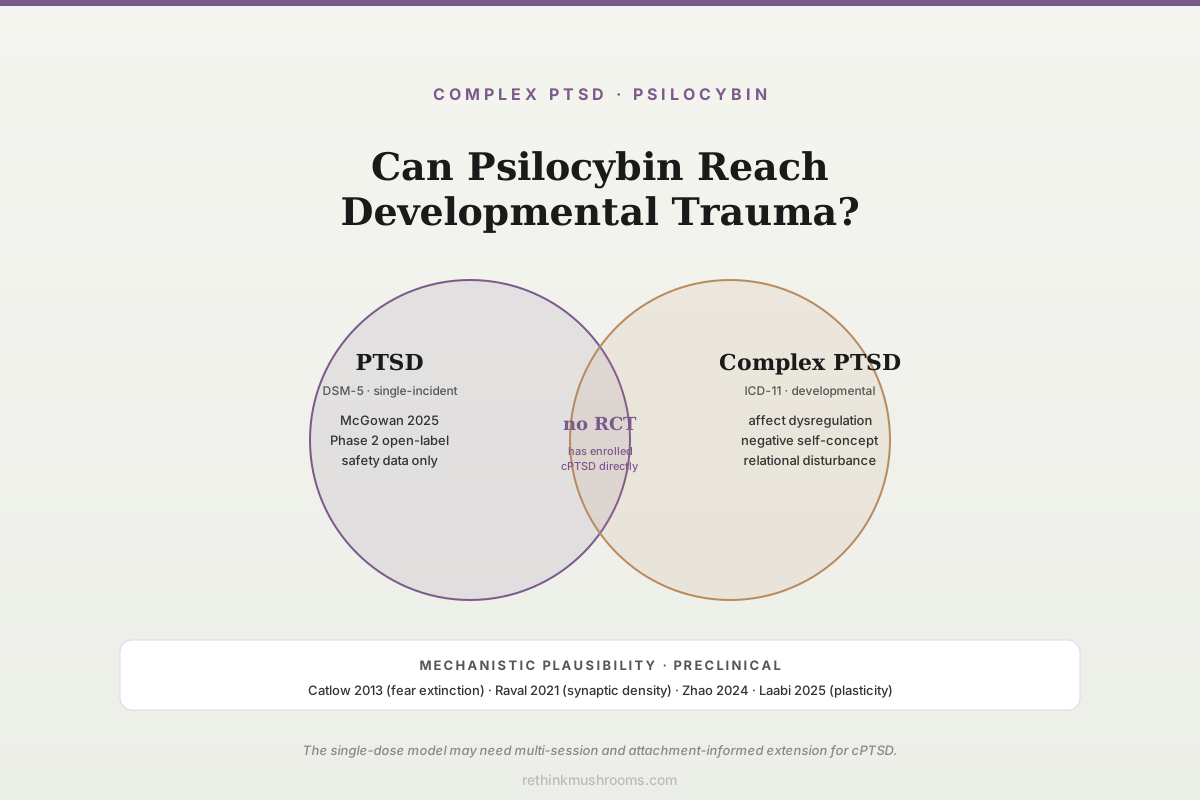
0 RCTs in cPTSD so far
Psilocybin trials for post-traumatic stress disorder have begun in single-incident PTSD, but no randomised controlled trial has yet been conducted in complex PTSD or developmental trauma populations. The absence is itself the key piece of evidence.
Khan et al., 2022; McGowan et al., 2025; Modlin et al., 2025
Phase 2 COMP360 · PTSD
open-label safety published 2025
ICD-11 cPTSD
formally distinguished from PTSD
Mechanism plausibility
extinction + plasticity signals exist
Khan et al., 2022; McGowan et al., 2025; Modlin et al., 2025
 View as image ↗
Complex post-traumatic stress disorder (cPTSD) is not single-incident PTSD with extra symptoms. The ICD-11 recognises cPTSD as a distinct diagnosis characterised by the core PTSD symptoms plus persistent disturbances in affect regulation, negative self-concept and difficulty in relationships, typically arising from prolonged or repeated trauma of an interpersonal nature, often beginning in childhood or adolescence. When a reader asks whether psilocybin can reach developmental trauma, they are asking a precise question about a population that trauma-focused researchers have long distinguished from the standard PTSD population. The honest state of the evidence is that psilocybin trials have begun in PTSD but have not yet specifically tested cPTSD in a randomised controlled design.[1][2]
For the broader context of psilocybin and trauma, see psilocybin for complex PTSD: is it different from standard PTSD?, psilocybin and childhood trauma: emerging research and considerations, psychedelic therapy for developmental trauma, and complex PTSD and dissociation: special considerations for psilocybin.
Key Takeaways
- Khan et al. (2022) reviewed the trauma-related psilocybin literature and identified no published randomised controlled trial in PTSD at that time, noting the field was at a pre-trial stage dominated by mechanism papers and protocols
- McGowan et al. (2025) published the first safety and tolerability data for single-dose COMP360 psilocybin in PTSD: an open-label nonrandomised Phase 2 trial in adults with PTSD
- Modlin et al. (2025) proposed a clinical conceptualisation of how psilocybin engages PTSD, framed around disruption of pre-determined maladaptive interpretive frameworks, with explicit caveats about cPTSD populations
- Catlow et al. (2013) demonstrated in rodents that psilocybin increases hippocampal neurogenesis and accelerates extinction of trace fear conditioning, a mechanism directly relevant to trauma learning
- Zhao et al. (2024) and Laabi et al. (2025) added contemporary preclinical evidence that psilocybin supports neuroplasticity and microglial immunomodulation, both relevant to stress-related conditions
- Raval et al. (2021) showed a single psilocybin dose increases synaptic density in the pig brain while reducing 5-HT2A receptor density, a biological signal for post-dose plasticity
- No published psilocybin RCT has enrolled cPTSD specifically, and the ICD-11 cPTSD diagnosis is typically an exclusion criterion rather than an inclusion criterion in current psilocybin trials
What Complex PTSD Actually Is
The ICD-11 defines complex PTSD as a separate diagnosis from PTSD, with the PTSD core symptoms (re-experiencing, avoidance, sense of current threat) plus three additional symptom clusters: disturbances in affect regulation, negative self-concept, and difficulties in relationships. The prototypical aetiology is exposure to an event, or more commonly a series of events, of an extremely threatening or horrific nature, usually prolonged or repeated, from which escape is difficult or impossible. Childhood abuse and neglect, prolonged captivity, and repeated violence in caregiving relationships are the paradigm examples.
Developmental trauma is a closely related concept, emphasising that the trauma occurred during a period of critical neurodevelopment. The clinical consequence is that cPTSD and developmental trauma patients often present with symptom patterns, defence structures and therapeutic responses that differ substantially from single-incident adult PTSD. Standard evidence-based psychotherapies for PTSD (prolonged exposure, cognitive processing therapy) were validated in single-incident trauma populations and have mixed performance in cPTSD cohorts.
This matters for psilocybin research because the published and forthcoming psilocybin trials for PTSD were designed around single-incident or combat PTSD cohorts and typically exclude patients with complex clinical presentations. Answering the developmental-trauma question rigorously will require trials designed specifically for that population.
What Has Actually Been Published in PTSD
Khan et al. (2022): the state of play before the trials
Khan and colleagues (2022) reviewed the psilocybin and trauma-related disorders literature and reached a straightforward conclusion. At that time, there was no completed randomised controlled trial of psilocybin in PTSD. The field had mechanism papers from related indications (depression, substance use), preclinical evidence supporting relevance to fear learning and extinction, and protocols in development, but not yet Phase 2 human RCT data.[1] The review highlighted the distinction between PTSD and complex PTSD as an open question for future trial design and implementation.
McGowan et al. (2025): first safety data in PTSD
McGowan and colleagues (2025) published the first safety and tolerability data from a Phase 2 open-label, nonrandomised, single-dose study of COMP360 psilocybin in adults with PTSD. The trial enrolled adult participants meeting DSM-5 PTSD criteria and delivered a single 25 mg dose of synthetic psilocybin with structured psychological support, evaluating acute and short-term adverse events, PTSD symptom change, and participant experience.[2] The trial was nonrandomised and open-label, so efficacy conclusions remain preliminary. The safety and tolerability profile was consistent with the broader psilocybin trial literature in depression and end-of-life distress: transient acute-day effects (anxiety, elevated blood pressure, headache, nausea), no unexpected serious adverse events, and acceptable tolerability in a PTSD population.
The important limitation, relevant to the developmental-trauma question, is that the McGowan trial enrolled PTSD, not cPTSD. Typical exclusion criteria in Phase 2 psilocybin PTSD trials include active psychosis, severe dissociative symptoms, and current severe personality disorder, all of which are more prevalent in cPTSD than in single-incident PTSD.
Modlin et al. (2025): a clinical framework for PTSD-psilocybin
Modlin and colleagues (2025) published a theoretical paper in Therapeutic Advances in Psychopharmacology proposing how psilocybin engages the cognitive architecture of PTSD. The framework positions psilocybin as disrupting a pre-determined and over-determined maladaptive interpretive framework, allowing reconsolidation of traumatic memories within an altered interpretive context.[3] The authors explicitly flagged cPTSD as a population that requires tailored protocol design because the interpretive framework in developmental trauma is typically more entrenched, more identity-structural, and entangled with early attachment history in a way that single-dose psilocybin may not be sufficient to address without extended therapeutic scaffolding.
The Modlin framework is conceptual, not empirical. Its value is as a hypothesis-generating structure for trials that have not yet been run.
The Mechanistic Case: Why Psilocybin Is Biologically Plausible For Trauma
Several preclinical findings provide a biological basis for the clinical interest in psilocybin for trauma. These findings do not prove clinical efficacy in cPTSD, but they establish plausibility.
Fear extinction and hippocampal neurogenesis
Catlow and colleagues (2013) demonstrated in rodents that psilocybin administration before extinction training accelerated extinction of trace fear conditioning and increased hippocampal neurogenesis. The hippocampus is central to contextual fear learning and memory updating, and pharmacological acceleration of extinction is a well-established target in PTSD drug development.[4] The relevance to cPTSD is indirect but not absent: developmental trauma often involves disrupted contextual learning and chronic fear generalisation, both of which are hippocampal-dependent processes.
Synaptic density and receptor dynamics
Raval and colleagues (2021) used positron emission tomography in the pig brain to show that a single dose of psilocybin increased synaptic density (measured by SV2A binding) while reducing cortical 5-HT2A receptor density. The finding is a biological signal for post-dose structural plasticity consistent with the clinical observation of sustained symptom reduction from a single dose.[5] For trauma populations, the structural plasticity hypothesis aligns with the therapeutic target of creating a window during which entrenched learned patterns might be revisable.
Broader neuroplasticity and glial effects
Zhao and colleagues (2024) reported that psilocybin promotes neuroplasticity and produces rapid and sustained antidepressant-like effects in rodent models, converging with the Raval synaptic findings.[6] Laabi and colleagues (2025) extended the story to microglia, showing that psilocybin and psilocin regulate microglial immunomodulation and support neuroplasticity via serotonergic signalling.[7] Neuroinflammation and microglial priming are increasingly implicated in stress-related and trauma-related disorders, so a pharmacological effect on both plasticity and microglia is theoretically relevant for cPTSD pathophysiology.
These mechanisms are promising but preclinical. They do not answer the clinical question of whether psilocybin, delivered with a particular psychological protocol, reduces cPTSD symptoms.
What We Can Reasonably Borrow From The Depression And Anxiety Evidence
Psilocybin has been tested extensively in depression and in end-of-life distress. Goodwin and colleagues (2022) published the COMP360 Phase 2b dose-ranging trial in treatment-resistant depression.[8] Davis and colleagues (2021) ran a randomised trial of psilocybin-assisted therapy for major depressive disorder.[9] Griffiths and colleagues (2016) and Ross and colleagues (2016) reported the foundational trials in cancer-related depression and anxiety.[10][11] Goel and colleagues (2022) reviewed the therapeutic-effects evidence.[12]
The relevance to cPTSD is mixed. Comorbidity between cPTSD and depression is high, and patients with cPTSD-related depression may derive the depression-related benefit from psilocybin that non-cPTSD depression patients derive. Whether the specific cPTSD features (affect dysregulation, negative self-concept, relational disturbance) improve on the same timecourse and magnitude as depressive symptoms is an open question. Most depression trial exclusion criteria have screened out patients with current or recent severe dissociation and patients with complex comorbid presentations, which happen to be the features that define cPTSD.
Why The Single-Dose Model May Be A Poor Fit For cPTSD
A single 25 mg dose of psilocybin, even delivered with strong preparation and integration, is a brief pharmacological intervention. In single-incident PTSD, where the pathology is organised around identifiable memories and a relatively bounded interpretive framework, a single disruptive event may be sufficient to enable therapeutic reconsolidation. In cPTSD, the pathology is structural. The interpretive framework is typically developmentally laid down, identity-level, and reinforced by ongoing relational and somatic patterns.
Modlin and colleagues (2025) raised this concern explicitly, noting that the psilocybin model of disrupting a maladaptive interpretive framework is most directly applicable to bounded traumatic memory architectures and may need significant extension (multiple sessions, longer integration, specific attachment-informed therapeutic scaffolding) to operate effectively in cPTSD populations.[3]
Parallel evidence from related psilocybin indications supports the concern. Meshkat and colleagues (2025) evaluated psilocybin-assisted psychotherapy in bipolar II treatment-resistant depression, a population with structural personality and mood features that often overlap with cPTSD; the approach was feasible, but the effect size was more modest than in non-complex MDD.[13] Aaronson and colleagues (2024) showed similar results in bipolar II TRD at a second centre.[14] The pattern suggests that psilocybin protocols optimised for acute mood syndromes may need redesign for structurally complex clinical populations, cPTSD included.
Dissociation And Screening Concerns
cPTSD is strongly associated with dissociative symptoms, including depersonalisation, derealisation and, in a subset of patients, dissociative identity phenomena. Acute psilocybin administration produces substantial alterations in consciousness that can include dissociative-like experiences, and research teams have raised concern that these acute effects may be difficult to distinguish from, or may intensify, pre-existing dissociation in patients with dissociative subtypes of PTSD or cPTSD.
Current psilocybin PTSD trials, including the McGowan 2025 protocol, typically screen out patients with prominent baseline dissociation. The absence of baseline-dissociation cohorts in the published PTSD literature is one of the most important caveats against assuming safety or efficacy of psilocybin in cPTSD populations. For a focused treatment of this question see complex PTSD and dissociation: special considerations for psilocybin.
Limitations Of The Evidence
Several limitations are central and worth stating plainly.
No randomised controlled trial of psilocybin has specifically enrolled a cPTSD cohort. Every published clinical outcome quoted in discussions of psilocybin and trauma to date comes from single-incident PTSD samples, depression samples, or other adjacent indications, not from cPTSD itself.
The McGowan 2025 open-label, nonrandomised Phase 2 PTSD trial produced safety and tolerability data, not efficacy data. Its participant population was adult PTSD meeting standard trial exclusion criteria.
The Modlin 2025 framework is conceptual. It has not been empirically tested in a registered trial.
The preclinical evidence on extinction learning, hippocampal neurogenesis and synaptic plasticity is robust and relevant to trauma biology, but preclinical signals do not always translate into clinical efficacy in structurally complex populations.
cPTSD trial design faces non-trivial methodological problems. Validated primary outcome measures specific to ICD-11 cPTSD are newer than the PCL-5 family of PTSD scales, and developmentally trauma-exposed populations have higher rates of comorbidities that complicate enrolment, retention and safety monitoring.
Finally, the commercial and regulatory landscape currently prioritises PTSD, not cPTSD, as a target indication. The FDA, Compass and Usona are focused on PTSD as defined by DSM-5, which does not include the cPTSD-specific symptom clusters in the ICD-11 formulation. Funding and approval economics may delay dedicated cPTSD trials even where the scientific interest exists.
What The Evidence Actually Establishes
- Complex PTSD is a distinct ICD-11 diagnosis with PTSD core symptoms plus affect dysregulation, negative self-concept and relational disturbance, typically from prolonged or developmental trauma
- No randomised controlled psilocybin trial has been conducted in a cPTSD-defined cohort; every clinical outcome quoted in the psilocybin-trauma literature to date derives from adjacent populations
- McGowan et al. (2025) published the first safety and tolerability data for single-dose COMP360 psilocybin in PTSD, with acceptable short-term tolerability in a standard PTSD population
- Modlin et al. (2025) proposed a conceptual framework for how psilocybin engages PTSD cognition, explicitly noting that cPTSD requires tailored protocol design
- Preclinical evidence on extinction (Catlow 2013), synaptic plasticity (Raval 2021), neuroplasticity (Zhao 2024) and microglial regulation (Laabi 2025) establishes biological plausibility for trauma applications without proving clinical efficacy in cPTSD
- The single-dose model successful in depression may be insufficient in cPTSD, where the interpretive framework is more developmentally entrenched; multi-session and attachment-informed protocol extensions are the most plausible next step
The Bottom Line
No randomised controlled trial of psilocybin has enrolled complex PTSD or developmental trauma populations. The first PTSD safety trial (McGowan 2025, COMP360 open-label) and the first clinical framework paper (Modlin 2025) both explicitly flag cPTSD as a different, more structurally entrenched clinical problem. Preclinical extinction and plasticity mechanisms (Catlow 2013, Raval 2021, Zhao 2024) support biological plausibility, but translation to cPTSD will likely require multi-session protocols, dissociation-aware screening and dedicated trial designs that do not yet exist.
Frequently Asked Questions
Sources & References
- 1RTHM-00770·Khan, Amanda J et al. (2022). “Psilocybin for Trauma-Related Disorders..” Current topics in behavioral neurosciences.Study breakdown →PubMed →↩
- 2RTHM-00941·McGowan, Niall M et al. (2025). “Investigating the safety and tolerability of single-dose psilocybin for post-traumatic stress disorder: A nonrandomized open-label clinical trial..” Journal of psychopharmacology (Oxford.Study breakdown →PubMed →↩
- 3RTHM-00946·Modlin, Nadav Liam et al. (2025). “Clinical conceptualisation of PTSD in psilocybin treatment: disrupting a pre-determined and over-determined maladaptive interpretive framework..” Therapeutic advances in psychopharmacology.Study breakdown →PubMed →↩
- 4RTHM-00279·Catlow, Briony J et al. (2013). “Effects of psilocybin on hippocampal neurogenesis and extinction of trace fear conditioning..” Experimental brain research.Study breakdown →PubMed →↩
- 5RTHM-00714·Raval, Nakul Ravi et al. (2021). “A Single Dose of Psilocybin Increases Synaptic Density and Decreases 5-HT2A Receptor Density in the Pig Brain..” International journal of molecular sciences.Study breakdown →PubMed →↩
- 6RTHM-00920·Zhao, Xiangting et al. (2024). “Psilocybin promotes neuroplasticity and induces rapid and sustained antidepressant-like effects in mice..” Journal of psychopharmacology (Oxford.Study breakdown →PubMed →↩
- 7RTHM-00934·Laabi, Salma et al. (2025). “Psilocybin and psilocin regulate microglial immunomodulation and support neuroplasticity via serotonergic and AhR signaling..” International immunopharmacology.Study breakdown →PubMed →↩
- 8RTHM-00761·Goodwin, Guy M et al. (2022). “Single-Dose Psilocybin for a Treatment-Resistant Episode of Major Depression..” The New England journal of medicine.Study breakdown →PubMed →↩
- 9RTHM-00682·Davis, Alan K et al. (2021). “Effects of Psilocybin-Assisted Therapy on Major Depressive Disorder: A Randomized Clinical Trial..” JAMA psychiatry.Study breakdown →PubMed →↩
- 10RTHM-00426·Griffiths, Roland R et al. (2016). “Psilocybin produces substantial and sustained decreases in depression and anxiety in patients with life-threatening cancer: A randomized double-blind trial..” Journal of psychopharmacology (Oxford.Study breakdown →PubMed →↩
- 11RTHM-00445·Ross, Stephen et al. (2016). “Rapid and sustained symptom reduction following psilocybin treatment for anxiety and depression in patients with life-threatening cancer: a randomized controlled trial..” Journal of psychopharmacology (Oxford.Study breakdown →PubMed →↩
- 12RTHM-00760·Goel, Dev B et al. (2022). “Potential Therapeutic Effects of Psilocybin: A Systematic Review..” Cureus.Study breakdown →PubMed →↩
- 13RTHM-00944·Meshkat, Shakila et al. (2025). “Psilocybin-Assisted Psychotherapy for Treatment-Resistant Depression in Bipolar II Disorder..” Psychedelic medicine (New Rochelle.Study breakdown →PubMed →↩
- 14RTHM-00863·Aaronson, Scott T et al. (2024). “Single-Dose Synthetic Psilocybin With Psychotherapy for Treatment-Resistant Bipolar Type II Major Depressive Episodes: A Nonrandomized Open-Label Trial..” JAMA psychiatry.Study breakdown →PubMed →↩