Psilocybin & PTSD
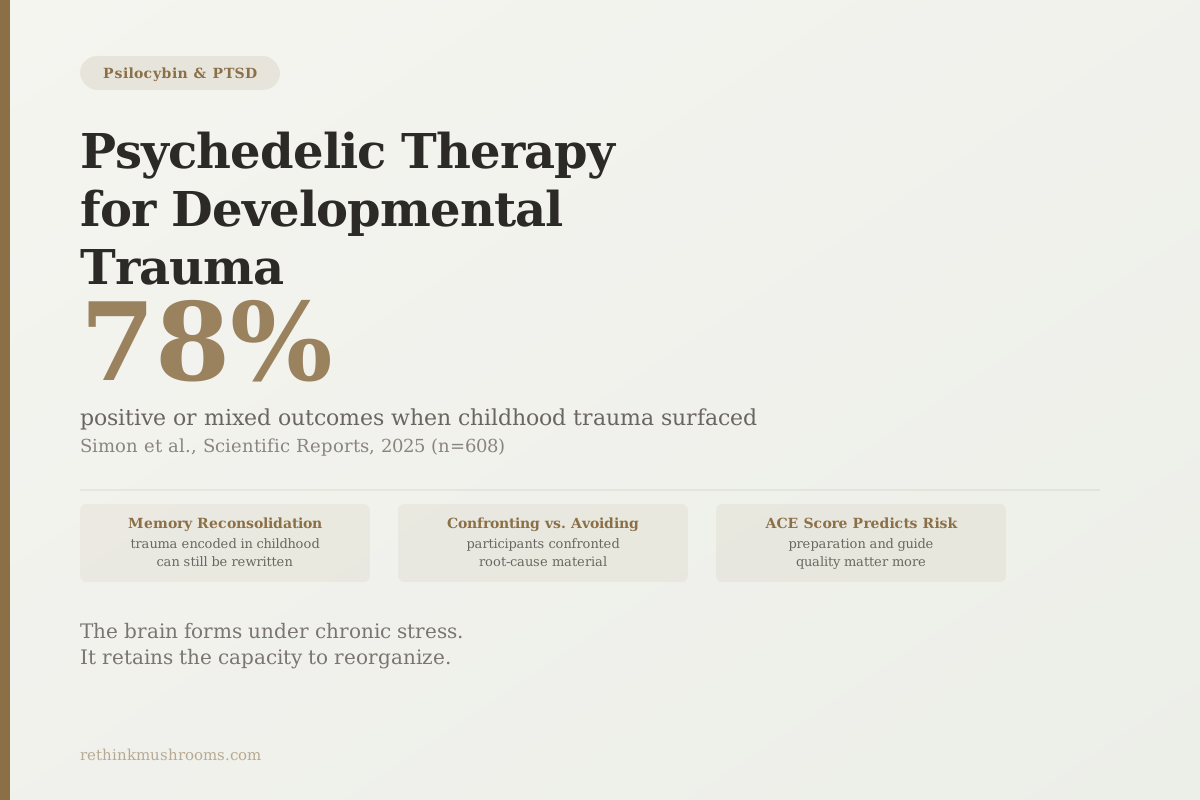
78% positive or mixed outcomes
Among 608 people who had difficult psychedelic experiences linked to recalled early childhood trauma, 78% reported positive or mixed integration outcomes — 50% predominantly positive and 28% mixed — in a 2025 Scientific Reports cohort study.
Simon et al., Scientific Reports, 2025
41.8%
of those with post-psychedelic difficulties linked them specifically to early childhood trauma (Simon 2025)
Higher ACE
score predicted greater difficulty following psychedelic use, making preparation more critical (Olofsson 2026)
21 PTSD
participants described psilocybin as enabling confrontation rather than avoidance of trauma material (Modlin 2025)
Simon et al., Scientific Reports, 2025
 View as image ↗
Developmental trauma doesn't look like most people picture when they think of PTSD. It's not a single event followed by hypervigilance and nightmares. It's what happens when threat or neglect is the recurring texture of childhood itself — when the danger was the person who was supposed to keep you safe, when the unpredictability wasn't a car accident but a household.
The brain forms during childhood. When it forms under repeated stress, it organizes itself around that stress: threat-detection systems calibrated for perpetual high alert, emotion-regulation circuits that never fully developed, attachment patterns built on the assumption that relationships are unsafe. This is developmental trauma. It is why adults who experienced it often describe feeling like decades of conventional therapy never quite reached the root of the problem.
Psilocybin research is beginning to address why — and whether psychedelic-assisted therapy can reach what standard treatment misses.
Early evidence is cautiously encouraging. A 2025 cohort study tracking 608 people who had difficult psychedelic experiences linked to early trauma found that 78% had positive or mixed integration outcomes.[5] The research also consistently shows that childhood trauma history predicts more complex experiences, which means preparation and guide quality matter more for this population than for others.[6]
This article covers what developmental trauma is and why it differs from single-incident PTSD, the mechanisms by which psilocybin may address it, and what the current data shows about outcomes and risk. For the broader PTSD clinical trials evidence base, see Psilocybin for PTSD: What the Clinical Trials Show. For the childhood trauma safety data specifically, see Psilocybin and Childhood Trauma: Emerging Research and Considerations.
Key Takeaways
- Developmental trauma arises from prolonged, repetitive, usually caregiver-based early experiences — distinct from single-incident PTSD and requiring different therapeutic approaches
- Standard PTSD therapies (EMDR, CPT, prolonged exposure) work primarily through fear extinction and narrative processing, which can be difficult for developmental trauma survivors whose capacity for emotional regulation is itself impaired
- Memory reconsolidation — the process by which a recalled memory briefly becomes malleable before being stored again — is the key mechanism allowing psilocybin to address trauma formed decades earlier in childhood (Raut et al., 2022)
- Among 608 people with post-psychedelic difficulties linked to childhood trauma, 50% had predominantly positive integration, 28% had mixed outcomes, and 22% had predominantly negative or re-traumatization experiences (Simon et al., 2025)
- Higher adverse childhood experience (ACE) scores predicted greater difficulty after psychedelic use, indicating that childhood trauma history is a relevant risk factor requiring more intensive preparation (Olofsson et al., 2026)
- Therapeutic alliance — the quality of relationship with the guide or therapist — is a significant predictor of outcomes in psilocybin-assisted therapy, and is especially critical for developmental trauma survivors whose original trauma was relational (Murphy et al., 2021)
What Is Developmental Trauma and Why Is It Different from PTSD?
Standard PTSD, as described in psychiatric diagnostic criteria, typically involves a discrete traumatic event or series of events, followed by a cluster of symptoms: intrusive memories, hypervigilance, avoidance of trauma-related stimuli, negative changes in mood and thinking.
Developmental trauma is a distinct clinical category. The term describes prolonged, repetitive experiences of threat, neglect, abuse, or emotional unavailability from caregivers during childhood — particularly during the windows when the brain is actively forming its basic architecture. The experiences don't need to be dramatic to be formative. Emotional neglect, chronic unpredictability, and inconsistent caregiving can each shape a developing nervous system as powerfully as more obvious forms of abuse.
The key distinction is that standard PTSD is trauma overlaid onto a nervous system that developed under reasonably safe conditions. Developmental trauma is different in kind: the nervous system itself developed under the threat. The result isn't a fear memory attached to an otherwise functional emotional regulatory system. The result is an entire regulatory system organized around the expectation of threat, abandonment, or unpredictability.
This is why adults with developmental trauma often describe symptoms that go beyond classic PTSD — affect dysregulation (difficulty managing emotional states when triggered), a pervasive negative self-concept, and difficulty forming trusting relationships. The ICD-11 captures some of this in its Complex PTSD diagnosis, which adds those three domains to standard PTSD criteria. The question of how psilocybin might work differently for C-PTSD versus single-incident PTSD is covered in the sibling article Psilocybin for Complex PTSD: Is It Different from Standard PTSD?.
Why Conventional Therapy Often Falls Short
The most widely used evidence-based PTSD treatments — Cognitive Processing Therapy (CPT), Prolonged Exposure (PE), and Eye Movement Desensitization and Reprocessing (EMDR) — share a common mechanism: they work by helping the brain learn that a memory or stimulus associated with trauma is no longer dangerous. This process, called fear extinction, is the brain's way of updating its threat predictions. CPT does it through cognitive reprocessing of traumatic narrative. PE does it through repeated, controlled exposure to trauma cues until the fear response diminishes. EMDR does it through bilateral stimulation while the person holds traumatic material in mind.
Fear extinction is a powerful mechanism. For single-incident trauma in people with intact emotional regulation capacities, these therapies produce meaningful outcomes.
The problem for developmental trauma is that fear extinction requires a stable emotional foundation. A person needs to remain within their tolerable range of emotional arousal — above numbness and below overwhelm — to engage with traumatic material productively. For developmental trauma survivors, that zone can be extremely narrow. The same nervous system that formed under chronic threat will often flood, dissociate, or collapse when asked to engage directly with the memories and feelings that standard therapy uses as its material.
Many developmental trauma survivors describe years of conventional therapy that reduced them to crisis states during sessions, or that only ever addressed symptoms without touching the underlying sense of self shaped by childhood experience.
A 2021 systematic review of psychedelics for PTSD noted that psilocybin's mechanisms are mechanistically distinct from fear extinction — psilocybin acts primarily through neuroplasticity (the brain's ability to reorganize and form new connections) and experiential processing, rather than through direct fear memory reprocessing.[11] That distinction matters for developmental trauma.
Memory Reconsolidation: Why Decades-Old Trauma Can Still Be Reached
One of the most counterintuitive aspects of psychedelic-assisted therapy for developmental trauma is the claim that it can address experiences formed 30 or 40 years ago in childhood. The mechanism is memory reconsolidation.
When a memory is recalled, it enters a briefly malleable state before being stored again. During this window — typically 4 to 6 hours after retrieval — the memory can be modified. New information can be incorporated. The emotional charge attached to the memory can be updated. This is memory reconsolidation, and it is not unique to psychedelics: it is a basic feature of how human memory works.
A 2022 review in Pharmacology and Therapeutics found that diverse PTSD therapies, including psilocybin, share memory reconsolidation as a common underlying mechanism.[1] Psilocybin appears to be particularly effective at creating the conditions for reconsolidation: the heightened emotional state of a psilocybin session destabilizes maladaptive trauma memories, and the therapeutic context provides the adaptive input that shapes how they are re-stored.
For developmental trauma, this is significant. The schemas formed in childhood — "I am fundamentally unworthy," "relationships lead to abandonment," "I have to be hypervigilant to survive" — are not just memories of events. They are organizing principles encoded in the nervous system over years of experience. Memory reconsolidation may be the mechanism through which a few psilocybin sessions can begin to rewrite what decades of childhood experience wrote in.
Preclinical support for this comes from Woodburn and colleagues in 2024, who found that psilocybin facilitated fear extinction in rodents in a dose-dependent manner and that 5-HT2A receptor activation — psilocybin's primary action in the brain — was necessary for the effect.[2] Critically, the context in which dosing occurred significantly shaped outcomes — direct preclinical evidence for why the therapeutic setting is not incidental but mechanistically important.
For a deeper exploration of the reconsolidation mechanism, see Reconsolidation Theory: How Psilocybin May Rewrite Trauma. The fear extinction data is covered in Fear Extinction and Psilocybin: How Psychedelics May Reprocess Trauma Memories.
Confronting Instead of Avoiding: What Participants Said
The qualitative evidence from actual PTSD participants provides a different kind of insight than the mechanistic data.
In 2025, Modlin and colleagues published a qualitative analysis of 21 participants from the COMP360 Phase 2 psilocybin trial who had PTSD diagnoses.[4] One consistent theme emerged: participants described conventional therapies as providing symptom management without lasting change, and described psilocybin as enabling them to confront rather than avoid the challenging material at the root of their distress.
That distinction — confronting versus avoiding — is particularly resonant for developmental trauma survivors. Many have spent years, sometimes decades, in therapy that offered coping strategies, symptom reduction, and narrative frameworks, but never created the conditions to go toward the original material. Avoidance is, after all, one of the defining symptoms of trauma: the nervous system learned very early that going toward certain feelings and memories was intolerable.
A 2024 review of psilocybin's mechanisms in PTSD by Choi and colleagues described how 5-HT2A receptor activation can reduce amygdala hyperactivity — dampening the brain's threat-detection center that normally prevents full engagement with traumatic material — while simultaneously opening a window for emotional processing.[3] The amygdala is the structure that sends the alarm signal when trauma-adjacent feelings arise. When that alarm is temporarily quieted, the window for actually working with the material may open.
The Trajectory Data: What Happens When Childhood Trauma Surfaces
The most direct data on what happens to developmental trauma survivors who go through psychedelic experiences comes from Simon and colleagues in 2025.[5]
Their cohort study recruited 608 individuals who had experienced difficulties following psychedelic use. Of these, 41.8% linked those difficulties specifically to early childhood trauma. The researchers tracked the trajectories of this group and found three patterns: 50% reported predominantly positive integration (the difficult experience led to meaningful processing and positive change), 28% reported mixed outcomes (both difficult and positive elements), and 22% reported predominantly negative outcomes including re-traumatization.
Several findings from this data deserve attention. First, 78% had at least some positive element to their trajectory — which contradicts the framing that childhood trauma history makes psychedelic use inadvisable across the board. Second, those who linked their difficulties to early trauma were more likely to be in guided settings, suggesting that trauma survivors who recognize the complexity of their situation are already self-selecting for professional support. Third, the 22% who experienced predominantly negative outcomes represents a real risk that shouldn't be minimized.
The 2026 Olofsson study added a specific risk metric: among naturalistic psychedelic users, higher ACE scores — a count of adverse childhood experiences that serves as a validated measure of early trauma burden — were associated with greater difficulty following psychedelic use.[6] Childhood trauma history is not a disqualifier for psychedelic therapy, but it is a predictor of more complex experiences that require better preparation.
The Therapeutic Relationship Is Not Optional
For developmental trauma specifically, there is a variable that the quantitative data alone can't fully capture: the relationship with the guide or therapist.
Murphy and colleagues found in 2021 that therapeutic alliance — the strength of the working relationship between patient and therapist — significantly predicted outcomes in psilocybin-assisted therapy for treatment-resistant depression.[7] High rapport predicted greater reduction in depression scores across 24 participants. For standard PTSD, this finding is relevant. For developmental trauma survivors, it is especially loaded.
Developmental trauma typically originates in relationships with caregivers. The experience of being harmed, neglected, or betrayed by the people who were supposed to be safe is the wound. When those same trauma survivors enter a psychedelic experience guided by another person, the quality of that relationship is not incidental to the outcome — it is the same relational template the original trauma was written on. A guide who is experienced, attuned, and trustworthy is providing not just safety in the conventional sense, but a corrective relational experience.
Aixalà's 2024 review of psychedelic integration in complex settings identified developmental and relational trauma as requiring a specifically elevated standard of care: trauma-informed preparation, experienced facilitators, extended integration support, and ongoing therapeutic relationships beyond the session itself.[8] Without that scaffolding, the risk of re-traumatization and difficult experiences is substantially higher.
This is not an experience suited to unguided use, an inexperienced facilitator, or retreat settings that do not conduct trauma-specific screening and preparation. The context the Woodburn preclinical data identified as mechanistically necessary for fear extinction is not metaphorical. It is the literal setting and relational container in which the experience occurs.
Where the Clinical Evidence Currently Stands
No randomized controlled trial has yet specifically enrolled participants with developmental trauma disorder as a primary clinical endpoint. This is the honest limit of the current evidence.
What exists is strong mechanistic rationale, supported by observational and qualitative data. A 2022 review by Khan and colleagues specifically distinguished between single-event PTSD and complex or developmental trauma in terms of psilocybin protocol requirements, identifying the need for longer integration periods, more intensive preparation, and trauma-informed guides for complex presentations.[11] A 2025 review by Miller and Zoladz reached the same conclusion: complex trauma presentations require more intensive protocols and longer integration periods than single-event PTSD, and identified fear extinction enhancement and neuroplasticity induction as the two primary mechanisms.[9]
The broader meta-analytic evidence supports psychedelics for PTSD symptoms generally. Yao and colleagues' 2024 large-scale meta-analysis found significant therapeutic effects for pooled psychedelics on PTSD, depression, and anxiety, with safety profiles acceptable across studies.[10]
The translation of that general PTSD evidence to developmental trauma specifically requires careful clinical reasoning. Developmental trauma is not simply more PTSD — it is a different configuration of symptoms, with different mechanisms of impairment, different responses to standard interventions, and different requirements for what the therapeutic container needs to provide. The mechanistic case for why psilocybin might be well-suited to it is stronger than the clinical evidence, which remains early-stage.
For a comprehensive view of active psilocybin PTSD trials, see Psilocybin for PTSD: Current Clinical Trials and Preliminary Data. The broader trauma processing mechanism is covered in Psilocybin and Trauma Processing: How It Facilitates Healing.
The Bottom Line
Developmental trauma differs from single-incident PTSD in ways that matter therapeutically: it's encoded during brain formation, affects regulatory systems rather than just discrete memories, and doesn't respond consistently to standard fear extinction protocols. Psilocybin's potential for developmental trauma rests on memory reconsolidation as a mechanism for reaching old material, reduced amygdala reactivity creating a window for processing, and the qualitative observation that participants experience it as enabling confrontation rather than avoidance. The trajectory data from Simon 2025 (n=608) shows 78% positive or mixed outcomes when childhood trauma surfaces in psychedelic experiences; the Olofsson 2026 data shows higher ACE scores predict greater difficulty. There are no developmental trauma-specific RCTs yet; the evidence is mechanistically strong and observationally supported, with clear warnings about the importance of preparation, guide quality, and integration support.
Frequently Asked Questions
Sources & References
- 1RTHM-01606·Raut, Sanket B et al. (2022). “Diverse therapeutic developments for post-traumatic stress disorder (PTSD) indicate common mechanisms of memory modulation..” Pharmacology & therapeutics.Study breakdown →PubMed →↩
- 2RTHM-02020·Woodburn, Samuel C et al. (2024). “Psilocybin Facilitates Fear Extinction: Importance of Dose, Context, and Serotonin Receptors..” ACS chemical neuroscience.Study breakdown →PubMed →↩
- 3RTHM-01874·Choi, Charles et al. (2024). “Mechanisms of psilocybin on the treatment of posttraumatic stress disorder..” Journal of psychopharmacology (Oxford.Study breakdown →PubMed →↩
- 4RTHM-02152·Modlin, Nadav Liam et al. (2025). “Investigational psilocybin treatment for post-traumatic stress disorder: a qualitative study of participant experience, trauma engagement, and differences from standard treatment..” EClinicalMedicine.Study breakdown →PubMed →↩
- 5RTHM-02181·Simon, Guy et al. (2025). “Recalled childhood trauma and post-psychedelic trajectories of change in a mixed-methods study..” Scientific reports.Study breakdown →PubMed →↩
- 6RTHM-02239·Olofsson, Michelle et al. (2026). “Difficulties following naturalistic psychedelic use and associations with adverse childhood experiences..” The International journal on drug policy.Study breakdown →PubMed →↩
- 7RTHM-01410·Murphy, Roberta et al. (2021). “Therapeutic Alliance and Rapport Modulate Responses to Psilocybin Assisted Therapy for Depression..” Frontiers in pharmacology.Study breakdown →PubMed →↩
- 8RTHM-01847·Aixalà, Marc (2024). “Deepening Psychedelic Integration: Exploring Complex Settings, Understanding User's Struggles, and Implementing Safe Interventions..” Current topics in behavioral neurosciences.Study breakdown →PubMed →↩
- 9RTHM-02149·Miller, Claire E et al. (2025). “Evaluating the potential for psilocybin as a treatment for post-traumatic stress disorder..” The Journal of pharmacology and experimental therapeutics.Study breakdown →PubMed →↩
- 10RTHM-02028·Yao, Yuan et al. (2024). “Efficacy and safety of psychedelics for the treatment of mental disorders: A systematic review and meta-analysis..” Psychiatry research.Study breakdown →PubMed →↩
- 11RTHM-00770·Khan, Amanda J et al. (2022). “Psilocybin for Trauma-Related Disorders..” Current topics in behavioral neurosciences.Study breakdown →PubMed →↩