Cordyceps Cultivation
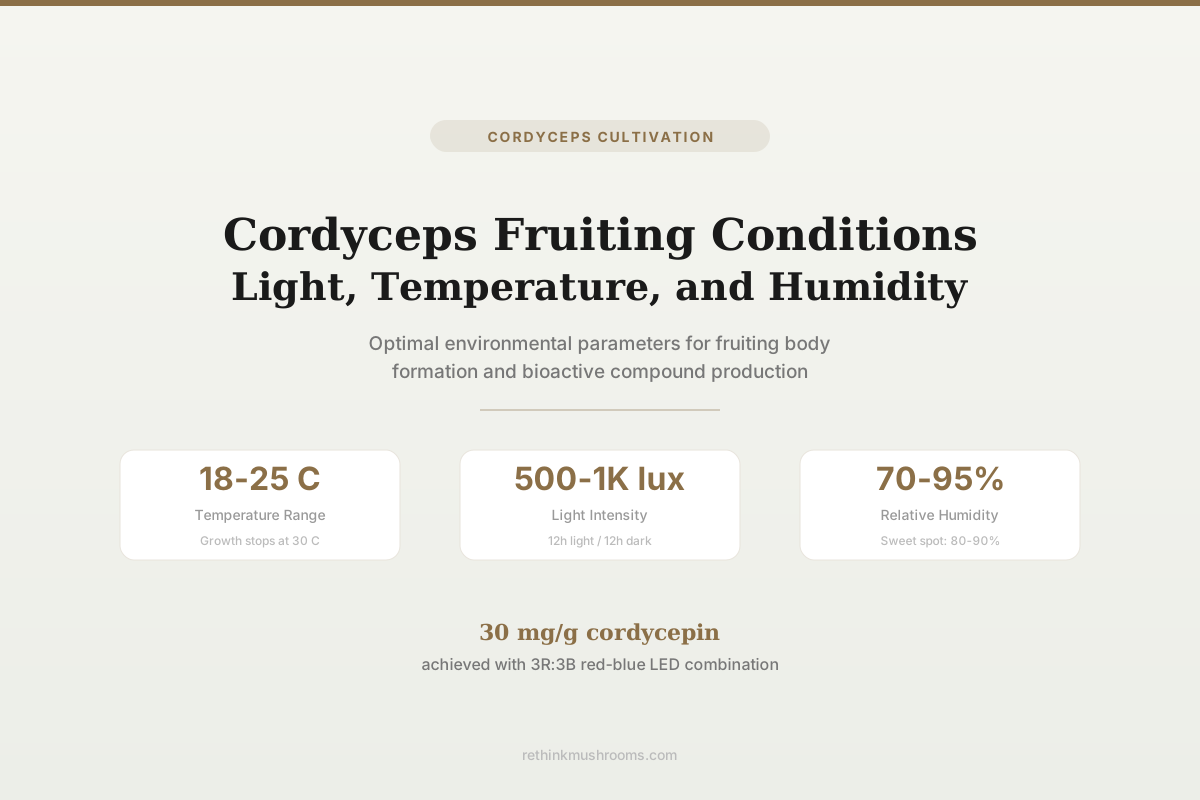
30 mg/g cordycepin
A 3R:3B red-blue LED combination achieved the highest reported cordycepin content at 30 mg/g in Cordyceps militaris fruiting bodies, according to a 2025 comprehensive review.
Park, Foods, 2025
18-25 C optimal range
fruiting body development
500-1,000 lux
light intensity for fruiting
70-95% RH
humidity during fruiting phase
Park, Foods, 2025
 View as image ↗
Cordyceps militaris cultivation requires precise environmental control at every stage. Unlike many edible mushrooms that fruit in darkness, C. militaris needs specific light wavelengths, narrow temperature windows, and carefully managed humidity to produce fruiting bodies with high bioactive compound content. A 2025 comprehensive review by Park in Foods synthesized decades of cultivation research, establishing that temperature, light spectrum, humidity, and substrate composition interact to determine both fruiting body yield and cordycepin concentration.[1] For an overview of the difficulty level involved, see Why cordyceps is harder to grow than other mushrooms. For substrate-specific guidance, see Growing Cordyceps militaris at home: rice substrate and LED light requirements.
Key Takeaways
- Park (2025) established optimal fruiting body formation at 16 to 23 C with 500 to 1,000 lux light for 8 to 12 hours daily and 70 to 95% relative humidity
- Yang et al. (2016) demonstrated that CmWC-1, the blue-light receptor gene, is essential for fruiting body development; knocking it out produced disordered fruiting bodies, reduced conidial formation, and eliminated carotenoid and cordycepin production
- Wu et al. (2016) found that the three cultivation stages (colonization, primordial initiation, fruiting) each require different temperature and light conditions for maximum yield
- A 3R:3B red-blue LED ratio achieved the highest reported cordycepin content at 30 mg/g, while green LED at 526 to 531 nm enhanced cordycepin to 2.89 mg/g (Park, 2025)
- Shrestha et al. (2012) showed that multi-ascospore isolates produced fruiting bodies more reliably than single-ascospore strains, with strain selection being as important as environmental conditions
- Mycelial growth peaks at 20 C in darkness, but cordycepin production peaks at 25 C, creating a tension between biomass and bioactive compound optimization
Temperature: Different Stages Need Different Ranges
Temperature management in C. militaris cultivation is not a single set point. Each growth stage has distinct thermal requirements, and the optimal temperature for mycelial biomass differs from the optimal temperature for cordycepin production.
Wu et al. (2016) systematically tested temperature effects across three cultivation stages. During the mycelium colonization stage, rice substrates were incubated at 23 C in darkness. During primordial initiation, temperature was dropped to 18 C with 12 hours of daily illumination. During the fruiting stage, temperature was raised back to 23 C with continued 12-hour light cycles. This three-stage protocol produced the highest fruiting body yield and biological efficiency.[2]
The Park (2025) review compiled temperature data across multiple studies and identified key thresholds. Most C. militaris cultures showed optimal mycelial growth at 20 C. Growth persisted under cold conditions (5 to 15 C) but was markedly slower. Growth ceased entirely at 30 C, establishing an upper survival limit for the species. Cordycepin production, however, peaked at 25 C, higher than the mycelial growth optimum.[1]
This creates a practical trade-off for cultivators. Running colonization at 20 C maximizes mycelial biomass and substrate colonization speed. Shifting to 18 C for primordial induction triggers the transition from vegetative to reproductive growth. Then raising temperature to 23 to 25 C during fruiting maximizes both fruiting body size and cordycepin content. Holding a single temperature throughout the entire cycle produces inferior results compared to this staged approach.
The temperature sensitivity also explains why wild Ophiocordyceps sinensis fruits only in the narrow alpine zone of the Tibetan Plateau (3,500 to 5,000 meters), where ambient temperatures during the fruiting season remain in the 15 to 20 C range. Cultivated C. militaris is more tolerant than its wild cousin, but even the cultivated species operates within a narrow thermal band compared to species like Pleurotus ostreatus (oyster mushroom) which fruits across a 10 to 30 C range.
pH adds another dimension to the temperature equation. Research on solid-state fermentation found that pH 5.5 combined with 21 days of incubation produced maximum cordycepin yields, indicating that slightly acidic conditions complement the temperature protocols for bioactive compound optimization.
Light: Wavelength Matters More Than Intensity
Light is the most distinctive requirement separating C. militaris cultivation from most other mushroom species. The molecular basis for this requirement was established by Yang et al. (2016), who identified the blue-light receptor gene CmWC-1 as essential for fruiting body development. When this gene was knocked out (inactivated), the resulting mutant strains showed thicker aerial hyphae, disordered fruit body development, a significant reduction in conidial (spore) formation, and eliminated carotenoid and cordycepin production.[3]
When the researchers hybridized the CmWC-1 knockout strains with wild-type strains of the opposite mating type, all these characteristics were restored. This confirmed that blue-light signaling through CmWC-1 is not merely beneficial but required for normal fruiting body morphology, pigment production, and secondary metabolite synthesis.
The practical implications for cultivators extend beyond simply providing light. The Park (2025) review compiled data on LED wavelength effects across multiple studies, revealing that light color dramatically affects both yield and compound profiles:
- Blue LED light (450 to 460 nm) increased carotenoid content to approximately 4.41 mg/g dry weight on oat-based medium, elevated cordycepin, and boosted antioxidant activity compared to other wavelengths
- Green LED light (526 to 531 nm) enhanced cordycepin to 2.89 mg/g
- Red-blue LED combination in a 3R:3B ratio achieved the highest reported cordycepin content at 30 mg/g, a ten-fold increase over single-wavelength treatments
- General illumination of 500 to 1,000 lux for 8 to 12 hours daily supported robust fruiting body formation across studies
The 3R:3B finding is striking: combining red and blue wavelengths produced synergistic effects far exceeding either wavelength alone. This suggests that the blue-light CmWC-1 receptor works in concert with red-light sensing pathways (likely phytochrome-like receptors, though the red-light receptor in C. militaris has not been fully characterized) to maximize secondary metabolite production. For commercial cultivators, this means that investing in dual-wavelength LED systems rather than standard fluorescent or white LED lighting could substantially increase the cordycepin content of harvested fruiting bodies.
The photoperiod also matters. A 12-hour light, 12-hour dark cycle consistently outperforms continuous lighting or continuous darkness during the fruiting stage. The dark period appears necessary for metabolic cycling and may allow accumulation of precursor compounds that are then converted to cordycepin during the illuminated phase.
Wu et al. (2016) tested illumination patterns specifically and found that the stage at which light is introduced matters as much as its spectrum. Light during the colonization stage was unnecessary and potentially counterproductive. Light during primordial initiation was essential for triggering the fruiting response. Light during the fruiting stage maintained morphological development and bioactive compound accumulation.[2]
Humidity: The Narrow Window Between Desiccation and Contamination
Relative humidity during C. militaris fruiting must be maintained between 70 and 95%. Below 70%, the substrate and developing primordia lose moisture faster than the mycelium can transport it, leading to desiccation, aborted primordia, and stunted fruiting bodies. Above 95%, standing water accumulates on surfaces and inside containers, creating conditions favorable for bacterial contamination, particularly Pseudomonas species and other opportunistic competitors.[1]
The humidity requirement interacts with the container system used. Cultivators using sealed jars or containers must balance gas exchange (C. militaris needs oxygen and produces CO2) against humidity retention. Too much ventilation drops humidity below optimal; too little ventilation raises CO2 levels and restricts oxygen, both of which impair fruiting. Many commercial operations use controlled-environment rooms with humidifiers and HEPA-filtered air exchange to maintain the 80 to 90% sweet spot.
During the colonization stage, humidity requirements are less critical because the substrate is sealed inside sterilized containers with limited gas exchange. The humidity challenge intensifies during primordial initiation and fruiting, when containers are typically opened or vented to allow fruiting body emergence. At this point, the growing environment must maintain high humidity without creating standing water, a balance that requires either automated climate control or frequent manual misting and monitoring. Temperature fluctuations compound the problem: temperature drops cause condensation on container walls and fruiting body surfaces, while temperature increases reduce relative humidity and accelerate desiccation.
Strain Selection: Genetics Interact with Environment
Environmental optimization can only work if the starting strain is capable of reliable fruiting. Shrestha et al. (2012) investigated fruiting body formation from multi-ascospore isolates versus single-ascospore progeny strains. Multi-ascospore isolates, which contain genetic material from both mating types, produced fruiting bodies more reliably than single-ascospore strains.[4]
This finding reflects the heterothallic (two mating type) reproductive biology of C. militaris. Successful fruiting requires both MAT1-1 and MAT1-2 mating type genes, and single-ascospore isolates may carry only one type. Multi-ascospore cultures naturally contain both, explaining their superior fruiting performance. The practical implication: cultivators who start from tissue cultures of known fruiting strains have better outcomes than those starting from single-spore isolations.
Zheng et al. (2015) used insertional mutagenesis to identify specific genes involved in fruiting body production and cordycepin formation. ATP-dependent helicase, cytochrome oxidase subunit I, and ubiquitin-like activating enzyme were all involved in in vitro fruiting body production. Serine/threonine phosphatase was linked to in vivo fruiting body production on insect hosts.[5]
These genetic findings explain why strain degeneration, the gradual loss of fruiting ability after repeated subculturing, is a persistent problem in commercial C. militaris cultivation. Mutations in any of these critical genes can reduce or eliminate fruiting capacity, even under otherwise optimal environmental conditions. Commercial operations typically maintain master culture banks frozen in glycerol at -80 C and limit working cultures to five to seven transfer generations before returning to the master stock.
The interaction between genetics and environment creates a layered optimization problem. A genetically vigorous strain can partially compensate for suboptimal conditions, while a degenerated strain may fail even under perfect environmental management. This is one reason why two cultivators using apparently identical protocols can achieve dramatically different results.
Substrate: The Nutritional Foundation
While this article focuses on environmental conditions, substrate composition directly interacts with temperature, light, and humidity requirements. The Park (2025) review compiled substrate performance data showing that rice substrates produced cordycepin at 8.92 mg/g and polysaccharides at 34.5 mg/g. Corncob particles yielded 9.45 mg/g cordycepin and 5.86 mg/g adenosine. The highest recorded cordycepin yield came from insect larvae substrates (Allomyrina dichotoma), reaching 89.5 mg/g, though this approach has limited commercial scalability.[1]
Oh et al. (2019) used metabolomic profiling to track how cordycepin accumulation changes during the growth cycle. Cordycepin was enriched during the senescence (aging) phase of C. militaris, suggesting that harvest timing, not just growth conditions, affects the final cordycepin content of the product.[6]
This creates a counterintuitive optimization challenge: harvesting fruiting bodies at peak visual maturity may not yield maximum cordycepin. Allowing the fruiting bodies to age slightly before harvest increases cordycepin at the cost of reduced visual appeal and potentially higher contamination risk. Commercial operations must balance marketability of fresh-looking fruiting bodies against the bioactive compound content valued by supplement manufacturers. Some operations now implement a two-tier harvest: early harvest for whole fruiting body sales, late harvest for extract and supplement production.
For detailed substrate protocols, see Cordyceps growing on brown rice: a challenging but rewarding project. For a practical overview of home cultivation, see How to grow Cordyceps militaris at home: is it possible?.
The Bottom Line
Successful Cordyceps militaris fruiting requires staged environmental management: colonization at 20 to 23 C in darkness, primordial initiation at 18 C with light introduction, and fruiting at 23 to 25 C with 500 to 1,000 lux for 8 to 12 hours daily. Blue light activates the CmWC-1 receptor essential for fruiting body development and secondary metabolite production, while a 3R:3B red-blue LED combination maximizes cordycepin content. Humidity must be maintained at 70 to 95%, and strain selection (multi-ascospore isolates with both mating types) is as important as environmental conditions for reliable fruiting.
Frequently Asked Questions
Sources & References
- 1RTHM-02159·Park, Hye-Jin (2025). “Influence of Culture Conditions on Bioactive Compounds in Cordyceps militaris: A Comprehensive Review..” Foods (Basel.Study breakdown →PubMed →↩
- 2RTHM-00841·Wu, Chiu-Yeh et al. (2016). “Effects of Illumination Pattern during Cultivation of Fruiting Body and Bioactive Compound Production by the Caterpillar Medicinal Mushroom, Cordyceps militaris (Ascomycetes)..” International journal of medicinal mushrooms.Study breakdown →PubMed →↩
- 3RTHM-00845·Yang, Tao et al. (2016). “The blue-light receptor CmWC-1 mediates fruit body development and secondary metabolism in Cordyceps militaris..” Applied microbiology and biotechnology.Study breakdown →PubMed →↩
- 4RTHM-00486·Shrestha, Bhushan et al. (2012). “Fruiting Body Formation of Cordyceps militaris from Multi-Ascospore Isolates and Their Single Ascospore Progeny Strains..” Mycobiology.Study breakdown →PubMed →↩
- 5RTHM-00413·Zheng, Zhuang-Li et al. (2015). “Identification of the Genes Involved in the Fruiting Body Production and Cordycepin Formation of Cordyceps militaris Fungus..” Mycobiology.Study breakdown →PubMed →↩
- 6RTHM-00582·Oh, Junsang et al. (2019). “Metabolomic profiling reveals enrichment of cordycepin in senescence process of Cordyceps militaris fruit bodies..” Journal of microbiology (Seoul.Study breakdown →PubMed →↩