Growing Cordyceps militaris at Home
Higher cordycepin in fruiting bodies vs. mycelium supplements
A 2022 systematic review found that Cordyceps militaris fruiting bodies contain significantly more cordycepin than mycelium-based or liquid culture products.
Nutrients, 2022
8–12 weeks
inoculation to harvest
18–22°C
optimal fruiting temperature
~50%
non-fruiting rate in unstable strains
Nutrients, 2022
 View as image ↗
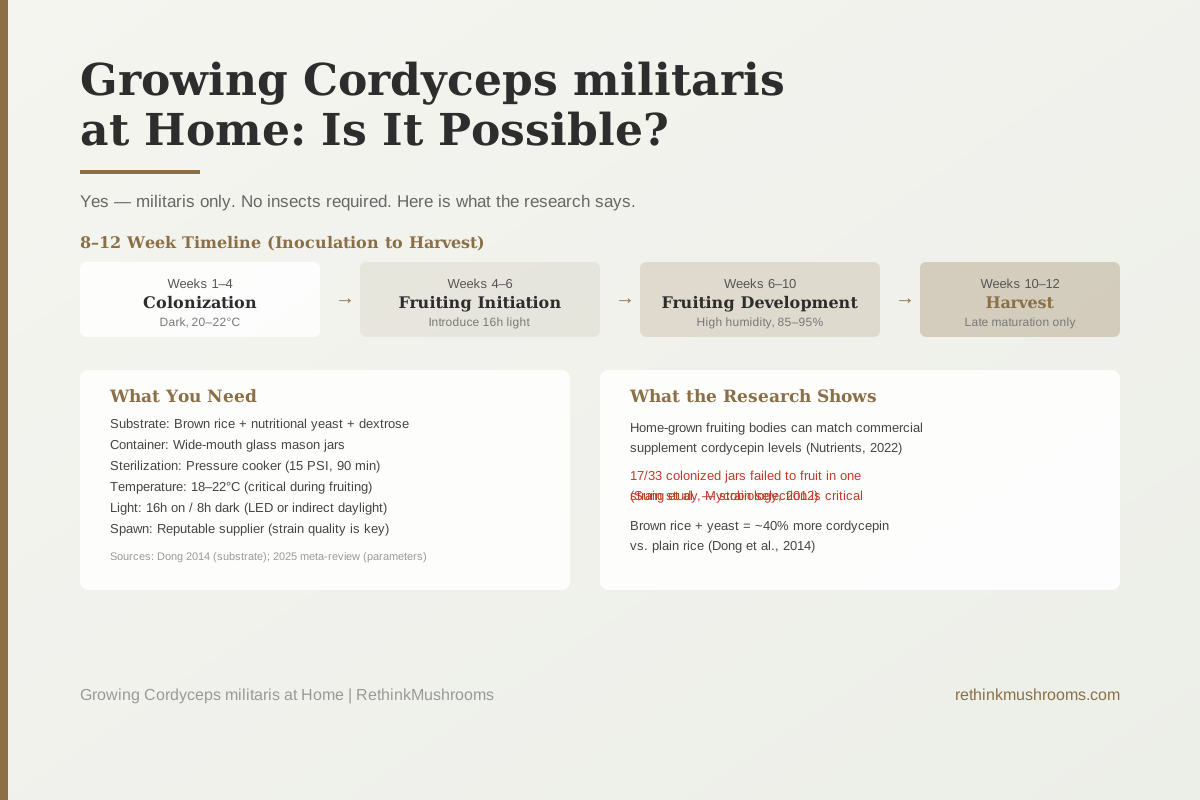
The answer is yes, with qualifications. Cordyceps militaris can be grown at home on sterilized brown rice substrate in glass jars, without insects, at temperatures of 18 to 22 degrees Celsius with 12 to 16 hours of daily light. The process takes 8 to 12 weeks from inoculation to harvest. Success rates vary significantly by strain quality.
The more interesting question is why you would bother. Most people asking about growing Cordyceps at home are doing so because they have read about cordycepin, the primary bioactive compound in Cordyceps that has been studied for athletic performance and other health effects. A 2022 systematic review found that home-grown fruiting bodies can contain as much cordycepin as commercial supplement products, and often more than mycelium-based capsules, which are produced without ever developing into mature fruiting structures.[1]
That changes the calculation for motivated growers.
For a broader introduction to mushroom growing, see How to Grow Mushrooms at Home: A Complete Beginner's Guide.
Key Takeaways
- Cordyceps militaris can be grown at home without insects on sterilized brown rice substrate at 18 to 22 degrees Celsius with 12 to 16 hours of daily light; sinensis cannot
- A 2022 systematic review (Nutrients) found home-grown militaris fruiting bodies contain significantly more cordycepin than mycelium-based commercial products and can match supplement-grade fruiting body extracts
- Strain genetics are the most consequential variable: a 2012 study (Sung et al.) documented that 17 out of 33 fully colonized jars of a single strain failed to produce fruiting bodies
- Brown rice outperforms wheat and corn as a substrate; supplementation with nutritional yeast and dextrose increased cordycepin yield by approximately 40% in a 2014 substrate comparison (Dong et al., International Journal of Medicinal Mushrooms)
- A 2025 meta-review (Foods) identified temperature 18 to 22°C, a 16h light / 8h dark photoperiod, and adequate nitrogen sources as the three most consistent predictors of fruiting body yield
- Cordyceps is substantially harder to grow than oyster or shiitake mushrooms; beginners are strongly advised to start with more forgiving species before attempting Cordyceps
Why Bother Growing Your Own: The Cordycepin Argument
Cordycepin (chemically called 3-deoxyadenosine) is the compound in Cordyceps most studied for health effects. It is found primarily in the fruiting bodies, the orange finger-like structures that emerge when the fungus matures fully.
The supplement market is dominated by two types of Cordyceps products: fruiting body extracts and mycelium products. Mycelium products are made by growing the fungal thread network on grain, then drying and grinding the whole thing, often without the fungus ever forming actual fruiting structures. A 2022 review published in Nutrients compared cordycepin content across these product types and found that fruiting bodies contain substantially more cordycepin than mycelium products, and that home-grown fruiting bodies can match or exceed the cordycepin levels found in commercial fruiting body supplements.[1]
This matters because the most studied clinical trials have used preparations with meaningful cordycepin content, typically standardized fruiting body extracts. Mycelium products often contain little to no cordycepin. If the goal is cordycepin exposure, growing fruiting bodies at home is one way to achieve it without relying on the supplement market.
Cordyceps sinensis vs. militaris: Why Only Militaris Works at Home
There are two species in the Cordyceps family that most people encounter. Cordyceps sinensis is the original species used in traditional Chinese medicine for centuries, found on the Tibetan Plateau growing out of ghost moth larvae. Cordyceps militaris is the species used in nearly all modern research and available in supplement products.
Growing sinensis at home is not possible for practical purposes. The fungus parasitizes specific insect larvae and requires the Tibetan Plateau's unique soil and temperature conditions. A 2018 review published in Mycology that systematically catalogued obstacles in Cordyceps cultivation identified the insect host requirement and environmental specificity as fundamental barriers that no artificial growing environment has reliably overcome for sinensis.[4]
Even at commercial scale with significant investment, sinensis cultivation has been extremely difficult. A 2019 review documented a breakthrough in large-scale sinensis cultivation achieving roughly 15 tons per year by 2017, but this required carefully controlled ghost moth larva rearing, specialized facilities, and over a decade of research investment.[5] It is not a model that translates to a home growing setup.
Militaris is different. It can be cultivated on sterilized grain substrate without any insect host. It fruits indoors under controlled conditions. All commercially available Cordyceps spawn and many growing guides focus on militaris specifically because it is the only species that realistically can be grown at home.
The Honest Answer: Success Rates Are Not Guaranteed
Most guides present Cordyceps growing as straightforward. It is not.
A 2012 study published in Mycobiology by Sung and colleagues investigated the relationship between strain genetics and fruiting body formation in Cordyceps militaris. In one part of the study, jars inoculated with a single-spore isolate of a particular strain were incubated under standard conditions. Of 33 jars that colonized well, 17 failed to produce any fruiting bodies at all. The mycelium grew normally. The substrate looked colonized. But the fruiting trigger never fired.[3]
This failure pattern is strain-dependent. Some militaris strains fruit reliably; others fruit sporadically; others essentially never fruit outside of highly controlled conditions. The genetic basis for this variability is one of the primary subjects of ongoing Cordyceps research.
The practical implication: the single most important decision a home grower makes is strain selection. Spawn purchased from reputable cultivators who select for fruiting reliability is substantially more likely to succeed than generic spawn from unknown sources. This is not a variable most guides discuss, but the research is clear that strain genetics outweigh environmental conditions in determining whether jars fruit or sit colonized and frustrating.
For a deeper explanation of why Cordyceps is harder to grow than other mushrooms, see Why Cordyceps Is Harder to Grow Than Other Mushrooms.
What You Need: Equipment and Substrate
The core requirements, per the research:
Substrate: Brown rice is the most evidence-supported substrate. A 2014 study published in the International Journal of Medicinal Mushrooms by Dong and colleagues compared fruiting body yield and cordycepin content across rice, wheat, corn, and mixed grain substrates. Brown rice produced the highest cordycepin and the highest fruiting body weight. Supplementing the brown rice with nutritional yeast and dextrose (a simple sugar) increased cordycepin content by approximately 40% compared to plain rice.[6]
Containers: Wide-mouth glass jars (pint or half-pint mason jars) are standard. The wide mouth allows fruiting bodies room to develop upward without obstruction. Polypropylene bags are also used commercially but are less practical for small-scale home grows.
Sterilization: Brown rice substrate must be fully sterilized at 15 PSI for 90 minutes in a pressure cooker before inoculation. This is different from many other mushroom species, which tolerate pasteurization. The longer colonization time of Cordyceps creates more opportunity for contamination, and full sterilization significantly reduces that risk.
Temperature: A 2025 meta-review published in Foods compiled culture condition data from multiple published studies and identified 18 to 22 degrees Celsius as the most consistently reported optimal range for fruiting body formation.[2] Deviations above 25 degrees during fruiting typically abort the fruiting process. A small grow tent with a temperature controller is a practical solution for maintaining stable conditions.
Light: Cordyceps militaris requires light to fruit. Unlike oyster mushrooms, which respond primarily to humidity and CO2 changes, Cordyceps fruiting is dependent on a light-sensitive protein in the fungus that must receive light to trigger the developmental switch into fruiting. A 16-hour light and 8-hour dark photoperiod is supported by the research as optimal. LED grow lights or natural indirect daylight both work, though specific LED wavelengths affect which compounds are produced in higher quantities. For LED wavelength specifics and how they affect cordycepin versus adenosine production, see Growing Cordyceps militaris at Home: Rice Substrate and LED Light Requirements.
Humidity and CO2: Fruiting bodies need high relative humidity (85 to 95%) and good air exchange to develop properly. Stagnant, CO2-rich air inhibits proper stroma development. Daily misting and brief fresh air exchanges are standard practice.
The Timeline: Eight to Twelve Weeks
After inoculating sterilized brown rice jars with Cordyceps militaris spawn, the general timeline unfolds in phases:
Colonization (2 to 4 weeks): The fungal threads spread through the rice, turning it into a solid white or cream-colored mass. Keep in darkness at 20 to 22°C. No light during this phase.
Fruiting initiation (1 to 2 weeks after colonization): Once the substrate is fully colonized and dense, introduce light. Small orange pins should begin appearing on the surface within one to two weeks. If nothing appears after three weeks of light exposure, the batch may not fruit.
Fruiting body development (4 to 6 weeks): Orange finger-like structures elongate and deepen in color. Continue maintaining humidity, temperature, and the 16h/8h light cycle. The 2025 meta-review notes that CO2 levels and humidity are among the variables most often cited as causes of stalled fruiting body development.[2]
Harvest: Fruiting bodies are ready when stroma are fully orange, upright, and beginning to show slight powdering (released spores) at the tips. Research has found that cordycepin content peaks during late-stage maturation, not at first orange coloration. Harvesting too early significantly reduces the cordycepin yield.
How Does This Compare to Buying Supplements?
Home-grown Cordyceps militaris fruiting bodies can be eaten fresh, dried and stored, or extracted into a tincture or powder. The 2022 systematic review that compared cordycepin across product types found that dried fruiting body material from cultivated militaris falls within the same concentration range as quality commercial fruiting body supplements, which typically contain 0.1 to 1.0% cordycepin by weight.[1]
Whether this is "worth it" depends on several non-scientific factors: the upfront cost of equipment, the learning curve of the first few failed batches, and the satisfaction of producing your own material from a well-characterized strain. It is not faster or cheaper than buying supplements initially. Over time, once spawn quality and growing conditions are dialed in, it can be.
For information on how to prepare mushroom substrate correctly, see How to Prepare Mushroom Substrate: Sterilization and Pasteurization. For those just starting out with mushroom cultivation, starting with a more forgiving species first is worth considering. See Your First Mushroom Grow: Step-by-Step for Beginners.
The Bottom Line
Cordyceps militaris can be grown at home on sterilized brown rice substrate at 18 to 22°C with 16 hours of daily light, without insects, in 8 to 12 weeks. A 2022 systematic review found home-grown fruiting bodies can match commercial supplement cordycepin levels. The most important variable is strain genetics: research documents that some strains fail to fruit in up to 50% of fully colonized jars. Only militaris (not sinensis) is viable at home; sinensis requires insect larvae and conditions specific to the Tibetan Plateau.
Frequently Asked Questions
Sources & References
- 1. Source details for this reference are not yet available.
- 2. Source details for this reference are not yet available.
- 3. Source details for this reference are not yet available.
- 4. Source details for this reference are not yet available.
- 5. Source details for this reference are not yet available.
- 6. Source details for this reference are not yet available.