Cordyceps Cultivation
11.9 mg/g cordycepin
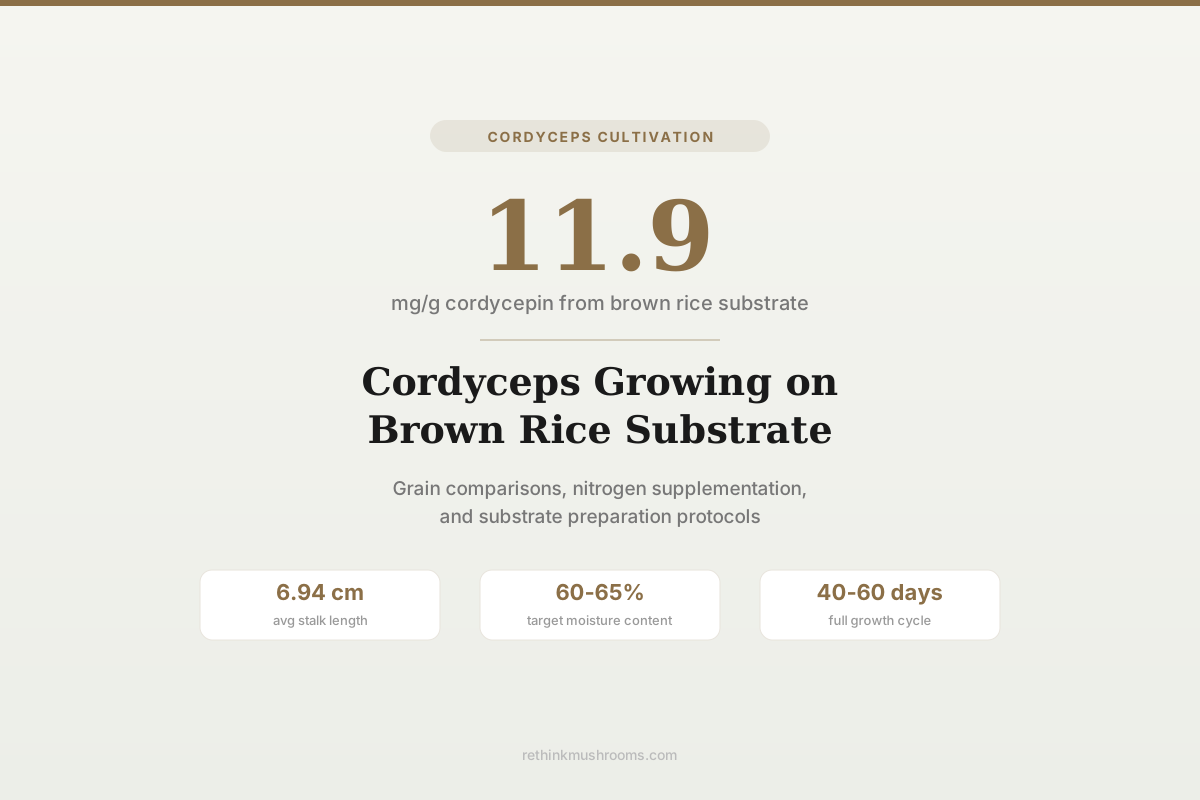
Brown rice substrate produced 11.9 mg/g cordycepin in Cordyceps militaris fruiting bodies, second only to germinated rice at 13.1 mg/g among grain substrates tested.
Comparative substrate research, 2024
Br+Ye substrate
fewest days to primordial initiation
6.94 cm avg stalk
brown rice fruiting body length
8.92 mg/g on rice
Park 2025 comprehensive review
Comparative substrate research, 2024
 View as image ↗
Brown rice is one of the most accessible and widely studied substrates for Cordyceps militaris cultivation. It provides the carbohydrate base, moisture retention, and physical structure that C. militaris mycelium needs to colonize and eventually produce fruiting bodies. Comparative research has tested brown rice against other grains, with and without nitrogen supplementation, to optimize both biomass yield and bioactive compound production. For the environmental conditions that interact with substrate choice, see Cordyceps fruiting conditions: light, temperature, and humidity. For a broader overview of cultivation challenges, see Why cordyceps is harder to grow than other mushrooms.
Key Takeaways
- Liang et al. (2014) tested brown rice, plumule rice, wheat, and pearl barley with four nitrogen sources and found that brown rice plus yeast extract (Br+Ye) required the fewest days for primordial initiation in C. militaris strain L
- Brown rice substrate produced cordycepin at 11.9 mg/g in fruiting bodies, compared to germinated rice at 13.1 mg/g and white rice at 8.92 mg/g (Park, 2025)
- Nitrogen supplementation with yeast extract or peptone consistently outperformed ammonia sulfate and monosodium glutamate for both colonization speed and fruiting body yield
- Fruiting bodies grown on brown rice achieved average stalk lengths of 6.94 cm and wet weights of 30.87 g, with morphology comparable to wild Cordyceps militaris
- The Park (2025) review found that insect larvae substrates produced dramatically higher cordycepin (89.5 mg/g) than any grain substrate, suggesting that the ancestral host medium remains biochemically superior for secondary metabolite production
- Substrate moisture content between 60 and 65% before sterilization produced the most consistent colonization results across studies
Brown Rice vs. Other Grain Substrates
Liang et al. (2014) conducted the most systematic comparison of grain substrates for C. militaris cultivation. The study tested brown rice (Br), plumule rice (Pr), wheat (W), and pearl barley (Pb), each supplemented with one of four nitrogen sources: peptone (P), yeast extract (Ye), ammonia sulfate (As), or monosodium glutamate (Mg). Two C. militaris strains (H and L) were tested across all combinations.[1]
The results varied by strain and outcome measure. For colonization speed, pearl barley plus yeast extract (Pb+Ye) was fastest for both strains, with complete colonization in 12.6 to 12.8 days. But for primordial initiation, the critical transition from vegetative growth to reproductive growth, brown rice plus yeast extract (Br+Ye) required the fewest days for strain L. Plumule rice plus peptone (Pr+P) was equally fast for this strain.
The highest fruiting body yield and biological efficiency came from different substrate combinations depending on the strain. This strain-dependent variability is a consistent finding in C. militaris research: a substrate that produces excellent results with one isolate may underperform with another. The practical implication is that cultivators using brown rice should test their specific strain against the substrate before committing to production scale. Small-batch trials (three to five containers) with a new strain-substrate combination can save significant time and resources compared to scaling up an untested pairing.
Cordycepin Yield: What Brown Rice Produces
The Park (2025) comprehensive review compiled cordycepin data across substrates. Rice-based substrates produced cordycepin at 8.92 mg/g with polysaccharide content of 34.5 mg/g. More specific data from comparative studies placed brown rice cordycepin at 11.9 mg/g, higher than white rice but lower than germinated rice at 13.1 mg/g.[2]
Corncob particles produced 9.45 mg/g cordycepin and 5.86 mg/g adenosine. The outlier was insect larvae substrate (Allomyrina dichotoma), which reached 89.5 mg/g cordycepin, roughly eight times higher than any grain substrate. This dramatic difference reflects the natural biology of Cordyceps: in the wild, C. militaris parasitizes insect larvae, and the complex nutritional profile of insect tissue appears to trigger maximal secondary metabolite production.
For brown rice cultivators, the 11.9 mg/g cordycepin figure represents a good yield for a grain substrate but leaves substantial room for optimization. Combining brown rice with nutrient supplements, adjusting harvest timing based on Oh et al. (2019) findings that cordycepin peaks during senescence, and using optimal LED wavelengths (the 3R:3B ratio achieving 30 mg/g in the Park review) could potentially increase yields beyond the baseline grain-substrate levels.[3]
The rice culture medium (the liquid remaining after colonization) also contained cordycepin, with brown rice medium producing the highest yield among grain media at 4.77 mg/g. This suggests brown rice releases or generates precursor compounds that support cordycepin biosynthesis even in the liquid fraction, making both the fruiting body and spent medium potentially valuable.
Substrate Preparation: The Technical Details
Successful brown rice substrate preparation requires attention to moisture content, sterilization parameters, and nutrient supplementation. The general protocol established across multiple research groups follows a consistent pattern.
Brown rice grains are hydrated before sterilization. The target moisture content is 60 to 65% by weight, achieved by soaking grains for 12 to 24 hours and then draining excess water. Too little moisture (below 55%) restricts mycelial growth; too much moisture (above 70%) creates anaerobic zones that favor bacterial contamination and impede gas exchange within the substrate.
Sterilization uses autoclaving at 121 C (15 PSI) for 60 to 120 minutes, depending on container size and substrate density. The extended sterilization time compared to many other mushroom substrates reflects the higher contamination susceptibility of C. militaris. Unlike aggressive species such as Pleurotus ostreatus, C. militaris mycelium grows slowly and cannot outcompete contaminants in partially sterilized substrate.
Nitrogen supplementation is added before sterilization. The Liang et al. (2014) data showed that yeast extract and peptone consistently outperformed inorganic nitrogen sources (ammonia sulfate) and amino acid sources (monosodium glutamate). A typical ratio is 1% (w/w) nitrogen source relative to grain weight. The yeast extract provides B vitamins and trace minerals alongside nitrogen, which may explain its superior performance compared to pure nitrogen sources.[1]
After sterilization and cooling, inoculation occurs in a sterile environment. Liquid culture inoculum is preferred over agar transfers because it distributes more evenly across the grain surface. Typical inoculation rates range from 5 to 10% (v/w) of liquid culture relative to substrate weight.
Colonization Phase on Brown Rice
After inoculation, brown rice substrates are incubated at 20 to 23 C in complete darkness for 14 to 21 days. During this phase, C. militaris mycelium grows through the grain kernels, consuming nutrients and building the hyphal network that will eventually support fruiting body formation.
Colonization speed on brown rice is moderate compared to other substrates. Liang et al. (2014) recorded colonization times of approximately 14 to 18 days for brown rice with yeast extract, versus 12.6 to 12.8 days for pearl barley with yeast extract. The slower colonization on brown rice is partly offset by brown rice's superior performance in the subsequent primordial initiation stage.
A critical observation from Shrestha et al. (2012) applies to the colonization phase: multi-ascospore isolates colonize and fruit more reliably than single-ascospore strains. Cultivators starting with tissue culture from a known fruiting strain will have better colonization uniformity than those using spore-derived inoculum, regardless of substrate choice.[4]
Visual indicators of healthy colonization include white, cottony mycelial coverage spreading uniformly across the grain surface. C. militaris mycelium on brown rice appears slightly denser than on white rice due to the additional nutrients in the bran layer. Yellow or orange coloration before the light-exposure phase suggests premature carotenoid production, which is unusual during colonization and may indicate stress or genetic instability. Green, black, or slimy patches indicate contamination and require immediate removal of affected containers from the growing area to prevent spore spread to adjacent cultures.
The colonization phase is where brown rice's moisture retention properties become apparent. Brown rice holds moisture more evenly than white rice due to its intact bran layer, which acts as a semi-permeable membrane around each grain. This creates more uniform hydration throughout the substrate depth, reducing dry spots that can stall colonization and wet spots that invite bacterial growth.
Fruiting on Brown Rice: Triggering the Transition
The transition from colonization to fruiting is triggered by environmental changes: introduction of light (500 to 1,000 lux, 12-hour photoperiod), temperature reduction to 18 C for primordial initiation, and increased fresh air exchange. On brown rice substrate, this transition typically begins 3 to 7 days after light introduction, with visible primordia (small orange bumps) appearing on the substrate surface.
Wu et al. (2016) demonstrated that the three-stage temperature protocol (23 C colonization, 18 C induction, 23 C fruiting) produced the highest yield across substrates, including rice-based media. The temperature drop is the primary fruiting trigger; light is essential but not sufficient alone.[5]
Brown rice provides a physical advantage during fruiting: the intact grain kernels create air pockets and structural support for emerging primordia. Finely ground substrates can compact during colonization, restricting gas exchange and creating conditions where primordia suffocate before reaching the surface. The coarse texture of brown rice maintains substrate porosity throughout the growth cycle.
Fruiting bodies grown on brown rice reach harvestable size (5 to 8 cm) in approximately 40 to 60 days from inoculation, depending on strain, temperature management, and light conditions. The average stalk length reported in comparative studies is 6.94 cm with wet weights of 30.87 g per container, producing fruiting bodies morphologically similar to those found on insect hosts in the wild.
Contamination: The Primary Challenge
Contamination is the single greatest obstacle to successful C. militaris cultivation on any substrate, and brown rice is no exception. The most common contaminants include Trichoderma species (green mold), Aspergillus species (various colors), Penicillium (blue-green), and Calcarisporium cordycipiticola (a white fungus specific to Cordyceps cultures).
Calcarisporium is particularly problematic because it is visually similar to C. militaris mycelium in early stages and only becomes distinguishable when it overgrows the culture. It appears more frequently when inoculation or early colonization temperatures exceed 23 C, reinforcing the importance of maintaining the 20 to 23 C colonization temperature.
Zheng et al. (2015) identified genetic factors in fruiting body production, and the same mutations that reduce fruiting capacity can also reduce the competitive ability of C. militaris against contaminants. Maintaining genetically vigorous strains through careful culture management is therefore a contamination prevention strategy as well as a yield optimization strategy.[6]
Sterile technique throughout the process (laminar flow hood for inoculation, HEPA filtration for the fruiting room, minimal container opening during colonization) reduces but never eliminates contamination risk. Commercial operations typically expect a 5 to 15% contamination rate even under good practices. Home cultivators working with still air boxes rather than laminar flow hoods may experience higher rates, particularly in humid climates where ambient mold spore counts are elevated. The extended 40 to 60 day growth cycle compounds the risk: every additional week of incubation is another week of contamination exposure. For a full overview of home cultivation feasibility, see How to grow Cordyceps militaris at home: is it possible?. For LED-specific guidance, see Growing Cordyceps militaris at home: rice substrate and LED light requirements.
The Bottom Line
Brown rice is a viable and well-studied substrate for Cordyceps militaris cultivation, producing cordycepin at 11.9 mg/g in fruiting bodies with morphology comparable to wild specimens. Nitrogen supplementation with yeast extract or peptone improves both colonization speed and yield. Brown rice underperforms insect larvae substrates for cordycepin production by roughly 8-fold but remains the most practical grain option for most cultivators. The primary challenges are contamination management during the 40 to 60 day growth cycle and maintaining strain vigor across subculture generations.
Frequently Asked Questions
Sources & References
- 1RTHM-00617·Liang, Zeng-Chin et al. (2014). “Various grain substrates for the production of fruiting bodies and bioactive compounds of the medicinal caterpillar mushroom, Cordyceps militaris (Ascomycetes)..” International journal of medicinal mushrooms.Study breakdown →PubMed →↩
- 2RTHM-02159·Park, Hye-Jin (2025). “Influence of Culture Conditions on Bioactive Compounds in Cordyceps militaris: A Comprehensive Review..” Foods (Basel.Study breakdown →PubMed →↩
- 3RTHM-00582·Oh, Junsang et al. (2019). “Metabolomic profiling reveals enrichment of cordycepin in senescence process of Cordyceps militaris fruit bodies..” Journal of microbiology (Seoul.Study breakdown →PubMed →↩
- 4RTHM-00486·Shrestha, Bhushan et al. (2012). “Fruiting Body Formation of Cordyceps militaris from Multi-Ascospore Isolates and Their Single Ascospore Progeny Strains..” Mycobiology.Study breakdown →PubMed →↩
- 5RTHM-00841·Wu, Chiu-Yeh et al. (2016). “Effects of Illumination Pattern during Cultivation of Fruiting Body and Bioactive Compound Production by the Caterpillar Medicinal Mushroom, Cordyceps militaris (Ascomycetes)..” International journal of medicinal mushrooms.Study breakdown →PubMed →↩
- 6RTHM-00413·Zheng, Zhuang-Li et al. (2015). “Identification of the Genes Involved in the Fruiting Body Production and Cordycepin Formation of Cordyceps militaris Fungus..” Mycobiology.Study breakdown →PubMed →↩