Turkey Tail & HPV / Cervical Health
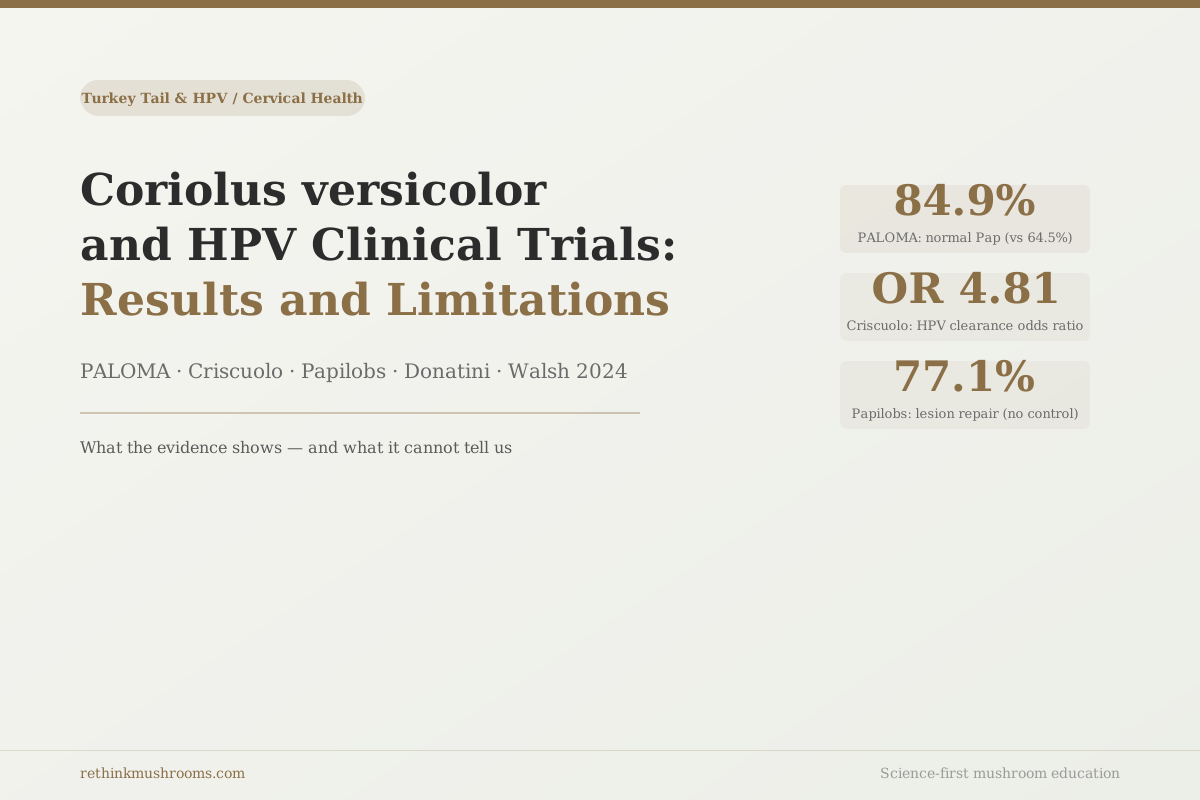
84.9% normal Pap
In the PALOMA multicenter controlled trial, 84.9% of women using the Coriolus versicolor-based vaginal gel had normal Pap smear and colposcopy results at 6 months, compared to 64.5% in the watchful-waiting group.
Serrano et al., Journal of Lower Genital Tract Disease, 2021
OR 4.81
odds ratio for HPV clearance in 183 women using the CV vaginal gel vs. watchful waiting (Criscuolo et al., 2021)
Top CAM tier
Walsh 2024 grouped topical Coriolus versicolor gel with oral/topical selenium and oral indol-3-carbinol as the three CAM therapies with the best supporting RCT data for HPV/cervical dysplasia
7 active ingredients
in the Papilocare vaginal gel used in all topical trials; isolating the Coriolus versicolor contribution is not possible
Serrano et al., Journal of Lower Genital Tract Disease, 2021
 View as image ↗
If you search for clinical evidence on Coriolus versicolor (the fungal name for Turkey Tail mushroom) and HPV, you will find promising numbers. 84.9% Pap smear normalization. 67% HPV clearance. Odds ratios of 4.81. These come from real studies, published in peer-reviewed journals, with controlled comparisons.
But almost every article presenting these numbers omits three things that significantly affect their interpretation. First, the studies are almost entirely about a specific multi-ingredient vaginal gel, not oral Turkey Tail supplements. Second, the lead product used in most trials contains six active ingredients besides Coriolus versicolor, making it scientifically impossible to attribute the results to CV alone. Third, CIN1 (the mildest form of cervical dysplasia) naturally regresses in approximately 80% of cases within 2 years without any intervention, which is the baseline against which any treatment effect must be measured.
This article covers the Coriolus versicolor HPV clinical trials systematically: what each found, how strong the design is, and what each study cannot tell us. For the broader question of whether Turkey Tail helps with HPV, see Turkey Tail and HPV: can a mushroom help clear the virus?. For background on what Turkey Tail is and its full compound profile, see what is Turkey Tail mushroom: a science-based introduction.
Key Takeaways
- The PALOMA multicenter controlled trial (n=91) found 84.9% normal Pap smear and colposcopy results at 6 months in the CV gel group vs. 64.5% in watchful waiting; HR-HPV clearance was 62.5% vs. 40.0% (Serrano et al., 2021)
- The Criscuolo 2021 retrospective study (n=183) found 67.0% vs. 37.2% HPV clearance with OR 4.81 (95% CI 2.43-9.53), the largest study by sample size but with an observational design
- The Papilobs real-life prospective study reported 77.1% lesion repair and 71.6% HPV clearance across follow-up; no control group (Cortés Bordoy et al., 2023)
- The only oral Turkey Tail HPV trial enrolled 41 patients, combined Turkey Tail with Ganoderma lucidum, and tested oral HPV only, not cervical HPV lesions (Donatini, 2014)
- All topical trials use Papilocare, a multi-ingredient vaginal gel containing at least 6 active components besides Coriolus versicolor; isolating the CV contribution is not possible from these studies
- A 2024 scoping review in the Journal of Lower Genital Tract Disease grouped topical Coriolus versicolor gel with oral and topical selenium therapies and oral indol-3-carbinol as the three CAM approaches with the most clinical benefit and best supporting RCT data for HPV and cervical dysplasia (Walsh et al., 2024)
The Oral vs. Topical Divide: Two Evidence Bases That Are Not Interchangeable
The first thing to understand about Coriolus versicolor HPV research is that there are two fundamentally different evidence streams, and they cannot be treated as the same thing.
Stream 1: Topical vaginal gel (Papilocare brand). Nearly all the published human evidence on CV and cervical HPV uses a specific vaginal gel formulation sold under the brand name Papilocare. This is a multi-ingredient product applied intravaginally. Coriolus versicolor is one of its components, alongside hyaluronic acid, Centella asiatica, Aloe vera, alpha-glucan oligosaccharide, Azadirachta indica, and carboxymethyl-beta-glucan. The gel acts locally on cervical tissue.
Stream 2: Oral Turkey Tail (or Trametes versicolor capsules). One published trial exists for oral Turkey Tail in HPV: Donatini 2014, 41 patients, oral HPV (mouth and throat, not cervical), combined with Ganoderma lucidum. That is the entire oral evidence base for HPV specifically.
Most supplement-focused websites describe the topical trial results and then recommend oral Turkey Tail capsules, treating them as equivalent. They are not. The delivery route, the target tissue, the product formulation, and the patient population are all different. The PALOMA trial results, for example, describe a specific gel applied locally to cervical tissue; they say nothing about what happens when you consume oral mushroom powder.
With that distinction established, here is what each study found.
The PALOMA Trial: The Most Rigorous Coriolus versicolor HPV Study
The PALOMA study (Serrano et al., Journal of Lower Genital Tract Disease, 2021) is the strongest piece of controlled clinical evidence for Coriolus versicolor in cervical HPV.[1]
It was a multicenter, prospective, open-label, randomized, parallel-group, watchful-waiting-controlled trial conducted across Spain. Ninety-one HPV-positive women with low-grade Pap smear alterations and concordant colposcopy were enrolled. Participants received either the Papilocare vaginal gel or watchful waiting (no intervention) for 6 months.
Results:
- Normal Pap smear and colposcopy at 6 months: 84.9% in the gel group vs. 64.5% in controls
- High-risk HPV clearance: 62.5% in the gel group vs. 40.0% in controls
- Both differences were statistically significant
These are meaningful numbers. A 20-point separation in Pap normalization rates and a 22-point separation in viral clearance rates, in a controlled trial, represent a real treatment signal.
Design strengths: Multicenter (reduces single-site bias), randomized, prospective, controlled comparison.
Design limitations: Open-label (neither participants nor physicians were blinded, introducing measurement bias and placebo response), conducted entirely in Spain, short follow-up (6 months), and, critically, uses Papilocare, not pure Coriolus versicolor.
A 2022 sub-analysis of the PALOMA data examined outcomes specifically in women over 40 years old.[5] Older women have generally lower natural HPV clearance rates due to age-related immune changes. Gil-Antuñano and colleagues found that the treatment benefit was maintained in this older subgroup, suggesting the gel may be particularly valuable in women whose age makes natural clearance less likely.
PALOMA 2, a follow-up trial, was completed and reported in the International Journal of Gynecological Cancer in 2025, extending the evidence with a longer study period.
The Criscuolo Study: Larger Sample, Observational Design
Criscuolo and colleagues published a retrospective observational study in Advances in Therapy in 2021, enrolling 183 women, the largest sample size in the Coriolus versicolor HPV literature.[2]
Results:
- HPV clearance at 6 months: 67.0% in the treated group vs. 37.2% in controls
- Odds ratio for clearance: 4.81 (95% CI 2.43 to 9.53)
- Colposcopy improvement: 76.1% vs. 40.8%
The OR of 4.81 means that, in this study population, treated women were nearly 5 times more likely to clear HPV at 6 months than untreated women. This is a large effect size for an observational study.
Design strengths: Larger sample than PALOMA, real-world patient population, direct comparison group.
Design limitations: Retrospective design means data were collected from medical records after the fact, not prospectively. Retrospective studies are prone to selection bias, incomplete data, and unmeasured confounders. Patients who chose to use the gel may differ systematically from those who did not (healthier, more motivated, higher socioeconomic status), which can inflate apparent treatment effects.
The Papilobs Real-Life Study: The Broadest Real-World Data
The Papilobs study (Cortés Bordoy et al., Cancers, 2023) took the most expansive approach: a Spanish multicentric real-life prospective study conducted from 2018 to 2021, enrolling women with HPV-dependent cervical lesions across multiple clinical settings.[3]
Results:
- 77.1% of patients showed repaired cervical lesions at 6 or 12 months
- 71.6% achieved HPV clearance across the study period
Design strengths: Prospective design, large real-world cohort, long follow-up (up to 12 months), reflects actual clinical practice in Spain.
Design limitations: No control group. Without a control group, it is impossible to separate treatment effects from natural history. Given that CIN1 (the mild lesion most commonly treated in these studies) naturally regresses in approximately 80% of cases within 2 years without any intervention, a 77% lesion repair rate in an uncontrolled study does not necessarily demonstrate a treatment effect. Some proportion of that 77% would have improved on its own.
A 2024 scoping review of all CAM therapies for HPV and cervical dysplasia, published in the Journal of Lower Genital Tract Disease, noted that the PAPILOBS-GR study (a Greek version of the Papilobs study) had completed enrollment but results remained unpublished at the time of the review.[7]
The Oral Evidence: One Small Preliminary Trial
If you are considering oral Turkey Tail supplementation for HPV, the evidence base is a single study: Donatini, published in the International Journal of Medicinal Mushrooms in 2014.[4]
Study details: 472 patients were screened with oral swabs for gingivitis, of whom 61 tested positive for oral HPV16 or HPV18 (HPV detected in the mouth, not the cervix). Twenty patients were assigned to a Laetiporus sulphureus (sulphur shelf) arm and 41 were assigned to a combined Trametes versicolor + Ganoderma lucidum (Reishi) arm for 2 months. This was described as a preliminary randomized study.
Results: 88% of patients in the TV+GL arm cleared oral HPV16 or HPV18 versus 5% in the LS comparator arm (p < 0.001). The study had no untreated/placebo control arm — the comparator was a different mushroom, not no treatment.
Critical limitations:
- It combined two mushrooms. The active arm included both Trametes versicolor (Turkey Tail) and Ganoderma lucidum (Reishi). It is not possible to determine how much of the effect came from TV, GL, or their combination.
- No untreated control. The 5% comparator clearance came from the LS arm, not a no-treatment or placebo group, so the natural-history clearance rate cannot be inferred from this study.
- It tested oral HPV only. Oral HPV infection behaves differently from cervical HPV infection. The two share the same virus strains but involve different immune environments and different natural clearance dynamics. Extrapolating from oral clearance to cervical clearance is not scientifically justified.
- Sample size of 41 in the TV+GL arm is small. This provides limited statistical power and a high probability of random variation, even with a striking p-value.
- Single-author preliminary report. The paper is two pages long in a niche specialty journal; full methods and dose details are not described in the abstract.
The Donatini 2014 study is the only oral Turkey Tail HPV trial. It is preliminary evidence that should be treated as hypothesis-generating, not as clinical confirmation of efficacy.
The HIV Extension: Evidence in Immunocompromised Patients
Most HPV research focuses on immunocompetent women. A 2025 cohort study by Hijona and colleagues extended the evidence to a harder-to-treat group: patients with HIV who also had high-risk HPV cervical lesions.[6]
HIV-positive individuals have impaired immune function, which both increases HPV persistence rates and makes natural clearance less likely. The fact that conservative treatment with a Coriolus versicolor-based approach showed clinical benefit in this immunocompromised population is notable. It suggests the gel's effect is not purely reliant on an intact immune system, though the specific contribution of each component (including CV) to outcomes in HIV patients cannot be determined from a product-level study.
This is the most recent published evidence in the Coriolus versicolor HPV literature and is entirely absent from competitor articles. For related immune support evidence in recovery contexts, see Turkey Tail and cervical health: immune-mediated antiviral effects.
The Independent Assessment: What Walsh 2024 Found Across All CAM Therapies
Walsh and colleagues published a scoping review in the Journal of Lower Genital Tract Disease in 2024 that examined every published complementary and alternative medicine approach for HPV infection and cervical dysplasia.[7] CAM therapies evaluated included AHCC, green tea catechins, folic acid, beta-carotene, and multiple herbal preparations.
The review's conclusion relevant to this article: topical Coriolus versicolor mushroom gel was identified — alongside oral and topical selenium therapies and oral indol-3-carbinol — as one of three CAM categories with the most clinical benefit and best supporting RCT data among all CAM therapies reviewed for HPV and cervical dysplasia. The review also noted that the overall CAM evidence base is "of low quality because of lack of standardized, clinically relevant treatment outcomes, lack of standardization of products, and minimal reporting on adverse and long-term effects" — placement in the top tier of CAM evidence is not the same as a strong recommendation.
This peer-reviewed independent assessment from a specialized clinical journal is not marketing copy. It provides a hierarchical placement based on methodological rigor. The PALOMA RCT is simply better designed than most CAM HPV studies, which rely on case reports, small pilot data, or no controlled comparison at all.
No competitor article on Turkey Tail and HPV cites Walsh 2024. For details on Turkey Tail's bioactive compounds and the PSK/PSP fractions responsible for immune activation, see Turkey Tail bioactive compounds: PSK, PSP, and beta-glucans.
The Critical Limitations the Numbers Don't Show
Reading the trial results alone (84.9%, OR 4.81, 77.1%) creates an impression of a well-established treatment. The following limitations are essential context.
Product confounding. Every topical trial uses Papilocare. Papilocare contains Coriolus versicolor polysaccharides alongside hyaluronic acid (tissue hydration and repair), Centella asiatica (wound healing), Aloe vera (anti-inflammatory), alpha-glucan oligosaccharide (prebiotic), Azadirachta indica (antiviral and antibacterial), and carboxymethyl-beta-glucan (immunomodulatory). Any or all of these components could contribute to the outcomes observed. The studies cannot isolate the Coriolus versicolor contribution, and no trial using pure CV gel (without co-ingredients) has been published.
Open-label design. The PALOMA trial was not blinded. Participants and clinicians knew who received the gel. This allows placebo effect, expectation bias, and differential follow-up compliance to influence measured outcomes. An open-label design is the minimum acceptable standard for a controlled trial but is substantially weaker than a double-blind placebo-controlled design.
Geographic concentration. All topical CV HPV trials are from Spain or Italy. HPV strain distribution, healthcare system factors, and baseline clearance rates vary across populations. Whether PALOMA results generalize to other ethnic groups and geographic regions has not been tested.
Outcome measure inconsistency. Different studies use different primary outcomes: normal Pap smear, colposcopy normalization, HPV DNA negativity, cytology normalization. These measure related but distinct aspects of disease. A patient can have a normal Pap smear while still testing HPV-positive, or vice versa. Pooling results across studies with different primary outcomes is methodologically problematic.
Natural regression baseline. CIN1, the mildest grade of cervical dysplasia, naturally regresses in approximately 80% of cases within 2 years without any intervention, according to established gynecological guidelines. Uncontrolled studies reporting 70-80% lesion resolution rates (like Papilobs) must be interpreted against this background. Only studies with a control group can demonstrate effects above the natural history baseline.
Unpublished data. The Walsh 2024 review noted that the PAPILOBS-GR study results were not yet published despite completion. Unpublished trial results introduce potential publication bias into the literature: positive results get published; neutral or negative results may not.
For dosing protocols used in these trials and what is actually available, see Turkey Tail for HPV: dosage and evidence-based protocols. For the distinction between HPV clearance and cervical dysplasia regression, see Turkey Tail and cervical dysplasia: from HPV clearance to prevention. For comparison with PSK vs. PSP compound differences, see PSK vs. PSP: comparing Turkey Tail's two star compounds.
The Bottom Line
Six studies have examined Coriolus versicolor and HPV in humans. Five use a multi-ingredient vaginal gel (Papilocare) with results ranging from 67-85% for combined or HPV-specific outcomes vs. 37-65% in watchful-waiting comparators. One small preliminary trial (Donatini, n=41 in the TV+GL arm) tested oral TV combined with Ganoderma lucidum for oral HPV only, with a Laetiporus sulphureus comparator (not an untreated control). The Walsh 2024 CAM scoping review placed topical CV gel in the top tier of CAM evidence for HPV — alongside oral/topical selenium and oral indol-3-carbinol — while characterizing the overall CAM evidence base as low quality. Critical limitations across the evidence base include product confounding (Papilocare has 7 active ingredients), open-label design, geographic concentration in Spain and Italy, and varying outcome measures. No study establishes the independent efficacy of Coriolus versicolor as a single ingredient.
Frequently Asked Questions
Sources & References
- 1RTHM-01432·Serrano, Luis et al. (2021). “Efficacy of a Coriolus versicolor-Based Vaginal Gel in Women With Human Papillomavirus-Dependent Cervical Lesions: The PALOMA Study..” Journal of lower genital tract disease.Study breakdown →PubMed →↩
- 2RTHM-01339·Criscuolo, Anna Angela et al. (2021). “Therapeutic Efficacy of a Coriolus versicolor-Based Vaginal Gel in Women with Cervical Uterine High-Risk HPV Infection: A Retrospective Observational Study..” Advances in therapy.Study breakdown →PubMed →↩
- 3RTHM-01681·Cortés Bordoy, Javier et al. (2023). “Effect of a Multi-Ingredient Coriolus-versicolor-Based Vaginal Gel in Women with HPV-Dependent Cervical Lesions: The Papilobs Real-Life Prospective Study..” Cancers.Study breakdown →PubMed →↩
- 4RTHM-00589·Donatini, Bruno (2014). “Control of oral human papillomavirus (HPV) by medicinal mushrooms, Trametes versicolor and Ganoderma lucidum: a preliminary clinical trial..” International journal of medicinal mushrooms.Study breakdown →PubMed →↩
- 5RTHM-01521·Gil-Antuñano, Santiago Palacios et al. (2022). “Efficacy of a Coriolusversicolor-Based Vaginal Gel in Human Papillomavirus-Positive Women Older Than 40 Years: A Sub-Analysis of PALOMA Study..” Journal of personalized medicine.Study breakdown →PubMed →↩
- 6RTHM-02096·Hijona Elósegui, Jesús Joaquín et al. (2025). “Clinical Benefit of a Conservative Treatment for High-Risk Human Papillomavirus Lesions in Patients with HIV..” AIDS research and human retroviruses.Study breakdown →PubMed →↩
- 7RTHM-02010·Walsh, Caroline J et al. (2024). “A Scoping Review of Complementary and Alternative Medicine for Human Papillomavirus Infections and Cervical Dysplasia..” Journal of lower genital tract disease.Study breakdown →PubMed →↩