Mushroom Skincare
3 evidence-grounded recipes
Tremella fuciformis polysaccharides have been characterised as roughly 87.76% hyaluronic acid at above 2000 kDa, and documented in cutaneous research for moisture retention, photoprotection against UV-induced fibroblast and keratinocyte damage, and barrier support — and they dissolve in water, which makes them workable in home preparations.
Galla et al., Foods, 2025 / Mineroff & Jagdeo, Archives of Dermatological Research, 2023
water-soluble
Tremella polysaccharides dissolve in water: the right medium for DIY masks
two fractions
Chaga and reishi split into a water-soluble polysaccharide half and an alcohol-locked triterpenoid half
patch test
mandatory before applying any mushroom preparation to face skin
Galla et al., Foods, 2025 / Mineroff & Jagdeo, Archives of Dermatological Research, 2023
 View as image ↗
Mushrooms have appeared in skincare products for years, but most DIY content on the subject skips the chemistry detail that determines whether a home preparation delivers anything at all. Different mushroom species carry their active compounds in different chemical forms: some dissolve in water and work in simple water-based recipes, while others require alcohol or oil extraction to come out of the mushroom at all.
That distinction separates mushroom face masks that can work from ones that are mostly expensive, mushroom-flavoured water on your face.
It also gets oversimplified in the other direction. The common slogan is that tremella works in water and everything else is useless. That is not quite right either, and the correction matters if you own a bag of chaga powder: most of these species carry two separate bioactive fractions, and warm water reaches one of them and leaves the other behind. A home soak is not a verdict on a species. It is a filter, and the useful question is which half of the species it selects.
This article covers what the research actually shows about mushroom compounds and skin, three home recipes built on the species with the strongest topical evidence, what warm water does and does not pull out of the other species, and where the real limits of DIY skincare sit.
For a broader look at mushroom products from supplements to skincare, see Mushroom Coffee: What Is It and Does It Actually Work?.
Key Takeaways
- Tremella fuciformis is the best-documented mushroom for topical skin benefit and is uniquely suited to DIY use because its active polysaccharides are water-soluble and remain intact in water-based preparations
- Chemical characterisation of a Tremella extract found hyaluronic acid made up roughly 87.76% of it, at a molecular weight above 2000 kDa — which is why the hyaluronic acid comparison is a measurement rather than marketing
- The skin evidence for Tremella is preclinical: cell studies in human fibroblasts and keratinocytes, plus mouse models including one where topical application reduced UV damage. There is no human clinical trial with a skin endpoint
- Chaga is not a dead end in water. Its water-extractable polysaccharides reduced senescence markers and restored antioxidant signalling in UVB-damaged human keratinocytes — but the triterpenoid and polyphenol chemistry chaga is marketed on is non-polar and needs alcohol extraction
- Reishi is the species where a water soak genuinely misses the point: its most studied anti-inflammatory compounds are ganoderic acids, which are alcohol-soluble
- Dried Tremella soaked in warm water produces a gel that can be applied directly to the face, with the soaking liquid carrying the water-soluble polysaccharides
- All mushroom preparations should be patch-tested, used fresh, and refrigerated for no more than 24 hours — home preparations contain no preservative system
- DIY preparations cannot replicate the standardised concentrations in formulated cosmeceutical products; they are a low-cost introduction, not a clinical-dose treatment
The Chemistry That Decides Whether a Mask Works
Every skin claim on a mushroom product traces back to a specific molecule, and every molecule has a solvent it will come out in. That is the whole game.
For Tremella, the answer is unusually clean: the skin research was done on the polysaccharides, and polysaccharides are exactly what water gets. For chaga, the answer splits in half. For reishi, the water largely misses what the research is about.
Extraction Chemistry
What a Bowl of Warm Water Can and Cannot Pull Out
Most of these species carry two separate bioactive fractions. Warm water reaches the polysaccharide fraction and leaves the terpenoid fraction in the mushroom. That is why a home soak is not a verdict on a species — it is a filter, and the useful question is which half of the species it selects.
- TremellaTremella fuciformisWater reaches the studied actives
Warm water reaches this
Polysaccharides — a (1→3) α-D-mannan backbone with glucuronic acid, xylose and fucose side chains
The isolated extract is roughly 87.76% hyaluronic acid by content at above 2000 kDa. The same polysaccharide protected UVA-stressed human dermal fibroblasts, protected human keratinocytes, and reduced UV damage when applied topically to mice.
Galla 2025; Fu 2021; Lin 2023
Needs alcohol or oil
Minor sterol and lipid fraction
No meaningful skin literature. Nothing important is left behind by using water.
—
- ChagaInonotus obliquusWater reaches one fraction of two
Warm water reaches this
Inonotus obliquus polysaccharides (IOP) — hot-water extractable
IOP reduced senescence markers p16, p21 and p53, raised HO-1, SOD and CAT through the Nrf2/HO-1 pathway, and restored autophagy in UVB-damaged human keratinocytes.
Lin 2023 (Int J Med Mushrooms)
Needs alcohol or oil
Triterpenoids and polyphenols — non-polar, need alcohol
Reviews of chaga credit its activity to polysaccharides, triterpenoids, polyphenols and lignin metabolites together. The terpenoid chemistry chaga is marketed on is the half a water soak does not extract.
Ern 2024; Paterska 2024
- ReishiGanoderma lucidumWater misses the main studied fraction
Warm water reaches this
Beta-glucans and water-soluble polysaccharides
Mild antioxidant and immune activity in the general polysaccharide literature. No topical skin endpoint established for the water fraction.
Paterska 2024 review
Needs alcohol or oil
Ganoderic acids and related triterpenes — need ethanol
A 23-study systematic review and meta-analysis found consistent anti-inflammatory activity (reduced TNF-α, IL-1β, IL-6). Clinical trials were excluded by design, so this is preclinical only.
Pozzobon 2026
- ShiitakeLentinula edodesWater reaches one fraction of two
Warm water reaches this
Ergothioneine and lentinan — both water-soluble
Ergothioneine protected mouse skin from UV-induced oxidative stress through PI3K/AKT/Nrf2. Ergothioneine content in a home soak is unmeasured.
Li 2024
Needs alcohol or oil
Sterols including ergosterol
Little topical skin research.
—
- CordycepsCordyceps spp.Water reaches the studied actives
Warm water reaches this
Aqueous polysaccharide, alditol and nucleoside fraction
An aqueous Cordyceps cicadae extract promoted hyaluronan synthesis in human skin fibroblasts — direct evidence that a water extract of a non-tremella species can act on skin cells.
Shao 2023
Needs alcohol or oil
Sterols and nucleoside-adjacent minor compounds
Not separately characterised for topical use.
—
Scope note: this figure is about which fraction is reachable, not about how much of it arrives. None of the cited studies used a kitchen soak. Every one of them used a purified extract at a known concentration, so none of them tells you the dose in a bowl of mushroom water.
Sources: Paterska et al. (2024), Nutrients 16(16) [ref 2]; Galla et al. (2025), Foods 14(8) [ref 3]; Fu et al. (2021) [ref 4]; Lin et al. (2023), Photochem Photobiol Sci 22(10) [ref 5]; Lin et al. (2023), Int J Med Mushrooms 25(10) [ref 7]; Ern et al. (2024), Mycology 15(2) [ref 14]; Pozzobon et al. (2026), Pharmaceuticals 19(1) [ref 8]; Li et al. (2024), Clin Cosmet Investig Dermatol 17 [ref 9]; Shao et al. (2023), PLoS One 18(7) [ref 10].
Fact Check
'Chaga powder in water does nothing for your skin'
The claim
“Chaga's actives are alcohol-soluble triterpenoids, so a water-based chaga mask delivers nothing and you may as well be rinsing with tea.”
A real chemistry point — chaga's triterpenoids and polyphenols genuinely are non-polar and need alcohol — that got flattened into a claim about the whole mushroom, when reviews of chaga credit its activity to polysaccharides as well.
What research shows
OverstatedChaga also contains a hot-water-extractable polysaccharide fraction with its own skin data. In a UVB-induced photoaging model in human keratinocytes, Inonotus obliquus polysaccharides reduced the senescence markers p16, p21 and p53, raised HO-1, SOD and CAT through the Nrf2/HO-1 pathway, and relieved the block on autophagy.
The correction is about which fraction, not about strength. A water soak still misses the triterpenoid chemistry chaga is sold on, and the keratinocyte study used purified polysaccharide at a known concentration on cells in a dish — not a mask on a face. 'Water gets a real fraction' is a much smaller claim than 'a chaga mask works.'
Lin et al., International Journal of Medicinal Mushrooms, 2023 (ref 7); Ern et al., Mycology, 2024 (ref 14); Paterska et al., Nutrients, 2024 (ref 2)
Why Tremella Is the Best-Documented Mushroom for DIY Skincare
Tremella fuciformis (snow mushroom) is the species where the chemistry and the evidence point the same direction. Its most studied bioactives are polysaccharides: long-chain carbohydrate molecules that are naturally water-soluble.[1] When dried Tremella is soaked in warm water, those polysaccharides dissolve into the soaking liquid, which then carries them in the same molecular form the research used.
The hyaluronic acid comparison you see on every snow mushroom product is, unusually for skincare copy, a measured claim. When researchers characterised a Tremella extract by NMR, infrared spectroscopy and MALDI-TOF, the most abundant polysaccharide in it was hyaluronic acid, accounting for roughly 87.76% of the extract, at a molecular weight above 2000 kDa.[3] The structure underneath is a straight chain of (1→3) α-D-mannan with glucuronic acid, xylose and fucose side chains — and it is the glucuronic acid, carrying a charged carboxyl group, that does the water-binding.
Molecule Anatomy
Why Tremella Actually Holds Water
The hyaluronic acid comparison is usually asserted. It has been measured. Here is the structure behind it — and the one number that also tells you where the effect stops.
Schematic
- BackboneA straight chain of (1→3) α-D-mannan
A long, flexible, unbranched spine — the physical length that lets one molecule span and hold a large hydration shell.
- Side chainsGlucuronic acid, xylose and fucose
Glucuronic acid carries a carboxyl group. Charged groups are what bind water molecules — this is the same chemistry hyaluronic acid uses.
- CompositionHyaluronic acid ≈ 87.76% of the extract
Confirmed by NMR, ATR/FTIR and MALDI-TOF. This is what makes "comparable to hyaluronic acid" a measurement rather than a metaphor.
- Molecular weightAbove 2000 kDa
Very large. Large enough to matter for what the molecule can and cannot do on skin — see below.
What 2000 kDa means for your face
A molecule this large does not travel through intact skin. It sits on the surface as a humectant film that slows water loss — real, visible, and temporary. Surface hydration is not the same thing as remodelling the dermis. The collagen-protection findings come from studies that applied purified polysaccharide directly to cells or to mouse skin, not from anything reaching human dermis through a mask.
The size figure is measured; the barrier-penetration consequence is a standard inference from molecular size, not a finding of the Galla study.
Sources: Galla et al. (2025), Foods 14(8), PMID 40282763 [ref 3] — structure, 87.76% hyaluronic acid content and >2000 kDa molecular weight by NMR, ATR/FTIR and MALDI-TOF; Mineroff & Jagdeo (2023), Archives of Dermatological Research [ref 1] — cutaneous evidence remains in vitro and animal, human clinical research limited.
That molecular weight figure is worth sitting with, because it is also the limit. A polysaccharide above 2000 kDa is far too large to cross intact skin. It sits on the surface as a humectant film that slows water loss. Surface hydration is real, visible, and temporary — and it is a different thing from remodelling the dermis.
The photoprotection evidence adds a second angle. Fu and colleagues found that Tremella fuciformis polysaccharides protected human dermal fibroblasts — the cells that produce collagen in the skin's deeper layers — from UVA-induced photodamage by activating the Nrf2/Keap1 antioxidant signalling pathway.[4] Lin and colleagues extended that in two directions: the same polysaccharides protected primary human keratinocytes from UV-induced apoptosis and reactive oxygen species through TXNIP and TXNRD2, and — the part that matters most for a topical article — topical application reduced UV-induced skin damage in a chronic UV-irradiated mouse model.[5]
Lin et al. (2023) · Photochemical & Photobiological Sciences
- Population
- Primary human skin keratinocytes in culture, plus a chronic UV-irradiated mouse model
- Intervention
- Tremella fuciformis polysaccharides (TFPS) — applied to cells in culture, and applied topically to mouse skin
- Comparator
- UV-exposed cells and animals without TFPS treatment
- Finding
- TFPS protected keratinocytes against UV-induced apoptosis and reactive oxygen species production, acting through thioredoxin interacting protein (TXNIP) and thioredoxin reductase 2 (TXNRD2). Topical TFPS treatment alleviated UV-induced skin damage in the chronic UV-irradiated mouse model.
preliminary This is the strongest evidence that the topical route reaches a skin outcome — and it is a mouse. Mouse skin is thinner and structurally different from human skin, the study used purified TFPS rather than a soak, and no human trial has tested topical Tremella on a skin endpoint.
Lin et al., Photochemical & Photobiological Sciences, 2023 (ref 5)
There is one more finding that complicates the tidy story, and it is worth knowing before you commit to masks. Xie and colleagues gave Tremella polysaccharides to mice with chemically induced atopic dermatitis by two routes at once — topical and oral — and compared them head to head. Both routes improved transdermal water loss, epidermal thickening and ear oedema. But oral administration was significantly more effective than topical, and the mechanism traced to raised regulatory T cells and shifts in gut microbiota rather than anything happening at the skin surface.[6] For inflamed skin specifically, the evidence points as much at eating the mushroom as at wearing it.
- Cell & Lab Studiescompleted
Human dermal fibroblasts protected from UVA via Nrf2/Keap1 (Fu 2021); primary human keratinocytes protected from UV apoptosis and ROS via TXNIP/TXNRD2 (Lin 2023); extract characterised as ~87.76% hyaluronic acid above 2000 kDa (Galla 2025)
- Animal Studiescurrent
Topical TFPS reduced UV damage in a chronic UV-irradiated mouse model (Lin 2023); topical and oral TFPS both improved atopic dermatitis in mice, oral significantly more so (Xie 2022)
- Case Reportsmissing
No published case series for topical Tremella on a dermatological endpoint
- Small Human Trialsmissing
No human trial has applied Tremella to skin and measured a skin outcome
- Large Randomized Trial (200+)missing
None
- Meta-Analysismissing
Nothing to pool
Tremella has better mechanistic and animal evidence than almost anything else in the mushroom skincare category, and it stops dead at the human rung. A 2023 review of its cutaneous benefits reaches the same conclusion: the work is in vitro and in vivo animal, and human clinical research remains limited. Treat a Tremella mask as a well-reasoned humectant, not a treatment.
Mineroff & Jagdeo, Archives of Dermatological Research, 2023 (ref 1); Fu 2021 (ref 4); Lin 2023 (ref 5); Xie 2022 (ref 6); Galla 2025 (ref 3)
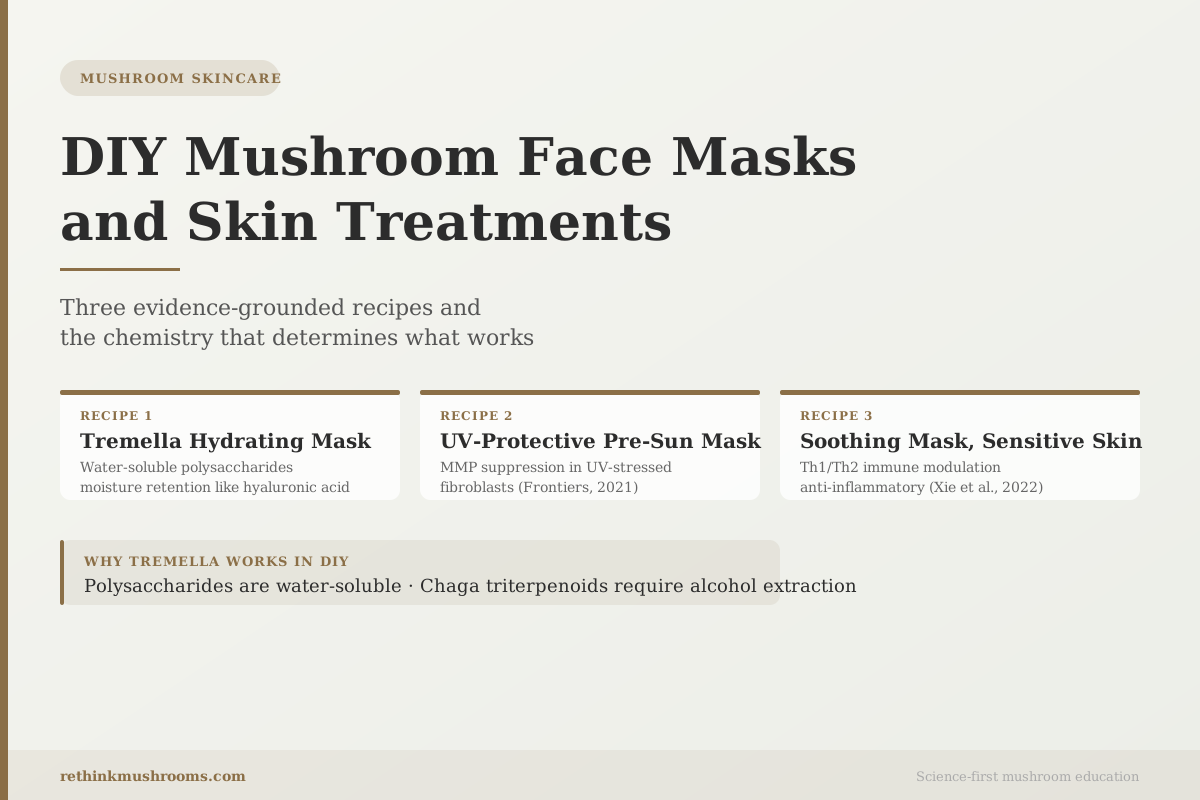
Recipe 1: Tremella Hydrating Mask (For All Skin Types)
What it does: Delivers Tremella polysaccharides to the skin surface for hydration and barrier support. Best for dry, dehydrated, or normal skin. Can be used 2-3 times per week.
Ingredients:
- 5-10g dried Tremella fuciformis (snow mushroom), broken into small pieces
- 200ml warm water (not boiling)
- Optional: 1 teaspoon raw honey (adds humectant properties)
- Optional: 3-5 drops of a light facial oil (jojoba or rosehip) for dry skin types
Instructions:
- Place the dried Tremella pieces in a bowl and cover with 200ml of warm water. The water should be warm but not boiling; high heat can degrade some polysaccharide structures.
- Soak for 20-30 minutes, stirring occasionally. The Tremella will begin to swell and release a slightly gelatinous liquid. The liquid is what you want.
- Strain out the Tremella pieces (reserve the soaked mushroom for cooking if desired, as it's edible and flavorful).
- Allow the strained liquid to cool to room temperature or slightly cool.
- If using honey, stir in the teaspoon while the liquid is still slightly warm.
- Apply the liquid to clean, damp skin using a cotton pad, soft brush, or clean hands. Allow to absorb for 15-20 minutes.
- Rinse off with cool water or pat dry without rinsing (the residue is non-irritating for most skin types).
- Use immediately. If storing, keep refrigerated and use within 24 hours.
The science: The gelatinous liquid from soaked Tremella carries the water-soluble polysaccharide fraction — the same fraction that, when isolated and characterised, proved to be predominantly high-molecular-weight hyaluronic acid.[3] Moisture retention is the best-supported property of this fraction and the one a home preparation is most likely to deliver, because it is a surface effect that does not require anything to penetrate.[1] The concentration will be lower and less consistent than in a formulated product, but the compounds are present in their active form.
Recipe 2: Tremella Pre-Sun Antioxidant Mask
What it does: Primes skin before outdoor exposure with the polysaccharide fraction shown to protect skin cells from UV-induced oxidative damage. Use as a 10-minute pre-application treatment before sunscreen — never as a sunscreen substitute.
Ingredients:
- 5g dried Tremella fuciformis
- 150ml warm water
- 1 teaspoon green tea (brewed, cooled, which adds complementary antioxidant polyphenols)
- Optional: 2-3 drops vitamin C serum (mix in just before application)
Instructions:
- Brew green tea and allow to cool completely.
- Soak Tremella in the cooled green tea for 20 minutes rather than plain water. The tea serves as the extraction medium, adding its own antioxidant compounds.
- Strain the liquid and apply to clean skin.
- Leave for 10-15 minutes.
- Rinse, apply your regular sunscreen.
The science: Tremella polysaccharides protected human dermal fibroblasts from UVA-induced photodamage by activating the Nrf2/Keap1 antioxidant pathway in cell culture,[4] and topical application reduced UV-induced damage in a chronic UV-irradiated mouse model.[5] That is the strongest topical rationale in this article, and it is still a mouse. This preparation absorbs no UV and blocks nothing. It should always be followed by SPF sun protection, and it is not a reason to spend longer in the sun.
Recipe 3: Soothing Tremella Mask for Sensitive or Reactive Skin
What it does: A gentler formulation for skin that tends toward reactivity, redness, or sensitivity. Built on the anti-inflammatory arm of the Tremella evidence, with two low-irritant supporting ingredients.
Ingredients:
- 5g dried Tremella fuciformis
- 150ml warm water
- 1 teaspoon colloidal oatmeal or finely ground rolled oats
- Optional: 1 teaspoon aloe vera gel
Instructions:
- Soak Tremella in warm water for 30 minutes. Strain.
- While still slightly warm, stir in the colloidal oatmeal until dissolved or well-dispersed.
- Allow to cool to room temperature.
- Stir in aloe vera if using.
- Apply a thin layer to clean skin. Leave for 15-20 minutes.
- Rinse gently with cool water.
The science: Xie and colleagues tested Tremella polysaccharides on chemically induced atopic dermatitis in mice by both routes. Topical application did produce measurable improvement in transdermal water loss, epidermal thickening and ear oedema — so the topical route is not inert for inflamed skin. But oral administration was significantly more effective, and the mechanism ran through regulatory T cells and gut microbiota rather than the skin surface.[6] Read that as a real but modest topical signal in diseased mouse skin, not as a treatment for a human skin condition. The oatmeal and aloe vera contribute their own soothing evidence base. Combined, the ingredients are low-irritant and appropriate for reactive skin types.
Other Mushroom Species: What Warm Water Gets You
Several mushroom species show up in skincare products and behave differently in home preparations. The pattern is consistent: ask which fraction the research was done on, then ask whether water reaches it.
Chaga (Inonotus obliquus): Chaga has two stories. A review of its therapeutic properties attributes its activity to several compound classes at once — polysaccharides, triterpenoids, polyphenols and lignin metabolites.[14] Triterpenoids and most polyphenols are non-polar and come out in alcohol, not water, and triterpenes are among the macrofungal compound classes the cosmetic literature treats as skin-active.[2] So the conventional warning is right that a water soak leaves that chemistry in the mushroom. But chaga also has a hot-water-extractable polysaccharide fraction with its own skin data: in a UVB-induced photoaging model in human keratinocytes, Inonotus obliquus polysaccharides reduced the senescence markers p16, p21 and p53, increased HO-1, SOD and CAT expression through the Nrf2/HO-1 pathway, and relieved the block on autophagy.[7] So a chaga soak is not nothing — it is a polysaccharide preparation rather than a triterpenoid one. If you specifically want the triterpenoid chemistry topically, look for commercial products using alcohol or dual extraction.
Reishi (Ganoderma lucidum): Reishi is the clearest case of a water soak missing the point. Its most studied anti-inflammatory compounds are the ganoderic acids and related triterpenes, and a 2026 systematic review and meta-analysis of 23 studies found consistent reductions in TNF-α, IL-1β and IL-6, primarily through MAPK and TLR-4/NF-κB signalling.[8] Two caveats matter. Those triterpenes need ethanol, so reishi powder in water gives you mostly beta-glucans instead. And the review excluded clinical trials by design — it is a synthesis of preclinical evidence, and its authors flag that bioavailability and long-term toxicity data were "notably absent."
Shiitake (Lentinula edodes): Shiitake contains ergothioneine, a water-soluble antioxidant that human skin cells take up and use. In a mouse model, ergothioneine protected skin against UV-induced oxidative stress through the PI3K/AKT/Nrf2 pathway.[9] A shiitake soak therefore delivers something real in principle — but ergothioneine content varies with growing conditions and nothing about a home preparation tells you how much you got. Shiitake also contains lentinan, another water-soluble polysaccharide.
Cordyceps: Worth naming because it undercuts any notion that Tremella is the only water-workable species. An aqueous Cordyceps cicadae extract, rich in polysaccharides, alditols and nucleosides, promoted hyaluronan synthesis in human skin fibroblasts.[10] That is a water extract acting on human skin cells — the same class of evidence Tremella rests on.
For a detailed comparison of what mushroom skincare products actually contain, see Tremella and Chaga in Skincare: Do Topical Mushroom Products Actually Work?.
What DIY Cannot Replicate
Home preparations have a real advantage: cost and freshness. You are not paying for packaging, preservatives, or retail markup, and the polysaccharides in a freshly made soak are in their natural form.
The limitation is not that a home mask is weaker. It is that nothing about it is specified. A formulated cosmeceutical fixes each variable to a number. A kitchen preparation leaves every one of them floating — the identity of the starting material, the extraction technique, the concentration, the molecular weight distribution, the pH.
Seven Variables
The Difference Is Not Potency. It Is How Many Numbers Are Fixed.
A home preparation and a formulated product can contain the same compound. What separates them is that one of them knows how much, at what size, at what pH, from what material. This is why a mask is worth making and still cannot be compared to a study.
Identity of the starting material
Kitchen preparation
Whatever the bag says
Formulated product
Verified by chromatography before it enters the batch
Analytical work was needed to separate genuine wildcrafted chaga from mycelium-on-grain supplements, because mislabeling and authenticity are documented problems in this category.
Windsor 2025
Extraction technique
Kitchen preparation
Warm water, 20–30 minutes, by eye
Formulated product
A specified method, validated against a compositional target
The tremella extract characterised at ~87.76% hyaluronic acid and >2000 kDa got there through a chosen technique; the authors state plainly that the technique determines the advantage.
Galla 2025
Concentration of active
Kitchen preparation
Unknown and unmeasured
Formulated product
Declared as a percentage per millilitre
Every skin finding cited in this article used a purified extract at a known concentration. Without a number, a home mask cannot be placed above or below the tested amount.
Fu 2021; Lin 2023
Molecular weight distribution
Kitchen preparation
Varies with heat, time and strain
Formulated product
Controlled, because size decides surface film versus penetration
Molecular weight is a measured property of the extract and it governs how the polysaccharide behaves on skin.
Galla 2025
Preservation
Kitchen preparation
None — refrigerate and use within 24 hours
Formulated product
A preservative system tested against microbial challenge
A sugar-rich aqueous extract with no preservative is a growth medium at room temperature.
General formulation practice — no study anchor
pH
Kitchen preparation
Whatever the ingredients happen to give
Formulated product
Buffered to a skin-compatible range
Standard formulation practice; an unbuffered preparation can sit outside the range the skin barrier tolerates well.
General formulation practice — no study anchor
Tested as a finished product
Kitchen preparation
Never
Formulated product
Sometimes — and that is the whole gap
A Cordyceps-containing cosmetic was carried through a 12-week randomised trial in 62 women with melasma, with adverse reactions at 3.3% versus 13.8% for hydroquinone cream. Both arms also received oral tranexamic acid, so this compares two add-ons rather than testing the mushroom alone.
Shen 2025
None of this makes a home mask pointless. It makes it a low-cost way to put a real, documented humectant on your face — and not a reason to expect the outcome any of the cited studies measured.
Sources: Galla et al. (2025), Foods 14(8) [ref 3]; Fu et al. (2021) [ref 4]; Lin et al. (2023), Photochem Photobiol Sci 22(10) [ref 5]; Shen et al. (2025), Journal of Cosmetic Dermatology 24(7):e70329 [ref 11]; Windsor et al. (2025), Int J Mol Sci 26(7) [ref 12]. Preservation and pH rows reflect general cosmetic formulation practice.
Two of those rows deserve emphasis. The extraction technique is not a background detail: the researchers who measured Tremella extract at roughly 87.76% hyaluronic acid concluded explicitly that a thoughtful choice of extraction technique is what enhances the advantage.[3] The composition is a property of the method, not of the mushroom sitting in the bag.
And the identity of the starting material is a genuine open problem in this category. When analysts set out to distinguish wildcrafted chaga from North American chaga supplements containing mycelium-fermented grain, they needed high-performance thin-layer chromatography and LC-ELSD to do it, precisely because inconsistent analytical standards raise concerns about authenticity and mislabeling.[12] If a laboratory needs chromatography to tell two products apart, a label does not settle the question and a kitchen certainly cannot.
Shen et al. (2025) · Journal of Cosmetic Dermatology
- Population
- 62 women with melasma, randomised to two 12-week treatment arms
- Intervention
- Oral tranexamic acid plus a topical skin-lightening cosmetic containing Cordyceps extract
- Comparator
- Oral tranexamic acid plus topical hydroquinone cream
- Finding
- Melasma Area and Severity Index, melanin index and erythema index all fell significantly from baseline in both arms. Adverse reactions were reported in 1 patient (3.3%) on the Cordyceps cosmetic versus 4 patients (13.8%) on hydroquinone cream. Patient satisfaction was similar between arms.
narrow-scope Read the design carefully: both arms received the same oral drug, so this compares two topical add-ons rather than testing a mushroom cosmetic on its own against placebo. Its value here is as an existence proof — a finished, standardised mushroom cosmetic carried through a randomised human trial, which is the one thing a home preparation structurally cannot be.
Shen et al., Journal of Cosmetic Dermatology, 2025 (ref 11)
None of this makes DIY preparations useless. It makes them introductory rather than clinical-dose. For mild concerns and general curiosity, a Tremella soak is a low-cost, low-risk way to put a documented humectant on your face. For managing a specific dermatological condition, formulated products with standardised extracts — the kind that can actually be carried through a randomised trial[11] — and a conversation with a dermatologist give you predictable dosing and a real evidence trail. For more on choosing formulated products, see How to Choose a Mushroom Supplement: The Science-Based Buyer's Guide.
Safety Guidelines
Mushroom allergy is uncommon but it is a real clinical category, and it is not independent of allergies you may already know about: allergic cross-reactivity between airborne fungi and fungus-related foods, edible mushrooms included, is well described.[13] That is the reason the patch test below is not optional.
Before Your First Mask
ModeratePatch test, and treat mushroom allergy as a real category
Concern
Fungal allergens are among the most common inhalant allergens, and allergic cross-reactivity between fungal species and fungus-related foods including edible mushrooms is well documented — the pattern is described in the literature as fungus food allergy syndrome. Someone already sensitised to airborne moulds is not automatically safe with an unfamiliar mushroom on their face.
What the research says
Apply a small amount of the prepared mask to the inside of your wrist or behind your ear and wait 24 hours. If no redness, itching, or swelling develops, it is likely safe for full-face use. Do this every time you change species or supplier, not just the first time.
Particularly relevant for: Anyone with known mould or fungal sensitisation, existing food allergies, eczema, or a history of contact dermatitis
What to do
Stop immediately and consult a clinician if you develop spreading redness, swelling, hives, or any breathing difficulty. This article is educational and is not medical advice; nothing here is intended to diagnose or treat a skin condition.
Xing et al., Journal of Immunology Research, 2022 (ref 13)
Use fresh, or refrigerated within 24 hours. Unlike commercial products, home preparations contain no preservative system. A sugar-rich aqueous extract is a growth medium at room temperature. Make a small batch, apply it, and refrigerate any remainder for use the next day only.
Avoid broken skin. Do not apply any home mushroom preparation to skin with open cuts, active acne lesions, cold sores, or eczema flares. The skin barrier is compromised in these areas and the risk of irritation or infection is higher.
Know your mushroom source. Use food-grade or cosmetic-grade dried mushroom from reputable suppliers. Given how much difficulty analytical laboratories have had verifying what is actually in mushroom products,[12] foraged or unverified powders are a poor choice for something you are putting on your face.
Do not apply mushroom supplement powders. Capsule and powder supplement products are formulated for internal use and may contain fillers, flow agents, or extraction byproducts not intended for skin contact. Use dried whole mushroom or powders sold specifically for culinary or skincare use. For more on how internal supplement forms differ, see Mushroom Capsules vs. Powder vs. Tincture: Which Is Best?.
This is not medical advice. If you are managing eczema, rosacea, psoriasis, melasma, or any diagnosed skin condition, talk to a dermatologist before adding a home preparation to your routine, and do not substitute one for prescribed treatment.
The Bottom Line
Tremella fuciformis is the mushroom best suited to DIY skincare because its active polysaccharides are water-soluble and survive the only extraction step a kitchen can perform — and because chemical characterisation has confirmed the hyaluronic acid comparison, at roughly 87.76% of an isolated extract. Its skin evidence is genuinely preclinical: human cell studies plus mouse models, including one where topical application reduced UV damage, with no human trial on a skin endpoint. Chaga and reishi split into two fractions, and warm water reaches only the polysaccharide half; that half is not empty for chaga, which has its own keratinocyte photoaging data, but it does miss the triterpenoid chemistry both species are marketed on. All home preparations should be patch-tested, used fresh within 24 hours, and understood as introductory-dose humectants rather than clinical-concentration alternatives to formulated products. Nothing here is medical advice.
Frequently Asked Questions
Sources & References
- 1RTHM-01754·Mineroff, Jessica et al. (2023). “The potential cutaneous benefits of Tremella fuciformis..” Archives of dermatological research.Study breakdown →PubMed →↩
- 2RTHM-01965·Paterska, Maja et al. (2024). “Macrofungal Extracts as a Source of Bioactive Compounds for Cosmetical Anti-Aging Therapy: A Comprehensive Review..” Nutrients.Study breakdown →PubMed →↩
- 3RTHM-02086·Galla, Rebecca et al. (2025). “Non-Animal Hyaluronic Acid from Tremella fuciformis: A New Source with a Structure and Chemical Profile Comparable to Hyaluronic Acid..” Foods (Basel.Study breakdown →PubMed →↩
- 4RTHM-01353·Fu, Hao et al. (2021). “Tremella fuciformis polysaccharides inhibit UVA-induced photodamage of human dermal fibroblast cells by activating up-regulating Nrf2/Keap1 pathways..” Journal of cosmetic dermatology.Study breakdown →PubMed →↩
- 5RTHM-01736·Lin, Mengting et al. (2023). “Tremella fuciformis polysaccharides alleviates UV-provoked skin cell damage via regulation of thioredoxin interacting protein and thioredoxin reductase 2..” Photochemical & photobiological sciences : Official journal of the European Photochemistry Association and the European Society for Photobiology.Study breakdown →PubMed →↩
- 6RTHM-01635·Xie, Lingna et al. (2022). “Tremella fuciformis polysaccharides alleviate induced atopic dermatitis in mice by regulating immune response and gut microbiota..” Frontiers in pharmacology.Study breakdown →PubMed →↩
- 7RTHM-00840·Lin, Jun et al. (2023). “Chaga Medicinal Mushroom, Inonotus obliquus (Agaricomycetes), Polysaccharides Alleviate Photoaging by Regulating Nrf2 Pathway and Autophagy..” International journal of medicinal mushrooms.Study breakdown →PubMed →↩
- 8RTHM-02241·Pozzobon, Rafaela Guedes et al. (2026). “Anti-Inflammatory Potential of Ganoderma lucidum Triterpenes: A Systematic Review and Meta-Analysis of Preclinical Evidence..” Pharmaceuticals (Basel.Study breakdown →PubMed →↩
- 9RTHM-01933·Li, Yongchao et al. (2024). “Ergothioneine Protects Against UV-Induced Oxidative Stress Through the PI3K/AKT/Nrf2 Signaling Pathway..” Clinical.Study breakdown →PubMed →↩
- 10RTHM-01787·Shao, Li et al. (2023). “Aqueous extract of Cordyceps cicadae (Miq.) promotes hyaluronan synthesis in human skin fibroblasts: A potential moisturizing and anti-aging ingredient..” PloS one.Study breakdown →PubMed →↩
- 11RTHM-02179·Shen, Sihao et al. (2025). “Effect of a New Skin-Lightening Cosmetic Containing Cordyceps Extract in the Treatment of Melasma: A Clinical Trial..” Journal of cosmetic dermatology.Study breakdown →PubMed →↩
- 12RTHM-02209·Windsor, Coleton et al. (2025). “What This 2025 Chaga Supplement Authentication Study Actually Found.” International journal of molecular sciences.Study breakdown →PubMed →↩
- 13RTHM-00802·Xing, Haiyan et al. (2022). “Recent Advances in the Allergic Cross-Reactivity between Fungi and Foods..” Journal of immunology research.Study breakdown →PubMed →↩
- 14RTHM-01886·Ern, Phoebe Tee Yon et al. (2024). “Chaga Therapeutic Properties: What This 2024 Review Actually Shows.” Mycology.Study breakdown →PubMed →↩