Mushroom Skincare
Tier 1 evidence: Tremella only
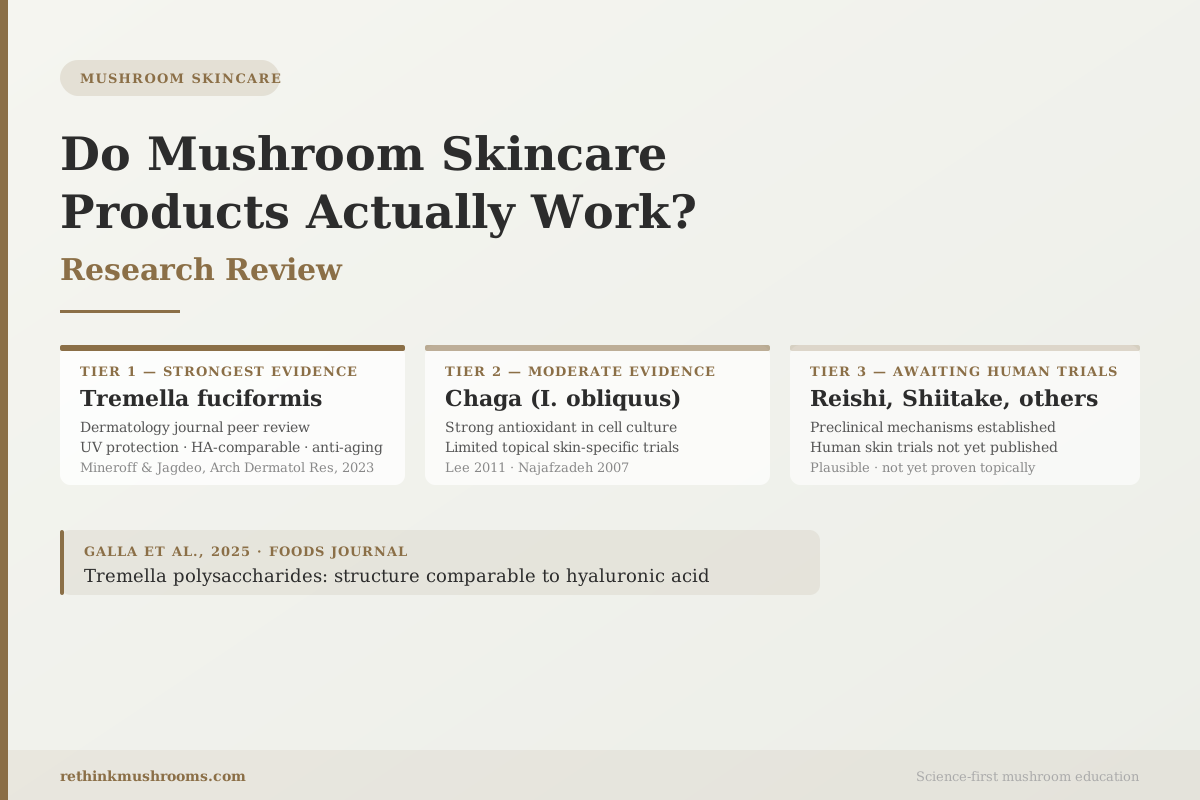
Of the mushroom species marketed in skincare, one, Tremella fuciformis, has a dermatologist-authored peer-reviewed review in a dermatology journal. Chaga has antioxidant cell culture evidence. Most others have preclinical data at best.
Mineroff & Jagdeo, Archives of Dermatological Research, 2023
Archives Derm Res
journal with peer-reviewed Tremella cutaneous evidence review (2023)
HA-comparable
Tremella polysaccharide structure is chemically comparable to hyaluronic acid (Galla 2025)
in vitro
most mushroom skincare evidence is cell culture, not human clinical trials
Mineroff & Jagdeo, Archives of Dermatological Research, 2023
 View as image ↗
Mushroom skincare is one of the fastest-growing segments in beauty, and the marketing around it makes it sound like the evidence is settled. It isn't. But that doesn't mean the products are all hype, either. The real picture is more specific: some mushroom species have genuinely compelling peer-reviewed evidence for skin benefit, some have supportive antioxidant data that doesn't translate cleanly to topical use, and others have almost nothing rigorous behind them.
The answer to "do mushroom skincare products work?" depends on which mushroom is in the product and what it claims to do.
This review covers the research by species, stratified by evidence quality, so you can assess a product's ingredient list against what the science actually supports.
For context on how mushroom products are formulated and what's in the growing skincare market, see Mushroom Coffee: What Is It and Does It Actually Work?.
Key Takeaways
- Tremella fuciformis (snow mushroom) has the strongest topical evidence, including a 2023 dermatologist-authored review in the Archives of Dermatological Research and multiple studies showing UV protection, anti-aging activity, and structural similarity to hyaluronic acid
- A 2025 study found that Tremella-derived polysaccharides have a chemical structure comparable to standard hyaluronic acid, supporting the hydration claims with structural chemistry evidence
- Chaga (Inonotus obliquus) has documented antioxidant activity in cell culture and human lymphocyte studies, but limited topical human skin trials; the gap between antioxidant activity and skin benefit in practice is real
- A 2024 animal proteomics study showed Tremella polysaccharides reduced collagen degradation markers and increased antioxidant enzyme expression in aged mice skin, providing multi-pathway anti-aging evidence
- Most mushroom skincare evidence is in vitro (cell culture) or animal-based; human clinical trials testing topical mushroom application on skin are rare across all species
- Product concentration of active compounds is often not disclosed, making it difficult to assess whether a given serum or cream contains a meaningful dose relative to what was studied
The Honest Answer: Evidence Is Not Equal Across Mushroom Species
Consumer content about mushroom skincare almost never stratifies evidence quality by species. Products are marketed with a general "mushroom extract" halo, implying that anything with a mushroom in it carries the same benefit. The peer-reviewed literature doesn't support this view.
When dermatologists and researchers review mushroom skincare evidence (as Mineroff and Jagdeo did in the Archives of Dermatological Research), they focus primarily on species where the compound-level mechanism and the topical evidence actually exist.[1] That review, published in a peer-reviewed dermatology journal, covers Tremella fuciformis specifically, not mushrooms in general.
A useful way to think about the evidence is in three tiers:
Tier 1: Strong topical-specific evidence. Species where peer-reviewed research specifically documents skin-relevant mechanisms and outcomes. Currently, Tremella fuciformis meets this bar.
Tier 2: Moderate antioxidant evidence with limited topical specificity. Species with documented antioxidant and cell-protective activity, but with research conducted in blood cells or general cell cultures rather than skin-specific tissue. Chaga fits here.
Tier 3: Promising but awaiting human trials. Animal models or in vitro studies showing relevant mechanisms that haven't yet been tested in human skin. Tremella's atopic dermatitis data and Reishi's triterpenoid anti-inflammatory data sit in this tier.
This framework matters when you're reading a product label. An ingredient list that includes a Tier 2 mushroom with a Tier 1 claim is not adequately supported by the evidence.
Tremella Has the Strongest Topical Evidence: Here's the Research
Tremella fuciformis stands out in the mushroom skincare literature because it has multiple distinct lines of evidence for different skin outcomes, and because some of that evidence specifically addresses topical application mechanisms.
Mineroff and Jagdeo's 2023 review in the Archives of Dermatological Research summarizes the cumulative evidence for Tremella's cutaneous benefits, covering hydration, UV protection, anti-inflammatory activity, and wound-healing properties.[1] Published in a dermatology-specific peer-reviewed journal and authored by dermatology researchers, this review gives Tremella a level of credibility in the skincare evidence landscape that no other mushroom species currently has.
The UV protection evidence comes from laboratory studies of human dermal fibroblasts, the cells in the deeper layer of skin that produce collagen. Researchers found that Tremella polysaccharides protected these cells from UVA-induced oxidative stress and specifically suppressed the expression of matrix metalloproteinases: enzymes that break down collagen when skin is repeatedly exposed to ultraviolet radiation.[2] The anti-photoaging claim for Tremella isn't just marketing extrapolation; it maps to a documented cellular mechanism in human skin cells.
The anti-aging evidence extends to an animal model using proteomics (large-scale protein expression analysis). Xu and colleagues found that Tremella polysaccharides significantly reduced collagen degradation markers and upregulated antioxidant enzyme expression in aging mouse skin, suggesting multi-pathway action on skin aging processes.[4] This is animal-model evidence, which means human skin may respond differently, but the proteomics data provides a comprehensive molecular picture of how Tremella interacts with aging skin biology.
For readers with sensitive or reactive skin: Xie and colleagues found that Tremella polysaccharides modulated the Th1/Th2 immune balance involved in atopic dermatitis in mice, reducing inflammatory markers.[7] This was internal administration, not topical, so the mechanism doesn't directly prove topical anti-inflammatory efficacy. But it does support the biological plausibility of Tremella's soothing properties in sensitive skin contexts.
The Hyaluronic Acid Comparison: What the 2025 Structural Chemistry Study Found
The most common marketing claim for Tremella is that it works "like hyaluronic acid" or is "better than hyaluronic acid" for skin hydration. These comparisons circulate widely in beauty media, often without primary research citations.
Galla and colleagues published a 2025 study in Foods that provides the most rigorous answer to this question available in the peer-reviewed literature.[3] The study conducted a structural chemistry comparison between Tremella-derived polysaccharides and standard hyaluronic acid. The finding: Tremella polysaccharides have a chemical structure comparable to hyaluronic acid, including similar molecular architecture and hydrophilic (water-attracting) properties.
This is structural chemistry evidence, not a human skin hydration trial. "Comparable structure" means the compounds are chemically similar in their water-binding capacity, not that a specific percentage of improvement was measured on human skin. The "better than HA" and "2.6x more effective" claims that appear in brand marketing are not from peer-reviewed sources and are not supported by the Galla 2025 paper.
What the structural comparison does support: the rationale for Tremella as a plant-based, non-animal alternative to HA in skincare formulations. This matters for vegan skincare consumers and for formulators looking for sustainably sourced hydrating agents with a credible molecular basis.
Chaga: Strong Antioxidant Evidence, Less Specific to Topical Skin
Chaga (Inonotus obliquus) is the second most marketed mushroom in skincare. The antioxidant evidence for Chaga is genuinely robust. The topical-specific evidence for skin is not.
Yun and colleagues (2011) found that Inonotus obliquus extract protected human cells from oxidative stress-induced premature senescence and apoptosis, meaning cell death from oxidative damage.[5] This study did not specifically use skin fibroblasts or keratinocytes. The anti-aging cellular protection mechanism is plausible and documented; the leap to "topical Chaga cream prevents skin aging" requires more direct skin-specific research that hasn't been published in peer-reviewed form.
Park and colleagues (2004) found that Chaga mushroom extract significantly inhibited oxidative DNA damage in human lymphocytes (blood immune cells).[6] This establishes potent antioxidant activity. Chaga's compounds protect genetic material from the kind of free-radical damage associated with photoaging and skin cancer. Again, this evidence is from blood cells, not skin tissue.
The gap between "strong antioxidant in cell culture" and "effective topical anti-aging product" is real and significant. For a compound to benefit skin when applied topically, it needs to penetrate the skin barrier, reach the target tissue at a biologically meaningful concentration, and remain active in the skin environment. Whether Chaga's polyphenol compounds accomplish all three in a cream or serum has not been demonstrated in peer-reviewed human skin studies.
The honest position on Chaga skincare: the antioxidant chemistry is credible, the topical delivery and efficacy in human skin has not been established to the same standard as Tremella.
The Evidence That Still Needs Human Trials
Beyond Tremella and Chaga, other mushroom species appear in skincare labels with varying levels of evidence behind them.
Reishi (Ganoderma lucidum) contains ganoderic acids with documented anti-inflammatory properties in preclinical models. These triterpenoids are the basis for Reishi's inclusion in soothing and anti-redness formulations. As with Chaga's triterpenoids, the key question is whether they penetrate and remain active in human skin at concentrations used in commercial products. No peer-reviewed human skin trials have established this.
Shiitake (Lentinula edodes) provides ergothioneine, a water-soluble antioxidant that accumulates in skin cells under oxidative stress. Ergothioneine has its own evidence base for cellular protection against UV damage, but again, topical trials in human skin are limited.
The pattern across these species: promising preclinical signals, plausible mechanisms, and a gap in human skin trial evidence that the industry has not yet filled.
For a practical guide to which mushrooms work in home preparations versus which require formulated products, see DIY Mushroom Face Masks and Skin Treatments.
The Concentration Gap: Why Good Evidence Doesn't Guarantee Product Efficacy
Even for Tremella, where the evidence is strongest, there is a practical challenge that the marketing never addresses: you can't tell from a product label whether it contains a dose of active compound that matches what was studied.
The research on Tremella polysaccharides used standardized, purified extracts at defined concentrations. Those concentrations produced the measured effects. Commercial products typically list Tremella extract as an ingredient but don't specify the percentage of active polysaccharide content. A product listing "Tremella fuciformis fruit extract" near the bottom of an ingredient list, where ingredient amounts are smallest by law, may contain a fraction of what any study used.
This is not a mushroom-specific problem. It applies to most plant-based active ingredients in cosmetics, where "contains X" on a label can mean anything from a trace amount to a biologically relevant dose. The difference matters for efficacy.
Questions worth asking when evaluating a product:
- Is the mushroom ingredient near the top or bottom of the ingredient list?
- Is the extract standardized to a specific percentage of active compound?
- Is the evidence cited by the brand from peer-reviewed sources or from their own marketing materials?
For guidance on evaluating mushroom product quality broadly, see Fruiting Body vs. Mycelium: The Great Mushroom Supplement Debate; the quality distinctions there apply to skincare formulations as well.
What the Research Legitimately Supports, and What It Doesn't
The mushroom skincare claims that the peer-reviewed literature actually supports:
Tremella for hydration: The structural similarity to hyaluronic acid (Galla 2025) and the dermatology review of cutaneous benefits (Mineroff & Jagdeo, 2023) support Tremella as a water-retaining humectant. The mechanism is documented; a hydration claim is reasonable.[3]
Tremella for UV-stress protection: The 2021 study showing MMP suppression and oxidative stress protection in UVA-exposed human dermal fibroblasts supports anti-photoaging claims.[2] "Helps protect against UV-induced collagen breakdown" is backed by cell-level data.
Tremella for anti-aging broadly: The 2024 proteomics study showing reduced collagen degradation and increased antioxidant enzymes in aging mouse skin supports a multi-mechanism anti-aging story.[4] With animal-model evidence, the claim should be hedged: "supports skin anti-aging processes" rather than "reverses aging."
Chaga for antioxidant protection: The antioxidant evidence in cell culture is real.[5][6] "Contains potent antioxidant compounds" is supportable; "clinically proven to prevent skin aging" is not.
What isn't supported: Claims that mushroom skincare products outperform HA, reverse wrinkles, treat skin conditions, or produce specific measured percentages of improvement at the doses in commercial products. These would require human clinical trials that have not been published.
The Bottom Line
Mushroom skincare evidence is not uniform across species. Tremella fuciformis has the strongest topical evidence base, including a 2023 dermatologist-authored review in Archives of Dermatological Research, cell-level UV protection data, structural comparability to hyaluronic acid, and animal proteomics showing anti-aging activity. Chaga has credible antioxidant evidence from cell culture but limited topical skin-specific human studies. Most other mushroom species marketed in skincare have preclinical evidence and plausible mechanisms but no peer-reviewed human skin trials. Product concentration remains an unsolved transparency problem across the entire category.
Frequently Asked Questions
Sources & References
- 1RTHM-01754·Mineroff, Jessica et al. (2023). “The potential cutaneous benefits of Tremella fuciformis..” Archives of dermatological research.Study breakdown →PubMed →↩
- 2RTHM-01353·Fu, Hao et al. (2021). “Tremella fuciformis polysaccharides inhibit UVA-induced photodamage of human dermal fibroblast cells by activating up-regulating Nrf2/Keap1 pathways..” Journal of cosmetic dermatology.Study breakdown →PubMed →↩
- 3RTHM-02086·Galla, Rebecca et al. (2025). “Non-Animal Hyaluronic Acid from Tremella fuciformis: A New Source with a Structure and Chemical Profile Comparable to Hyaluronic Acid..” Foods (Basel.Study breakdown →PubMed →↩
- 4RTHM-02026·Xu, Yuanyuan et al. (2024). “iTRAQ-Based Proteomic Profiling of Skin Aging Protective Effects of Tremella fuciformis-Derived Polysaccharides on D-Galactose-Induced Aging Mice..” Molecules (Basel.Study breakdown →PubMed →↩
- 5RTHM-00241·Yun, Jong Seok et al. (2011). “Inonotus obliquus protects against oxidative stress-induced apoptosis and premature senescence..” Molecules and cells.Study breakdown →PubMed →↩
- 6RTHM-00076·Park, Yoo Kyoung et al. (2004). “Chaga mushroom extract inhibits oxidative DNA damage in human lymphocytes as assessed by comet assay..” BioFactors (Oxford.Study breakdown →PubMed →↩
- 7RTHM-01635·Xie, Lingna et al. (2022). “Tremella fuciformis polysaccharides alleviate induced atopic dermatitis in mice by regulating immune response and gut microbiota..” Frontiers in pharmacology.Study breakdown →PubMed →↩