Enoki Immunity
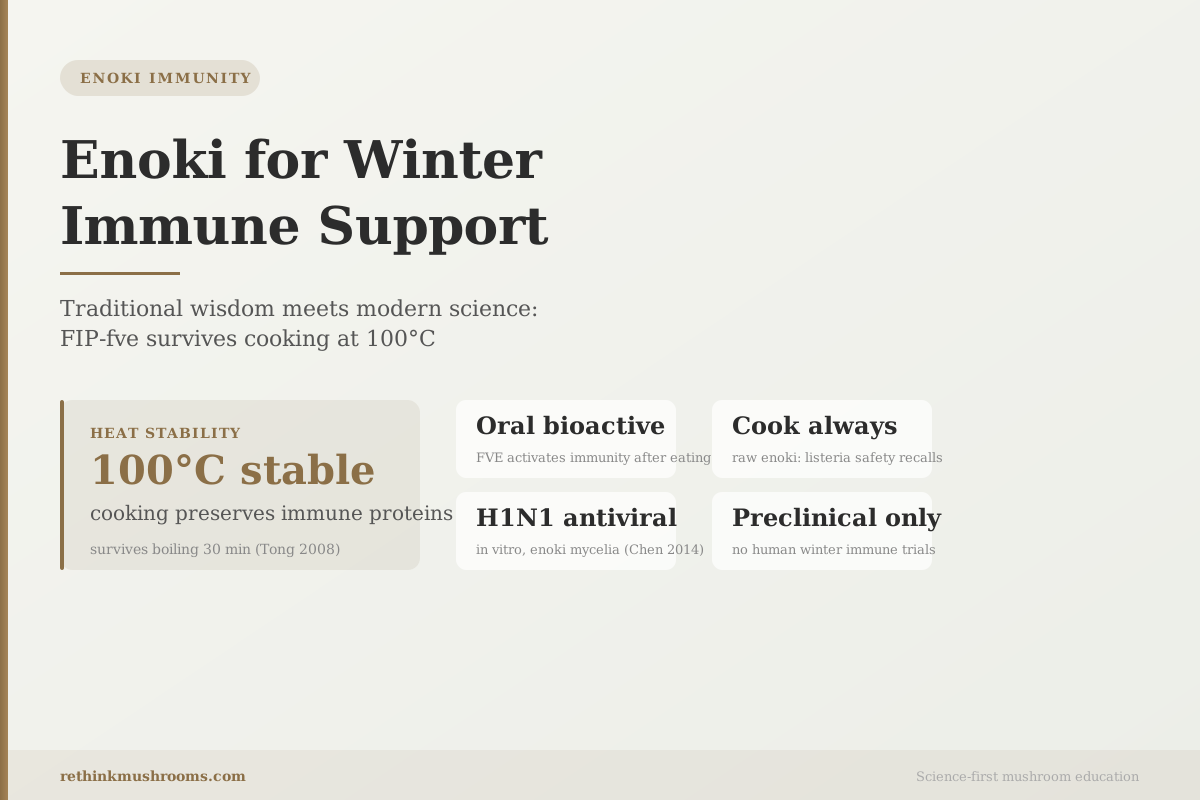
100°C heat stable
FIP-fve, the immune-activating protein in enoki mushrooms, survives boiling for 30 minutes and even autoclaving at 121°C, meaning cooked enoki retains its immunomodulatory properties.
Tong et al., 2008
Winter mushroom
enoki fruits naturally in cold weather (5-15°C), giving it its traditional winter wellness reputation in East Asian medicine
Oral bioactive
Chang et al. (2010) found that oral FVE protein activates both innate and adaptive immunity after ingestion, not just in test tubes
Cook always
raw enoki has been linked to multiple listeria outbreaks in the US, UK, and Canada; thorough cooking eliminates this risk
Tong et al., 2008
 View as image ↗
Enoki mushrooms do not fruit in summer. Their natural growing season begins in late autumn when temperatures drop, and they are harvested through winter into early spring. This cold-weather fruiting cycle is where the name "winter mushroom" comes from, and it is also why enoki has been part of winter wellness traditions in East Asian medicine for centuries, appearing in hot pots, soups, and warming broths precisely during the seasons when respiratory illnesses are most common.
Modern research has identified specific immune-active proteins in enoki that give a biological basis to this traditional use. The most studied of these is FIP-fve, a fungal immunomodulatory protein that activates both the innate and adaptive branches of the immune system when consumed. One finding about this protein stands out as particularly practical: it survives cooking. Boiling, steaming, and even autoclaving do not destroy it. This means the enoki you eat in a hot pot in January is still delivering its immune-active compounds, not just its flavor.
There is also a safety dimension to the cooking question that most sites covering enoki's immune benefits do not mention. Raw enoki mushrooms have been linked to multiple listeria monocytogenes outbreaks and food safety recalls in the United States, United Kingdom, and Canada. Always cooking enoki before eating is both the safest approach and, per the heat stability research, the approach that preserves rather than destroys the proteins of interest. For the full overview of enoki as a species, what is enoki mushroom provides the foundation.
Key Takeaways
- Enoki mushrooms fruit naturally in cold weather (optimally 5-15°C), which is the origin of the "winter mushroom" name and its traditional winter wellness association in East Asian medicine
- Tang et al. (2016) reviewed the traditional use and documented biological activities of enoki as a culinary medicine with established immune-relevant compounds
- Tong et al. (2008) found that FIP-fve (the immunomodulatory protein in enoki) retains activity after boiling at 100°C for 30 minutes and after autoclaving at 121°C; cooking does not destroy the immune properties
- Chang et al. (2010) demonstrated that orally administered FVE (enoki's immunomodulatory protein) activates both innate immunity (natural killer cells, macrophages) and adaptive immunity (T and B lymphocytes) in a mouse model, confirming oral bioavailability
- Chen et al. (2014) found that enoki mycelia extract showed antiviral activity against influenza H1N1 in vitro by preventing viral-induced cell death; the study was in laboratory conditions, not a human trial
- Raw enoki mushrooms have been linked to multiple confirmed listeria monocytogenes outbreaks and food safety recalls (US, UK, Canada); thorough cooking eliminates this risk and does not reduce immune-active compound potency
Why Enoki Is Called a Winter Mushroom (The Botany Behind the Name)
Flammulina velutipes grows naturally on dead or dying broadleaf trees, particularly elm and hackberry. Unlike most edible fungi that prefer warm, moist conditions, enoki thrives in cold weather. Its natural fruiting season begins around the first autumn frost and peaks during winter, typically when ambient temperatures sit between 5 and 15 degrees Celsius. In Japan, the mushroom grows on hackberry (enoki) trees, which is where its Japanese name comes from.
In traditional Chinese medicine, enoki is called jīn zhēn gū (golden needle mushroom) and has been included in winter diet recommendations for centuries. The traditional framing centers on warming dishes: hot pots, clear broths, and soups where enoki is added near the end of cooking and eaten with the broth. The mushroom appears in seasonal wellness texts not because of understood mechanisms but because of observed population patterns over generations of use.
Tang and colleagues (2016) published a review specifically documenting the culinary medicine status of enoki alongside its scientifically studied biological activities, providing the most comprehensive modern synthesis of traditional use and experimental evidence.[1] The review confirmed that enoki's immune-relevant compounds, including its immunomodulatory proteins and polysaccharides, are present in concentrations relevant to health effects at dietary intake levels. The "culinary medicine" framing in Tang's title captures the core distinction: enoki is not a pharmaceutical intervention but a food with documented bioactive properties at the amounts people actually eat.
The cold-weather connection also has a nutritional logic independent of mechanism. Winter is when respiratory illnesses (influenza, rhinovirus colds, respiratory syncytial virus) circulate most intensely. A food that grows abundantly in winter, is traditionally incorporated into warming meals during cold seasons, and contains proteins with documented immune activity represents the kind of convergence that gives traditional medicine practices their durability.
The Finding That Changes the Cooking Question: FIP-fve Survives Boiling
The most practically important piece of research for anyone eating enoki for immune support is a 2008 study on heat stability.
Tong and colleagues (2008) tested whether the immunomodulatory proteins in enoki (and reishi) mushrooms retained biological activity after food processing conditions.[2] The specific question was whether cooking would destroy the immune-relevant proteins, which are the same category of molecule (proteins) that cooking can denature and inactivate.
The result was striking for the cooking context: FIP-fve maintained immunomodulatory activity after exposure to 100 degrees Celsius for 30 minutes, which is a longer boiling time than any home cooking method would typically apply to enoki. The protein also retained activity after autoclaving at 121 degrees Celsius, which is the high-temperature pressurized sterilization process used in laboratory and medical equipment, a far more extreme heat treatment than any culinary preparation.
This heat stability is mechanistically unusual. Many proteins lose their three-dimensional shape (denature) when exposed to high temperatures, which destroys their biological activity. FIP-fve appears to either refold correctly after heat exposure or has a structural configuration that resists unfolding at cooking temperatures. The practical consequence is direct: enoki hot pot, enoki miso soup, stir-fried enoki, and any other cooking method that applies typical heat for typical cooking durations does not render the immune proteins inactive.
For the consumer question, this closes the loop: the traditional preparation (enoki in hot soup and broth during winter) delivers the immune-active compounds intact.
What Happens When You Eat Enoki: Oral Bioavailability of FVE
Many bioactive compounds found in foods are only active in laboratory conditions. Applied to isolated cells in a petri dish, they produce measurable effects. Eaten by an actual human, they get broken down by stomach acid and digestive enzymes before reaching the tissues where they would need to act. The oral bioavailability question, whether a compound that is active in vitro is still active after digestion, is one of the most important gaps in nutritional supplement research.
Chang and colleagues (2010) addressed this question directly for enoki's immunomodulatory protein FVE (functionally equivalent to FIP-fve; the nomenclature differs slightly between research groups).[3] They administered FVE orally to mice (not by injection, not in cell culture) and then measured immune system responses.
The findings were positive across both major branches of immune function. Innate immunity, the fast-acting first line of defense that does not require prior exposure to a pathogen, showed increased activity in natural killer (NK) cells and macrophages. NK cells are immune cells that recognize and destroy infected or cancerous cells without needing specific prior instruction. Macrophages are the cells that engulf pathogens and coordinate the early immune response. Adaptive immunity, the slower but more targeted branch that builds specific memory against pathogens encountered before, also showed activation in T and B lymphocytes.
The study also tested anti-tumor activity in a hepatocellular (liver cancer) mouse model, finding that orally administered FVE suppressed tumor growth. This particular application is separate from the winter immune support framing, but it confirms that the oral administration route is producing systemic immune effects, not just localized gut activity.
The oral bioavailability finding is what connects the in vitro science to the culinary context. FVE survives digestion and reaches the systemic immune system in biologically active form. Eating enoki is not equivalent to injecting the extracted protein, and the doses in human food consumption are much lower than the doses tested in mouse studies. But the mechanism is confirmed to operate through the oral route, which is necessary for any food-based immune benefit.
For more detail on the protein structure and immune mechanism, see enoki and the immune system.
Flu Season and Antiviral Activity: The H1N1 Data
Chen and colleagues (2014) tested whether extracts from Basidiomycete mycelia, including enoki, showed activity against influenza type A (serotype H1N1) in cell culture conditions.[4] H1N1 is the influenza strain responsible for the 2009 pandemic and one of the seasonal influenza strains that circulates annually.
The study found that enoki mycelia extract inhibited H1N1 virus-induced apoptosis in host cells. Apoptosis is programmed cell death, and influenza viruses trigger it in the cells they infect as part of how they spread through tissue. By preventing this virus-induced cell death, the enoki extract reduced viral propagation in the cell culture model.
The limitation is significant and should be stated directly: this was an in vitro study in cell culture, not a human trial or even an animal model. In vitro antiviral activity is a necessary first step in identifying candidates for further research, but many compounds that inhibit viruses in cell culture fail to produce the same effects in living organisms because of pharmacokinetic factors (how the compound is absorbed, distributed, metabolized, and excreted). No human trial has tested enoki consumption against influenza outcomes.
What Chen 2014 contributes is mechanistic plausibility for the flu season framing. The compound found in enoki mycelia has a demonstrable mechanism of interfering with influenza replication at the cellular level. This is genuinely different from many traditional winter wellness claims that rest entirely on epidemiological association or in vitro immune stimulation assays without any viral model.
Paired with the FVE oral bioavailability data (Chang 2010) and the heat stability of FIP-fve (Tong 2008), a biological picture emerges: enoki contains proteins that survive cooking, reach the immune system after eating, activate both innate and adaptive immunity, and in at least one laboratory model interfere with influenza replication. The evidence is preclinical throughout, with no human winter immunity trials yet conducted. But the mechanistic framework is more complete than most winter immune foods can claim.
The Safety Warning Most Immune Articles Skip: Always Cook Enoki
This section does not appear in most content covering enoki immune benefits. It should.
Raw enoki mushrooms have been the subject of multiple confirmed food safety actions from regulatory agencies in the United States, United Kingdom, and Canada, all involving listeria monocytogenes contamination. The US Food and Drug Administration issued multiple recall notices for raw enoki mushrooms from various producers, particularly brands imported from Korea, during 2020 and in subsequent years. The UK Food Standards Agency and Health Canada issued parallel advisories. In some cases, listeria-contaminated raw enoki was linked to illness and hospitalizations.
Listeria monocytogenes is a bacterium that causes listeriosis, an illness that is particularly dangerous for pregnant people, older adults, and anyone with a weakened immune system. The irony of consuming raw enoki for immune support while exposed to listeria is not subtle.
Thorough cooking kills listeria. Boiling, stir-frying at adequate temperature, or any cooking method that brings the enoki to above 70 degrees Celsius for sufficient time eliminates the bacteria. Given that Tong 2008 confirmed FIP-fve survives 100 degrees Celsius for 30 minutes with immunomodulatory activity intact, cooking enoki is both the safest preparation and the one that preserves (rather than destroys) the immune-relevant compounds.
The practical recommendation is simple: do not eat enoki raw. The traditional preparations (hot pot, soup, stir-fry) all involve cooking. This is not a case where the traditional use and the modern safety evidence are in tension. They point in the same direction.
What the Evidence Adds Up To for Winter Use
Enoki's winter immune support case rests on four converging points.
First, the traditional evidence: enoki has been deliberately included in winter diets in East Asian food cultures for centuries, in forms and quantities (cooked, in warm broths) that happen to be the same preparations that preserve its bioactive proteins.
Second, the oral bioavailability confirmation: Chang 2010 established that enoki's immune protein FVE is active after oral administration, reaching the systemic immune system in functional form rather than being deactivated by digestion.
Third, the heat stability data: Tong 2008 confirmed that cooking does not destroy FIP-fve. The concern that "cooking destroys the benefits" does not apply to enoki's immune proteins; they are unusually heat-stable.
Fourth, the antiviral plausibility: Chen 2014 found enoki mycelia inhibit H1N1 replication in cell culture through a mechanism (blocking viral-induced apoptosis) that is relevant to how influenza causes illness.
The caveats are honest ones. All the mechanistic research is preclinical. There is no randomized controlled trial testing enoki consumption against cold or flu incidence in humans. The doses used in mouse studies are not directly translatable to human food portions. And any claim that eating enoki will prevent a specific illness is well beyond what the current evidence supports.
What the evidence does support: enoki contains specific immune-active proteins with documented mechanisms, those proteins survive the cooking methods that also eliminate listeria risk, and the traditional winter wellness framing has more biological plausibility behind it than most traditional claims.
The Bottom Line
Enoki mushrooms are naturally cold-weather fungi with a documented history of winter wellness use in East Asian medicine. Modern research has identified immunomodulatory proteins (FIP-fve/FVE) that activate innate and adaptive immunity after oral administration, survive cooking temperatures up to 121°C, and in vitro show antiviral activity against influenza H1N1. All mechanistic evidence is preclinical. Critically, raw enoki has been linked to multiple listeria outbreaks; thorough cooking eliminates this risk while preserving the immune-active compounds.
Frequently Asked Questions
Sources & References
- 1. Source details for this reference are not yet available.
- 2. Source details for this reference are not yet available.
- 3. Source details for this reference are not yet available.
- 4. Source details for this reference are not yet available.