Poria cocos: GABA, Anxiety & Sleep
29 minutes
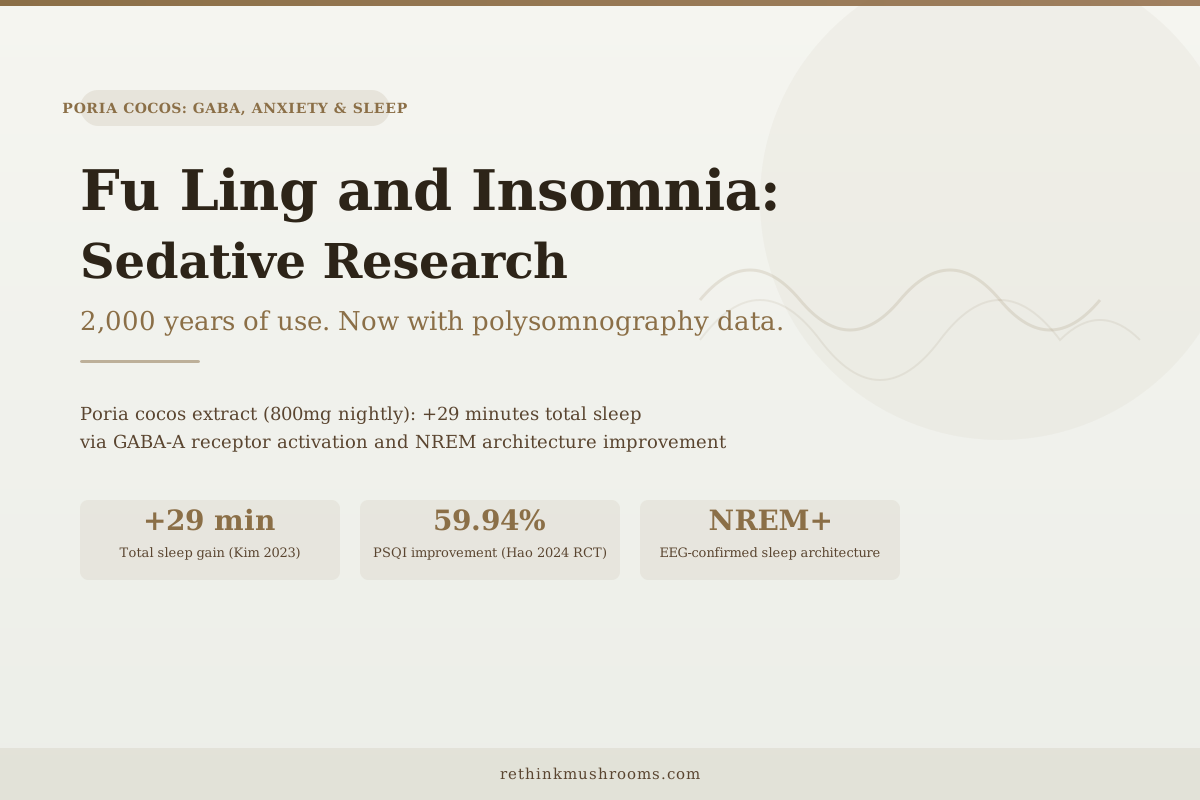
A 2023 polysomnography study found that 800mg of Poria cocos extract nightly added 29 minutes of total sleep and cut nighttime awakening time by 28 minutes in insomnia patients.
Kim et al., Nutrients, 2023
800mg
nightly extract dose used in the 2023 clinical study
59.94%
improvement in sleep quality scores in the 2024 combination RCT
NREM
sleep phase specifically increased per EEG data in the rat model
Kim et al., Nutrients, 2023
 View as image ↗
In 2023, researchers at a Korean sleep clinic recruited 21 patients with diagnosed insomnia and gave them 800mg of Poria cocos extract every night for two weeks. At the end of the study, they measured sleep using polysomnography, the same EEG-based monitoring used in clinical sleep laboratories. Total sleep duration increased from 327.4 to 356.5 minutes. Time spent awake during the night dropped from 76.3 to 48.0 minutes.
These numbers come from peer-reviewed research published in Nutrients. They represent the most rigorous human sleep data available on Fu Ling, a mushroom that traditional Chinese medicine has used for insomnia and nervous restlessness for at least 2,000 years. And they are entirely absent from every competitor article on the subject.
This article walks through what the research actually shows on Fu Ling (Poria cocos) and insomnia, what the active compounds are, how they work, what clinical evidence exists, and where the data runs out.
Key Takeaways
- A 2023 polysomnography clinical study (n=21) found that 800mg of Poria cocos extract nightly increased total sleep duration by 29 minutes (327 to 356 min, p=0.014) and reduced nighttime awakening time by 28 minutes (p=0.009); this was the first human polysomnography data on Poria for insomnia
- The active compound responsible for Poria's sedative effects is pachymic acid, a triterpenoid that binds GABA-A receptors at the benzodiazepine binding site, opening chloride channels and reducing nervous system activity
- A 2022 rat model study (Kim et al.) confirmed via EEG that oral Poria cocos extract reduces sleep latency and increases NREM (deep, restorative) sleep, identifying GABA-A receptor activation as the mechanism
- Shah et al. (2014) found that pachymic acid at 5mg/kg prolonged pentobarbital-induced sleep time and increased the levels of GABA-A receptor subunits (alpha and beta) in mice, connecting the specific compound to the specific receptor change
- A 2024 double-blind placebo-controlled RCT found that a combination of Poria cocos + Ziziphus spinosa + GABA reduced PSQI sleep quality scores by 59.94% and improved total sleep duration by 12.96% in 4 weeks; the limitation is the combination design, making it impossible to isolate Poria's contribution alone
- No large-scale standalone human RCT has tested Poria cocos alone for insomnia; the Kim 2023 study had no control group, making its results promising but not definitive
The 2023 Clinical Study: Polysomnography Data No Competitor Has Covered
Fu Ling (Poria cocos) has been described as "calming to the mind" in Chinese medical texts since at least the first century BCE. Until 2023, that description had never been tested against polysomnography, the method that directly measures what the sleeping brain actually does.
Kim and colleagues recruited 21 patients meeting standard diagnostic criteria for insomnia disorder. Each patient received 800mg of Poria cocos extract tablet every night for two weeks, and sleep was measured at baseline and endpoint using full polysomnographic monitoring.[1]
The results across the primary endpoints:
Total sleep time increased from 327.4 minutes to 356.5 minutes, a gain of 29.1 minutes (p=0.014). Sleep efficiency, which measures the percentage of time in bed actually spent sleeping, improved from 72.1% to 78.2%. Arousal time, the total duration of nighttime awakenings, fell from 76.3 minutes to 48.0 minutes (p=0.009). Sleep onset latency also trended downward.
These improvements were measured by the same equipment used in hospital sleep studies. Patients were not asked how they felt they slept; their brainwave activity was directly recorded.
The limitation to state plainly: this was an open-label study with no placebo control group. With 21 participants and no control arm, the results cannot prove that Poria was responsible for the improvements rather than expectation effects, regression to the mean, or natural sleep variation over two weeks. The study's value is in establishing that measurable, objectively recorded sleep improvements occurred in a clinical population using a real-world Poria dose. A controlled trial would be needed to confirm causality.
No competitor article on Fu Ling and insomnia cites this study.
Pachymic Acid: The Compound That Explains How Poria Calms Sleep
To understand why Poria cocos affects sleep, you need to understand one compound: pachymic acid.
Pachymic acid is a lanostane-type triterpenoid, one of the 120+ triterpene compounds identified in Poria cocos by Ríos in a comprehensive 2011 pharmacological review.[6] Of these compounds, pachymic acid is the one with the most evidence for sedative and calming effects.
In 2014, Shah and colleagues tested the specific effects of pachymic acid on GABA-A receptors and sleep behavior in mice.[4] At 5mg/kg, pachymic acid suppressed locomotor activity (spontaneous movement), prolonged the duration of sleep induced by pentobarbital (a sedative), and activated GABA-A receptors by opening chloride channels.
The GABA-A receptor is the main target for most prescription sleep medications, including benzodiazepines. When GABA-A receptors are activated, chloride ions flow into neurons, making them less likely to fire. The result is reduced nervous system activity throughout the brain, which produces sedation and facilitates sleep.
Pachymic acid activates these same receptors. What Shah's research also found: pachymic acid treatment increased the protein levels of the alpha and beta subunits of GABA-A receptors in the brain. This upregulation of receptor subunits suggests that pachymic acid doesn't just activate the receptor in the short term; it may increase the receptor's sensitivity or capacity over time.
A 2022 pharmacological review by Wei and colleagues confirmed pachymic acid as the primary sedative-active constituent of Poria cocos, summarizing its sedative-hypnotic properties alongside anti-inflammatory and other activities.[5]
For deeper reading on the pachymic acid compound itself, see Poria Bioactive Compounds: Pachymic Acid, Triterpenoids, and Beta-Glucans.
EEG Evidence: What Poria Does to Brain Activity During Sleep
One of the most useful ways to evaluate a sleep compound is to look at what it does to sleep architecture, the structural pattern of sleep stages throughout the night. Not all sleep is equivalent. NREM sleep, particularly the deep slow-wave phases, is when the body carries out physical repair, memory consolidation, and metabolic restoration. A compound that merely sedates can actually suppress these phases, which is why some pharmaceutical sleep aids, particularly benzodiazepines, produce a feeling of grogginess despite inducing more total sleep time.
In 2022, Kim and colleagues tested oral Poria cocos extract in a rat model of caffeine-induced insomnia.[3] After administering Poria cocos extract, they used EEG (electroencephalography, brainwave measurement) to track the animals' sleep architecture.
The findings: Poria cocos extract reduced sleep latency (the time to fall asleep) and increased NREM sleep duration. GABA-A receptor activation was identified as the mechanism driving the changes.
The NREM increase is significant because it runs in the opposite direction from what benzodiazepines typically produce. Benzodiazepines tend to reduce slow-wave sleep while increasing total sleep time. Poria cocos appears to increase total sleep time by increasing the restorative phases rather than suppressing them. This architectural distinction matters for how a person feels after a night of Poria-influenced sleep versus pharmacological sleep aid use.
To see how Poria's sleep architecture effects compare to other mushrooms studied for sleep, see Mushrooms and Sleep Architecture: REM and Deep Sleep Effects.
The 2024 RCT: Real Clinical Data With an Important Caveat
The strongest clinical study design for a health intervention is the double-blind placebo-controlled randomized controlled trial (RCT). The 2024 Hao study provides that design, with a significant caveat.
Hao and colleagues conducted a double-blind placebo-controlled RCT testing a formula that combined Poria cocos, Ziziphus spinosa (jujube seed, another traditional sleep herb), and gamma-aminobutyric acid (GABA) itself.[2] After four weeks, PSQI sleep quality scores in the active group improved by 59.94% compared to placebo. Total sleep duration increased by 12.96%.
These are substantial, clinically meaningful improvements measured in a rigorous trial design.
The caveat: this was a combination formula. Ziziphus spinosa (suan zao ren) has its own well-documented sleep-promoting properties, and GABA was directly included as a supplement. The RCT cannot separate Poria cocos' individual contribution from the contributions of Ziziphus or supplemental GABA. It is possible that Poria contributed modestly, substantially, or even minimally to these results.
What the Hao 2024 study does establish: the combination of Poria with two synergistic sleep compounds produces clinically significant, placebo-controlled improvements in sleep quality and duration over four weeks. Whether that period is driven primarily by Poria, by the combination, or by the GABA component is not determinable from this study's design.
Dose and Duration: What the Research Used
From the available studies, two data points are relevant for dose and duration questions:
800mg nightly was the dose used in the Kim 2023 polysomnography clinical study, the highest-quality human study on Poria for insomnia specifically. The preparation was a standardized extract tablet. No dosage comparison was conducted in that study, so 800mg should be understood as "a dose that produced measurable effects in a clinical study," not as an established optimal dose.
Four weeks appears to be the minimum window for clinically meaningful sleep quality improvement based on the Hao 2024 RCT data. The 59.94% PSQI improvement and 12.96% sleep duration increase were measured at the four-week endpoint. The Kim 2023 study used a two-week observation window and also found significant effects, suggesting measurable changes can appear within two weeks for some outcomes.
Guo and colleagues' 2026 pharmacological narrative update confirmed sedative and anxiolytic activities as documented effects of Poria cocos while noting that the dose-response relationships and optimal formulations remain areas for further clinical work.[6]
For the mechanistic explanation of how Poria's sedative effects connect to its broader GABAergic activity, see Poria and GABAergic Activity: The Sedative Mechanism Behind Fu Ling's Calming Effect.
A Note on the Difference Between Sedation and Sleep Quality
These are not the same thing, and it matters for how to read Poria's research.
A compound that sedates (causing drowsiness and reducing alertness) can increase total time spent sleeping without improving sleep quality. This is what heavy alcohol consumption does: it increases sleep onset speed and total sedation time while fragmenting sleep architecture and reducing restorative phases.
The Kim 2022 EEG data and the Kim 2023 polysomnography data together suggest Poria cocos produces a different pattern. The EEG study showed increased NREM sleep (restorative deep sleep). The clinical study showed decreased arousal time (less fragmentation). These are signs of improved sleep quality, not merely increased sedation.
This distinction is relevant for anyone comparing Poria to pharmaceutical sleep aids. The conventional sleep medications that act on GABA-A receptors, particularly the benzodiazepine class, are well-documented to compress slow-wave sleep while increasing total sleep time, a tradeoff that often leaves users feeling unrefreshed. The preclinical EEG data on Poria points in the opposite direction.
It is too early, with current evidence, to make firm claims about this difference for humans. The Kim 2022 rat EEG data is preclinical; the Kim 2023 human study did measure sleep architecture (through polysomnography) but was limited by its open-label design and small sample. What can be said: the mechanism is pointing in a direction that, if confirmed by controlled human trials, would distinguish Poria meaningfully from the benzodiazepine sleep aid class.
For more on Poria's GABAergic mechanisms and how they differ from pharmaceutical interventions, see Poria and GABAergic Activity: Anxiolytic Mechanisms. For context on how mushrooms generally affect anxiety and stress, see Functional Mushrooms for Anxiety: What the Research Shows.
What the Evidence Cannot Yet Tell Us
The research picture on Fu Ling and insomnia has real substance to it. The polysomnography clinical study is a meaningful milestone. The GABA-A receptor mechanism is specific and well-characterized. The EEG data on sleep architecture provides genuine insight. The 2024 RCT, limitations acknowledged, shows clinically significant effects.
What does not yet exist is a large-scale, well-powered, placebo-controlled RCT of Poria cocos alone for insomnia in humans. The Kim 2023 study, despite using rigorous sleep measurement methods, had no control group and enrolled 21 participants. Without a control arm, placebo effects, expectation, and natural variation over the two-week period cannot be ruled out as contributors to the improvement.
The animal and mechanistic evidence is robust. The human evidence is promising but preliminary.
The 2,000 years of use in Chinese medicine, catalogued in texts from the Shen Nong Ben Cao Jing through to the Ben Cao Gang Mu, should not be dismissed as irrelevant. Long-term traditional use in a clinical medical tradition, with consistent descriptions of efficacy for specific presentations (restlessness, palpitations, difficulty sleeping), represents a form of observational evidence with its own weight. It is not a substitute for controlled trials, but it is also not nothing.
The current synthesis: Poria cocos has a specific, mechanistically characterized effect on GABA-A receptors via pachymic acid, with EEG-confirmed sleep architecture improvements in preclinical models, polysomnography-confirmed clinical improvements in a small open-label study, and a positive RCT using a combination formula. The gap is a well-powered standalone human RCT. Until that exists, Poria's sleep research sits in the "mechanistically compelling and clinically suggestive" category rather than "clinically established."
For the anxiety applications of the same GABA-A mechanism, see Poria for Anxiety: Calming Effects in Traditional Medicine and Poria for Stress and Restlessness: Clinical Applications.
The Bottom Line
Fu Ling (Poria cocos) is one of the few functional mushrooms with polysomnography-confirmed human sleep data: a 2023 open-label clinical study found 29 additional minutes of total sleep and a 28-minute reduction in nighttime awakenings at 800mg nightly. The mechanism runs through pachymic acid's activation of GABA-A receptors, confirmed in animal models with EEG-tracked NREM sleep increases. A 2024 combination RCT showed 59.94% improvement in PSQI scores, though Poria's individual contribution within the formula cannot be isolated. The evidence is mechanistically specific and clinically promising; a large placebo-controlled standalone RCT has not yet been conducted.
Frequently Asked Questions
Sources & References
- 1. Source details for this reference are not yet available.
- 2. Source details for this reference are not yet available.
- 3. Source details for this reference are not yet available.
- 4. Source details for this reference are not yet available.
- 5. Source details for this reference are not yet available.
- 6. Source details for this reference are not yet available.