Mushrooms & Sleep
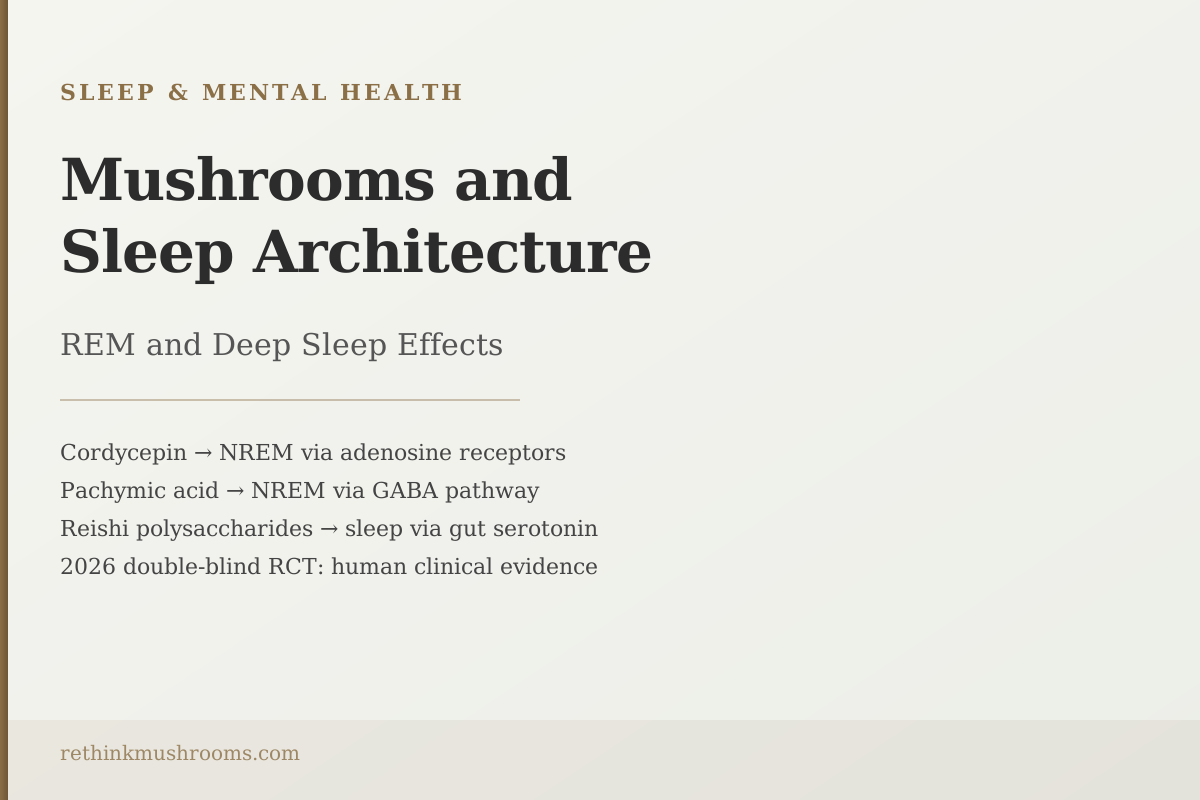
2026 RCT
A double-blind placebo-controlled trial found mushroom blend supplementation significantly improved sleep quality, fatigue, and stress versus placebo — the highest-quality human evidence for medicinal mushrooms and sleep.
Hisamuddin et al., Brain and Behavior, 2026
NREM sleep
specifically increased by cordycepin via adenosine A1 receptors — the same pathway caffeine blocks, in reverse
GABA pathway
pachymic acid from reishi and poria cocos potentiates the same receptor as sleep medications, without the dependency profile
Gut-dependent
reishi polysaccharides lost their sleep benefit entirely in antibiotic-treated mice with no gut bacteria — confirming microbiota dependency
Hisamuddin et al., Brain and Behavior, 2026
 View as image ↗
Most people know they need sleep. Fewer know that sleep is not a single state but a nightly sequence of stages with different biological functions. NREM stage 3 (slow-wave or deep sleep) is where physical repair and immune consolidation happen. REM sleep is where emotional processing and memory encoding occur. Waking up exhausted after a full eight hours often means one or more stages got cut short, not that total sleep time was insufficient.
Medicinal mushrooms have been studied across three distinct pathways that affect sleep stage composition, not just total sleep time. Cordycepin from Cordyceps targets adenosine receptors to specifically increase NREM sleep. Pachymic acid from reishi and poria cocos potentiates GABA receptors to promote sedation without dependency. Reishi polysaccharides reshape gut microbiota to increase serotonin, which governs sleep timing and architecture. These are different compounds working through different mechanisms, affecting different parts of the sleep cycle. The term mushrooms sleep architecture doesn't describe a single phenomenon; it describes at least three parallel research threads.
This article maps each mechanism to the specific sleep stages it affects, explains the evidence strength for each, and covers the 2026 double-blind human RCT that provides the strongest clinical signal in this field.
For the broader context on mushrooms and stress, which is a primary driver of sleep disruption, see adaptogenic mushrooms for stress and how they help your body cope.
Key Takeaways
- Cordycepin (from Cordyceps militaris) specifically increased NREM sleep duration in a 2013 study by acting as an adenosine A1 receptor agonist — the same receptor adenosine activates to make you sleepy, and the same one caffeine blocks to keep you awake
- Pachymic acid, a triterpene found in both poria cocos and reishi, potentiates GABAA receptors in a 2014 animal study — the same receptor class targeted by sleep medications, but acting at a different binding site without the same dependency profile
- A 2024 randomized controlled trial found a Poria cocos + Ziziphus + GABA combination significantly improved sleep quality versus placebo, providing clinical validation for the GABA-ergic mechanism
- Ganoderma polysaccharides promoted sleep through a gut microbiota-dependent pathway in a 2021 mouse study — antibiotic-treated mice with depleted gut bacteria lost the sleep benefit entirely, confirming the mechanism requires the gut microbiome
- Poria cocos polysaccharides reversed gut dysbiosis caused by sleep deprivation and reduced anxiety-like behavior, suggesting a bidirectional protective relationship with the sleep-gut axis
- A 2026 double-blind placebo-controlled RCT found mushroom blend supplementation significantly improved sleep quality, fatigue, and stress compared to placebo in human subjects
Sleep Architecture 101: Why Stage Specificity Matters
Sleep cycles through five stages roughly every 90 minutes. Stages 1 and 2 are light NREM sleep, where the body begins to relax and heart rate slows. Stage 3 is slow-wave sleep (SWS), the deepest NREM stage, where growth hormone is released, muscles repair, and the immune system consolidates its activity. REM sleep follows, where dreams occur and the brain processes emotional memory.
These stages serve different functions. A compound that only increases stage 2 light sleep does something different from one that increases stage 3 deep sleep or REM. Most discussion of "better sleep quality" blurs these distinctions entirely.
The research on mushrooms is specific enough to distinguish between them. Cordycepin data from Hu et al. explicitly shows increased NREM sleep in rats, not just longer total sleep time.[1] GABA-ergic compounds like pachymic acid primarily affect NREM sleep onset and duration, since GABA activity is highest in the transition from wakefulness to NREM.[2] Serotonin-based mechanisms from Ganoderma polysaccharides affect sleep timing and the depth of sleep architecture overall, since serotonin is a direct precursor to melatonin, the sleep-onset hormone.[3]
These mechanisms do not all produce identical outcomes. Understanding which one is relevant to a given sleep problem requires understanding how they differ.
Cordycepin and NREM Sleep: The Caffeine Pathway in Reverse
When you drink coffee, caffeine blocks adenosine receptors in your brain. Adenosine is the molecule your brain accumulates during waking hours as a byproduct of neuronal activity. As it builds up, it binds to adenosine A1 and A2A receptors, signaling increasing pressure to sleep. Caffeine blocks those receptors, which is why it keeps you awake. When caffeine wears off, adenosine floods in, and you crash.
Cordycepin, the bioactive compound in Cordyceps militaris, does the opposite. It acts as an adenosine receptor agonist, binding to adenosine A1 receptors and activating them, promoting the sleep-pressure signal rather than blocking it.
In 2013, Hu and colleagues published a study in eCAM testing cordycepin's effect on sleep in rats.[1] Cordycepin significantly increased NREM sleep duration. When the researchers administered adenosine receptor blockers before the cordycepin, the sleep effect disappeared, confirming the mechanism was adenosine-dependent. This is pharmacological precision: the study didn't just show that cordycepin helps sleep; it identified the specific receptor pathway through which it acts.
NREM sleep is the most restorative stage for physical recovery. Stage 3 NREM is when the body produces most of its growth hormone and conducts its deepest tissue repair. An adenosine receptor agonist that specifically enhances NREM is targeting the physically restorative component of the sleep cycle.
The practical implication: cordycepin's effects would theoretically be most relevant for people whose sleep problem is insufficient deep sleep or early morning awakening, rather than difficulty falling asleep. But because this is animal data, the translation to human subjects and to effective oral doses remains unvalidated.
For the broader picture of how different mushrooms compare on total sleep evidence, see the best mushrooms for sleep: a research-based guide.
Pachymic Acid, GABA, and Sleep's Braking System
GABA (gamma-aminobutyric acid) is the brain's primary inhibitory neurotransmitter. It slows neuronal activity. GABAA receptors are the channel proteins that open when GABA binds to them, letting chloride ions into the neuron and making it less likely to fire. Sleep medications like benzodiazepines and z-drugs (zolpidem, zaleplon) work primarily by binding to GABAA receptors and increasing their sensitivity to GABA.
Pachymic acid is a triterpene compound found in both poria cocos (Wolfiporia extensa) and reishi (Ganoderma lucidum). In 2014, Shah and colleagues tested pachymic acid's effect on sleep in mice using a pentobarbital-induced sleep model, which is the standard method for measuring GABA-ergic sedative activity.[2] Pachymic acid extended sleep duration and increased the number of mice that fell asleep. When GABAA receptor blockers were administered, the effect disappeared, confirming the mechanism was GABA-ergic.
Critically, pachymic acid appears to act at a different binding site on the GABAA receptor than benzodiazepines. Benzodiazepines bind at the benzodiazepine site, which mediates both the sedative and the tolerance-inducing effects. Positive allosteric modulators acting at alternative binding sites can enhance GABA activity without producing the same dependency or tolerance profile. The Shah 2014 data is consistent with this pattern, though the specific binding site for pachymic acid requires further structural characterization.
The clinical validation came in 2024. Hao and colleagues ran a randomized double-blind placebo-controlled trial testing a supplement combining Poria cocos, Ziziphus spinosa (another GABA-ergic herb), and GABA directly.[6] The combination significantly improved sleep quality scores and also produced skin health improvements versus placebo. The fact that Poria cocos was specifically included in a GABA-focused combination study reflects the mechanistic hypothesis about pachymic acid's mode of action.
Reishi contains pachymic acid alongside ganoderic acids and other triterpenes. A 2012 study by Cui et al. showed that Ganoderma lucidum extract significantly extended total sleep time and increased NREM sleep in rats with a clear dose-response relationship, establishing the species-level sleep effect before the specific mechanism was fully characterized.[4]
For the full picture on reishi specifically and how its triterpene and polysaccharide components work differently for sleep, see reishi before bed: how it improves sleep quality. And for how the GABA pathway connects reishi and poria cocos to anxiety reduction as well, see poria for anxiety: calming effects in traditional medicine.
The Gut-Serotonin Route: Reishi Polysaccharides and the Microbiome Connection
The most novel mechanistic finding in mushroom sleep research doesn't involve the brain directly. It involves the gut.
In 2021, Yao and colleagues published a study in Scientific Reports testing whether Ganoderma lucidum polysaccharides promoted sleep in mice, and if so, through what mechanism.[3] The polysaccharides did promote sleep. The researchers then administered antibiotics to a group of mice before giving them the polysaccharides, effectively depleting the gut microbiome. In antibiotic-treated mice, the sleep-promoting effect disappeared entirely.
That result is the key finding. It demonstrates that the sleep benefit from reishi polysaccharides is not a direct pharmacological effect on the brain. It is gut-microbiota-dependent: without gut bacteria, the sleep signal doesn't work.
The mechanism the researchers identified was: polysaccharides reshape gut microbiota composition, which increases tryptophan metabolism, which elevates serotonin levels in the hypothalamus (the brain region that governs sleep-wake timing). Serotonin is then converted to melatonin, the hormone that regulates the circadian sleep onset signal. When the gut bacteria are removed, the entire tryptophan-to-serotonin-to-melatonin chain collapses.
This has a specific timing implication: gut microbiota changes take hours to manifest. An intervention that works through gut signaling would logically produce its sleep benefit over longer timescales than a direct GABA-ergic compound. Taking reishi before bed supports the overnight gut-to-brain signaling window. The gut microbiota is also a long-term target, which suggests that consistent daily use would produce more stable sleep architecture effects than intermittent use.
This mechanism is separate from the triterpene/GABA pathway. Reishi contains both polysaccharides (gut-serotonin pathway) and triterpenes like pachymic acid (GABA pathway), which means it operates through at least two sleep-relevant mechanisms simultaneously.
For a deeper breakdown of how reishi's two compound classes produce different sleep effects, see reishi for sleep: how triterpenes and polysaccharides promote rest without sedation.
Sleep Deprivation and the Gut: Poria Cocos as a Recovery Agent
Sleep deprivation does not just cause tiredness. In 2022, Zhang and colleagues published research showing that sleep deprivation causes gut dysbiosis: a disruption in the composition and function of gut microbiota.[5] The disrupted gut microbiome then increases anxiety-like behavior in the sleep-deprived animals, creating a compounding cycle where poor sleep degrades the gut, the degraded gut worsens anxiety, and the anxiety further disrupts sleep.
Poria cocos water-soluble polysaccharides reversed the gut dysbiosis and reduced the anxiety-like behavior. The mechanism appeared to involve regulation of inflammatory signaling pathways (specifically TNF-alpha and NF-kappaB), which the gut activates when its microbial population shifts toward pro-inflammatory species.
The practical implication is bidirectional. Poria cocos doesn't just help sleep; it repairs some of the collateral damage that sleep loss inflicts on gut health, which itself contributes to better sleep in subsequent nights. If the Zhang et al. findings translate to humans, supplementation during periods of acute sleep disruption would serve a different function than maintenance supplementation during normal sleep.
This same gut-protective mechanism connects to anxiety as well, since gut dysbiosis from sleep deprivation directly increases anxiety-like behavior in the animal models. For research on how poria cocos affects anxiety through related pathways, see poria for anxiety: calming effects in traditional medicine.
The 2026 Human RCT: A Mushroom Blend Against Placebo
All of the mechanistic data described above comes from animal studies or cell culture work. The most rigorous human evidence in this cluster is the 2026 randomized controlled trial by Hisamuddin and colleagues, published in Brain and Behavior.[7]
The trial tested a mushroom blend supplement under double-blind placebo-controlled conditions, measuring effects on sleep quality, fatigue, and stress. Participants receiving the mushroom blend showed significantly greater improvements in sleep quality versus the placebo group. Effects were also observed for fatigue and stress measures, consistent with the adaptogenic framing of mushroom blend supplementation affecting the HPA axis and stress response alongside sleep architecture.
This is the study that competitor content does not have. As of 2026, Hisamuddin et al. represents the highest level of clinical evidence for mushroom supplementation improving sleep outcomes in humans. Most consumer content in this space is built on the animal mechanistic studies alone; the human RCT data changes the evidence picture.
For the complete range of what a mushroom blend covers across sleep, fatigue, and recovery, see mushrooms for better sleep: what the research shows.
Mapping the Evidence: Mushrooms to Sleep Stages
| Compound / Species | Mechanism | Primary Sleep Stage Affected | Evidence Level |
|---|---|---|---|
| Cordycepin (Cordyceps) | Adenosine A1 receptor agonist | NREM (deep sleep) | Preclinical (animal) |
| Pachymic acid (Poria/Reishi) | GABAA receptor potentiation | NREM onset and duration | Preclinical + RCT (Hao 2024) |
| Reishi polysaccharides | Gut microbiota → tryptophan → serotonin | Sleep timing and architecture | Preclinical (animal, gut-dependent) |
| Mushroom blend | Multiple mechanisms combined | Overall sleep quality | RCT (Hisamuddin 2026) |
The table reveals the evidence asymmetry: the most specific sleep-stage data (cordycepin/NREM; pachymic acid/NREM onset) comes from animal research. The human clinical evidence (Hao 2024 GABA-Poria RCT; Hisamuddin 2026 blend RCT) confirms that mushroom supplementation improves subjective sleep quality in people, but doesn't yet characterize the specific sleep stage changes at the level the animal studies do.
That gap between mechanistic specificity and clinical validation is the current state of this research area. The mechanisms are well-characterized in animal models. Human clinical trials are emerging. The Hao 2024 and Hisamuddin 2026 studies are first-generation clinical evidence, not conclusive proof of stage-specific effects in humans.
For context on how HPA axis regulation and cortisol reduction feed into improved sleep architecture, see how mushrooms regulate the HPA axis and cortisol.
The Bottom Line
Three distinct pathways explain how medicinal mushrooms affect sleep architecture: cordycepin from Cordyceps acts on adenosine A1 receptors to increase NREM sleep; pachymic acid from poria cocos and reishi potentiates GABAA receptors to promote sleep onset without the dependency profile of pharmaceutical sleep aids; and reishi polysaccharides reshape gut microbiota to increase serotonin levels, a mechanism that is completely eliminated when gut bacteria are removed. A 2024 clinical trial validated the GABA-Poria mechanism in humans, and a 2026 double-blind RCT confirmed that mushroom blend supplementation significantly improves sleep quality versus placebo. The animal mechanistic data is specific and pharmacologically coherent; human stage-specific evidence is limited but growing.
Frequently Asked Questions
Sources & References
- 1. Source details for this reference are not yet available.
- 2. Source details for this reference are not yet available.
- 3. Source details for this reference are not yet available.
- 4. Source details for this reference are not yet available.
- 5. Source details for this reference are not yet available.
- 6. Source details for this reference are not yet available.
- 7. Source details for this reference are not yet available.