Mushrooms & Mental Health (Non-Psychedelic)
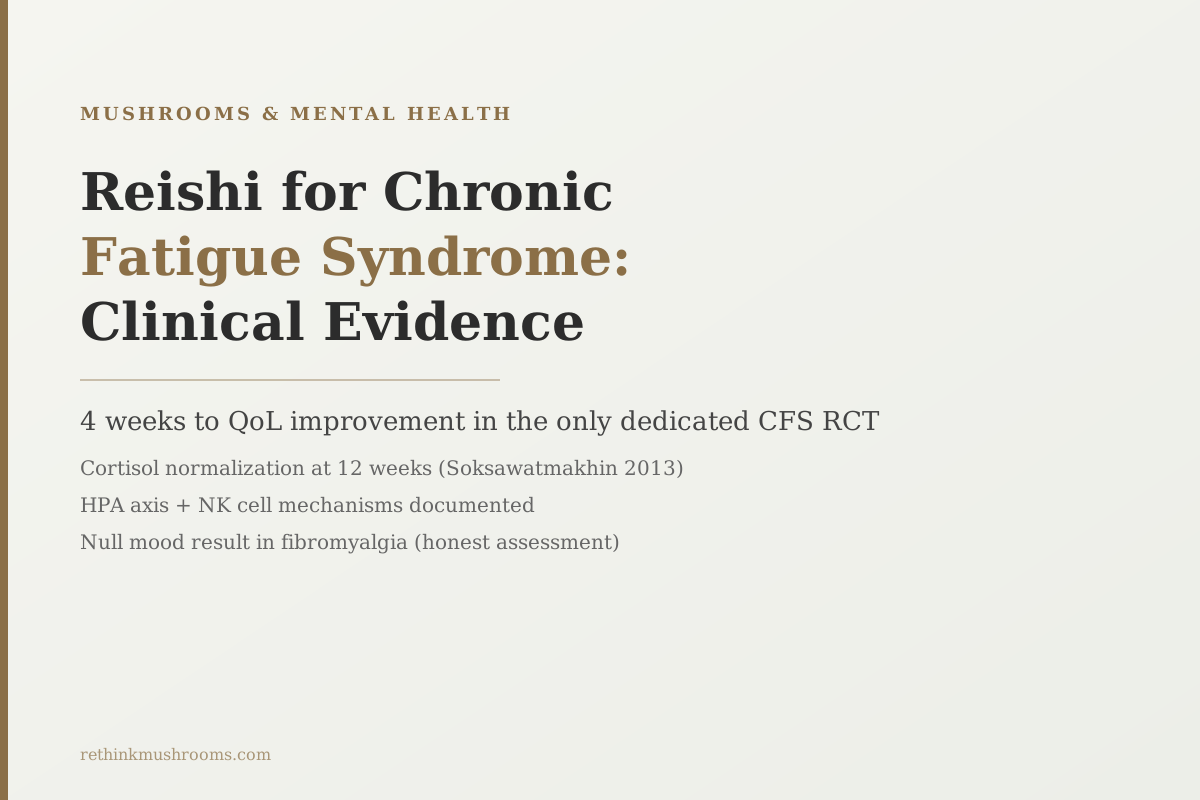
4 weeks to significant quality-of-life improvement in the only dedicated CFS trial
In a pilot RCT of 50 CFS patients, Ganoderma lucidum extract improved quality of life at 4 weeks and normalized cortisol levels at 12 weeks compared to placebo: the only controlled trial specifically designed for CFS patients.
Soksawatmakhin et al., Asian Academic Society of Pharmacy Journal, 2013
Neurasthenia RCT
Ganoderma polysaccharide significantly reduced fatigue vs placebo in an overlapping fatigue syndrome (Gao et al., J Med Food, 2005)
Cancer fatigue RCT
Ganoderma spore powder significantly reduced fatigue in breast cancer patients vs placebo (Zhao et al., PLoS One, 2012)
HPA axis + NK cells
two CFS-relevant biological pathways where Ganoderma triterpenes show mechanistic activity (Zhou et al., Molecules, 2019)
Soksawatmakhin et al., Asian Academic Society of Pharmacy Journal, 2013
 View as image ↗
Chronic fatigue syndrome, now often referred to as ME/CFS (myalgic encephalomyelitis/chronic fatigue syndrome), is characterized by severe, persistent fatigue that is not explained by other medical conditions and is not relieved by rest. It affects multiple biological systems at once: immune dysregulation, abnormal stress hormone patterns, impaired cellular energy production, and reduced natural killer cell activity are all documented features. That biological profile is part of why reishi for chronic fatigue syndrome has attracted clinical interest.
The evidence base is small. One small RCT has tested Ganoderma lucidum specifically in CFS patients. Broader controlled trials in neurasthenia (a historical fatigue syndrome with considerable overlap with CFS) and cancer-related fatigue provide supporting human evidence. This article covers all of it honestly, including the one significant null result. For the adaptogenic mushroom picture more broadly, see Adaptogenic Mushrooms for Stress: How They Help Your Body Cope.
Key Takeaways
- The only dedicated Ganoderma RCT for CFS (Soksawatmakhin et al., 2013) found significant quality-of-life improvement at 4 weeks and cortisol normalization at 12 weeks in 50 patients. It was published in a non-MEDLINE journal with a small sample, which limits the strength of inference.
- A separate Ganoderma polysaccharide RCT in neurasthenia, a fatigue syndrome with substantial overlap with CFS, found significant fatigue reduction and wellbeing improvement vs. placebo over 8 weeks (Gao et al., J Med Food, 2005).
- Ganoderma spore powder significantly reduced cancer-related fatigue in breast cancer patients receiving endocrine therapy vs. placebo, providing human RCT evidence of Reishi's anti-fatigue effect in a chemically validated fatigue state (Zhao et al., PLoS One, 2012).
- Ganoderma triterpenes (ganoderic acids) regulate the HPA axis and modulate natural killer cell activity, both of which are specifically dysregulated in CFS patients (Zhou et al., Molecules, 2019).
- Ganoderma lucidum significantly improved physical fitness markers in women with fibromyalgia, a condition sharing fatigue and functional impairment with CFS (Collado Mateo et al., 2015).
- A null result should be noted: Ganoderma at 6g/day did NOT significantly improve mood or health-related quality of life in fibromyalgia after statistical correction for multiple comparisons (Collado Mateo et al., 2020).
What CFS Is and Why Reishi's Biology Fits the Condition
Chronic fatigue syndrome is not ordinary tiredness. The cardinal feature is post-exertional malaise: activity that would be normal for a healthy person causes a disproportionate worsening of symptoms that can last days or weeks. CFS patients also commonly show abnormal cortisol rhythms (the stress hormone that regulates the body's daily energy cycle is often dysregulated), reduced natural killer cell activity (a type of immune cell that fights viruses and tumors, often found underperforming in CFS), and signs of mitochondrial stress (impaired energy production in cells).
These features matter for evaluating reishi because they are specifically relevant to Ganoderma lucidum's documented mechanisms. Ganoderma triterpenes, the bioactive compounds ganoderic acids and related molecules, are known to modulate the HPA axis, the brain-to-body system that controls cortisol release. Ganoderma polysaccharides have documented effects on natural killer cell activity. And several Ganoderma compounds have mitochondria-relevant mechanisms in preclinical work.[3]
This mechanistic fit does not prove that reishi works for CFS. It explains why researchers have investigated it and why the question is scientifically reasonable. The evidence for the mechanisms is summarized later; first, the clinical trials.
The Only Dedicated CFS Trial: Soksawatmakhin 2013
Soksawatmakhin and colleagues conducted a pilot RCT in 50 patients meeting the Fukuda criteria for chronic fatigue syndrome. The Fukuda criteria are the internationally used diagnostic standards for CFS. Patients received Ganoderma lucidum extract or placebo and were assessed at 4 and 12 weeks.
At 4 weeks, the treatment group showed significant improvements in quality-of-life scores compared to placebo. At 12 weeks, the treatment group showed cortisol normalization, meaning their stress hormone levels moved toward a more typical pattern. The treatment was well-tolerated with no serious adverse events reported.
This is the single most important study for any content about reishi and CFS. It is also the most limited. The study was published in the Asian Academic Society of Pharmacy Journal, a peer-reviewed but non-MEDLINE-indexed journal, which means it has not undergone the same indexing and visibility as studies that appear in PubMed. The sample size was 50 patients. There was no long-term follow-up beyond 12 weeks. These are real limitations.
The absence of larger replication trials means the Soksawatmakhin 2013 data should be treated as preliminary. It shows that a controlled CFS trial of Ganoderma produced measurable improvements on validated outcomes. It does not establish that Ganoderma is an effective CFS treatment. The difference matters.
Neurasthenia: The Closely Related Fatigue Syndrome with Stronger RCT Data
Neurasthenia is a historical diagnosis, largely replaced in Western medicine by more specific conditions including CFS and generalized anxiety disorder. It was characterized by physical and mental exhaustion, weakness, and an inability to recover from ordinary activities. The overlap with modern CFS is substantial.
Gao and colleagues conducted a randomized, double-blind, placebo-controlled trial of a Ganoderma lucidum polysaccharide extract called Ganopoly in 123 neurasthenia patients. Over 8 weeks, the Ganopoly group showed significantly greater reduction in fatigue severity and improvement in overall wellbeing compared to placebo.[1]
This study is indexed in PubMed, was conducted in a larger sample than the Soksawatmakhin trial, and used a well-characterized extract. It is the best-controlled evidence for Ganoderma's effects on a fatigue syndrome. The limitation is that neurasthenia and CFS are not the same condition, and effects demonstrated in one do not guarantee the same in the other. CFS has more specific immunological and neurological features, and the diagnostic criteria are distinct.
Still, the neurasthenia RCT provides the strongest controlled human evidence that Ganoderma polysaccharides reduce fatigue in a population whose core complaint resembles CFS closely enough to be clinically meaningful.
Cancer Fatigue: RCT Evidence in a Validated Fatigue State
Zhao and colleagues tested Ganoderma spore powder in breast cancer patients receiving endocrine therapy, a population with well-characterized cancer-related fatigue that has measurable biological causes. This group provided a model for testing fatigue reduction where the underlying mechanism of fatigue is defined.[2]
The randomized, controlled trial found that Ganoderma spore powder significantly reduced cancer-related fatigue compared to placebo. This result matters for CFS because it demonstrates Ganoderma's anti-fatigue effect in humans under controlled conditions, where fatigue is measurable and biologically validated. Cancer-related fatigue involves immune activation, HPA axis disruption, and inflammatory signaling, all of which overlap substantially with proposed CFS pathophysiology.[2]
The cancer population is distinct from CFS patients, and results from one do not transfer directly. But the demonstration that Ganoderma reduces fatigue in a human RCT with objective endpoints strengthens the biological plausibility of the CFS-specific hypothesis.
Why CFS Biology Matches Reishi's Mechanisms: HPA Axis, NK Cells, and Mitochondria
The three biological features of CFS most relevant to Ganoderma's known mechanisms are cortisol dysregulation, natural killer cell dysfunction, and mitochondrial stress.
Zhou and colleagues published a comprehensive review of Ganoderma triterpene (ganoderic acid) mechanisms, covering the evidence base across multiple systems. For HPA axis regulation, ganoderic acids have been shown to modulate the signaling pathway that controls cortisol production and release. Cortisol dysregulation is one of the most consistently documented features of CFS: some patients show abnormally low morning cortisol, while others show flattened diurnal rhythms. Compounds that normalize HPA axis signaling are mechanistically relevant.[3]
Natural killer cells in CFS patients show reduced cytotoxic activity, meaning they are less effective at identifying and eliminating abnormal cells. The mechanisms overlap with viral reactivation patterns frequently observed in CFS. Ganoderma polysaccharides and triterpenes both have documented effects on NK cell activation and cytotoxic function. The cortisol normalization seen at 12 weeks in the Soksawatmakhin trial may reflect this HPA axis modulation rather than direct energy effects.[3]
The mitochondrial angle is more speculative. Some CFS research identifies impaired cellular energy production as a feature of the condition. Ganoderma compounds have mitochondria-relevant mechanisms in preclinical models, but the translation to CFS-specific benefit has not been tested directly.
For the broader context of how adaptogenic mushrooms regulate cortisol and the HPA axis, see How Mushrooms Regulate the HPA Axis and Cortisol.
Physical Fitness in Fibromyalgia: A Closely Related Population
Fibromyalgia shares several features with CFS: chronic fatigue, post-exertional symptoms, widespread pain, and functional impairment. They are distinct diagnoses, but the overlap in symptom profile and underlying biology has led researchers to study similar interventions in both.
Collado Mateo and colleagues tested Ganoderma lucidum supplementation in women with fibromyalgia specifically for physical fitness outcomes. The trial found that Ganoderma improved physical fitness markers compared to controls, suggesting a functional benefit in a condition where physical deconditioning is a major contributor to quality of life decline.[4]
Physical fitness in fibromyalgia is not the same as the fatigue mechanism in CFS, but the populations are similar enough that positive physical outcomes in fibromyalgia provide supporting context for investigating Ganoderma in CFS.
The Null Result You Should Know About
The same research group, Collado Mateo and colleagues, conducted a second trial specifically measuring mood and health-related quality of life in fibromyalgia patients receiving 6 grams of Ganoderma lucidum per day for 6 weeks. The study used validated outcome measures and adequate statistical power to detect clinically meaningful effects.[5]
After applying Bonferroni correction, a statistical adjustment used when testing multiple outcomes simultaneously to reduce the chance of false positives, Ganoderma did not produce statistically significant improvements in mood, happiness, or health-related quality of life compared to placebo.[5]
This null result is worth naming clearly for two reasons. First, it prevents overclaiming: Ganoderma does not appear to reliably improve mood or broad quality of life in fibromyalgia patients at this dose and duration. Second, it distinguishes specific effects from general effects. The physical fitness improvement seen in the 2015 trial does not extend to mood and wellbeing according to this more rigorously analyzed 2020 trial. These are different outcomes, and honesty about that separation makes the positive findings more credible.
What Users Actually Report: The 2024 Symptom Survey
El-Hajj and colleagues conducted a cross-sectional survey of real-world Reishi mushroom users, documenting the symptoms they reported improving and the adverse effects they experienced. The most commonly reported improvements were in energy levels, fatigue, and sleep quality.[6]
This type of survey has significant limitations. Respondents self-selected, meaning they were more likely to continue using Reishi and therefore more likely to have positive experiences. There is no control group, no blinding, and no objective measurement. Placebo effects and general health improvements from lifestyle changes cannot be distinguished from Reishi's specific contributions.
What surveys do provide is the practical signal about which outcomes users prioritize and what they experience in the real world. The convergence of fatigue and energy as the most commonly reported improvements is consistent with the controlled trial evidence and adds face validity to the clinical findings. The reported adverse effects, primarily gastrointestinal symptoms in some users, provide relevant safety context that clinical trials do not always capture in adequate sample sizes.[6]
What the Evidence Shows and Where Its Limits Are
For someone with CFS asking whether Reishi has clinical support: the honest answer is more nuanced than either "yes, it works" or "there's no evidence."
One dedicated CFS pilot RCT exists (Soksawatmakhin 2013) showing improved quality of life and cortisol normalization in 50 patients. That trial has real limitations: it was small, it was published in a non-MEDLINE journal, and it has not been replicated. A larger, well-conducted RCT in a CFS population with modern diagnostic criteria does not yet exist.
Broader human RCT evidence for Ganoderma's anti-fatigue effects in neurasthenia and cancer-related fatigue is stronger, with PubMed-indexed controlled trials showing significant effects. The mechanistic fit between Ganoderma and CFS biology (HPA axis, NK cell activity, inflammation) is logical and documented in the laboratory. A rigorous null result for mood and quality of life in fibromyalgia shows the limits of those positive effects.
The situation is: biologically plausible, mechanistically grounded, with preliminary human clinical support specifically for CFS and stronger evidence in overlapping fatigue conditions, but without the large-scale CFS-specific RCT that would establish it as a validated treatment.
For the broader adaptogenic mushroom picture for stress recovery and burnout, see Mushrooms for Burnout and Fatigue: Adaptogenic Recovery. For the reishi stress evidence specifically, see Reishi for Stress: The Calming Mushroom Research Review.
The Bottom Line
Reishi's evidence for chronic fatigue syndrome is promising but limited. The only dedicated CFS RCT (Soksawatmakhin 2013, 50 patients) found improved quality of life at 4 weeks and cortisol normalization at 12 weeks. Stronger evidence comes from the neurasthenia RCT (Gao 2005) and cancer fatigue RCT (Zhao 2012), which are PubMed-indexed controlled trials in overlapping fatigue populations. Ganoderma triterpenes have documented mechanisms relevant to CFS biology, including HPA axis modulation and NK cell activity. A null result for mood and QoL in fibromyalgia (Collado 2020) should temper broader claims. What is needed is a large, well-powered CFS-specific RCT with modern diagnostic criteria.
Frequently Asked Questions
Sources & References
- 1. Source details for this reference are not yet available.
- 2. Source details for this reference are not yet available.
- 3. Source details for this reference are not yet available.
- 4. Source details for this reference are not yet available.
- 5. Source details for this reference are not yet available.
- 6. Source details for this reference are not yet available.