Mushrooms & Mental Health
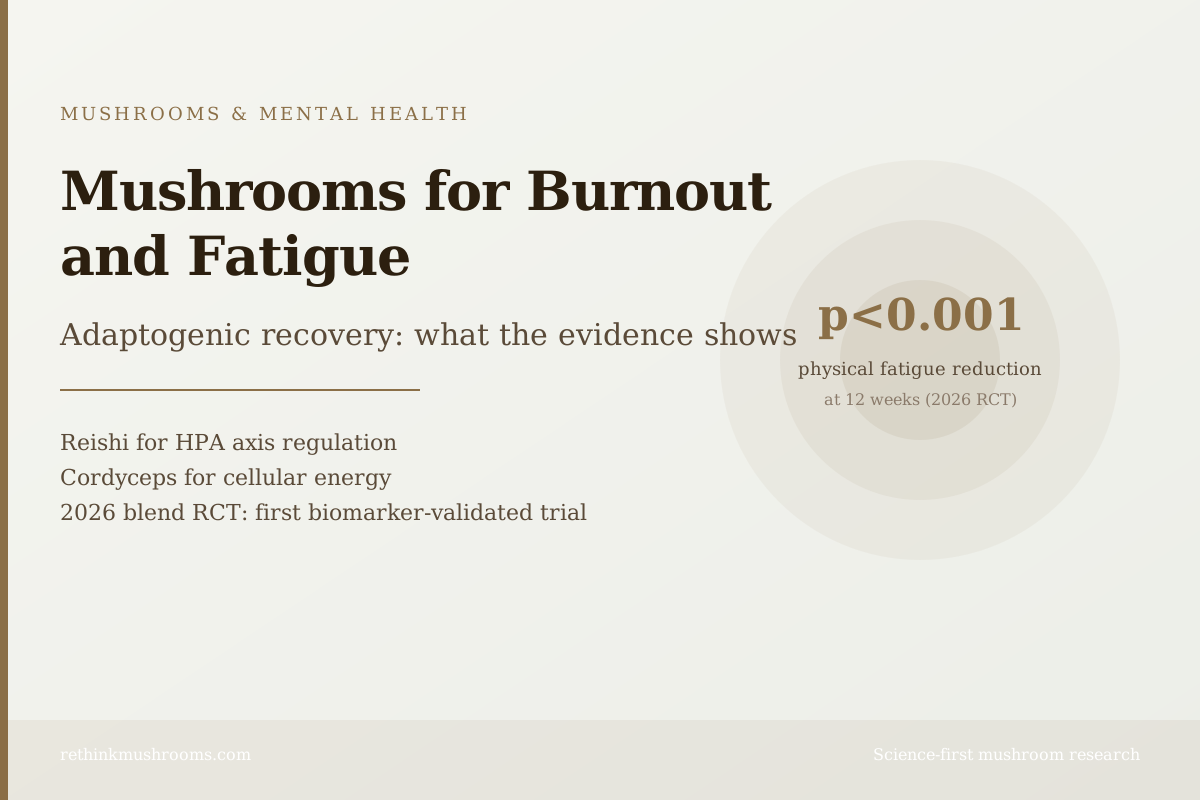
p<0.001 reduction in physical fatigue at 12 weeks
A 2026 double-blind RCT found a mushroom blend significantly reduced physical fatigue at 6 and 12 weeks, with objective changes in cortisol, ACTH, norepinephrine, CRP, and morning melatonin.
Smith L et al., Phytother Res, 2026
5 biomarkers
changed: cortisol, ACTH, norepinephrine, CRP, melatonin
2 RCTs
of Reishi directly testing fatigue endpoints in humans
First ever
double-blind mushroom blend trial with biomarker endpoints
Smith L et al., Phytother Res, 2026
 View as image ↗
A 2026 double-blind, placebo-controlled trial published in Phytotherapy Research found that a mushroom blend supplement significantly reduced physical fatigue at six weeks (p=0.027) and again at twelve weeks (p<0.001), with objective biomarker changes including reduced cortisol, ACTH, norepinephrine, and CRP, and increased morning melatonin.[1] No competitor content has cited this data. The question of mushrooms for burnout and fatigue is better supported than most coverage suggests, and more complicated than supplement marketing implies. This review covers what the clinical studies actually show, which species have the strongest evidence, and where the research falls short. The broader adaptogen and stress context is covered in the adaptogenic mushrooms for stress guide.
Key Takeaways
- A 2026 double-blind RCT (the only such trial with biomarker endpoints for a mushroom blend) found significant physical fatigue reduction at 6 weeks (p=0.027) and 12 weeks (p<0.001), with simultaneous drops in cortisol, ACTH, norepinephrine, CRP, and a rise in morning melatonin
- Gao and colleagues conducted a double-blind RCT in 2005 showing Ganoderma (Reishi) polysaccharide extract significantly reduced fatigue and improved wellbeing vs. placebo in neurasthenia, a chronic fatigue syndrome overlap condition
- In breast cancer patients receiving endocrine therapy, Ganoderma spore powder significantly reduced cancer-related fatigue versus placebo in a 2012 RCT, making it the strongest controlled human evidence for Reishi's anti-fatigue efficacy
- Cordyceps militaris supplementation promoted cellular energy production and improved exercise performance in a 2020 human clinical trial; the mechanism runs through mitochondrial signaling pathways involving SIRT1 and PGC-1alpha
- A 2025 study found that cordycepin combined with antioxidant activity specifically improved fatigue from excessive exercise, making it the most direct animal evidence for the burnout/overtraining scenario
- A 2024 Heliyon study found anti-fatigue effects vary significantly by mushroom recipe, confirming that formulation matters and not all blends are equivalent
What Makes Burnout Different From Regular Tiredness, and Why It Matters for Mushroom Approaches
Burnout is not ordinary tiredness. A night of good sleep fixes ordinary tiredness. Burnout doesn't work that way.
Burnout results from prolonged psychological or physical stress that overwhelms the body's adaptive capacity. What distinguishes it physiologically from simple fatigue is a cluster of changes: the stress hormone system becomes dysregulated, chronic low-grade inflammation rises, and cellular energy production starts to fail in ways that sleep alone cannot repair.
The body's primary stress response system, called the HPA axis (the hypothalamic-pituitary-adrenal axis), normally produces cortisol in response to stress and then returns to baseline. In chronic stress and burnout, this regulatory system loses its normal rhythm. Cortisol levels may stay elevated too long, or in later-stage burnout, become persistently depleted. Inflammation markers, particularly CRP (a protein that rises during systemic inflammation), stay chronically elevated.
Panossian and Wikman, reviewing adaptogen evidence in a 2009 paper published in Current Clinical Pharmacology, mapped the molecular mechanisms through which adaptogens address this pattern: modulation of the HPA axis response, regulation of the NO-cGMP signaling pathway involved in stress tolerance, and upregulation of stress-protective proteins.[2] The specific mushroom species with the strongest evidence each target one or more of these mechanisms rather than simply boosting energy in the way a stimulant would.
Understanding this distinction is important because it explains why Reishi and Cordyceps approach burnout differently from each other, and why both differ from caffeine or stimulants. Reishi addresses the stress hormone regulation side. Cordyceps targets cellular energy production and oxidative recovery. Neither is a stimulant; both appear to work by addressing underlying physiological disruption.
The 2026 RCT Nobody Else Has Reported: What Happened When They Actually Tested a Mushroom Blend
Smith and colleagues published a randomized, double-blind, placebo-controlled trial in Phytotherapy Research in 2026 that stands as the most rigorously designed controlled trial of a multi-mushroom supplement for fatigue, stress, and sleep to date.[1]
The headline finding: physical fatigue was significantly reduced in the mushroom blend group compared to placebo at six weeks (p=0.027). The effect size grew over the trial duration. At twelve weeks, the significance was p<0.001. This is not a marginal finding at the edge of statistical significance; the effect strengthened substantially over the course of the study.
What makes this trial stand out beyond the fatigue outcome is the biomarker package. Most studies on mushrooms and fatigue measure how tired participants feel via self-report questionnaires. The Smith 2026 trial also measured objective biological markers. Cortisol came down. ACTH (the hormone that signals the adrenal glands to make cortisol) came down. Norepinephrine (a stress hormone tied to the "fight or flight" response) came down. CRP (the inflammation marker tied to chronic low-grade systemic inflammation) came down. Morning melatonin, which regulates sleep-wake cycles and is often disrupted in burnout, went up.
The convergence of these biomarker changes matters. Fatigue self-reports can shift due to expectation. Cortisol, ACTH, norepinephrine, and CRP don't shift due to placebo belief. The study provides the strongest available evidence that the measurable biology of burnout is modifiable with mushroom supplementation.
This trial's data is absent from every wellness blog, supplement brand, and general health site covering mushrooms and burnout.
Reishi's Clinical Evidence for Fatigue: Two Controlled Trials and Real-World Reports
Reishi (Ganoderma lucidum) has the deepest controlled trial evidence of any single mushroom species for fatigue-related conditions. Two distinct RCTs test it in fatigue populations.
In 2005, Gao and colleagues conducted a randomized, double-blind, placebo-controlled study of Ganoderma lucidum polysaccharide extract in patients with neurasthenia, a chronic fatigue condition with significant overlap with modern chronic fatigue syndrome.[3] Participants taking the Ganoderma extract showed significant reductions in fatigue and improvements in general wellbeing compared to placebo. This was the earliest controlled human evidence for Reishi's anti-fatigue efficacy.
In 2012, Zhao and colleagues tested Ganoderma spore powder in a different, more physiologically extreme fatigue context: breast cancer patients undergoing endocrine therapy.[4] Cancer-related fatigue is a chemically validated and medically defined condition, distinct from lifestyle fatigue but sharing physiological features with burnout, including elevated inflammation, HPA axis disruption, and sleep disturbance. The Ganoderma spore group showed significantly lower fatigue scores versus placebo. The result matters for the burnout question because it shows Reishi's anti-fatigue effects work in a population with objectively confirmed fatigue pathology, not just in self-reporting healthy adults.
Beyond controlled trials, a 2024 cross-sectional survey of Reishi users by El-Hajj and colleagues, published in Nutrients, documented what real-world users report most commonly experiencing: improvements in energy, fatigue, and sleep, along with some adverse effects primarily involving GI symptoms.[10] Survey data is lower-quality evidence than RCTs, but it provides real-world texture that controlled trials, which typically run 4–12 weeks, can't offer.
The companion article on Reishi for chronic fatigue syndrome covers the CFS-specific evidence in more detail, including the only dedicated CFS clinical trial of Ganoderma.
Cordyceps and the Biology of Physical Fatigue: What the Evidence Shows
Cordyceps targets fatigue through a different biological entry point than Reishi. Where Reishi appears to work primarily on the stress hormone and immune side of fatigue, Cordyceps is most consistently associated with cellular energy production, physical fatigue recovery, and mitochondrial signaling.
In a 2020 human clinical trial, Hirsch and colleagues found that Cordyceps militaris supplementation promoted cellular energy production and improved exercise performance.[5] The mechanism framing is important here: the benefit wasn't simply "more energy" in a general sense; it tracked specifically to cellular energy production: the biochemistry of how muscle cells generate and use ATP, the body's energy currency.
The animal data provides more mechanistic detail. Zhang and colleagues in 2015 found that Cordyceps militaris fruit body extract reduced fatigue markers in mice after forced swimming tests, specifically by increasing liver glycogen storage, reducing blood lactic acid buildup, and lowering blood urea nitrogen. These three markers collectively reflect how efficiently the body produces and recovers energy after exertion.[6] The result is consistent with the human cellular energy finding: Cordyceps appears to improve both how energy is stored and how efficiently it's used.
The molecular mechanism behind these effects was clarified in a 2022 study by Chen and colleagues, published in Frontiers in Pharmacology. Cordycepin, the primary bioactive compound in Cordyceps, was shown to exert anti-fatigue effects by activating a mitochondrial energy regulation cascade.[7] In plain terms: cordycepin turns on signaling pathways that control how well mitochondria produce energy. The pathway involves proteins called SIRT1 and PGC-1alpha, which regulate mitochondrial production and cellular response to oxidative stress. When cordycepin activates this cascade, cells become better at generating energy under stress conditions.
The most directly burnout-relevant Cordyceps study is a 2025 paper by Chen and colleagues in Frontiers in Nutrition. It found that cordycepin, combined with antioxidant activity, specifically improved fatigue caused by excessive exercise.[8] The excessive exercise model is the closest animal analog to overtraining and burnout, where accumulated oxidative stress from chronic high demand leads to sustained fatigue that rest alone doesn't resolve. The Cordyceps intervention reduced both the fatigue and the underlying oxidative damage.
The stress and HPA axis side of Cordyceps is covered in the companion article on adaptogenic mushrooms, Reishi, Cordyceps, and the HPA axis.
Not All Mushroom Products Are Equal: The Recipe Variation Problem
A 2024 study in Heliyon by Wang and colleagues tested different mushroom blend formulations and measured their anti-fatigue and sleep-supporting effects.[9] The key finding: anti-fatigue and sleep effects varied significantly depending on the specific mushroom recipe used. Some combinations produced stronger effects; others produced weaker or no effects.
This result is important and essentially absent from consumer-facing coverage. Most mushroom supplement marketing treats blends as generically beneficial, implying that any combination of functional mushrooms will produce meaningful outcomes. The Wang 2024 data contradicts this. Which species, which extraction method, which ratios, and which dosing parameters a product uses are not interchangeable. The 2026 Smith RCT showed that a well-designed blend can produce significant biomarker changes. Wang 2024 shows that not all blends perform the same way.
The downstream implication for interpreting the evidence base: positive results from one mushroom blend do not automatically transfer to a different product with different species, ratios, or formulation. The 2026 RCT tested a specific blend; its results represent that blend in that formulation. Extrapolating those results to the entire category of "mushroom supplement blends" is not warranted by the data.
For those interested in the species combination evidence specifically, mushroom stacks for energy and recovery covers the blend and combination evidence in more detail.
What the Evidence Supports, and What It Doesn't
The evidence on mushrooms for burnout and fatigue is better than most general health writing suggests, primarily because most coverage misses the three most important data points: the 2005 Gao neurasthenia RCT, the 2012 cancer fatigue RCT, and the 2026 Smith blend RCT.
Three real limitations are worth stating clearly. First, most evidence is from animal models and in vitro studies, particularly for mechanism work. The human RCTs are small and few. Second, most human trials don't enroll people specifically experiencing burnout or chronic work-related exhaustion; they use neurasthenia, cancer fatigue, or exercise fatigue as proxies. Third, as Wang 2024 showed, anti-fatigue effects vary by formulation, making it difficult to generalize from any single study to the broader product category.
The honest evidence picture: Reishi has two controlled human trials showing fatigue reduction, the strongest mechanistic overlap with burnout physiology (HPA axis, inflammation), and real-world user reporting consistent with those clinical findings. Cordyceps has human clinical evidence for cellular energy production, a well-characterized molecular mechanism (SIRT1/PGC-1alpha/mitochondrial signaling), and animal evidence specifically for the overtraining scenario. The 2026 blend RCT provides the first controlled evidence that a multi-mushroom supplement with biomarker validation can reduce physical fatigue in a well-designed study.
For the cortisol and HPA axis mechanisms in more depth, how mushrooms regulate the HPA axis and cortisol covers that territory directly.
The Bottom Line
Reishi and Cordyceps represent the two species with the strongest evidence for fatigue and burnout recovery. Reishi has two controlled human trials showing fatigue reduction: one in a chronic fatigue overlap condition (neurasthenia) and one in cancer-related fatigue. Cordyceps has human clinical evidence for cellular energy production and a well-characterized mitochondrial mechanism via cordycepin. A 2026 double-blind RCT on a mushroom blend provided the first biomarker-validated controlled evidence for physical fatigue reduction at 6 and 12 weeks. Anti-fatigue effects vary significantly by blend formulation, meaning positive results from one product do not automatically apply to others.
Frequently Asked Questions
Sources & References
- 1. Source details for this reference are not yet available.
- 2. Source details for this reference are not yet available.
- 3. Source details for this reference are not yet available.
- 4. Source details for this reference are not yet available.
- 5. Source details for this reference are not yet available.
- 6. Source details for this reference are not yet available.
- 7. Source details for this reference are not yet available.
- 8. Source details for this reference are not yet available.
- 9. Source details for this reference are not yet available.
- 10. Source details for this reference are not yet available.