Mushrooms & Mental Health
2 compound classes — 2 sleep pathways
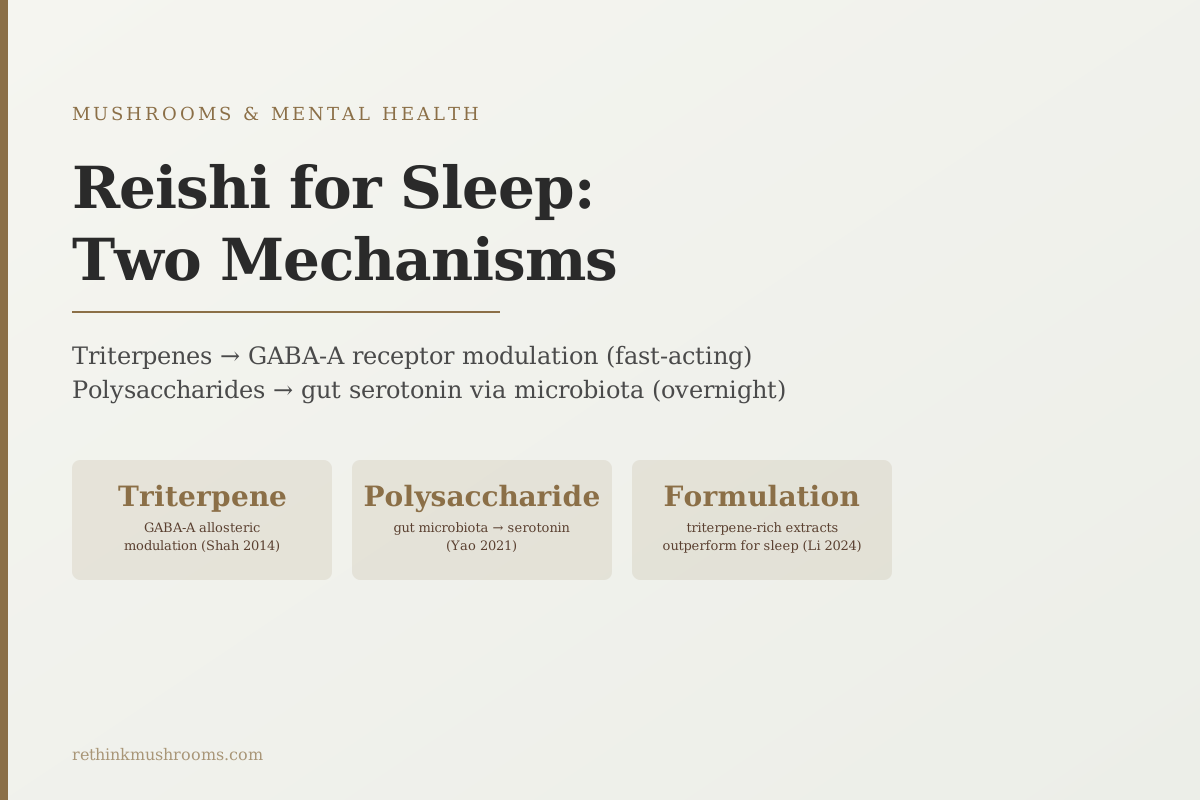
Reishi's sleep effects run through two distinct mechanisms driven by different compound classes: triterpenes (including pachymic acid) modulate GABA-A receptors in the brain, while polysaccharides reshape gut bacteria to increase serotonin production overnight.
Shah et al., Biomolecules & Therapeutics, 2014; Yao et al., 2021
GABA-A
receptor pathway activated by reishi triterpenes — the same receptor class as benzodiazepines, via a gentler allosteric mechanism with no dependency risk
Gut-serotonin
polysaccharide pathway: Yao et al. (2021) confirmed this is gut-microbiota-dependent — antibiotic-treated mice lost the sleep benefit when gut bacteria were depleted
Triterpene-rich
extracts outperform polysaccharide-only products specifically for sleep, per Li et al. (Heliyon, 2024) recipe comparison data
Shah et al., Biomolecules & Therapeutics, 2014; Yao et al., 2021
 View as image ↗
Reishi (Ganoderma lucidum) contains two structurally and functionally distinct compound classes that affect sleep through entirely different mechanisms.
The first class is triterpenes — lanostane-type compounds like ganoderic acids and pachymic acid. These interact directly with GABA-A receptors in the brain: the receptors that respond to GABA (gamma-aminobutyric acid), the brain's main inhibitory neurotransmitter. Triterpene compounds act as positive allosteric modulators of these receptors, amplifying the calming signal that GABA generates without directly activating the receptor the way a sedative drug would.
The second class is polysaccharides — long-chain sugar molecules in the mushroom cell wall. These don't act on the brain directly. Instead, they reshape the composition of gut bacteria, and the reshaped gut microbiome affects how much tryptophan — an amino acid the body uses to make serotonin — gets converted into serotonin in the intestinal tract. More gut serotonin influences the gut-brain axis in ways that support sleep onset and quality.
These two mechanisms operate on different timescales, through different molecular chains, and respond to different compound concentrations in a product. Understanding which pathway a given reishi extract primarily delivers is practically useful for choosing the right supplement.
For how this relates to reishi's calming and anxiety-reducing effects, see reishi for anxiety: calming effects and research. For the pillar on adaptogenic mushrooms, see adaptogenic mushrooms for stress: how they help your body cope. For the broader mushroom-and-sleep comparison, see mushrooms for better sleep: what the research shows.
Key Takeaways
- Pachymic acid, a triterpene in Ganoderma lucidum (and its close relative Poria cocos), enhances sleep by acting as a positive allosteric modulator of GABA-A receptors — amplifying GABA's calming effect without directly triggering the receptor (Shah et al., Biomolecules & Therapeutics, 2014)
- Reishi polysaccharides promote sleep through a gut-dependent mechanism: reshaping gut microbiota to increase tryptophan-to-serotonin conversion; antibiotic-treated mice with depleted gut bacteria lost the sleep benefit entirely, confirming gut-dependence (Yao et al., 2021)
- Cui et al. (J Ethnopharmacol, 2012) documented that Ganoderma lucidum extract significantly prolonged total sleep time and increased non-REM sleep in rats in a dose-dependent manner — the foundational preclinical sleep duration data
- A 2021 network analysis (Qiu et al., BMC Microbiology) identified GABA signaling, serotonin metabolism, and neuroendocrine regulation as the three central target hubs for Ganoderma's anti-insomnia activity, with >100 bioactive compounds interacting simultaneously
- Li et al. (Heliyon, 2024) found that triterpene-rich Ganoderma extract formulations significantly outperformed polysaccharide-only formulations specifically for sleep — meaning product composition matters for people using reishi for this purpose
- A 2026 narrative review of Poria cocos pharmacology (Guo et al., Frontiers in Nutrition, 2026) confirmed that pachymic acid-class triterpenoids — found in both Poria and Reishi — are the primary sedative and sleep-promoting compounds in these mushrooms
The Triterpene Pathway: How GABA-A Modulation Promotes Sleep
Shah and colleagues documented the molecular mechanism behind reishi's triterpene sleep pathway in research published in Biomolecules & Therapeutics in 2014.[1]
Pachymic acid — a lanostane triterpene found in both Ganoderma lucidum (reishi) and Poria cocos, a closely related species — enhanced sleep duration in the standard pharmacological sleep test (a pentobarbital-induced sleeping time model that measures how compounds extend or shorten sedative drug effects) by activating the GABA-A receptor system.
GABA-A receptors are the primary target of all benzodiazepine sleep medications (temazepam, triazolam) and of alcohol. They work by making neurons less likely to fire when GABA binds to them. The brain regions most relevant for sleep and anxiety — the limbic system, the hypothalamus — are densely populated with GABA-A receptors.
Pachymic acid does not bind to the same site as benzodiazepines on the GABA-A receptor. It is a positive allosteric modulator operating at a different binding location — a structural distinction that has significant practical implications. A compound that directly activates GABA-A receptors (like a benzodiazepine) bypasses the body's own GABA signaling and produces sedation regardless of ambient GABA levels. A positive allosteric modulator amplifies the effect of GABA that is already present — which means the calming effect is proportional to the brain's natural GABA activity rather than a pharmacologically forced state. This mechanistic difference explains why reishi produces calming without the dependence, tolerance, and withdrawal profile of GABA-A agonist drugs.
A 2026 narrative review by Guo and colleagues in Frontiers in Nutrition confirmed that this GABA-ergic mechanism — specifically driven by pachymic acid and related lanostane triterpenoids — is the primary established pharmacological basis for both Poria cocos's and Ganoderma lucidum's sedative and sleep-promoting effects.[6]
The Polysaccharide Pathway: Gut Microbiota and Serotonin
Yao and colleagues published a mechanistic study in 2021 that traced how reishi polysaccharides promote sleep through an entirely different molecular route — one that doesn't involve GABA-A receptors at all.[2]
The study tracked: gut microbiota composition, intestinal serotonin production, hypothalamic serotonin levels, and sleep architecture in mice treated with Ganoderma lucidum polysaccharides. The results documented a causal chain:
- Reishi polysaccharides altered gut microbiota composition — specifically increasing bacteria species associated with tryptophan metabolism
- The altered microbiome converted more dietary tryptophan into serotonin (5-hydroxytryptamine, or 5-HT) in the gut
- Elevated gut serotonin influenced hypothalamic serotonin signaling via the gut-brain axis
- Mice in the treatment group showed extended non-rapid eye movement sleep (the deeper, restorative sleep stages)
The most telling experiment in the Yao study: mice treated with antibiotics before receiving the polysaccharides — depleting their gut bacteria — did not experience the sleep benefit. The effect was entirely gut-microbiota-dependent. When you remove the bacteria that process tryptophan, the polysaccharides cannot produce the sleep effect.
This mechanism explains the "overnight" quality of polysaccharide sleep support. Gut bacteria don't change composition instantly. The tryptophan-to-serotonin conversion process happens in the gut and the gut-brain signaling cascades take time. This is why consistent nightly use of reishi polysaccharides builds sleep effects over days rather than producing an immediate response like a sedative compound would.
Serotonin in the intestinal tract is also a precursor to melatonin production — the body converts serotonin to melatonin in the pineal gland through N-acetyltransferase activity. More available serotonin upstream means more potential melatonin production, supporting the circadian timing aspect of sleep rather than just the depth.
Why These Two Pathways Are Additive, Not Redundant
Qiu and colleagues published a network analysis study in BMC Microbiology in 2021 that mapped all of Ganoderma's anti-insomnia mechanisms simultaneously.[4]
The network analysis identified three central target hubs for Ganoderma's sleep effects: GABA signaling, serotonin metabolism, and neuroendocrine regulation (the hormonal signaling between the nervous system and endocrine glands that governs daily biological rhythms, including the sleep-wake cycle).
Over 100 bioactive Ganoderma compounds were found to interact with these hubs simultaneously and through different entry points. No single compound accounted for the full effect — the sleep-promoting activity of a whole reishi extract emerges from multiple compounds acting on multiple targets at the same time.
This network architecture explains why the GABA and serotonin pathways are additive. A triterpene-rich extract does a lot of GABA hub work and some serotonin hub work. A polysaccharide-rich extract does a lot of serotonin hub work and some neuroendocrine hub work. A full-spectrum extract with both compound classes hits all three hubs simultaneously. The practical corollary: a supplement that provides only one compound class is delivering partial coverage of the sleep-promoting network.
Foundational Sleep Duration Data: What Rat Models Show
Cui and colleagues published the foundational preclinical sleep duration study in the Journal of Ethnopharmacology in 2012.[3]
Ganoderma lucidum extract significantly prolonged total sleep time in rats across multiple experimental conditions. The study also found increased non-REM sleep duration specifically. The relationship between dose and sleep extension was dose-dependent — higher doses produced proportionally longer sleep extension, which confirms the effect is pharmacologically real rather than noise.
This study established the preclinical baseline: reishi extract reliably extends sleep time and increases the deeper, restorative phases of sleep in animal models. The GABA-ergic and gut-serotonin mechanisms documented by later studies provide the molecular explanation for what Cui's 2012 behavioral data showed.
Which Extract Type Delivers Which Effect: The Li 2024 Finding
The mechanistic separation between triterpene and polysaccharide pathways has a practical implication that most supplement buyers never encounter: different Ganoderma extract formulations can deliver very different effects.
Li and colleagues published research in Heliyon in 2024 comparing multiple Ganoderma extract recipes — varying in their ratios of polysaccharide content to triterpene content — and found that triterpene-rich formulations significantly outperformed polysaccharide-only formulations for sleep specifically.[5] Polysaccharide-rich formulations showed stronger anti-fatigue effects, while triterpene-rich formulations showed superior sleep-aiding effects.
The implication: if you are buying reishi for sleep, a product standardized to triterpene content (typically reflected in a "triterpenoids %" specification on the label) is more likely to deliver the primary sleep-promoting mechanism than a product specified only by polysaccharide percentage. A dual-extract product (one made using both hot water extraction for polysaccharides and ethanol extraction for triterpenes) captures both pathways simultaneously.
Hot water extraction alone — the most common extraction method and the one most products use — produces higher polysaccharide content but lower triterpene content. The gut-serotonin pathway comes through; the GABA-ergic pathway is less represented. Ethanol or dual extraction captures more of the ganoderic acid triterpene fraction.
Reishi vs. Melatonin: Different Mechanisms, Potentially Complementary
Melatonin and reishi work through different targets on entirely different parts of the sleep system.
Melatonin acts directly on MT1 and MT2 receptors in the suprachiasmatic nucleus — the brain's central biological clock. It signals to the clock that it's nighttime, cueing the system to initiate sleep. Melatonin is excellent for sleep timing — shifting the circadian phase, reducing sleep onset latency — but has limited effects on sleep depth or quality once asleep.
Reishi's triterpene pathway acts on GABA-A receptors to deepen sleep quality. Reishi's polysaccharide pathway supports the serotonin-melatonin precursor chain upstream of the pineal gland. Neither pathway replicates what melatonin does (circadian signaling), but both address what melatonin cannot: sleep depth and the anxiety-driven difficulty staying asleep.
Because they target separate mechanisms, reishi and melatonin are unlikely to interfere with each other at typical supplement doses. Whether combining them produces better sleep than either alone has not been tested in a human clinical trial. The mechanistic rationale for complementarity is strong — they address different aspects of the sleep-wakefulness system — but this should not be construed as a recommendation to combine them. People on sleep medications should discuss any supplement additions with a physician.
For a comparison of reishi against other mushrooms for sleep, see the best mushrooms for sleep: a research-based guide. For the HPA axis connection to sleep disruption, see how mushrooms regulate the HPA axis and cortisol. For Poria cocos specifically, see poria for anxiety: calming effects in traditional medicine.
The Bottom Line
Reishi's sleep effects come from two mechanistically distinct compound classes. Triterpenes — particularly pachymic acid — modulate GABA-A receptors as positive allosteric modulators, deepening sleep without the dependency profile of pharmaceutical GABA-A drugs (Shah 2014). Polysaccharides reshape gut microbiota to increase tryptophan-to-serotonin conversion overnight, an effect that is entirely gut-microbiota-dependent (Yao 2021). A 2024 study found triterpene-rich extracts outperform polysaccharide-only products specifically for sleep, making extract type relevant to product selection. Neither mechanism is sedating in the pharmacological sense — both work with natural sleep processes.
Frequently Asked Questions
Sources & References
- 1. Source details for this reference are not yet available.
- 2. Source details for this reference are not yet available.
- 3. Source details for this reference are not yet available.
- 4. Source details for this reference are not yet available.
- 5. Source details for this reference are not yet available.
- 6. Source details for this reference are not yet available.