Poria (Wolfiporia extensa / Fu Ling)
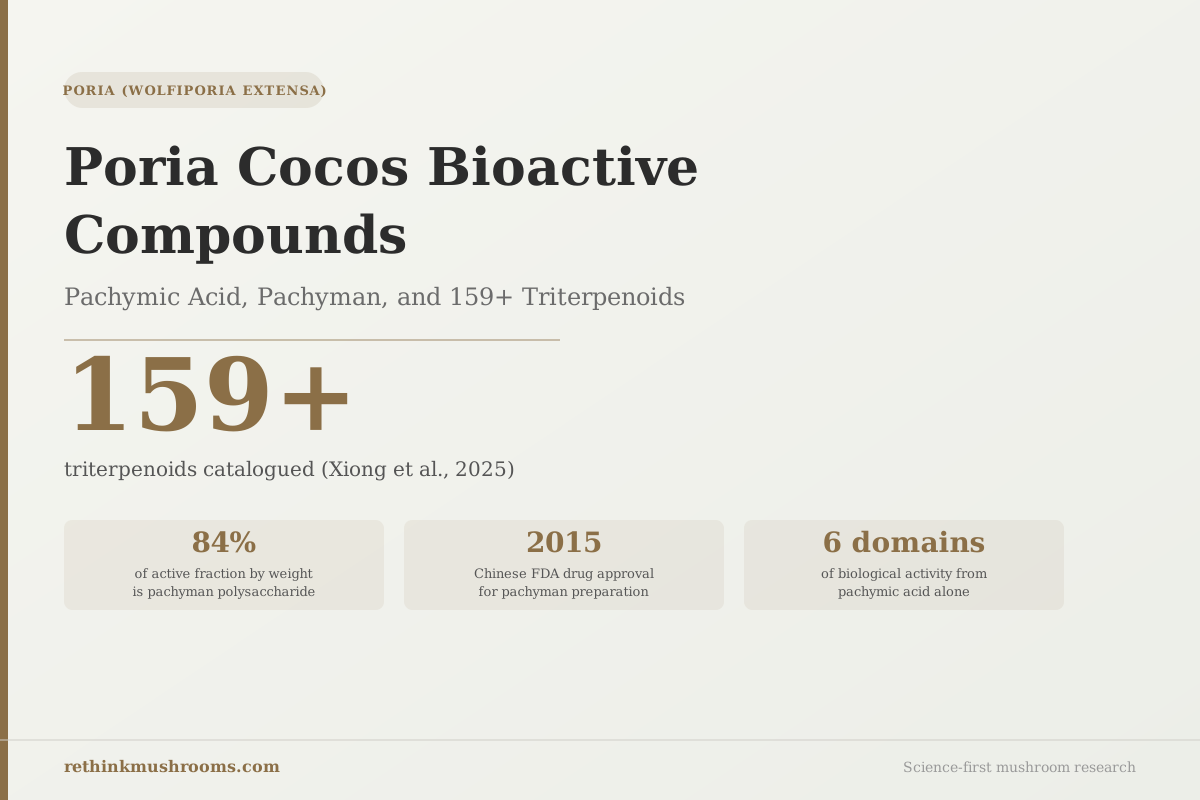
159+ triterpenoids
A 2025 systematic review of Wolfiporia extensa identified over 159 distinct triterpenoids. Pachyman, the dominant beta-glucan polysaccharide, earned Chinese FDA drug approval in 2015 as a cancer adjuvant.
Xiong et al., Frontiers in Pharmacology, 2025
84%
of Poria's active compounds by proportion are polysaccharides (Xiong et al., 2025)
2015
year the Chinese FDA approved Poria polysaccharide (pachyman) as a drug for cancer and immune deficiency
6 domains
therapeutic areas where pachymic acid shows confirmed biological activity (Wei et al., 2022)
Xiong et al., Frontiers in Pharmacology, 2025
 View as image ↗
Most mushrooms that get labeled "immune supportive" or "anti-cancer" in supplement marketing contain beta-glucans. Poria cocos contains those too, but that's a starting point, not the full story.
A 2025 systematic review catalogued over 159 distinct triterpenoid compounds in Wolfiporia extensa alongside its polysaccharide fraction.[1] The triterpenoids and polysaccharides work through completely different mechanisms. The polysaccharides interact with immune receptors on the surface of macrophages. The triterpenoids, led by pachymic acid, inhibit inflammatory signaling pathways and directly affect cancer cell survival.
One of those polysaccharides, pachyman, earned Chinese FDA drug approval in 2015 for treating multiple cancer types and immune deficiency. That regulatory milestone is one of the most concrete validations of a mushroom compound's clinical utility anywhere in the world, and it's almost entirely absent from Western coverage.
This article covers what Poria's compounds are, how each class works, and what the evidence base looks like. For the broader introduction to Poria in traditional and modern medicine, see the complete Poria guide.
Key Takeaways
- A 2025 review identified 159+ distinct triterpenoids in Wolfiporia extensa; polysaccharides constitute approximately 84% of the pharmacologically active fraction by mass
- Pachyman, Poria's primary beta-glucan, activates macrophages via the TLR4/MD2/NF-κB pathway and earned Chinese FDA drug approval in 2015 as the only mushroom polysaccharide with this regulatory status
- Pachymic acid is the most pharmacologically active triterpene, confirmed active across six domains: anti-inflammatory, anti-tumor, neuroprotective, hepatoprotective, hypoglycemic, and sedative (Wei et al., 2022)
- A 2023 network pharmacology study found 27 bioactive compounds in Wolfiporia extensa interact with 17 key inflammatory targets; pachymic acid showed the highest binding affinity across TNF, IL-6, and TP53 pathways
- Poricoic acids (a distinct triterpenoid subclass) showed anti-tumor-promoting activity in cancer bioassays, with 25-methoxyporicoic acid A showing the strongest effect of 14 tested compounds (Akihisa et al., 2009)
- Polysaccharides and triterpenoids require different extraction methods: hot water for polysaccharides, ethanol for triterpenoids. A dual extract provides both
Poria's Three Compound Classes: What You're Actually Getting
Poria cocos (also classified as Wolfiporia extensa) grows as a dense underground sclerotium on the roots of pine trees. Its medicinal activity comes from three compound classes, each with a different chemistry and a different set of biological targets.
| Compound Class | Key Members | Primary Target | Main Effect |
|---|---|---|---|
| Polysaccharides | Pachyman (dominant), pachymaran, modified derivatives | TLR4/MD2 receptors, Dectin-1, NF-κB | Immune activation, anti-tumor (indirect) |
| Triterpenoids | Pachymic acid, tumulosic acid, poricoic acids A–H, 25-methoxyporicoic acids | NF-κB, MAPK, PI3K/Akt, GABA-A, Bcl-2 | Anti-inflammatory, anti-cancer, neuroprotective, sedative |
| Sterols | Ergosterol, lanosterol | Membrane structure, vitamin D2 precursor | Cellular integrity, minor anti-cancer |
The Ríos 2011 review in Planta Medica established this three-class framework as the foundational phytochemical profile for Poria.[2] Since then, the triterpenoid count has expanded dramatically, from around 30 known compounds in 2011 to 159+ catalogued by Nie et al. in 2020 and confirmed at that count by Xiong et al. in 2025.[3][1]
The polysaccharides constitute roughly 84% of the pharmacologically active mass. Most of what you're getting in a Poria supplement by weight is polysaccharide, not triterpene. But the triterpenoids carry distinct biological activities that the polysaccharides don't replicate, which is why extraction method determines what you actually receive in the product.
Pachyman: The Beta-Glucan With Regulatory Recognition
Pachyman is the primary polysaccharide in Poria cocos, accounting for most of the polysaccharide fraction by weight. Its backbone is a (1→3)-beta-D-glucan chain with (1→6) branch points, a specific structural architecture that determines how it interacts with immune receptors.
Li and colleagues documented the structural and clinical evidence base for pachyman in two 2019 reviews. The structural finding: the (1→3) backbone with (1→6) branching is what allows pachyman to bind Dectin-1 and toll-like receptors (TLRs) on macrophage surfaces.[4] This specific branching pattern is structurally distinct from beta-glucans in oats or brewer's yeast, which is why research on oat beta-glucan doesn't automatically apply to Poria's polysaccharide.
The immune activation pathway was clarified in 2024 by Sun and colleagues. They isolated a specific Poria polysaccharide fraction (PCP-W1) and found it activated macrophage M1 polarization through the TLR4/MD2/NF-κB signaling cascade. The activation induced nitric oxide production, IL-6, TNF-alpha, and CD86 expression: the molecular signature of a classically activated, tumor-fighting macrophage.[5]
The regulatory milestone: in 2015, the Chinese FDA approved Polysaccharide of Poria cocos oral solution as a drug for treating cancer, hepatitis, and immune deficiency. Li and colleagues' 2019 review covering 74 independent studies from 1970 to 2018 documents this approval and the clinical evidence supporting it.[4] This makes pachyman the only mushroom polysaccharide with Chinese regulatory drug approval, a distinction that's essentially unmentioned in Western supplement coverage.
Structural modifications to pachyman change its activity profile. Chen and colleagues in 2010 showed that carboxymethylated and sulfated derivatives of Poria's beta-glucan produced significantly enhanced macrophage activation and tumor cell inhibition compared to unmodified pachyman.[6] This matters for evaluating supplements: the specific polysaccharide preparation matters, not just that polysaccharides are present.
Pachymic Acid: Active Across Six Therapeutic Domains
Of the 159+ triterpenoids in Wolfiporia extensa, pachymic acid is the most comprehensively studied and pharmacologically active.
Wei and colleagues' 2022 review in Experimental and Therapeutic Medicine mapped pachymic acid's confirmed biological activity across six distinct domains: anti-inflammatory (via NF-κB and MAPK suppression), anti-tumor (via apoptosis induction and cell cycle arrest), neuroprotective (via PI3K/Akt signaling), hepatoprotective, hypoglycemic (via GLUT4 upregulation), and sedative (via GABA-A receptor activation).[7]
A single compound active across six therapeutic domains is unusual. Most pharmaceutical compounds are designed to be specific. Pachymic acid's broad activity profile reflects the evolutionary chemistry of the fungal kingdom, which optimizes for broad ecological functions rather than narrow pharmaceutical specificity. Whether that breadth is a feature or a limitation for clinical use is a genuine question the field hasn't resolved.
The anti-inflammatory mechanism is the most mechanistically detailed. Lee and colleagues in 2017 used bioactivity-guided isolation to find the strongest NF-κB inhibitors from Poria's sclerotium. Of eight tested triterpenoids, pachymic acid showed the most potent inhibition of nitric oxide production in LPS-stimulated macrophages, confirming NF-κB suppression as the primary mechanism.[8]
Gui and colleagues in 2021 extended this in a rat pneumonia model. Pachymic acid dose-dependently reduced TNF-alpha, IL-6, and IL-1beta levels and simultaneously suppressed both NF-κB p65 nuclear translocation and MAPK phosphorylation (p38 and ERK subunits).[9] Hitting both NF-κB and MAPK simultaneously explains the breadth of pachymic acid's anti-inflammatory effect. These two pathways are often redundant, so blocking just one can leave the other intact.
The anti-tumor mechanism runs through the mitochondrial apoptosis pathway. Gapter and colleagues in 2005 showed pachymic acid induced apoptosis in DU-145 prostate cancer cells by suppressing Bcl-2 (the anti-apoptosis protein) and activating caspase-3 (the executioner enzyme).[10]
The 2023 network pharmacology analysis by Jin and colleagues provided a broader view: 27 bioactive compounds in Wolfiporia extensa map to 17 key inflammatory targets. Pachymic acid showed the highest binding affinity of all 27 compounds across TNF, IL-6, and TP53 binding sites.[14] TP53 is the tumor suppressor gene. Pachymic acid's binding to TP53-related targets suggests anti-tumor activity through multiple pathways.
Poricoic Acids: The Anti-Tumor-Promoting Subclass
Pachymic acid is the lead triterpenoid, but it's one member of a large family. The poricoic acids are a distinct lanostanoid subclass with their own specific biological activity.
Akihisa and colleagues published two key studies defining this subclass. The 2007 study identified multiple lanostane-type triterpene acids from Poria cocos with inhibitory activity against Epstein-Barr virus early antigen, a validated screening assay for anti-tumor-promoting compounds.[11] The 2009 follow-up established the structure-activity relationship: 25-methoxyporicoic acid A showed the strongest anti-tumor-promoting activity of 14 tested compounds in the series, establishing it as the most potent member of this subclass.[12]
Lai and colleagues in 2016 added to the cancer-relevant triterpenoid catalog. They isolated five new lanostane-type triterpenoids from Poria cocos sclerotium, several showing selective cytotoxicity against human hepatocellular carcinoma and lung cancer cell lines.[13] These are structurally distinct from pachymic acid and operate through different mechanisms, which explains why the 159-compound catalogue continues to grow. Researchers keep finding new lanostanoids with distinct activity profiles.
The practical significance: the total triterpenoid content of a Poria supplement is not what determines its activity. The specific triterpenoid profile, and the ratios between pachymic acid, poricoic acids, and the many other lanostanoids, determines what the supplement actually does. This is a complexity that standard "triterpenoid percentage" labeling doesn't capture.
Why Extraction Method Determines What You Get
Polysaccharides and triterpenoids have incompatible extraction chemistries. This is the critical fact that gets skipped in almost all product marketing.
Polysaccharides are large, hydrophilic (water-attracting) molecules. They extract efficiently into hot water. Most of Poria's immune-activating beta-glucan content, including pachyman, comes out in a hot water extraction.
Triterpenoids, including pachymic acid and the poricoic acids, are lipid-soluble (fat-attracting) molecules. They don't dissolve well in water. They require an alcohol-based (usually ethanol) extraction to pull them into a usable form.
A hot-water-only Poria extract will be high in polysaccharides and low in triterpenoids. An ethanol-only extract will be rich in triterpenoids and sparse on polysaccharides. A dual extract uses both solvents sequentially and captures both fractions, but the ratio and the total concentrations depend on the specific process.
This matters for interpreting the research. The Chinese FDA-approved product is a polysaccharide preparation. The anti-inflammatory and anti-tumor data for pachymic acid comes from triterpenoid preparations. A supplement that only lists "Poria extract, standardized to 40% polysaccharides" is specifically the immune-activation side of the compound profile. For the full compound range that matches the 2025 review and the six-domain activity of pachymic acid, the extraction method needs to include both fractions.
For the full pharmacological picture of how these compounds work in the body through their signaling pathways, see the pharmacology of Wolfiporia extensa.
What the Evidence Basis Actually Looks Like
Most of the compound-level research reviewed here comes from in vitro (cell-based) and animal studies. This is where the evidence is strong for mechanisms and weak for direct clinical translation.
The exception is pachyman's clinical evidence. The 2015 Chinese FDA drug approval represents the strongest regulatory recognition any mushroom polysaccharide has achieved, backed by the 74-study evidence base reviewed by Li and colleagues in 2019.[4] The 2026 Frontiers in Nutrition narrative update by Guo and colleagues summarizes the current evidence state across eight therapeutic domains including gut health, sleep quality, immune regulation, antioxidant effects, and glucose-lipid metabolism regulation.[15]
For pachymic acid specifically, the clinical data is limited. The six-domain activity profile from Wei et al. is derived from combining multiple preclinical studies. Human clinical trials specifically testing isolated pachymic acid are sparse. The compound's GABAergic sedative activity has clinical support through a Poria extract sleep trial, but the extract is a mixture, not isolated pachymic acid.
The honest summary: the polysaccharide evidence (pachyman) has the strongest regulatory and clinical backing. The triterpenoid evidence (pachymic acid, poricoic acids) is mechanistically rich and preclinically compelling, but awaits the kind of human clinical validation that the polysaccharide has accumulated. Both are genuine bioactive compounds with documented molecular activities. Neither can be dismissed as marketing language, and neither should be oversold as proven clinical treatments.
For the historical context behind Poria's 2,500 years of use in Chinese medicine, see Fu Ling in traditional Chinese medicine.
The Bottom Line
Poria cocos contains two pharmacologically distinct compound classes: polysaccharides (pachyman, 84% of active fraction by mass, Chinese FDA-approved drug since 2015) that activate macrophages via TLR4/MD2/NF-κB, and triterpenoids (159+ identified, led by pachymic acid) that inhibit inflammatory signaling through NF-κB and MAPK while showing anti-tumor, neuroprotective, and sedative activity across six therapeutic domains. These compound classes require different extraction methods (hot water for polysaccharides, ethanol for triterpenoids), making extraction type the critical variable in evaluating any Poria supplement.
Frequently Asked Questions
Sources & References
- 1RTHM-02212·Xiong, Qi et al. (2025). “Progress in the study of bioactivity, chemical composition and pharmacological mechanism of action in Wolfiporia cocos (F.A. Wolf) Ryvarden & Gilb..” Frontiers in pharmacology.Study breakdown →PubMed →↩
- 2RTHM-00431·Ríos, José-Luis (2011). “Chemical constituents and pharmacological properties of Poria cocos..” Planta medica.Study breakdown →PubMed →↩
- 3RTHM-01268·Nie, Anzheng et al. (2020). “Phytochemistry and Pharmacological Activities of Wolfiporia cocos (F.A. Wolf) Ryvarden & Gilb..” Frontiers in pharmacology.Study breakdown →PubMed →↩
- 4RTHM-01091·Li, Xiulian et al. (2019). “Molecular basis for Poria cocos mushroom polysaccharide used as an antitumour drug in China..” Journal of cellular and molecular medicine.Study breakdown →PubMed →↩
- 5RTHM-01999·Sun, Mingjie et al. (2024). “Screening of Poria cocos polysaccharide with immunomodulatory activity and its activation effects on TLR4/MD2/NF-κB pathway..” International journal of biological macromolecules.Study breakdown →PubMed →↩
- 6RTHM-00332·Chen, Xiaoyu et al. (2010). “Immunopotentiation and anti-tumor activity of carboxymethylated-sulfated beta-(1-->3)-d-glucan from Poria cocos..” International immunopharmacology.Study breakdown →PubMed →↩
- 7RTHM-01632·Wei, Chunyong et al. (2022). “Pharmacological profiles and therapeutic applications of pachymic acid (Review)..” Experimental and therapeutic medicine.Study breakdown →PubMed →↩
- 8RTHM-00886·Lee, Seoung Rak et al. (2017). “Bioactivity-guided isolation of anti-inflammatory triterpenoids from the sclerotia of Poria cocos using LPS-stimulated Raw264.7 cells..” Bioorganic chemistry.Study breakdown →PubMed →↩
- 9RTHM-01360·Gui, Yanjun et al. (2021). “Pachymic acid inhibits inflammation and cell apoptosis in lipopolysaccharide (LPS)-induced rat model with pneumonia by regulating NF-κB and MAPK pathways..” Allergologia et immunopathologia.Study breakdown →PubMed →↩
- 10RTHM-00153·Gapter, Leslie et al. (2005). “Induction of apoptosis in prostate cancer cells by pachymic acid from Poria cocos..” Biochemical and biophysical research communications.Study breakdown →PubMed →↩
- 11RTHM-00205·Akihisa, Toshihiro et al. (2007). “Triterpene acids from Poria cocos and their anti-tumor-promoting effects..” Journal of natural products.Study breakdown →PubMed →↩
- 12RTHM-00284·Akihisa, Toshihiro et al. (2009). “Anti-tumor-promoting effects of 25-methoxyporicoic acid A and other triterpene acids from Poria cocos..” Journal of natural products.Study breakdown →PubMed →↩
- 13RTHM-00801·Lai, Kuei-Hung et al. (2016). “Cytotoxic Lanostanoids from Poria cocos..” Journal of natural products.Study breakdown →PubMed →↩
- 14RTHM-01713·Jin, Juri et al. (2023). “Bioactive Compounds and Signaling Pathways of Wolfiporia extensa in Suppressing Inflammatory Response by Network Pharmacology..” Life (Basel.Study breakdown →PubMed →↩
- 15RTHM-02230·Guo, Yanquan et al. (2026). “Research progress on the pharmacological effects of Poria cocos: a narrative update..” Frontiers in nutrition.Study breakdown →PubMed →↩