Poria Fu Ling Introduction & Foundations
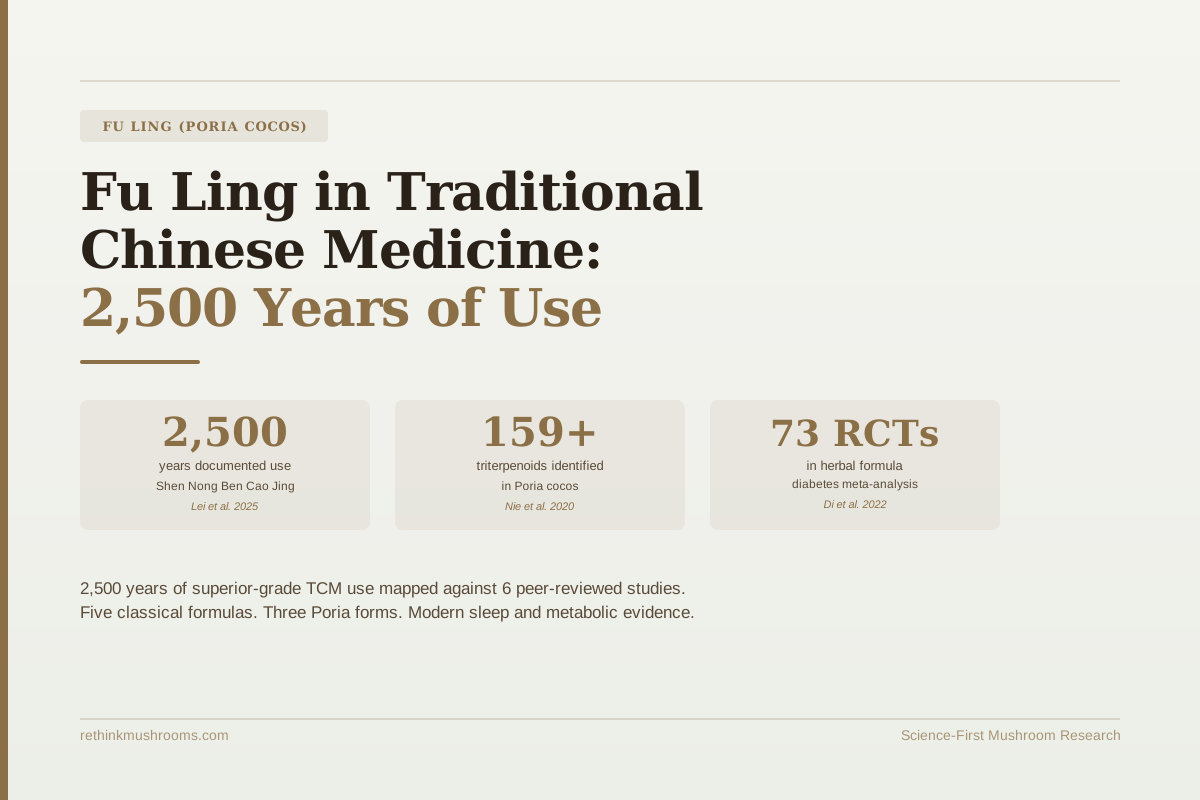
2,500 years
Fu ling carries one of the longest continuously documented histories of any medicinal fungus, classified as superior grade in the Shen Nong Ben Cao Jing, the foundational text of Chinese herbal medicine.
Lei et al., J Ethnopharmacology, 2025
120+
triterpenoids identified in Poria cocos (Lei et al., 2025)
73 RCTs
in Di 2022 herbal formula diabetes meta-analysis
800mg/day
Poria dose in Kim 2023 single-arm sleep study
Lei et al., J Ethnopharmacology, 2025
 View as image ↗
Around 200 BCE, when the Shen Nong Ben Cao Jing was compiled, its authors sorted 365 medicinal substances into three tiers. Fu ling, the dried underground body of the fungus Poria cocos, went into the top tier: shang pin, or superior grade. This wasn't an honorary title. It meant the substance could be taken continuously without causing harm, and that regular use strengthened the body rather than merely treating illness. Over two and a half millennia of use in traditional Chinese medicine (TCM), fu ling kept that status. A 2025 historical review by Lei and colleagues confirmed the 2,500-year continuous record in Chinese medical texts.[5] For background on what fu ling is and why it became so central to the classical pharmacopeia, see the complete overview of Poria fu ling.
This article traces that history: the classical texts that first documented fu ling, the formulas that relied on it, the three distinct forms TCM recognized within a single fungal species, and what modern pharmacology has found when it looked at the same claims.
Key Takeaways
- The Shen Nong Ben Cao Jing (around 200 BCE) placed fu ling in the highest medicinal tier, "superior grade" (shang pin), meaning suitable for continuous long-term use without harm (Lei et al., 2025)
- Traditional Chinese medicine recognized three distinct Poria forms: bai fu ling (white, for Spleen and digestion), chi fu ling (red, for fluid and heat), and fu shen (root-attached, for calming the mind)
- Fu ling appears as a primary ingredient in five major classical formulas, including Si Jun Zi Tang (foundational Spleen tonic) and Gui Zhi Fu Ling Wan (gynecological formula still prescribed in modern TCM)
- A 2023 single-arm clinical study of 21 insomnia sufferers found statistically significant improvements in total sleep duration (327 to 357 min, p=0.014) and reduced arousal time (76 to 48 min, p=0.009) after 800mg daily Poria cocos extract, matching TCM's "calm the Heart Shen" indication (Kim et al.)
- A 2022 meta-analysis of 73 RCTs found herbal formulas containing fu ling improved fasting blood glucose and HbA1c in type 2 diabetes patients (Di et al.)
- Lei and colleagues (2025) report that 120 triterpenoid compounds have been identified in Poria cocos, providing a plausible chemical basis for its wide range of classical applications
The First Written Record: What the Shen Nong Ben Cao Jing Actually Said
The Shen Nong Ben Cao Jing is named after the mythical Divine Farmer (Shen Nong), but it was compiled by practitioners over several centuries, reaching its current form around the first or second century CE. Lei and colleagues' 2025 historical review in the Journal of Ethnopharmacology traces fu ling's documented presence in this foundational text, establishing the 2,500-year continuous record.[5]
The text described fu ling's key properties in terms that TCM still uses today: it quiets the mind, nourishes the Spleen and Stomach, and resolves dampness. "Dampness" in TCM refers to a state of sluggish fluid metabolism in the body, not literal moisture. In practical terms, it described conditions involving heaviness, water retention, loose stools, and a foggy mental state. The Shen Nong Ben Cao Jing positioned fu ling as a remedy for restlessness, poor appetite, and digestive weakness.
What stands out about the superior grade designation is the time-scale assumption. Superior grade herbs were designed for months or years of continuous use, not acute treatment of a specific illness. The authors were distinguishing between herbs that treat disease (and shouldn't be taken indefinitely) and herbs that build baseline health over time. Fu ling was placed firmly in the second category.
Why "Superior Grade" Was the Highest Classification in Chinese Herbal Medicine
The Shen Nong Ben Cao Jing organized its 365 substances into three tiers: shang pin (superior), zhong pin (middle), and xia pin (inferior). The tiers were not rankings of potency for specific diseases. They were assessments of safety profile and intended use pattern.
Superior grade herbs (shang pin) were considered non-toxic and health-promoting. They could be taken continuously. Middle grade herbs were effective treatments for specific conditions but were not intended for indefinite use. Inferior grade herbs were powerful therapeutic agents that required caution and short-term protocols.
Only 120 of the 365 substances earned the superior grade designation. Fu ling was among them, alongside ginseng (Panax ginseng), astragalus (Huang Qi), and jujube (Da Zao). The consistent placement of fu ling in this tier across 2,500 years of subsequent texts, from the Han dynasty through the Qing dynasty, reflects a stable clinical consensus.[5] Practitioners kept prescribing it, and classical formula collections kept featuring it as a primary ingredient.
That consensus turns out to align with modern toxicology. Ríos and colleagues' foundational 2011 review of Poria cocos chemistry in Planta Medica identified no significant toxic compounds in the established chemical profile.[1] The shang pin classification and the modern safety record point in the same direction.
Three Forms of Poria: Not One Substance but Three Clinical Distinctions
Modern discussions of fu ling typically treat it as a single ingredient. Traditional Chinese medicine did not. Classical practitioners recognized three distinct forms based on where in the fungal mass the material originated and what it looked like. Each was considered to have different properties and was used for different clinical presentations.
Bai fu ling: The white inner flesh of the Poria sclerotium. This was the most commonly used form and the one most directly associated with Spleen and Stomach applications. Its primary roles were resolving dampness in the digestive system, strengthening digestive function, and calming mild restlessness with a digestive component. Most classical formulas using "fu ling" without further specification were using bai fu ling.
Chi fu ling: The reddish outer layer of the sclerotium. This form was used more specifically for fluid regulation, urinary problems, and conditions involving accumulated heat. The reddish color was interpreted in TCM as indicating an affinity for clearing heat from the Blood level and guiding fluids downward through the urinary tract.
Fu shen: The portion of the sclerotium that grew directly around a pine tree root. This form was considered particularly potent for calming the Heart and settling the mind. When a formula targeted insomnia, anxiety, palpitations, or emotional agitation, practitioners preferentially chose fu shen over the other forms.
This three-form distinction has practical implications for interpreting modern research. Kim 2023's sleep trial used Poria cocos extract generally, not specifically fu shen.[4] Whether fu shen produces stronger sleep or anxiolytic effects than generic Poria remains an untested question. The classical practitioners had a specific hypothesis that modern trials have not yet addressed.
Five Classical Formulas That Built Fu Ling's Historical Record
Fu ling's presence in major classical formulas across 1,800 years of Chinese medical texts gives a concrete picture of how TCM physicians actually applied it. Five formulas appear repeatedly across the foundational collections.
Si Jun Zi Tang (Four Gentlemen Decoction): This is one of the most foundational formulas in all of TCM, used for the pattern called Spleen qi deficiency. The four ingredients are ginseng, white atractylodes (Bai Zhu), fu ling, and licorice root (Gan Cao). The formula addresses fatigue, poor appetite, loose stools, and low energy that originates from a weakened digestive system. Si Jun Zi Tang serves as the template from which dozens of later formulas were constructed. It appears in the Song dynasty text Pi Wei Lun (Treatise on the Spleen and Stomach, 1249 CE) and remains among the most commonly prescribed formulas in contemporary TCM practice.
Ling Gui Zhu Gan Tang: Named for its four primary ingredients, fu ling being first (ling). This formula targets excess water metabolism problems, particularly when fluid accumulates in the chest or upper abdomen and produces palpitations, shortness of breath, or dizziness on standing. It appears in Zhang Zhongjing's Shang Han Lun (Treatise on Cold Damage), composed around 220 CE.
Gui Zhi Fu Ling Wan (Cinnamon Twig and Poria Pill): Also from the Shang Han Lun, this formula addressed blood stasis patterns in gynecology: retained blood causing lower abdominal masses or menstrual irregularities. Fu ling's role within the formula is to resolve dampness and calm the mind in the context of the other herbs' stronger blood-moving action.
Zhu Ling Tang: A formula for urinary problems, particularly when heat and fluid accumulation combine to cause difficult, painful, or scanty urination. Fu ling appears alongside Polyporus umbellatus (Zhu Ling), another medicinal fungus with a stronger diuretic action.
Si Ling San (Four-Ingredient Powder with Poria): A simpler formula targeting dampness accumulation presenting as diarrhea, edema, reduced urination, and generalized heaviness. This formula is often the starting point when a practitioner needs to address excess fluid without introducing more complex herbs.
Across these five formulas, fu ling served four distinct roles: strengthening Spleen function and digestion, regulating fluid and dampness accumulation, supporting gynecological formulas, and calming the mind. Each role tracks back to a different body system that classical TCM attributed to fu ling's range of action.
The Spleen Qi Claim and Modern Metabolic Research
The TCM concept of "Spleen qi deficiency" has no direct equivalent in modern medicine. The pattern encompasses fatigue, poor appetite, loose stools, weight gain associated with excess dampness, and metabolic sluggishness. In modern terms, the closest overlap is with metabolic syndrome and type 2 diabetes: conditions involving impaired glucose metabolism, weight regulation, and energy utilization.
Di and colleagues published a 2022 meta-analysis in PLoS One examining 73 randomized controlled trials of herbal formulas in type 2 diabetes management.[3] A substantial portion of the formulas analyzed were built around the TCM framework for Spleen qi deficiency, with fu ling as a primary ingredient. The meta-analysis found improvements in fasting blood glucose and HbA1c (the three-month average blood sugar measure) in patients receiving these formulas compared to control groups.
This is not the same as evidence that fu ling alone produces metabolic effects. The formulas in Di's meta-analysis contained multiple ingredients, and isolating fu ling's specific contribution would require trials testing it in isolation against placebo. Those trials do not yet exist in sufficient number to draw firm conclusions.
What the meta-analysis demonstrates is that formulas built on TCM Spleen qi frameworks, where fu ling is a central herb, produce measurable metabolic changes in humans. The mechanism is plausible: Ríos 2011 and Nie 2020 both identified polysaccharide compounds in Poria cocos with documented effects on glucose metabolism in laboratory settings.[1][2] The path from classical Spleen qi theory to modern metabolic research is coherent, even if the human evidence tests formulas rather than fu ling alone.
Calming Heart Shen: What a Small 2023 Trial Found
The concept of "Heart Shen" (心神) in TCM doesn't refer to the physical heart. It describes the mind's seat of consciousness and emotional stability. When classical texts say fu ling or fu shen "calms the Heart Shen," they mean addressing restlessness, anxiety, palpitations, and difficulty sleeping that originates from mental agitation rather than physical exhaustion.
Kim and colleagues published a 2023 single-arm clinical study in the journal Nutrients testing whether Poria cocos could improve sleep in adults with insomnia.[4] The study enrolled 21 insomnia sufferers who received 800mg daily Poria cocos extract, with outcomes measured before and after the intervention. Participants showed statistically significant improvements in total sleep duration (327 to 357 minutes, p=0.014) and a notable reduction in arousal time (76 to 48 minutes, p=0.009). This is preliminary pre-post evidence from a small single-arm study — not a placebo-controlled trial — and replication in randomized designs would be needed to confirm the effect.
The mechanism the researchers proposed involves the GABA-A pathway. GABA (gamma-aminobutyric acid) is the brain's main inhibitory neurotransmitter: the chemical signal that tells neurons to slow down and quiet the nervous system. GABA-A receptors are the same sites that benzodiazepine drugs (commonly prescribed for anxiety and insomnia) activate. Compounds in Poria cocos appear to interact with these receptors in ways that may promote sedation and reduce anxiety.[4]
The trial is small. Twenty-one participants provides preliminary evidence, not a definitive conclusion. Replication in larger trials with standardized extracts would be needed to confirm the effect size and identify the specific active compounds. Whether fu shen specifically outperforms generic Poria in sleep applications remains untested.
For comparison with how other calming mushrooms work, the research on reishi for stress documents a different body of clinical evidence operating through distinct mechanisms. TCM historically distinguished fu ling's calming action from reishi's, and modern pharmacology suggests they work through different pathways rather than duplicating each other.
120 Triterpenoids and Counting: The Chemical Profile Behind Fu Ling's Range
A common objection to TCM's broad claims for individual herbs is that it seems implausible for a single substance to affect digestion, fluid metabolism, sleep, and immune function simultaneously. From a single-molecule pharmaceutical perspective, that breadth would be suspicious.
Poria cocos is not delivering a single molecule. Lei and colleagues' 2025 comprehensive review in the Journal of Ethnopharmacology reports that 120 triterpenoid compounds have been identified in Poria cocos to date.[5] Nie and colleagues' 2020 review in Frontiers in Pharmacology documented the full scope of identified triterpene and polysaccharide chemistry prior to this point.[2] Triterpenoids are carbon-based compounds that fungi and plants produce, many of which have documented biological activity at cell receptors and enzyme sites in the human body.
This chemical complexity means the fungus delivers a mixture of compounds acting on different systems. Some interact with immune cells. Others influence glucose uptake and metabolism. Others, as the sleep research indicates, interact with the nervous system's calming receptors. Ríos 2011 provided the foundational map of Poria cocos compound classes, covering both the polysaccharide fraction (the source of most immune-related effects) and the triterpenoid fraction.[1] Guo and colleagues' 2026 review in Frontiers in Nutrition expanded that profile further, reflecting the continued discovery of new compounds from Poria cocos samples.[6]
The breadth of TCM applications, which reads as implausible from a single-drug perspective, becomes more understandable when Poria cocos is recognized as a chemically complex organism delivering at least 120 identified triterpenoid compounds — alongside its polysaccharide fraction — simultaneously.
The question of which compounds predominate in a given supplement depends heavily on how the extract was processed. This connects to a broader debate in mushroom supplements about extraction methods and which compound classes survive different preparation techniques. The research on how mushrooms regulate the HPA axis and cortisol response covers some of this context from a different angle.
Where the Classical Claims Still Outrun the Evidence
The correspondence between TCM applications and modern findings is real but uneven. The sleep indication has a small human trial supporting it. The metabolic indication has a meta-analysis of formulas containing fu ling. These are actual human data.
Most other classical applications rest almost entirely on laboratory evidence. Studies in cell cultures and animal models suggest mechanisms for fu ling's immune effects, its anti-inflammatory activity, and its influence on various metabolic pathways. Human trials at the scale needed to confirm these effects in defined populations don't yet exist.
TCM also made claims that don't translate cleanly into testable modern hypotheses without further specification. "Calming the Heart Shen" describes a cluster of presentations: anxiety, palpitations, insomnia, and emotional volatility. Each would require a different outcome measure in a clinical trial. Sleep quality is one proxy. Anxiety questionnaire scores are another. Neither fully captures the classical concept.
The 2,500-year historical record doesn't automatically validate all applications. Long continuous use means the substance was consistently prescribed, not necessarily that it consistently worked for every indication. What the historical record does provide is a map of where to look. The indications that persisted across centuries and diverse geographic contexts, Spleen-related digestion, fluid metabolism, and calming the mind, are the ones most worth testing rigorously in modern trials. The current data on sleep and metabolic formulas is a beginning.
The Bottom Line
Fu ling's 2,500-year presence in traditional Chinese medicine reflects a stable clinical consensus: across dynasties and geographic regions, practitioners consistently reached for it when treating digestive weakness, fluid accumulation, and mental restlessness. Modern pharmacology has identified 120 triterpenoid compounds (Lei et al., 2025) and confirmed plausible mechanisms for these classical applications. A small 2023 single-arm study found significant improvements in sleep duration and arousal time at 800mg daily via the GABA-A pathway, and a 2022 meta-analysis of 73 RCTs found metabolic improvements in diabetes patients taking fu ling-based herbal formulas. The human evidence base is real but limited in scale; the strongest claims remain supported by laboratory findings and multi-herb formula trials rather than large single-ingredient randomized trials.
Frequently Asked Questions
Sources & References
- 1RTHM-00431·Ríos, José-Luis (2011). “Chemical constituents and pharmacological properties of Poria cocos..” Planta medica.Study breakdown →PubMed →↩
- 2RTHM-01268·Nie, Anzheng et al. (2020). “Phytochemistry and Pharmacological Activities of Wolfiporia cocos (F.A. Wolf) Ryvarden & Gilb..” Frontiers in pharmacology.Study breakdown →PubMed →↩
- 3RTHM-01503·Di, Yuan Ming et al. (2022). “Benefits of herbal formulae containing Poria cocos (Fuling) for type 2 diabetes mellitus: A systematic review and meta-analysis..” PloS one.Study breakdown →PubMed →↩
- 4RTHM-01720·Kim, Hyeyun et al. (2023). “Efficacy of Poria Cocos Extract on Sleep Quality Enhancement: A Clinical Perspective with Implications for Functional Foods..” Nutrients.Study breakdown →PubMed →↩
- 5RTHM-02126·Lei, Juanhong et al. (2025). “A multidimensional perspective on Poria cocos, an ancient fungal traditional Chinese medicine..” Journal of ethnopharmacology.Study breakdown →PubMed →↩
- 6RTHM-02230·Guo, Yanquan et al. (2026). “Research progress on the pharmacological effects of Poria cocos: a narrative update..” Frontiers in nutrition.Study breakdown →PubMed →↩