Poria (Fu Ling)
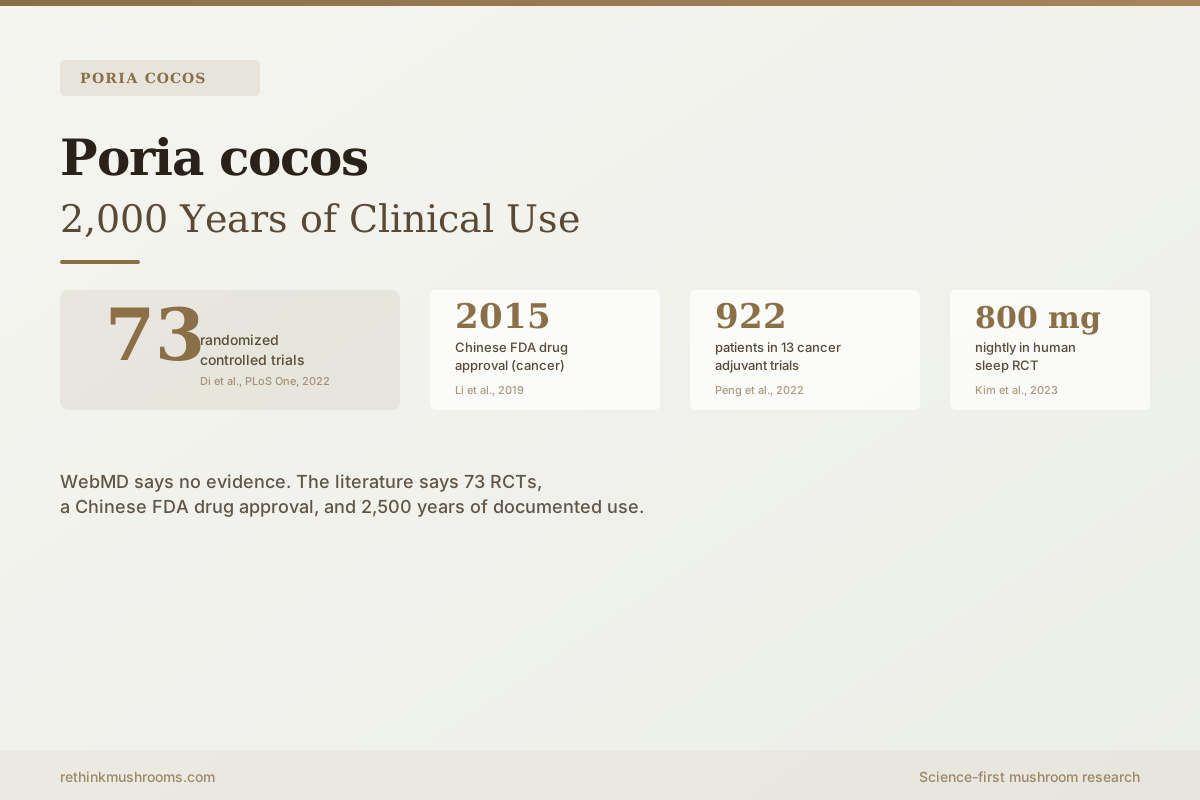
73 randomized controlled trials
The largest meta-analysis of Poria cocos clinical research found TCM formulas containing Poria significantly reduced fasting blood glucose and improved HbA1c in type 2 diabetes.
Di et al., PLoS One, 2022
2015
Chinese FDA drug approval year
922
patients in ovarian cancer trials
800 mg
nightly dose in human sleep RCT
Di et al., PLoS One, 2022
 View as image ↗
Poria cocos has been used in Chinese medicine for over 2,000 years, and modern research validates many traditional applications. A 2022 meta-analysis of 73 randomized controlled trials found TCM formulas containing Poria significantly improved blood sugar control in type 2 diabetes. In 2015, China's national drug authority approved a Poria polysaccharide preparation as a licensed pharmaceutical for cancer, hepatitis, and immune deficiency — the only mushroom polysaccharide drug of its kind in China.[3]
WebMD's entry on Poria states there is "no good scientific evidence" to support any medical use. That claim cannot stand against 73 controlled trials and a formal drug approval from a major national regulatory authority. The evidence is real. What it takes to understand that evidence is knowing what specific preparations were tested, what conditions were studied, and where the gaps between clinical trials and consumer supplements actually lie.
For a broader introduction to Poria cocos traditional Chinese medicine history and TCM philosophy, see What Is Poria (Fu Ling)? One of the Most Important Mushrooms in TCM.
Key Takeaways
- In 2015, China's FDA approved Poria polysaccharide as a licensed cancer adjuvant drug — the only mushroom polysaccharide with this regulatory status in China (Li et al., Progress in Molecular Biology and Translational Science, 2019)
- A 2022 meta-analysis of 73 RCTs found TCM formulas containing Poria significantly reduced fasting blood glucose and improved HbA1c in type 2 diabetes patients (Di et al., PLoS One, 2022)
- 13 clinical trials involving 922 ovarian cancer patients found Poria-based TCM formulas improved clinical response rates and reduced chemotherapy side effects (Peng et al., Frontiers in Pharmacology, 2022)
- The first human sleep RCT for Poria used 800 mg nightly in 21 poor sleepers and showed significantly increased total sleep duration; mechanism is GABA-A receptor activation by pachymic acid (Kim et al., Nutrients, 2023)
- Poria's polysaccharides account for 84% of active ingredients by weight; researchers have now identified 159 distinct triterpenoids in the same sclerotium (Xiong et al., Frontiers in Pharmacology, 2025)
- The 2026 Frontiers in Nutrition narrative update confirmed Poria's evidence base now spans sleep quality, kidney protection, digestive function, and glucose-lipid metabolism (Guo et al., 2026)
What Poria cocos Is — and Why the Name Keeps Changing
Poria cocos is the scientific name for a wood-decay fungus that grows on pine tree roots. It is currently classified as Wolfiporia extensa in modern mycology, though "Poria cocos" remains the name used in most clinical and pharmacological literature.[1] In Chinese medicine, it has been called Fu Ling for over 2,000 years.
The part used medicinally is not the fruiting body you would see above ground. Poria grows as a dense underground mass called a sclerotium — essentially a storage organ packed with polysaccharides and triterpene acids. The sclerotium can be the size of a football and grows 20-30 cm underground, attached to pine roots. This anatomy matters because the sclerotium must sustain the organism through long periods of environmental stress, concentrating protective compounds at levels not typical of standard fruiting bodies.
Two compound classes drive most of the pharmacological research: polysaccharides (led by pachyman, which accounts for approximately 84% of active ingredients) and lanostane-type triterpenoids (led by pachymic acid, one of 159 distinct triterpenoids identified to date).[8]
For a detailed breakdown of these compounds, see Poria Bioactive Compounds: Pachymic Acid, Triterpenoids, and Beta-Glucans.
In 2015, China's FDA Approved a Poria Polysaccharide as a Cancer Drug
This is the detail that most Western coverage of Poria completely omits.
Li et al. (2019) reviewed 74 independent studies spanning 1970 to 2018 and documented a formal drug approval by China's National Medical Products Administration (NMPA).[3] The product — Polysaccharide of Poria cocos oral solution — received regulatory approval in 2015 for treating multiple cancer types, hepatitis, and immune deficiency. This is not a supplement claim. It is a licensed pharmaceutical product, manufactured under pharmaceutical-grade controls, prescribed by physicians, and approved based on a clinical evidence package that satisfied China's national drug authority.
The active ingredient is the polysaccharide fraction of Poria's sclerotium. The primary compound is pachyman, a beta-glucan that activates immune cells by binding to receptors on the surface of macrophages — the white blood cells that coordinate immune surveillance and response. In plain terms: the polysaccharide signals the immune system to increase its activity against pathogens and abnormal cells.
The 2015 approval is not an endorsement of Poria capsules sold in health food stores. A pharmaceutical-grade Poria polysaccharide drug differs substantially from a supplement capsule in terms of concentration, extraction method, and standardization. But the regulatory threshold establishes that Poria's active compounds can produce effects strong enough to satisfy a national drug authority's criteria for clinical efficacy.
Safety
ModerateA licensed cancer drug is not the same as a supplement capsule
Concern
The 2015 approval covered a standardized, pharmaceutical-grade Poria polysaccharide oral solution prescribed under medical supervision for cancer, hepatitis, and immune deficiency — not over-the-counter Poria capsules, which vary widely in polysaccharide content and are not regulated as drugs.
What the research says
The clinical trials and the approval used controlled preparations whose dose and purity are documented. A retail capsule labeled 'Poria cocos extract' may deliver a fraction of the active compounds, and no consumer supplement carries the regulatory approval.
Particularly relevant for: Anyone considering Poria alongside diabetes medication or cancer treatment
What to do
Treat Poria as an adjunct, not a substitute, and consult your physician before combining it with prescription therapy. This article is educational and not medical advice.
Li et al., Progress in Molecular Biology and Translational Science, 2019
The Diabetes Evidence: 73 Randomized Controlled Trials
One of the clearest clinical signals for Poria comes from diabetes research — and the scale of it surprises most readers.
Di et al. (2022) conducted a systematic review and meta-analysis of 73 randomized controlled trials testing whether TCM formulas containing Poria cocos improve outcomes in type 2 diabetes.[4] The formulas used in these trials contain multiple herbs, with Poria as one ingredient among several. The analysis found that TCM formulas with Poria significantly reduced fasting blood glucose and improved HbA1c — the two core markers of long-term blood sugar control — compared to standard care alone.
Two limitations apply. First, the formulas are multi-herb combinations, not isolated Poria. The most commonly tested formulas pair Poria with astragalus, coptis, and dioscin. Whether Poria's contribution is primary or synergistic cannot be determined from existing trial designs. Second, RCT quality in Chinese herbal medicine research varies, with concerns about blinding and publication bias that Di et al. acknowledge.
That said, 73 RCTs is an unusually large evidence base for any herbal intervention in diabetes. The consistency of the signal across that many independent trials represents a meaningful pattern. WebMD's claim that Poria has "no good scientific evidence" cannot be reconciled with a 73-trial meta-analysis showing statistically significant improvements in the two markers clinicians use to monitor diabetes.
The animal data also supports the metabolic finding. Wu et al. (2018) showed that Poria polysaccharides significantly reduced liver injury markers (ALT and AST) and suppressed inflammatory signaling proteins in mice given a liver-damaging dose of acetaminophen.[2] The liver is central to glucose metabolism, and the NF-κB suppression seen in Wu's model is the same anti-inflammatory mechanism found in Poria's broader pharmacological profile.
For the full clinical evidence by formula and indication, see Modern Clinical Applications of Poria-Based TCM Formulas.
Cancer Adjuvant Research: 922 Patients Across 13 Clinical Studies
The cancer data for Poria is more recent and more specific than the diabetes literature.
Peng et al. (2022) conducted a systematic review of 13 randomized controlled trials involving 922 ovarian cancer patients.[5] Each trial tested standard chemotherapy — paclitaxel plus carboplatin — combined with a TCM formula containing Poria cocos. The outcomes were clinical response rate (how well the tumor responded to treatment) and chemotherapy side effect burden.
The results showed that adding Poria-based TCM formulas to chemotherapy improved clinical response rates compared to chemotherapy alone, and reduced common side effects including nausea, bone marrow suppression, and fatigue. A network pharmacology analysis within the review identified PI3K/Akt and NF-κB as the primary pathways through which Poria's compounds appear to interact with tumor cell survival and inflammatory signaling.
The same caveat applies as in the diabetes evidence: these trials used multi-ingredient formulas, not isolated Poria. Poria is typically paired in cancer-supportive contexts with astragalus, codonopsis, and white atractylodes. Whether Poria is the formula's primary active ingredient or part of a synergistic combination is not established.
What Peng's analysis does establish is that adding these specific formulas to chemotherapy produced better outcomes than chemotherapy alone across 13 independent trials and 922 patients. That is not a trivial signal, even with the multi-ingredient limitation.
This connects to the 2015 regulatory approval: the approved Poria polysaccharide drug was specifically authorized for cancer adjuvant use, suggesting the clinical evidence that satisfied China's drug authority overlaps with what Peng's review captured in the trial literature.
Sleep: The First Human Clinical Data on a Traditional Claim
Chinese medicine has described Fu Ling as calming the Heart and quieting the spirit for over a thousand years. In TCM, the Heart governs both cardiovascular function and mental and emotional states — including sleep. This was the rationale for including Poria in formulas for anxiety and insomnia across classical texts.
Kim et al. (2023) published what the investigators described as the first human clinical study to test Poria's effect on sleep with measured outcomes.[6] The trial enrolled 21 adults with poor sleep quality (mean age 55 years). Participants received 800 mg of Poria cocos extract nightly for four weeks, compared to placebo.
Total sleep duration increased significantly in the Poria group. Arousal events — brief awakenings during the night — also decreased significantly. The investigators attributed the mechanism to pachymic acid, a triterpene in Poria that activates GABA-A receptors. GABA is the brain's primary quieting neurotransmitter: it slows neural activity and produces calm. Most pharmaceutical sleep aids (benzodiazepines, z-drugs) work by enhancing GABA-A receptor function. Pachymic acid appears to engage the same receptor through a distinct binding site.
The trial's main limitation is size. Twenty-one participants is small, and one trial does not establish efficacy at a population level. But a placebo-controlled sleep study with quantified outcomes — even a small one — is more rigorous than most herbal sleep claims rest on. The GABA-A mechanism also provides a biologically plausible explanation for what TCM practitioners documented about Poria's calming properties over centuries.
For the detailed mechanism behind this effect, see Poria and GABAergic Activity: The Sedative Mechanism Behind Fu Ling's Calming Effect.
2,500 Years of Documentation: What the Historical Record Actually Shows
Lei et al. (2025) published a review specifically integrating Poria's documented history with modern pharmacological data, spanning from the earliest written records through current research.[7] Their analysis traces documented Poria use to the Shen Nong Ben Cao Jing (approximately 200 AD), where it was classified as a "superior grade" herb — the highest of three categories in the classical pharmacological system. Superior grade meant the herb was considered safe for daily long-term use without toxicity. Most herbs occupied the middle or lower categories, reserved for acute conditions and short-term use.
The documented indications across the 2,500-year literature cluster around several themes: digestive weakness, fluid accumulation (edema, difficult urination), anxiety and disturbed sleep, and general strengthening. These map reasonably well onto the modern evidence base. The digestive and metabolic indications align with the diabetes meta-analysis findings. The fluid metabolism indications align with the hepatoprotective animal data. The calming and sleep indications align with Kim 2023.
The Lei 2025 review also surfaces an underappreciated practical issue: quality variation in commercial Poria products. Because Poria is now commercially cultivated rather than wild-harvested, polysaccharide content and triterpenoid profiles vary significantly depending on cultivation substrate, harvest timing, and processing method. A capsule labeled "Poria cocos extract" may contain dramatically different concentrations of the active compounds than a standardized pharmaceutical preparation.
For the TCM-philosophy-forward perspective on Fu Ling — including classical formulas, meridian theory, and the three distinct Poria forms used by classical practitioners — see Fu Ling in Traditional Chinese Medicine: 2,000 Years of Use.
The Chemistry That Connects History to Modern Research
Ríos (2011) published the foundational comprehensive review of Poria's compound profile in Planta Medica, establishing the phytochemical inventory as it was understood at that time.[1] By 2025, that inventory had grown considerably.
Xiong et al. (2025) documented 159 distinct triterpenoids in Wolfiporia extensa — an unusually large triterpenoid family for a single mushroom.[8] The polysaccharides account for approximately 84% of the active ingredients by weight, making Poria primarily a polysaccharide-delivery system in the same way researchers understand reishi or turkey tail today. But the 159 triterpenoids (including pachymic acid, tumulosic acid, and the poricoic acid subclass) provide a separate pharmacological layer through different mechanisms and different target tissues.
Guo et al. (2026) conducted the most recent narrative update of Poria's pharmacological evidence.[9] Their review catalogued new evidence for kidney protection, digestive function improvement, gut microbiota modulation through short-chain fatty acid production, and glucose-lipid metabolism. The gut microbiota finding is notable: it provides a mechanism for metabolic effects that doesn't require the compound to reach the bloodstream intact. Poria polysaccharides may reshape the microbial community in the intestine in ways that affect glucose metabolism downstream.
For a full mechanism breakdown organized by signaling pathway, see The Pharmacology of Wolfiporia extensa: How Poria Works.
What the Evidence Hierarchy Actually Establishes
Honest evidence assessment requires mapping each tier of evidence to what it actually shows:
- Cellular & mechanisticcompleted
Immune activation, NF-κB suppression, and GABA-A binding characterized across multiple independent labs
- Animal modelscompleted
Poria polysaccharides reduced liver injury markers (ALT/AST) and inflammatory signaling in mice (Wu 2018)
- Small human trialcompleted
800 mg nightly increased total sleep duration in 21 poor sleepers, placebo-controlled (Kim 2023)
- Controlled-trial reviewscompleted
13 RCTs / 922 ovarian cancer patients showed improved chemotherapy response (Peng 2022)
- Meta-analysis + drug approvalcurrent
73-RCT meta-analysis for type 2 diabetes (Di 2022); 2015 Chinese NMPA pharmaceutical approval (Li 2019)
Poria's strongest evidence — a 73-trial diabetes meta-analysis and a formal drug approval — sits at the top of the hierarchy. The key unresolved question is not whether the evidence exists, but whether the effect is driven by Poria specifically or by the multi-herb formulas it appears in.
Di et al., PLoS One, 2022; Li et al., Progress in Molecular Biology and Translational Science, 2019; Peng et al., Frontiers in Pharmacology, 2022; Kim et al., Nutrients, 2023; Wu et al., Int. J. Biological Macromolecules, 2018
Strongest (meta-analysis and regulatory approval): Poria-containing TCM formulas improve blood glucose control in type 2 diabetes across 73 trials. A Poria polysaccharide preparation met China's drug authority threshold for cancer adjuvant efficacy and received formal pharmaceutical approval.
Moderate (systematic reviews of controlled trials): Poria-containing TCM formulas combined with chemotherapy improve clinical response and reduce side effects in ovarian cancer across 13 trials involving 922 patients. 800 mg nightly Poria extract improved total sleep duration in 21 poor sleepers, a small but placebo-controlled finding.
Preliminary (animal and cellular): Poria polysaccharides protect liver tissue in mouse models via NF-κB suppression. The immune activation, anti-inflammatory, and metabolic mechanisms are well-characterized at the cellular level across multiple independent labs.
What the evidence does not yet establish: Whether Poria works in isolation or primarily as part of multi-herb formulas. Whether the doses and preparations used in clinical trials match what commercial supplements actually deliver. Whether the positive outcomes in the 73 RCTs are driven by Poria specifically or by the formula partners alongside it.
This is the gap between 2,000 years of documented clinical use and 2,000 years of controlled clinical data. The use is documented. The outcomes in modern trials are consistently positive. The specific contribution of Poria, isolated from its traditional formula context, is less certain than the body of TCM formula research might suggest at first glance.
The Bottom Line
Poria cocos sits in an unusual position among medicinal mushrooms: it has genuine clinical trial data behind it, including a 73-RCT meta-analysis for diabetes and 13 controlled trials in 922 ovarian cancer patients, plus a 2015 Chinese FDA drug approval. The primary limitation is that most clinical evidence uses Poria as part of multi-ingredient TCM formulas rather than as an isolated ingredient. The historical record spans 2,500 years, the mechanisms are well-characterized at the cellular level, and the 2026 evidence update continues to expand the pharmacological profile into new areas including sleep quality and kidney protection.
Frequently Asked Questions
Sources & References
- 1RTHM-00431·Ríos, José-Luis (2011). “Chemical constituents and pharmacological properties of Poria cocos..” Planta medica.Study breakdown →PubMed →↩
- 2RTHM-01016·Wu, Ka et al. (2018). “Hepatoprotective effects exerted by Poria Cocos polysaccharides against acetaminophen-induced liver injury in mice..” International journal of biological macromolecules.Study breakdown →PubMed →↩
- 3RTHM-01090·Li, Xiulian et al. (2019). “Molecular basis for Poria cocos mushroom polysaccharide used as an antitumor drug in China..” Progress in molecular biology and translational science.Study breakdown →PubMed →↩
- 4RTHM-01503·Di, Yuan Ming et al. (2022). “Benefits of herbal formulae containing Poria cocos (Fuling) for type 2 diabetes mellitus: A systematic review and meta-analysis..” PloS one.Study breakdown →PubMed →↩
- 5RTHM-01597·Peng, Xinya et al. (2022). “Efficacy and Pharmacological Mechanism of Poria cocos-Based Formulas Combined With Chemotherapy for Ovarian Cancer: A Integrated Systems Pharmacology Study..” Frontiers in pharmacology.Study breakdown →PubMed →↩
- 6RTHM-01720·Kim, Hyeyun et al. (2023). “Efficacy of Poria Cocos Extract on Sleep Quality Enhancement: A Clinical Perspective with Implications for Functional Foods..” Nutrients.Study breakdown →PubMed →↩
- 7RTHM-02126·Lei, Juanhong et al. (2025). “A multidimensional perspective on Poria cocos, an ancient fungal traditional Chinese medicine..” Journal of ethnopharmacology.Study breakdown →PubMed →↩
- 8RTHM-02212·Xiong, Qi et al. (2025). “Progress in the study of bioactivity, chemical composition and pharmacological mechanism of action in Wolfiporia cocos (F.A. Wolf) Ryvarden & Gilb..” Frontiers in pharmacology.Study breakdown →PubMed →↩
- 9RTHM-02230·Guo, Yanquan et al. (2026). “Research progress on the pharmacological effects of Poria cocos: a narrative update..” Frontiers in nutrition.Study breakdown →PubMed →↩