Poria (Fu Ling): Diuretic, Digestive Health & Edema
2 tight junction proteins
Poria polysaccharides upregulate Occludin and ZO-1, two of the molecular seals that hold intestinal cells together. When these proteins increase, the gut barrier strengthens and the chronic inflammation that drives bloating decreases.
Duan et al., Int. J. Biol. Macromol., 2023
2,000+ yrs
documented use in TCM for diuretic, sedative, and tonic effects, reviewed with modern pharmacology (Ríos, 2011)
motilin + gastrin
gut motility hormones raised by Poria water extract in a spleen deficiency model (Li et al., 2023)
IL-2 + AQP2
immune and water-channel markers raised by Fuling water extract in a spleen deficiency comparison (Min et al., 2023)
Duan et al., Int. J. Biol. Macromol., 2023
 View as image ↗
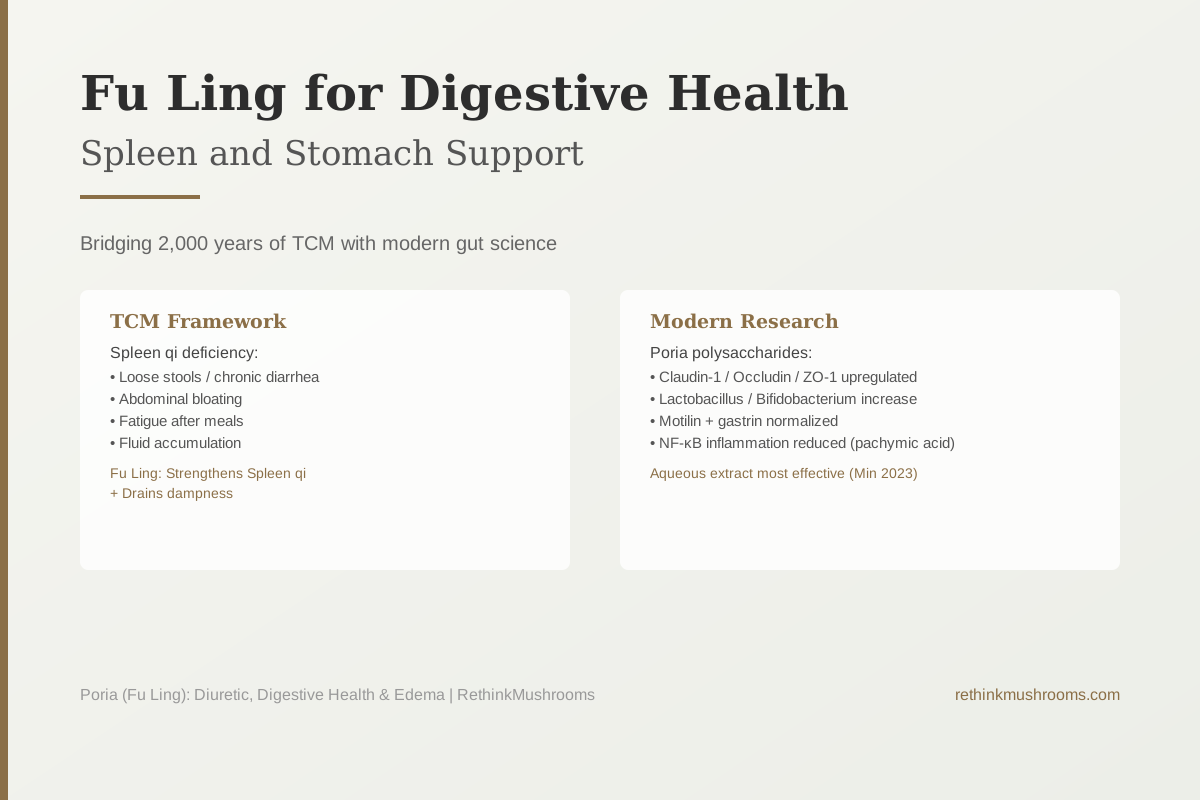
Fu Ling, the Traditional Chinese Medicine (TCM) name for the fungus Poria cocos, has been prescribed for weak digestion for more than two thousand years. The TCM prescription is specific: it "strengthens Spleen qi and drains dampness," language that sounds esoteric until you understand what it describes. Modern researchers studying Poria polysaccharides have found something that maps directly onto those ancient observations. Poria strengthens the gut wall, shifts the community of bacteria living in the gut toward more beneficial species, and modulates the hormones that regulate gut movement, which is broadly what you would expect from a treatment that "strengthens the spleen" in the digestive sense.
This article bridges those two framings. The TCM language describes a clinical observation accumulated over centuries. The modern research provides a molecular explanation for what was observed. For background on what Poria is and its broader history in TCM, see What Is Poria? Fu Ling, One of the Most Important Mushrooms in TCM.
Key Takeaways
- In TCM, the "Spleen" refers to the digestive and metabolic system, not the anatomical spleen; "spleen qi deficiency" describes symptoms including loose stools, bloating, fatigue, and poor appetite
- Poria polysaccharides increased the Occludin and ZO-1 tight junction proteins in intestinal epithelium, strengthening the gut barrier, and raised short-chain fatty acid levels in the gut (Duan et al., Int. J. Biol. Macromol., 2023)
- In an antibiotic-associated diarrhea model, Poria polysaccharides reversed gut dysbiosis and restored the intestinal mucosal barrier (Xu et al., 2023)
- In a spleen deficiency model, Poria water extract raised motilin and gastrin and modulated aquaporin water channels through the AC-cAMP signaling pathway, alongside improved digestive markers (Li et al., 2023)
- A comparison of Fuling preparations in a spleen deficiency model found the water extract reduced motilin and gastrin and raised IL-2 and AQP2, while serotonin and IL-4 were unchanged (Min et al., 2023)
- All evidence is from animal models; no human randomized controlled trial has directly tested Poria for IBS or bloating as a primary endpoint
What TCM "Spleen" Means: Not What You Think
To understand what Fu Ling does for digestion, the first step is understanding what TCM practitioners mean by "Spleen." This is not the anatomical spleen (the immune organ on the left side of the abdomen). In TCM, the Spleen is a functional system that governs the transformation of food and fluids into energy and usable nutrients. It is roughly equivalent to the combination of digestive enzyme function, gut motility, and fluid metabolism that modern medicine distributes across the stomach, small intestine, pancreas, and lymphatic system.
Spleen qi deficiency in TCM is a clinical pattern, not a diagnosis of organ disease. The pattern includes: loose stools or frequent diarrhea, abdominal bloating and distension, poor appetite, fatigue after meals, and a tendency to accumulate fluid in the abdomen and limbs. Poria has been used within this framework for its diuretic, sedative, and tonic effects for centuries, a history compiled and evaluated against modern pharmacology in a widely cited review.[1]
Fu Ling addresses this pattern through the TCM framework of "strengthening Spleen qi and draining dampness." Dampness in this context is excess fluid that accumulates when the digestive system cannot properly metabolize and excrete it. The treatment goal is to restore normal digestive function and clear the accumulated fluid.
Modern researchers studying Poria cocos have found biomarkers that correspond to these symptoms: motilin and gastrin regulate gut motility and stomach emptying; aquaporins (a family of proteins that control water movement through cells) regulate fluid distribution; and gut microbiota composition influences whether food ferments beneficially or produces bloating gas. These are the molecular correlates of what TCM practitioners were observing and treating.
How Poria Polysaccharides Strengthen the Gut Barrier
The most direct evidence for Poria's digestive mechanism comes from a 2023 study by Duan and colleagues, who tested Poria cocos polysaccharides on intestinal barrier function in mice.[2]
The gut barrier is a single layer of epithelial cells lining the intestinal wall. These cells must do two contradictory things simultaneously: absorb nutrients from the gut contents while preventing bacteria and bacterial toxins from crossing into the bloodstream. The structural solution is tight junction proteins, molecular fasteners that seal the gaps between adjacent intestinal cells. When these proteins are abundant and intact, the barrier holds. When they are degraded, bacterial toxins and incompletely digested food molecules leak through into the bloodstream, triggering chronic, low-grade inflammation. This condition is sometimes called increased intestinal permeability, or informally, leaky gut.
In the Duan study, Poria polysaccharides strengthened the intestinal physical barrier by upregulating the expression of Occludin and ZO-1, two of the core sealing proteins of the tight junction system, while lowering markers of a leaky barrier such as serum endotoxin, diamine oxidase, and D-lactate. The polysaccharides also boosted the biochemical barrier (mucin MUC2 and secretory IgA), modulated immune signaling, and raised short-chain fatty acid levels in the small intestine, effects the authors linked to a shift in gut microbial composition.
This mechanism gives the TCM "strengthen the spleen" description a molecular translation. Strengthening the gut barrier reduces the inflammatory load that drives chronic digestive symptoms including bloating, irregular bowel habits, and fatigue after meals.
A 2025 study by Chen and colleagues extended this finding: in a colitis-associated colorectal cancer model, Poria polysaccharides restored intestinal tight junction proteins (E-cadherin, ZO-1, and Claudin-3), reduced gut permeability, and favorably shifted gut microbiota, confirming the barrier-restoration effect in a different disease context.[5]
Poria and Gut Bacteria: The Prebiotic Effect
Alongside the gut barrier evidence, multiple studies have documented how Poria polysaccharides interact with gut microbiota, the community of bacteria that lives in the large intestine and influences everything from immune function to mood.
Xu and colleagues used an antibiotic-associated diarrhea model to test this. Antibiotics disrupt gut microbiota by killing beneficial bacteria along with the harmful ones, often causing diarrhea, bloating, and gut inflammation that can persist for weeks or months after a course of treatment. When Poria cocos polysaccharides were administered, the dysbiosis (the medical term for an unhealthy imbalance in gut bacteria) reversed, the intestinal mucosal barrier was restored, and immune and metabolic signaling normalized, including the short-chain fatty acid receptor GPR41 and the regulatory immune marker FOXP3.[3]
Short-chain fatty acids are compounds produced when beneficial gut bacteria ferment dietary fiber. Butyrate, the most studied, is the primary energy source for the cells lining the colon and plays a direct role in maintaining the gut barrier. The finding by Duan and colleagues that Poria polysaccharides raised short-chain fatty acid levels in the gut is a marker of improved bacterial community function, not just a shift in population numbers.[2]
Wan and colleagues found related results in a colitis model in 2024.[4] Poria polysaccharides mitigated ulcerative colitis symptoms in mice, reducing body weight loss, colon-length shortening (colons shorten with inflammation), and disease activity scores. They enhanced colonic barrier integrity by increasing tight junction protein abundance and suppressed NF-κB activation, an inflammatory signaling switch. The polysaccharides also reversed dysbiosis: beneficial bacteria such as the Akkermansiaceae family increased while harmful bacteria such as the Erysipelotrichaceae family decreased.
These bacterial shifts are directly relevant to digestive symptoms. Akkermansia and related mucin-associated bacteria support the gut barrier and are consistently linked to a healthier gut lining, while an overgrowth of pro-inflammatory families is associated with gas production, inflammation, and loose stools, which are exactly the symptoms of TCM spleen qi deficiency. Notably, the authors showed the benefit was transferable: transplanting feces from Poria-treated mice into antibiotic-treated mice reproduced the anti-colitis effect, strong evidence that the microbiota shift is causal rather than incidental.
The Spleen Deficiency Biomarker Studies: Connecting TCM and Molecular Science
The most direct evidence connecting the TCM spleen qi deficiency pattern to measurable biological markers comes from two 2023 studies that induced spleen deficiency in rats and measured what Poria water extract changed.
Li and colleagues set out to identify the effective components of Poria water extract and its mechanism in a dampness-and-spleen-deficiency model.[6] After treatment, the extract increased fecal moisture, urine output, D-xylose absorption (a marker of gut absorptive function), amylase, albumin, and total protein, alongside body weight. Mechanistically, it raised serum motilin (MTL) and gastrin (GAS) and activated the AC-cAMP-PKA-CREB signaling cascade in the stomach, while adjusting aquaporin water channels across the gut (raising AQP3 in the colon and lowering several others). The researchers screened out eleven active components and concluded that Poria drains dampness by regulating the cAMP-aquaporin pathway and the gut-motility hormones motilin and gastrin.
Motilin is a hormone produced by intestinal cells that regulates the speed of muscular contractions moving food through the gut. Gastrin is a hormone produced by stomach cells that stimulates acid secretion and helps coordinate gut motility. Aquaporins are water-channel proteins that regulate how water moves through cell membranes in the kidney and gut wall, the molecular basis for clearing what TCM calls "dampness."
Min and colleagues took a complementary approach, comparing Fuling and its preparations (raw powder, cooked powder, aqueous extract, and alcohol extract) in a separate spleen deficiency model.[7] They measured motilin, gastrin, aquaporin-2 (AQP2), interleukin-2 (IL-2), IL-4, and serotonin (5-HT). Fuling and its extracts reduced motilin and gastrin and increased IL-2 and AQP2, while IL-4 and serotonin showed no significant change. The authors concluded that Fuling supports digestive function and water metabolism in this model.
A candid reading of these two studies shows both convergence and tension. Both found that Poria water extract engages the same core machinery, the gut-motility hormones motilin and gastrin and the aquaporin water channels, and both improved digestive or water-metabolism markers. But the direction of the motilin and gastrin change differed between the two models (Li saw an increase; Min saw a decrease), a reminder that "spleen deficiency" is induced differently across labs and that Poria's effect on these hormones is best described as modulatory rather than uniformly raising or lowering them. What the traditional decoction is doing, both studies agree, is acting on digestion and fluid balance through measurable, conventional physiology. Because the traditional preparation of Fu Ling is almost always a water-based decoction, the fact that both studies used water extracts is consistent with, though not by itself proof of, the traditional preparation method.
Pachymic Acid: Reducing the Inflammation Behind Bloating
Poria contains two main classes of bioactive compounds: polysaccharides (the gut barrier and microbiota effects described above) and triterpenoids. Pachymic acid is the most studied triterpenoid in Poria, and its anti-inflammatory activity is relevant to digestive health.
Wei and colleagues published a comprehensive review of pachymic acid's pharmacological profiles in 2022, summarizing its cytotoxic, anti-inflammatory, antihyperglycemic, antiviral, antibacterial, and sedative-hypnotic activities along with its biosynthesis and pharmacokinetics.[8] The mechanism most relevant to digestive applications is anti-inflammatory: across multiple studies, pachymic acid inhibits NF-κB, a molecular switch that sits at the center of the inflammatory response inside cells. When NF-κB is activated, cells produce a cascade of inflammatory proteins that drive tissue swelling, permeability changes, and pain. When pachymic acid blocks it, that cascade is reduced, the same NF-κB suppression Wan and colleagues observed with whole Poria polysaccharides in their colitis model.
In the gut, NF-κB activation is a primary driver of inflammatory conditions from gastritis to colitis, and it contributes to the chronic, low-grade gut inflammation associated with increased intestinal permeability. Pachymic acid's NF-κB inhibition complements the polysaccharide tight junction effects: polysaccharides rebuild the barrier while triterpenoids reduce the inflammatory process that is degrading it.
Pachymic acid and the Poria triterpenoids also contribute to the fungus's well-known diuretic effect, which is covered in depth in Poria as a Natural Diuretic: How It Reduces Water Retention. The shared chemistry between digestive support and diuresis helps explain why the same plant material has been used in TCM for both "dampness draining" (fluid clearance) and "spleen strengthening" (digestive support).
For a full breakdown of Poria's bioactive compound classes, see Poria Bioactive Compounds: Pachymic Acid, Triterpenoids, and Beta-Glucans. For the broader historical context of how Fu Ling was used across 2,000 years of TCM practice, see Poria cocos in Traditional Chinese Medicine: 2,000 Years of Clinical Use.
What the Evidence Currently Shows, and What It Doesn't
The studies described above produce a consistent biological story: Poria polysaccharides strengthen the gut barrier, shift microbiota toward beneficial species, modulate gut motility hormones, and reduce gut inflammation. The triterpenoid fraction adds anti-inflammatory effects via NF-κB inhibition.
- Cell & mechanism studiescompleted
Tight junction proteins, NF-κB inhibition, aquaporin and hormone signaling all characterized
- Animal modelscurrent
Barrier, microbiota, colitis, diarrhea, and spleen-deficiency models in mice and rats
- Small human trialsmissing
No published trial for IBS, bloating, or gut microbiota as a primary endpoint
- Large RCTsmissing
- Meta-analysesmissing
Poria's digestive mechanisms are well characterized in cells and animals, and recent reviews rank the gut barrier and microbiota effects among the better-supported areas of Poria research. But the evidence stops at animal models: no human randomized controlled trial has tested Poria for a digestive endpoint like IBS or functional bloating.
Duan 2023; Xu 2023; Wan 2024; Chen 2025; Li 2023; Min 2023; Xiong 2025; Guo 2026
Two recent reviews of Poria pharmacology reinforce that the digestive effects are a genuine research focus. Xiong and colleagues, in a 2025 review of Wolfiporia cocos in Frontiers in Pharmacology, listed regulation of the intestinal flora among the fungus's documented pharmacological activities alongside anti-inflammatory and immunomodulatory effects.[9] Guo and colleagues, in a 2026 narrative update in Frontiers in Nutrition summarizing research from 2023 to 2025, explicitly identified "improving digestive system function" as one of Poria's core pharmacological effects, with mechanisms centered on modulation of the gut microbiota.[10]
The honest limitation: all of this evidence comes from animal models. No human randomized controlled trial has specifically tested Poria cocos for IBS, functional bloating, or gut microbiota improvement as a primary endpoint. The spleen deficiency studies by Li and Min are well-designed for their purpose but remain animal-based research. The colitis and diarrhea studies are preclinical.
This does not mean the evidence is irrelevant. The mechanisms are biologically plausible, the animal models used are well-established, and the clinical observations from centuries of TCM practice align with what the research is finding. But anyone encountering Poria-based digestive health claims should understand that the evidence sits at the animal research stage for these specific endpoints, not at the human clinical trial stage. Nothing here is medical advice; if you have persistent digestive symptoms, consult a qualified healthcare provider.
For the related diuretic and edema applications, which share some of the same mechanisms, see Poria and Edema: Traditional Use with Modern Evidence and Poria for Bloating and Fluid Retention: Clinical Applications.
The Bottom Line
Fu Ling's reputation as a digestive herb in TCM maps onto specific, measurable biological mechanisms in animal studies: Poria polysaccharides increase the Occludin and ZO-1 tight junction proteins that seal the gut wall, raise short-chain fatty acid levels, shift microbiota toward beneficial families such as Akkermansiaceae, reverse dysbiosis-associated diarrhea, and modulate gut motility hormones (motilin and gastrin) and aquaporin water channels. Pachymic acid, the triterpenoid compound, adds NF-κB anti-inflammatory effects that reduce the gut inflammation driving chronic bloating. The traditional decoction uses water extracts, and the spleen-deficiency studies also used water extracts, consistent with the traditional preparation method. All of the evidence is preclinical; human clinical trials for digestive endpoints are lacking.
Frequently Asked Questions
Sources & References
- 1RTHM-00431·Ríos, José-Luis (2011). “Chemical constituents and pharmacological properties of Poria cocos..” Planta medica.Study breakdown →PubMed →↩
- 2RTHM-01689·Duan, Yuting et al. (2023). “Poria cocos polysaccharide improves intestinal barrier function and maintains intestinal homeostasis in mice..” International journal of biological macromolecules.Study breakdown →PubMed →↩
- 3RTHM-01825·Xu, Huachong et al. (2023). “Poria cocos Polysaccharide Ameliorated Antibiotic-Associated Diarrhea in Mice via Regulating the Homeostasis of the Gut Microbiota and Intestinal Mucosal Barrier..” International journal of molecular sciences.Study breakdown →PubMed →↩
- 4RTHM-02011·Wan, Jin et al. (2024). “Poria cocos polysaccharide alleviates dextran sulphate sodium-induced ulcerative colitis in mice by modulating intestinal inflammatory responses and microbial dysbiosis..” International journal of biological macromolecules.Study breakdown →PubMed →↩
- 5RTHM-02067·Chen, Lin et al. (2025). “Poria cocos polysaccharides ameliorate AOM/DSS-induced colorectal cancer in mice by remodeling intestinal microbiota composition and enhancing intestinal barrier function..” International journal of biological macromolecules.Study breakdown →PubMed →↩
- 6RTHM-01727·Li, Huijun et al. (2023). “Screening the effective components in treating dampness stagnancy due to spleen deficiency syndrome and elucidating the potential mechanism of Poria water extract..” Chinese journal of natural medicines.Study breakdown →PubMed →↩
- 7RTHM-01753·Min, Feng et al. (2023). “Effectiveness of Fuling () and its extracts against spleen deficiency in rats tonifying spleen..” Journal of traditional Chinese medicine = Chung i tsa chih ying wen pan.Study breakdown →PubMed →↩
- 8RTHM-01632·Wei, Chunyong et al. (2022). “Pharmacological profiles and therapeutic applications of pachymic acid (Review)..” Experimental and therapeutic medicine.Study breakdown →PubMed →↩
- 9RTHM-02212·Xiong, Qi et al. (2025). “Progress in the study of bioactivity, chemical composition and pharmacological mechanism of action in Wolfiporia cocos (F.A. Wolf) Ryvarden & Gilb..” Frontiers in pharmacology.Study breakdown →PubMed →↩
- 10RTHM-02230·Guo, Yanquan et al. (2026). “Research progress on the pharmacological effects of Poria cocos: a narrative update..” Frontiers in nutrition.Study breakdown →PubMed →↩