Psilocybin Species Taxonomy
165+ species
Recognized Psilocybe species — the genus at the core of psilocybin-producing fungi, whose biosynthetic gene cluster evolution was mapped by 2024 PNAS phylogenomics. Including 20+ Panaeolus and scattered occurrences across 10+ other genera, the total across all fungi exceeds 200.
Bradshaw et al. PNAS. 2024
10+
fungal genera where psilocybin has been independently confirmed
2018
year horizontal gene transfer was established as the mechanism connecting unrelated genera
~13%
of herbarium specimens catalogued as Psilocybe actually belonged to other genera entirely (Bradshaw 2022)
Bradshaw et al. PNAS. 2024
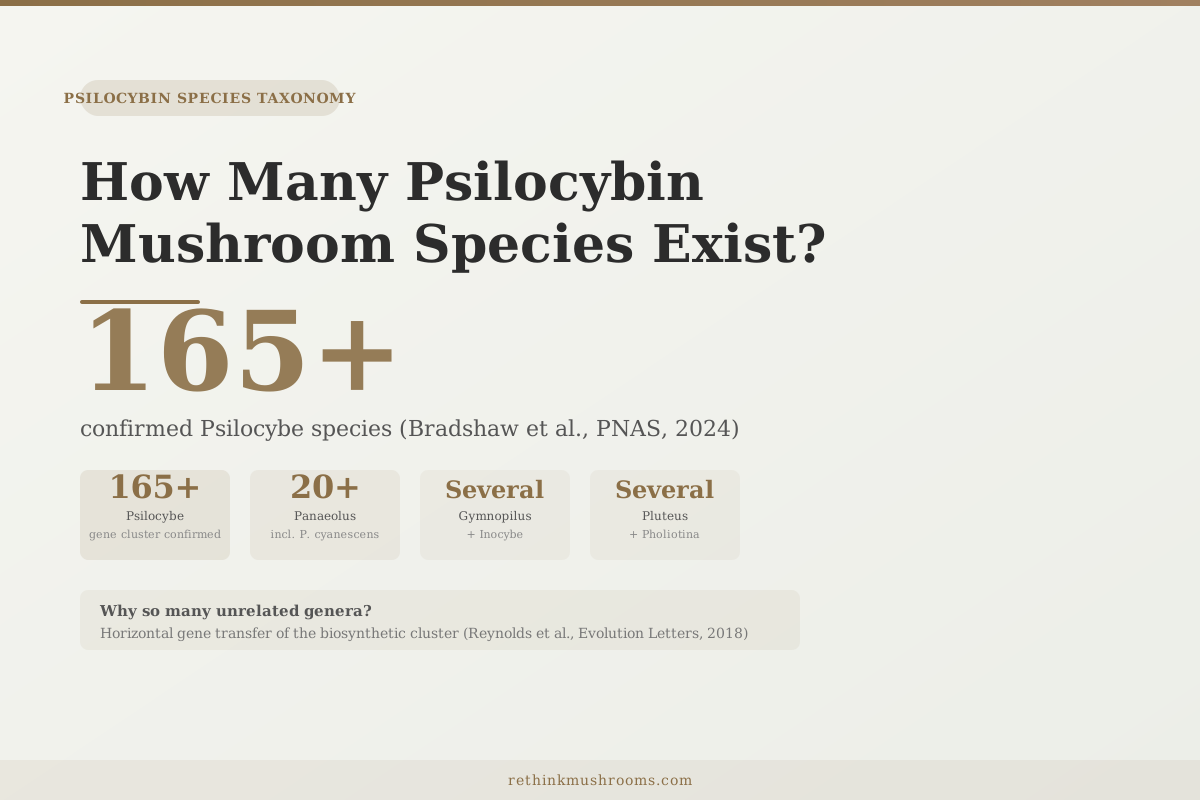 View as image ↗
The question "how many psilocybin mushroom species are there?" sounds simple. The answer depends on what you're counting, and counting itself turns out to be harder than it looks.
Older estimates often cited "approximately 200 species." That figure grouped species where psilocybin had merely been detected alongside species where the biosynthetic machinery for making psilocybin has been genetically characterized. A 2024 PNAS study by Bradshaw and colleagues used full genomic sequencing (phylogenomics) to place this on firmer footing: the genus Psilocybe — the core group of psilocybin-producing fungi — comprises approximately 165 recognized species, and the study reconstructed how the psilocybin biosynthetic gene cluster evolved across the genus.[1]
Add the non-Psilocybe genera, and the total across all fungal families does exceed 200. But the more interesting question than "how many?" is "why so many unrelated lineages?" The answer to that involves a process called horizontal gene transfer, and it is the most important biological fact about the distribution of psilocybin that almost no popular content discusses.
For a deep look at the specific gene cluster involved and how it works, see The Psilocybin Gene Cluster: Genetics of Magic Mushrooms. For the world's most widely cultivated psilocybin species, see Psilocybe cubensis: The World's Most Cultivated Magic Mushroom.
Key Takeaways
- The genus Psilocybe — the core of psilocybin-producing fungi — comprises approximately 165 recognized species; Bradshaw et al. (PNAS, 2024) used phylogenomics to reconstruct how the psilocybin biosynthetic gene cluster evolved across the genus
- Psilocybin occurs in 10+ unrelated fungal genera including Panaeolus, Gymnopilus, Inocybe, Pluteus, and Pholiotina
- Reynolds et al. (2018) demonstrated that the psilocybin gene cluster spread across these unrelated lineages through horizontal gene transfer, not shared ancestry
- Bradshaw et al. (2022) found widespread misdetermination rates in academic herbarium specimens, meaning historical species counts were unreliable
- Cohen et al. (2025) showed that metabolite diversity across 42 psilocybin-producing strains does not sort cleanly by species name. Knowing the species does not reliably predict potency
- New species are still being described; the count is not final
The Current Count: What 2024 Phylogenomics Found
The genus Psilocybe contains the largest number of confirmed psilocybin-producing species in any single genus. Bradshaw and colleagues published the most rigorous current analysis in PNAS in 2024, using phylogenomics, which means full genome sequencing and evolutionary analysis rather than morphological description or single-gene barcoding.[1]
Their analysis worked from a genus of approximately 165 recognized Psilocybe species and reconstructed the evolution of the psilocybin biosynthetic gene cluster across it. Before this work, the intact gene cluster had been sequenced from only a handful of species; Bradshaw and colleagues sequenced 71 metagenomes from fungarium specimens (including 23 type specimens) to map the cluster's evolutionary history within the genus. Phylogenomics adds a criterion that morphology and chemical detection alone cannot: confirming the genetic machinery to produce psilocybin biosynthetically, rather than a compound that might have been accumulated from environmental sources or attributed to a misidentified specimen.
Psilocybe cubensis is the most widely cultivated species and the one most familiar to readers globally, but it is not the most potent or even morphologically representative of the genus. The genus spans tropical, subtropical, and temperate habitats across six continents, with diversity concentrated in Mexico, Central America, Southeast Asia, and the Pacific Northwest of North America.
The Two Ways to "Have Psilocybin": Detection vs. Gene Cluster
Not every species listed in psilocybin mushroom catalogs has been confirmed to possess the biosynthetic gene cluster. Some species appear on lists because psilocybin was detected in a chemical assay. Others appear because of reports in ethnomycology literature that predate modern analytical methods.
The distinction matters for reliability. Chemical detection confirms the compound was present in a specific specimen on a specific day. Gene cluster confirmation indicates the organism has the biosynthetic pathway and should consistently produce psilocybin. Van Court and colleagues, in their 2022 Fungal Biology review of diversity and history of psilocybin-containing fungi, identified this as a key gap in the literature: many species on published lists lack rigorous voucher specimens with verified chemistry.[2]
For the purposes of a defensible species count, the ~165 recognized Psilocybe species anchored by Bradshaw 2024's phylogenomic analysis is the most reliable current figure.
Why Unrelated Genera All Have Psilocybin: Horizontal Gene Transfer
Here is the puzzle. Psilocybe is in the family Hymenogastraceae. Panaeolus is in Bolbitiaceae. Gymnopilus is in Hymenogastraceae but in a different branch. Inocybe is in Inocybaceae. Pluteus is in Pluteaceae. These are not closely related organisms. Under normal evolutionary logic, a biosynthetic pathway this complex would not arise independently in unrelated lineages.
Reynolds and colleagues solved this puzzle in 2018, publishing their analysis in Evolution Letters.[3] The psilocybin biosynthetic gene cluster, which consists of four core enzymes (PsiD, PsiK, PsiM, and PsiH), is found in a compact chromosomal arrangement that is nearly identical across all these genera. Identical arrangement across unrelated lineages is the signature of horizontal gene transfer: the cluster was copied and transferred between fungal species through mechanisms that bypass normal vertical inheritance from parent to offspring.
In other words, psilocybin-making did not evolve once in a common ancestor and get inherited by all these genera. The recipe transferred between unrelated fungal lineages, like a file copied between unrelated computers. This explains why the Psilocybe gene cluster looks almost identical to the Panaeolus gene cluster: they share the same ancestral transferred sequence, not a shared evolutionary ancestor.
Reynolds' analysis suggests the original horizontal transfer events happened multiple times over evolutionary history, and subsequent Bradshaw 2024 phylogenomics work has traced how the cluster has evolved and diversified within the genus Psilocybe since its acquisition.[1]
For the full story of this gene transfer, see Horizontal Gene Transfer: How Psilocybin Genes Jump Between Species.
Non-Psilocybe Genera: What Is Actually Out There
Beyond Psilocybe, Van Court 2022 cataloged confirmed psilocybin occurrence in the following genera:[2]
| Genus | Confirmed psilocybin species | Notable feature |
|---|---|---|
| Psilocybe | ~165 (the reference genus) | Core group of psilocybin-producing fungi |
| Panaeolus | 20+ | Largest non-Psilocybe genus; includes highly potent P. cyanescens |
| Gymnopilus | Several (e.g. G. purpuratus, G. junonius) | Some species also contain gymnopilins, a separate psychoactive class |
| Inocybe | Few (e.g. I. aeruginascens) | Source of aeruginascin; some species contain toxic muscarine |
| Pluteus | Few (e.g. P. salicinus, P. cyanopus) | Wood-rotting saprophytes, unrelated to the above |
| Pholiotina / Conocybe | Several | Some species also carry deadly amatoxins — never forage without lab ID |
Panaeolus: The largest non-Psilocybe psilocybin-containing genus, with 20+ species showing hallucinogenic properties. Panaeolus cyanescens (also called Copelandia cyanescens) is one of the most potent species in any genus. Panaeolus tropicalis is widely distributed across tropical regions. Panaeolus species tend to grow on dung and decaying plant material in open environments.
Gymnopilus: Multiple species including G. purpuratus and G. junonius contain psilocybin, though Gymnopilus may also contain gymnopilins, which are bitter terpenoids with a separate mechanism of psychoactive action. This means some Gymnopilus species may produce altered states through pathways other than psilocybin/5-HT2A binding.
Inocybe: Inocybe aeruginascens is the most studied psilocybin-containing Inocybe species. Inocybe species are notable for containing aeruginascin, a trimethylammonium analogue of psilocybin first characterized by Jensen and colleagues in 2006.[9] Aeruginascin's pharmacology differs from psilocybin's in ways that may affect the subjective quality of the experience.
Pluteus: Pluteus salicinus and P. cyanopus contain psilocybin. Pluteus species are wood-rotting saprophytes unrelated to any of the above genera.
Pholiotina and Conocybe: Several species in these genera have confirmed psilocybin. Both genera also contain muscarine and amatoxins in some species, making any Pholiotina or Conocybe identification without laboratory verification hazardous.
The Gotvaldová 2022 multi-species tryptamine profiling paper provides chemical data across many of these genera, documenting species-specific alkaloid ratios including the relative proportions of psilocybin, psilocin, baeocystin, norbaeocystin, and aeruginascin.[4] For a full discussion of the non-Psilocybe genera, see Panaeolus, Gymnopilus, and Other Psilocybin-Containing Genera.
The Misdetermination Problem: Why Historical Counts Were Unreliable
A 2022 Applied and Environmental Microbiology study by Bradshaw and colleagues examined Psilocybe herbarium specimens from multiple institutions and applied DNA barcoding to verify species identifications.[7]
The result was unsettling for anyone relying on historical species lists. The authors found that close to 13% of specimens catalogued as Psilocybe actually belonged to other genera entirely — a genus-level error, before species-level accuracy is even considered — and concluded that specimen determinations are "largely unreliable, even at the genus level." A voucher specimen labeled as one Psilocybe species was frequently a different species, and the associated metabolite profiles often differed from what the labeled name would predict. Public sequence databases compounded the problem: many entries labeled as Psilocybe were poor-quality or attributable to other genera such as Deconica.
The implications for a species count are significant. Historical accounts of psilocybin in a particular species, based on specimens that may have been misidentified, cannot be fully trusted. Species descriptions based on morphology alone, without DNA sequence confirmation, have higher error rates than the literature has historically acknowledged.
This does not mean the ~165 figure is wildly wrong. Bradshaw 2024 used genomic methods that are not subject to morphological misdetermination. But it does mean that the "200+ species" figure that persisted in older literature included uncertain entries that modern molecular methods are now resolving.
Why Species Name Doesn't Predict Potency
A natural follow-up question: if I know the species, can I predict how strong it is?
Cohen and colleagues answered this in 2025, analyzing 42 psilocybin-producing fungal strains using comprehensive metabolite profiling.[5] They found significant metabolite diversity both within and between species. Strains of the same species showed notably different alkaloid profiles. The species name alone did not reliably predict alkaloid content.
This is consistent with the Dörner 2022 genetic survey, which found variation in psilocybin biosynthetic enzyme gene sequences across Psilocybe species that correlates with differences in alkaloid output between species.[6] Subtle differences in the enzyme sequences responsible for each biosynthetic step produce different ratios of psilocybin, baeocystin, and other tryptamines.
The practical meaning: potency data reported for any given species represents averages across samples, and individual specimens can fall well above or below those averages. For a detailed treatment of what drives within-species variability, see Why Psilocybin Potency Varies So Much Between Mushrooms and Psilocybin Content by Species: A Comprehensive Potency Guide.
New Species Are Still Being Described
The current count of ~165 confirmed Psilocybe species is not a closed number. New species are still being formally described from undersampled regions. The African continent, Southeast Asia, and parts of South America remain significantly under-surveyed compared to North America and Europe, where most mycological collecting has historically occurred.
Van Court 2022 specifically identified geographic gaps in the research record as a priority for future work, noting that psilocybin-containing diversity in tropical regions is almost certainly underrepresented in the current literature.[2]
The count is a snapshot, not a final figure.
On Safety: The Acute Toxicity of Psilocybin Mushrooms
One data point worth including in any overview of psilocybin species is the acute toxicity profile of the compounds themselves. Zhuk and colleagues, in a 2015 Toxins study, measured the lethal dose in mice for psilocybin mushroom extract and psilocin.[8]
The therapeutic index (the ratio of the lethal dose to the active dose) was very high, confirming the well-established observation that psilocybin compounds are among the least acutely toxic psychoactive substances known. This context is relevant when discussing species across different genera: the variation in alkaloid ratios between species affects the character of effects, but all confirmed psilocybin-containing species share the same general low acute toxicity profile for the psilocybin compounds themselves.
This does not mean all psilocybin-containing species are safe to forage. Some genera that occasionally contain psilocybin, including Inocybe, Pholiotina, and Conocybe, also contain other compounds (muscarine, amatoxins) that carry genuine toxicity risk. Identification without laboratory verification is not a safe basis for consumption. For the lookalike safety context, see Deadly Mushroom Lookalikes: Identification Guides That Could Save Your Life.
The Bottom Line
The genus Psilocybe — the core of psilocybin-producing fungi — comprises approximately 165 recognized species, and Bradshaw et al. (PNAS, 2024) used phylogenomics to reconstruct how the psilocybin biosynthetic gene cluster evolved across the genus. Adding non-Psilocybe genera (Panaeolus, Gymnopilus, Inocybe, Pluteus, Pholiotina, and others) brings the total across all fungal families beyond 200. The reason psilocybin appears in these unrelated lineages is horizontal gene transfer of the biosynthetic gene cluster, established by Reynolds 2018. Historical species counts were unreliable due to widespread misdetermination in herbarium specimens — Bradshaw 2022 found close to 13% of specimens catalogued as Psilocybe belonged to other genera entirely. Species name alone does not predict potency (Cohen 2025). The count is not final: undersampled regions continue to yield new descriptions.
Frequently Asked Questions
Sources & References
- 1RTHM-00865·Bradshaw, Alexander J et al. (2024). “Phylogenomics of the psychoactive mushroom genus Psilocybe and evolution of the psilocybin biosynthetic gene cluster..” Proceedings of the National Academy of Sciences of the United States of America.Study breakdown →PubMed →↩
- 2RTHM-01629·Van Court, R C et al. (2022). “Diversity, biology, and history of psilocybin-containing fungi: Suggestions for research and technological development..” Fungal biology.Study breakdown →PubMed →↩
- 3RTHM-01000·Reynolds, Hannah T et al. (2018). “Horizontal gene cluster transfer increased hallucinogenic mushroom diversity..” Evolution letters.Study breakdown →PubMed →↩
- 4RTHM-00762·Gotvaldová, Klára et al. (2022). “Extensive Collection of Psychotropic Mushrooms with Determination of Their Tryptamine Alkaloids..” International journal of molecular sciences.Study breakdown →PubMed →↩
- 5RTHM-02069·Cohen, Jonathan et al. (2025). “Comprehensive analysis of 42 psilocybin-producing fungal strains reveals metabolite diversity and species-specific clusters..” Scientific reports.Study breakdown →PubMed →↩
- 6RTHM-00755·Dörner, Sebastian et al. (2022). “Genetic Survey of Psilocybe Natural Products..” Chembiochem : a European journal of chemical biology.Study breakdown →PubMed →↩
- 7RTHM-01490·Bradshaw, Alexander J et al. (2022). “DNA Authentication and Chemical Analysis of Psilocybe Mushrooms Reveal Widespread Misdeterminations in Fungaria and Inconsistencies in Metabolites..” Applied and environmental microbiology.Study breakdown →PubMed →↩
- 8RTHM-00415·Zhuk, Olga et al. (2015). “Research on acute toxicity and the behavioral effects of methanolic extract from psilocybin mushrooms and psilocin in mice..” Toxins.Study breakdown →PubMed →↩
- 9RTHM-00101·Jensen, Niels et al. (2006). “Aeruginascin, a trimethylammonium analogue of psilocybin from the hallucinogenic mushroom Inocybe aeruginascens..” Planta medica.Study breakdown →PubMed →↩