Mushroom Foraging Safety
No antidote for amatoxin poisoning
Amanita phalloides (Death Cap) is involved in the majority of fatal mushroom poisonings worldwide; alpha-amanitin inhibits RNA polymerase II and the liver is the main target organ, with no effective antidote established.
Garcia et al., Toxicology, 2015
~7,400
annual US mushroom exposure cases (NPDS 1999-2016, Brandenburg & Ward 2018)
Cyclopeptides
produced 68-89% of US mushroom fatalities (Brandenburg & Ward 2018)
52 deaths
reported in NPDS 1999-2016 (~2.9/year), mostly older adults eating misidentified species
Garcia et al., Toxicology, 2015
 View as image ↗
In December 2016, fourteen people from Southeast Asian immigrant communities in Northern California were hospitalized with acute liver failure over ten days. They had foraged mushrooms they recognized. The mushroom they picked, Amanita phalloides (the Death Cap), looks nearly identical in its egg stage to the paddy straw mushroom (Volvariella volvacea), a prized edible across Vietnamese and Chinese cuisine. The visual difference between the two species is narrow enough that people who had picked paddy straws for decades made the same mistake.
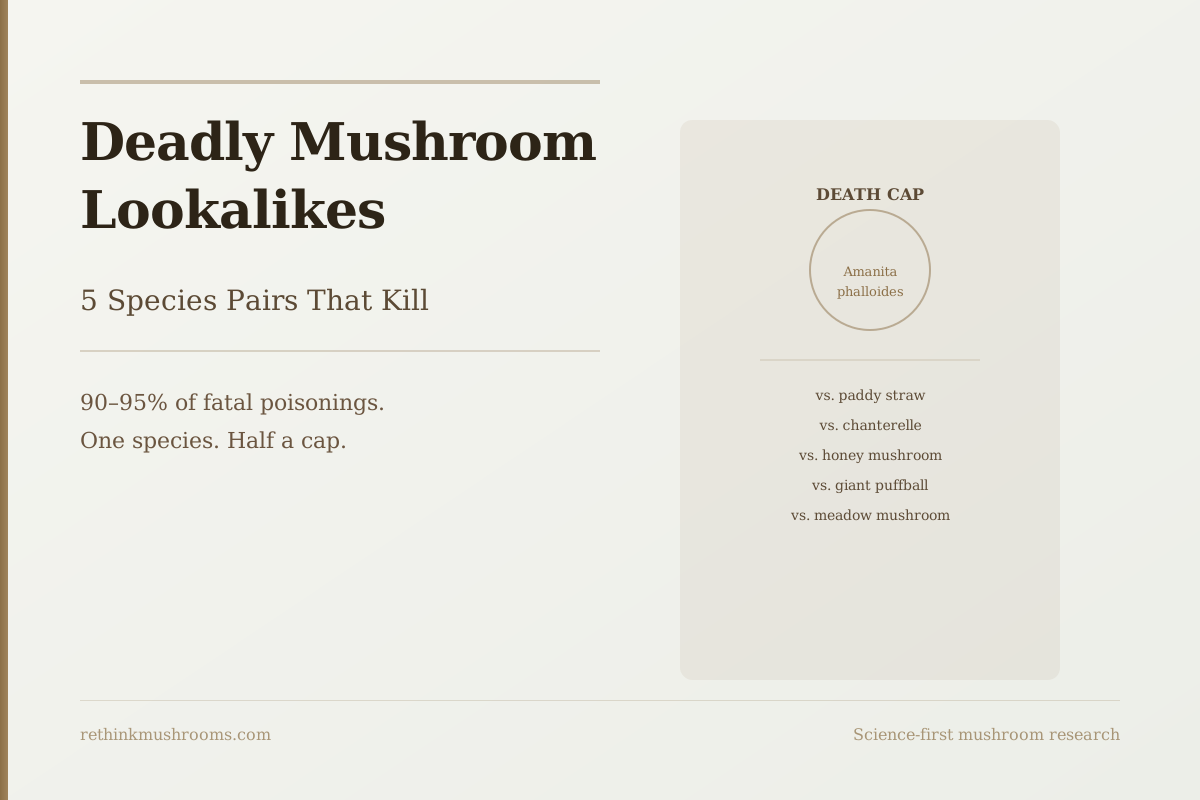
Deadly mushroom lookalikes are the leading cause of fatal mushroom poisoning worldwide. Understanding the specific pairs, not just the general principle, is what actually prevents harm. This article is part of our broader guide to mushroom nutrition and species identification. The five lookalike pairs below account for the vast majority of severe poisoning outcomes in North America, backed by the clinical and epidemiological literature.
Key Takeaways
- Amanita phalloides (Death Cap) is involved in the majority of fatal mushroom poisonings worldwide; alpha-amanitin inhibits RNA polymerase II and the liver is the main target organ (Garcia et al., 2015)
- Amatoxins are not neutralized by cooking, boiling, freezing, or drying; no preparation method makes a Death Cap safe to eat
- Brandenburg and Ward (2018) compiled US National Poison Data System reports from 1999-2016: ~133,700 mushroom exposure cases (~7,428/year), 52 fatalities (~2.9/year), with cyclopeptide-producing species responsible for 68-89% of deaths
- Jack O'Lantern poisoning (Omphalotus illudens) causes vomiting, diarrhea, and weakness with complete recovery typically within 18 hours; in the original 14-person case series, no fatalities occurred (French & Garrettson, 1988)
- The most reliable single check for the Death Cap is the volva: a cup-shaped sac buried at the base of the stem that requires digging gently through leaf litter to find
The 5 Deadliest Mushroom Lookalikes in North America
The table below covers the five pairs most responsible for serious poisoning outcomes in North America. Each distinguishing feature listed is consistent and reliable across populations and seasons, not a folk rule that sometimes fails.
| Edible species | Deadly lookalike | Most reliable distinguishing feature |
|---|---|---|
| Chanterelle (Cantharellus spp.) | Jack O'Lantern (Omphalotus illudens) | Jack O'Lanterns glow faintly orange-green in complete darkness; grow in dense clusters on or near wood |
| Paddy straw mushroom / Caesar's mushroom | Death Cap (Amanita phalloides) | Death Cap has pure white gills, a volva (cup) at the base, and a greenish-yellow cap |
| Honey mushroom (Armillaria spp.) | Funeral bell (Galerina marginata) | Galerina produces a rust-brown spore print; honey mushroom spore print is white |
| Giant puffball (Calvatia gigantea) | Death Cap egg stage (A. phalloides) | Cut the puffball in half: solid white throughout is safe; any internal outline of a cap means stop |
| Meadow mushroom (Agaricus campestris) | Destroying Angel (Amanita bisporigera) | Destroying Angel gills stay white at every stage; meadow mushroom gills turn pink, then brown, as the specimen matures |
The following sections cover each pair in detail, including how to test in the field and what the clinical record shows about poisoning outcomes.
The Death Cap and Caesar's Mushroom: Half a Cap, a Lethal Dose
Amanita phalloides, the Death Cap, is involved in the majority of human fatal cases of mushroom poisoning worldwide.[1] Garcia and colleagues describe its primary toxin, alpha-amanitin, as a potent inhibitor of RNA polymerase II that produces protein deficit and ultimately cell death, with the liver as the main target organ.[1] No effective antidote has been established, and an initial latent period followed by gastrointestinal disorders can lead clinicians and patients to underestimate severity until jaundice, seizures, or coma develop.
The lethal dose is small relative to a typical specimen — public health and clinical literature commonly cite that a single mature cap can contain enough amatoxin to kill an adult, though exact toxin content varies with specimen size, region, and growing conditions.
The confusion with edible species happens at a specific life stage. In its egg stage, before the cap has opened, the Death Cap is enclosed in a white membrane that makes it look like a small white egg pushing out of the soil. At this stage it resembles two edible species closely:
Paddy straw mushroom (Volvariella volvacea): A Southeast Asian edible prized in Vietnamese and Chinese cooking. Both species emerge as white eggs. The key difference is what the egg looks like when cut: the paddy straw mushroom cuts to show a uniformly white interior, while the Death Cap egg shows a partial cap-and-stem outline inside the white membrane.
Caesar's mushroom (Amanita caesarea): A prized European edible that appears occasionally in the American Southwest. The egg of Caesar's mushroom cuts to reveal a vivid orange cap; the Death Cap egg reveals a pale greenish-white cap.
Once fully emerged, the Death Cap has three features that together are reliable identifiers:
- Volva: A cup-shaped sac at the base of the stem, often buried under soil or leaf litter. Dig gently at the base of the stem. If there is a white sock of membrane at the base, stop.
- White gills: Pure white, never pink or brown, even in fully mature specimens.
- Greenish-yellow cap: Most often pale olive-green to yellowish. Color varies with age and light, but the greenish cast is consistent.
No single feature is definitive on its own. The volva-plus-white-gills combination rules out most safe species, but responsible identification requires confirming all features together.
A fact that surprises many experienced foragers: amatoxins are not destroyed by heat. Cooking, boiling, freezing, and drying all leave alpha-amanitin intact, and Garcia et al. note that the discovery of an effective antidote remains a major unsolved issue.[1] There is no preparation method that renders a Death Cap edible. For the full biology of what happens after ingestion, see The Death Cap: Why It's So Dangerous.
Chanterelles vs. Jack O'Lanterns: The Most Common Beginner Mistake
Chanterelles (Cantharellus spp.) are among the most sought-after wild edibles in North America. Their egg-yolk yellow color and fruity apricot scent make them seem easy to identify. Jack O'Lanterns (Omphalotus illudens, and the related O. olearius in the Southeast) are bright orange-yellow, similarly shaped, and found in overlapping forests in late summer and fall.
French and Garrettson (1988) reported a 14-person case series of Jack O'Lantern poisoning, establishing it as a recognized medical event rather than a rare curiosity.[3]
Jack O'Lanterns are not lethal in the documented case literature. The French series reported vomiting in 8 of 14, diarrhea in 5 of 14, and weakness in 2 of 14, with complete recovery within 18 hours. No fatalities have been documented from Omphalotus poisoning in standard clinical reviews.[3] The clinical danger is that beginner foragers who recover from a Jack O'Lantern poisoning sometimes assume the incident was a fluke and continue foraging without expert guidance. The next mistake may involve a more dangerous species.
Three features distinguish chanterelles from Jack O'Lanterns reliably:
Where they grow: Chanterelles grow singly or in small scattered groups from soil. Jack O'Lanterns grow in large, dense clusters at the base of trees or from buried wood roots. A cluster emerging from wood or near a stump is a red flag.
Ridges vs. gills: Chanterelles have forking, blunt-edged ridges that run down the stem. These ridges are not true gills and they cannot be separated cleanly from the cap. Jack O'Lanterns have true gills: thin, crowded, sharp-edged, and clearly distinct from each other.
Bioluminescence: In complete darkness, Jack O'Lantern gills produce a faint greenish glow, a documented mycological characteristic that distinguishes them from all common edible species (chanterelles do not glow). Place the specimen in a completely dark room, wait fifteen minutes for eyes to adjust, and look for the faint glow.
For species-specific lookalike guidance on another common beginner target, see Morel Foraging Safety: Identifying True vs. False Morels.
Honey Mushrooms vs. Galerina: The Trap That Catches Experienced Foragers
Honey mushrooms (Armillaria spp.) are a popular edible among experienced foragers. They grow in large clusters on dead stumps, living tree bases, and buried wood roots, and they have a recognizable ring around the upper stem. The problem is that Galerina marginata, called the Funeral Bell, grows in the same habitat, in similar clusters, on the same wood, and at the same time of year.
Galerina marginata contains amatoxins, the same family of toxins found in the Death Cap. It is smaller and more uniformly brown than honey mushrooms, but the overlap in growth pattern has caught foragers who believed their identification was solid.
The spore print is the most reliable differentiator. Honey mushroom spore print: white. Galerina spore print: rust-brown to ochre. A spore print takes thirty minutes to several hours. Place the cap face-down on white paper and leave it undisturbed. A rust-brown print terminates the identification process for that specimen.
Brandenburg and Ward's 2018 analysis of US National Poison Data System reports from 1999-2016 documented 133,700 mushroom exposure cases over the period (~7,428/year), with 704 cases of major harm and 52 fatalities (~2.9/year).[2] Cyclopeptide-producing mushrooms (the amatoxin family that includes Death Caps and Galerina) were responsible for 68-89% of those fatalities, primarily in older adults who unintentionally misidentified edible species. Misidentification of edible mushroom species was identified as the most common cause and a preventable target for education.[2]
For more on getting started safely in the field, see Mushroom Foraging for Beginners: Safety First.
Giant Puffballs vs. Death Cap Eggs: One Cut That Changes Everything
Giant puffballs (Calvatia gigantea) are often recommended to beginning foragers as a safe starting species. Their large white globe shape seems unmistakable. They are safe, with one exception. Small, immature puffballs found in late summer can be confused with the egg stage of Amanita species, including the Death Cap.
The field test is straightforward and always required before eating any puffball: cut the specimen in half, top to bottom. A true puffball is solid white throughout, with no internal structure visible. A Death Cap egg, or the egg of any other Amanita species, shows a distinct internal outline of a cap, stem, and gill structure even at this early stage. The silhouette is visible as a darker shadow against the pale white membrane interior.
This cut takes ten seconds. Even partial ingestion of an amatoxin-containing mushroom is dangerous: Garcia and colleagues describe alpha-amanitin as the principal toxic actor, and its inhibition of RNA polymerase II makes any meaningful ingestion clinically significant.[1]
Meadow Mushrooms vs. Destroying Angels: The White Gills Problem
Meadow mushrooms (Agaricus campestris) grow in open fields and lawns across North America. They resemble the common supermarket mushroom and were a staple wild food in the American Midwest for generations. Destroying Angels (Amanita bisporigera and A. virosa) grow in similar open or semi-open habitats, are pure white at all life stages, and also contain lethal amatoxins.
The key distinction is gill color across the mushroom's development:
Meadow mushroom gills: Pink when young, turning deep pink-brown as the cap opens, chocolate-brown in fully mature specimens. Any pink at any stage rules out Destroying Angel.
Destroying Angel gills: White at every stage, from button to fully open cap. The gills never change color regardless of maturity.
A secondary check is the volva. Destroying Angels always have the characteristic Amanita cup at the base of the stem, often buried below the soil surface. Dig gently to expose the full base. Meadow mushrooms have no volva.
White gills in any field-collected mushroom warrant extra scrutiny, particularly when combined with a ring on the stem and a white cap. This combination is the physical description of the Destroying Angel, and it resembles enough edible species to be a recurring source of confusion.
The Three ID Checks That Catch the Most Dangerous Misidentifications
Across all five lookalike pairs, three field checks intercept the most dangerous errors:
The volva check: Dig gently at the base of the stem. Any mushroom with a white cup-shaped sac at the base is in the Amanita genus. Most Amanita species are toxic or lethal. Finding a volva ends the identification process unless the forager is an expert mycologist.
The spore print: Place the cap face-down on white and black paper simultaneously. Thirty to sixty minutes produces a visible print. White print plus white gills plus a ring plus a volva means Amanita. Rust-brown print on a clustered wood-grower means Galerina. A spore print cannot be mimicked by the mushroom.
The cut test for puffballs: Every puffball, every time, before any preparation or tasting. Solid white interior means the specimen is a true puffball. Any internal structure means stop.
These checks do not replace expert verification. They catch the most common fatal misidentifications. Brandenburg and Ward's epidemiology data identifies misidentification of edible mushroom species as the most common cause of poisoning, and a preventable target for education.[2]
Also worth knowing: the assumption that cooking neutralizes toxins is one of the most dangerous myths in foraging. For a detailed look at what heat does and does not do to mushroom compounds, see Raw vs. Cooked Mushrooms: Why Heat Matters. And for a full framework of pre-foraging safety rules, see Safe Foraging Rules: How to Never Eat a Poisonous Mushroom.
If You Ate the Wrong Mushroom
If someone has eaten a mushroom that may have been misidentified, contact US Poison Control immediately: 1-800-222-1222. Do not wait for symptoms to appear.
The timing of symptom onset is the most important clinical signal. Symptoms beginning within two hours of eating usually indicate GI irritants, which are unpleasant but rarely life-threatening. Symptoms beginning more than six hours after eating are consistent with amatoxin poisoning, a medical emergency regardless of how mild the initial presentation feels.
An important counterintuitive fact: symptom improvement after the initial wave of nausea and vomiting does not mean the danger has passed. Amatoxin poisoning progresses through a phase of apparent recovery lasting one to three days, during which liver damage continues silently. Patients who leave the hospital during this phase face worse outcomes. For the full clinical picture and what to expect in the emergency room, see Mushroom Poisoning Symptoms: What to Do If You Ate the Wrong One.
Bring the mushroom to the hospital if possible, or a clear photograph if the specimen is unavailable. Species identification by a mycologist or Poison Control specialist affects treatment decisions.
The Bottom Line
The five lookalike pairs covered here (chanterelle and Jack O'Lantern, Death Cap and paddy straw, honey mushroom and Galerina, giant puffball and Death Cap egg, meadow mushroom and Destroying Angel) account for the vast majority of serious mushroom poisoning outcomes in North America. Garcia et al. 2015, Brandenburg and Ward 2018, and French and Garrettson 1988 point consistently to the same conclusion: visual similarity at first glance is high, but specific field tests (the volva check, the spore print, the puffball cut) reliably separate the safe from the lethal. No preparation method destroys amatoxins. The six-hour symptom rule is the key clinical triage point after any suspected ingestion.
Frequently Asked Questions
Sources & References
- 1RTHM-00686·Garcia, Juliana et al. (2015). “Amanita phalloides poisoning: Mechanisms of toxicity and treatment..” Food and chemical toxicology : an international journal published for the British Industrial Biological Research Association.Study breakdown →PubMed →↩
- 2RTHM-00942·Brandenburg, William E et al. (2018). “Mushroom poisoning epidemiology in the United States..” Mycologia.Study breakdown →PubMed →↩
- 3RTHM-00008·French, A L et al. (1988). “Poisoning with the North American Jack O'Lantern mushroom, Omphalotus illudens..” Journal of toxicology. Clinical toxicology.Study breakdown →PubMed →↩