Mushroom Foraging Safety
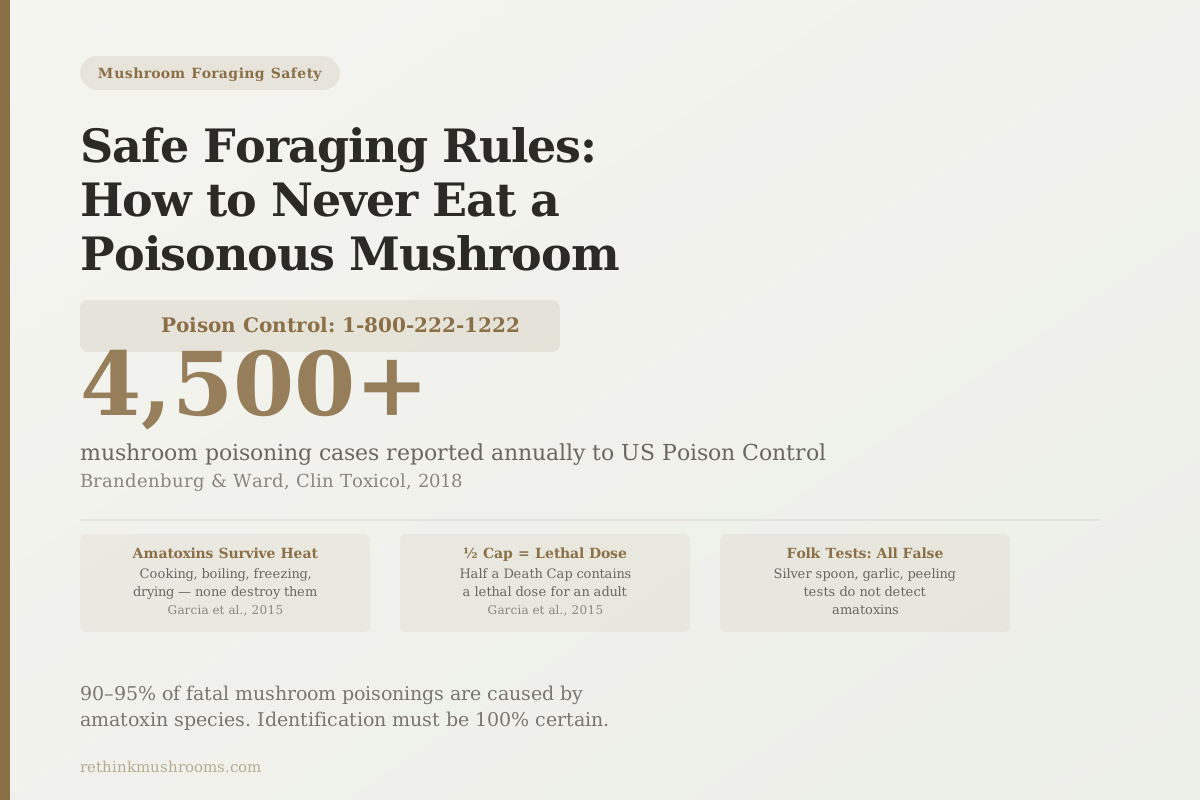
4,500+ poisoning cases annually
More than 4,500 mushroom poisoning cases are reported to US Poison Control each year. The most dangerous share a common thread: adults who believed they had correctly identified an edible species. These rules are grounded in what the clinical evidence shows actually causes harm.
Brandenburg & Ward, Clin Toxicol, 2018
90–95%
of fatal mushroom poisonings worldwide are caused by amatoxin species — primarily the Death Cap (Amanita phalloides) and closely related species (Garcia 2015)
Heat-stable
amatoxins are not destroyed by cooking, boiling, freezing, or drying — there is no preparation method that makes a misidentified mushroom safe (Garcia 2015)
½ cap
half of one Death Cap mushroom contains a lethal dose for an average adult (Garcia 2015)
Brandenburg & Ward, Clin Toxicol, 2018
 View as image ↗
Poison Control (US): 1-800-222-1222 — call immediately if you believe you may have eaten a toxic mushroom, before symptoms appear.
Mushroom foraging is not dangerous in the way beginners imagine — some vague threat from the forest. The danger is specific: a small number of species can kill you, they sometimes look like desirable edibles, and several widespread misconceptions about how to tell the difference are flatly wrong.
The cooking myth is the most important misconception to correct first. The toxins responsible for 90–95% of fatal mushroom poisonings worldwide cannot be destroyed by heat, and that fact alone should change how anyone approaches unverified identification.[1]
More than 4,500 mushroom poisoning cases are reported to US Poison Control centers each year.[2] The vast majority are not life-threatening. But the cases that are life-threatening are largely preventable, and they follow predictable patterns that the epidemiology documents clearly. Understanding those patterns is more useful than general caution.
For beginners looking for the broader picture before these rules, see Mushroom Foraging for Beginners: Safety First. For information on the specific Death Cap and its mechanism, see The Death Cap (Amanita phalloides): Why It's So Dangerous.
Key Takeaways
- Amatoxins — the class of toxins responsible for 90–95% of fatal mushroom poisonings worldwide — are not destroyed by cooking, boiling, freezing, or drying; there is no preparation step that neutralizes them after misidentification (Garcia 2015)
- Half of one Death Cap mushroom (Amanita phalloides) contains a lethal dose for an adult; the species is responsible for the majority of mushroom fatalities globally (Garcia 2015)
- More than 4,500 mushroom poisoning cases are reported to US Poison Control annually; children under 6 represent 62% of exposures, usually from non-toxic backyard species; the dangerous poisonings are almost always adults who believed they had correctly identified something edible (Brandenburg 2018)
- All widely promoted folk tests for mushroom safety — silver spoon blackening, garlic turning color, peeling the cap — are false; none reliably distinguish toxic from edible species
- AI mushroom identification apps have improved but have documented failure rates for the specific species (young Death Caps in their egg stage) most likely to be confused with common edibles
- Mislabeling and species substitution in commercial markets is documented — foraging safety principles apply to purchased mushrooms as well as wild-harvested ones (2024 systematic review)
The 7 Never Rules for Mushroom Foraging
These are the rules that, followed without exception, prevent the vast majority of serious mushroom poisonings:
- Never eat a mushroom with white gills unless you have confirmed every distinguishing identification feature with an expert or verified field guide. White gills are a feature of Amanita species, including the Death Cap.
- Never eat a mushroom with a volva — a cup-like structure at the base of the stem, at or just below ground level — unless you know with certainty what it is. A volva is a signature feature of the deadly Amanita species.
- Never assume cooking destroys toxins. Amatoxins survive cooking, boiling, freezing, and drying. If you've misidentified a mushroom, no preparation method protects you.
- Never trust folk safety tests — the silver spoon, the garlic test, peeling the cap, or any other traditional rule of thumb. None of these tests reliably distinguish toxic from edible species.
- Never rely on app-only identification for a mushroom you intend to eat. Apps are a learning tool, not a safety tool — they have documented failure rates for the species most likely to cause lethal poisoning.
- Never try an unfamiliar species when you're far from medical care. Amatoxin symptoms can appear 6–24 hours after ingestion. If you're deep in the backcountry, you may not reach a hospital in time.
- Never let apparent symptom improvement reassure you after eating an unidentified mushroom. The most dangerous period of amatoxin poisoning is when patients begin to feel better — before liver failure sets in days later.
Who Actually Gets Poisoned, and Why
Mushroom poisoning epidemiology in the US has been documented comprehensively. The picture is more specific — and more actionable — than general warnings suggest.
Brandenburg and Ward analyzed national US poisoning data and found that the majority of reported cases involve children under six, who represent 62% of mushroom exposure calls to Poison Control.[2] These are overwhelmingly cases of toddlers in backyards picking up and tasting wild mushrooms — almost always non-toxic species that cause no serious harm or only mild GI upset. The exposure is frightening for parents, but the clinical outcome is rarely severe.
The cases that end fatally are different in almost every dimension. They involve adults. They involve people who believed they had correctly identified an edible species. And they disproportionately cluster around a small number of dangerous species and a small number of mistaken identities.
Geographically, the data shows two regional clusters for severe poisonings: the Pacific Coast states, where Amanita phalloides (the Death Cap) is established and growing in range, and the northeastern US, where Galerina marginata (a deadly lookalike for the honey mushroom) is a recurring source of poisoning among more experienced foragers.
The pattern within these cases is consistent: confident identification of a species that looked familiar, consumption without 100% verification, symptoms appearing hours later, and delayed or incomplete treatment because patients didn't seek care early enough.
The Cooking Myth: Why Heat Provides No Protection
This is the most dangerous misconception in foraging, and it deserves its own section.
Many beginner guides, and quite a few experienced foragers, operate on the implicit assumption that cooking is a safety backstop. That if you're not completely sure what a mushroom is, boiling it for a long time, cooking it thoroughly, or drying it first will at least reduce any toxicity.
This is not true for the toxins most likely to kill you.
Garcia and colleagues, in a systematic review of Amanita phalloides toxicology, documented explicitly that amatoxins — the class of compounds responsible for 90–95% of fatal mushroom poisonings worldwide — survive cooking, boiling, freezing, and drying.[1] Alpha-amanitin, the primary toxin, is a cyclic peptide with extraordinary chemical stability. It does not denature at cooking temperatures. It is not broken down by stomach acid. It enters the bloodstream intact, is taken up by liver cells, and inhibits RNA polymerase II — the enzyme cells use to synthesize messenger RNA. Without mRNA synthesis, liver cells cannot produce the proteins they need to function and begin to die.
Half of one Death Cap mushroom contains enough alpha-amanitin to be lethal to an average adult.[1]
The implication for foragers is precise: there is no preparation step between wrong identification and poisoning. If you misidentify a Death Cap as a Caesar's mushroom, a paddy straw mushroom, a puffball, or any other edible species, and you cook and eat it, you will receive the full lethal dose.
This means identification must be 100% correct. There is no 99%-sure safety margin.
Folk Tests That Don't Work
The silver spoon test — the idea that a silver utensil will tarnish or change color when stirred in a pot with poisonous mushrooms — is false. Silver tarnishing involves reaction with sulfur compounds. Amatoxins do not contain sulfur; they do not tarnish silver.
The garlic test — that garlic added to cooking mushrooms will turn black if the mushrooms are toxic — is false. Garlic discoloration reactions are not reliable indicators of any specific toxin class and will not detect amatoxins.
The "if it peels, it's safe" claim — that edible mushrooms can be peeled and toxic ones cannot — is false. All mushrooms can be peeled to some degree; peelability has nothing to do with toxicity.
The "if worms or insects are eating it, it's safe for humans" rule is false. Insects process toxins differently than mammals; fly larvae can consume Death Caps.
The "if it tastes bitter, it's toxic; if it's pleasant, it's safe" rule is false. Death Caps taste pleasant — they are described as tasting similar to Caesar's mushrooms, which is part of why they cause so many poisonings.
None of these tests can be safely relied upon. The mechanism behind most of them — that toxicity produces an observable physical reaction during preparation — is simply not how amatoxins work.
AI App Identification: A Tool, Not a Safety System
Smartphone mushroom identification apps have improved substantially in recent years. Several can correctly identify common culinary species with high reliability under ideal conditions — good lighting, clear photos, adult specimens.
The specific failure mode that matters for safety: young Amanita phalloides fruiting bodies, before the cap has opened and before the distinctive features are fully expressed, look nearly identical to the paddy straw mushroom (Volvariella volvacea) — a prized edible in Vietnamese, Chinese, and other Southeast Asian cuisines. This specific lookalike confusion is responsible for a disproportionate number of fatal poisonings in immigrant communities in California, documented in CDC data on the 2016 Northern California outbreak.
In this stage of development, photographs of the two species can be virtually indistinguishable even to experienced human observers. AI apps performing pattern matching on images face the same problem.
Apps are a genuinely useful learning tool for building familiarity with species and their features. They are not a reliable safety system for confirming that a species is safe to eat. The distinction matters: use an app to learn, and use physical verification of identifying features (spore print, volva, gill color, ring structure, smell, habitat) to confirm before eating.
The Market and Restaurant Dimension
Foraging safety is often discussed as though it only applies to mushrooms gathered from the wild. The evidence suggests the risk extends to commercial settings.
A 2024 systematic review documented the scale of mislabeling and species substitution in commercially sold mushrooms.[3] Species are substituted, either through deliberate fraud or supply chain error, and commercial packaging can misidentify the contents. This doesn't mean commercial mushrooms are routinely dangerous — the risk is orders of magnitude lower than wild foraging for unknown species. But it does mean that "I bought it at a market" is not a complete safety guarantee for unusual species or imported dried mushrooms.
The highest risk in commercial settings involves imported dried mushrooms or fresh specialty mushrooms sold at informal markets where supply chain documentation is limited. For consumers purchasing unusual mushroom species from unfamiliar suppliers, knowing what the species should look like, and where it comes from, remains part of the safety calculus.
The Symptom Timing Rule
If you or someone else has eaten a mushroom that might be toxic, the timing of symptoms provides important clinical information.
Symptoms appearing within one to two hours of eating are typically associated with GI-irritant species — a category that includes the Jack O'Lantern mushroom (a common chanterelle lookalike), some raw honey mushrooms, and several Tricholoma species. These species cause significant discomfort — nausea, vomiting, diarrhea — but are rarely fatal and typically resolve on their own.
Symptoms appearing six or more hours after eating are associated with amatoxin-producing species. This delayed onset is characteristic: while symptoms from GI irritants hit fast, the molecular mechanism of amatoxins means the initial GI phase (which is itself painful) only develops after the toxin has already been absorbed.
The most dangerous period follows the initial GI phase. Patients often feel significantly better 24–72 hours after eating a Death Cap, as the acute GI symptoms subside. This is not recovery — it is the pause before acute liver failure. Patients who leave the hospital or stop seeking treatment during this period have measurably worse outcomes. Anyone who ate an unidentified mushroom and developed symptoms — even if they now feel better — should remain under medical supervision.
If you ate a mushroom you're uncertain about, call Poison Control at 1-800-222-1222 before symptoms appear. Bring a photograph of the mushroom or, better, a physical sample in a paper bag. Do not induce vomiting unless Poison Control specifically instructs it.
For a complete guide to what to do after a suspected poisoning, including what treatments are used and when liver transplantation may be indicated, see Mushroom Poisoning Symptoms: What to Do If You Eat the Wrong One. For the specific identification guidance on the most common deadly lookalike pairs in North America, see Deadly Mushroom Lookalikes: Identification Guides That Could Save Your Life.
The Bottom Line
The rules that prevent fatal mushroom poisoning follow from a small number of clinical facts: amatoxins (responsible for 90–95% of mushroom fatalities) survive all cooking methods; half a Death Cap contains a lethal dose; the dangerous poisonings involve adults who believed they had correctly identified something edible. Folk safety tests are uniformly unreliable. App-based identification fails specifically for the species most likely to cause fatal poisoning. Symptoms that appear to improve 24–72 hours after amatoxin exposure do not indicate recovery — they indicate the pause before liver failure. If there is any uncertainty about a mushroom you've eaten, call Poison Control at 1-800-222-1222 immediately.
Frequently Asked Questions
Sources & References
- 1. Source details for this reference are not yet available.
- 2. Source details for this reference are not yet available.
- 3. Source details for this reference are not yet available.