Mushroom Foraging Safety
½ cap = lethal dose
Half a cap of Amanita phalloides (Death Cap) contains enough toxin to kill an adult. Amatoxins account for 90-95% of fatal mushroom poisonings worldwide. Death arrives on day 3-7, not hour one.
Garcia et al., Biomed Res Int, 2015
1-800-222-1222
US Poison Control Center: call immediately if unsure, before any symptoms appear
3 phases
of amatoxin poisoning; Phase 2 (false recovery, 24-72h) is when patients stop seeking treatment and die (Kayes 2024)
30%
of severe amatoxin poisoning cases required emergency liver transplant or died (Escudie 2007, N=27)
Garcia et al., Biomed Res Int, 2015
 View as image ↗
Half a cap of Amanita phalloides contains enough toxin to kill an adult. The full cap doesn't need to be consumed, the mushroom doesn't need to taste bad, and cooking doesn't help. Amatoxins survive boiling, frying, freezing, and drying intact.[1] Of all fatal mushroom poisonings worldwide, amatoxin-containing species account for 90-95%.
The most dangerous aspect of amatoxin poisoning isn't the toxin's potency. It's the clinical course: patients feel violently ill, then feel completely recovered, then die of liver failure three to seven days after the meal. That period of apparent recovery is when people stop seeking treatment. Understanding this three-phase progression, and what to do in each phase, is the core of this article.
US Poison Control Center: 1-800-222-1222
Call this number immediately if there is any suspicion of mushroom poisoning. Do not wait for symptoms. Clinical toxicology protocols treat mushroom poisoning as a time-sensitive emergency from the moment of ingestion, not from the onset of symptoms. If the mushroom can be identified or photographed, do so. If not, save any remaining material in a paper bag. For context on the mushrooms worth understanding nutritionally, see mushroom nutrition facts: the complete species-by-species guide.
Key Takeaways
- Call US Poison Control immediately at 1-800-222-1222 if mushroom poisoning is suspected. Do not wait for symptoms to appear; the toxicology consultation is free, available 24 hours, and critical for early treatment decisions
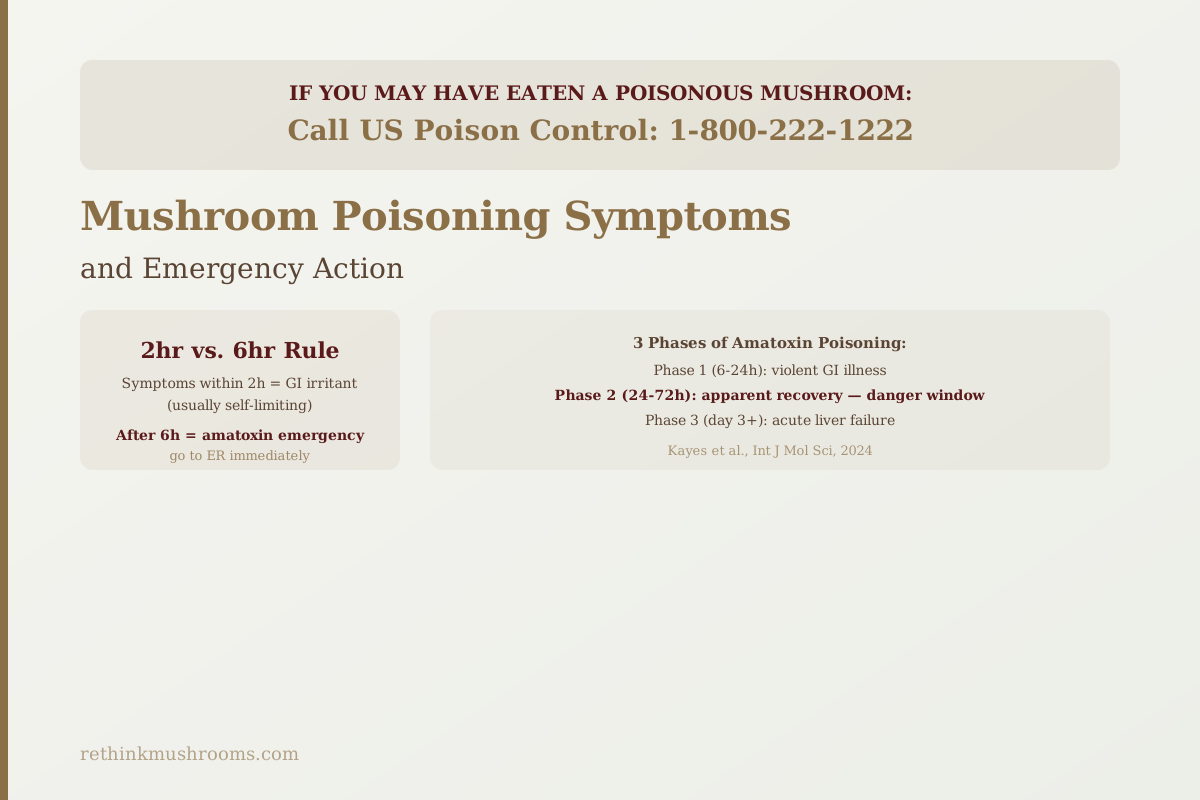
- The clinical triage rule: symptoms within 2 hours of eating suggest GI irritant species (usually self-limiting); symptoms appearing after 6 hours suggest amatoxin poisoning, which is a medical emergency
- Amatoxins from Amanita phalloides and related species account for 90-95% of fatal mushroom poisonings globally; half a cap contains a lethal adult dose; the toxin is not destroyed by cooking (Garcia 2015)
- Amatoxin poisoning follows three phases: Phase 1 (violent GI symptoms, 6-24h), Phase 2 (apparent full recovery, 24-72h), Phase 3 (acute liver and kidney failure beginning day 3). Phase 2 is the most dangerous window because patients stop seeking treatment (Kayes 2024)
- Silibinin is the most evidence-supported pharmacological treatment for amatoxin poisoning; it is approved as first-line treatment in Europe and available in the US only as an Investigational New Drug (IND) through hospital pharmacy (Lacombe 2016)
- 30% of patients with severe amatoxin poisoning in one cohort required emergency liver transplant or died; prothrombin time and bilirubin are the strongest predictors of fatal outcome (Escudie 2007, N=27)
Call First: The 2-Hour vs. 6-Hour Rule That Tells You How Serious It Is
The single most important piece of information in mushroom poisoning management is the onset timing of symptoms. Clinical toxicologists use a 2-hour and 6-hour rule to triage severity.
If symptoms appear within 2 hours of eating: This timing suggests a GI irritant species (not amatoxin). Mushrooms in this category include Jack O'Lantern (Omphalotus illudens), little brown mushrooms with low-grade toxins, and many species that cause nausea, vomiting, and diarrhea through direct GI irritation. These are miserable but rarely life-threatening in adults who receive supportive care.
If symptoms appear more than 6 hours after eating: This timing is the critical warning. Amatoxin poisoning consistently has a delayed onset of 6 to 24 hours. The delay exists because α-amanitin must be absorbed through the gut, reach the liver via portal circulation, and inhibit RNA polymerase II in hepatocytes before cell death begins. By the time GI symptoms appear, toxin absorption is already advanced. This is a medical emergency requiring immediate hospitalization regardless of how the patient looks at the time of symptom onset.[2]
The clinical protocol documented in toxicology literature, as summarized in Kayes and colleagues' 2024 comprehensive review, establishes that the 2-hour threshold and 6-hour threshold serve as the primary triage decision points.[2]
If someone has eaten a mushroom of uncertain identity at any point in the past 24 hours and is not yet symptomatic, call Poison Control (1-800-222-1222) immediately. The absence of symptoms within the first hours does not mean safety. It may mean the timing has not yet arrived.
What Mushroom Poisoning Symptoms Actually Look Like
Mushroom toxins fall into several distinct categories, each producing a different symptom pattern. The three most important for a layperson to recognize are:
GI irritant syndrome (early onset, 15 minutes to 2 hours). Nausea, vomiting, abdominal cramping, diarrhea. Caused by species including oyster-look-alike mushrooms with irritant compounds, poorly cooked or raw button mushrooms in some individuals, and many small brown LBMs (little brown mushrooms). Usually self-limiting with supportive care in otherwise healthy adults. Children and people with underlying conditions can dehydrate and require medical attention. The onset timing within 2 hours is the key distinguishing feature.
Muscarine syndrome (30 minutes to 2 hours). Sweating, salivation, tearing, small pupils, slowed heart rate, low blood pressure. Caused by some Inocybe and Clitocybe species. The toxin mimics acetylcholine. Usually manageable but requires medical evaluation for the cardiac and respiratory effects. Also early-onset.
Amatoxin syndrome (6 to 24 hours, progressing over days). This is the dangerous late-onset pattern. The Death Cap (Amanita phalloides), Death Angel (Amanita bisporigera), and the smaller but equally dangerous Galerina marginata all produce α-amanitin. Garcia and colleagues documented the clinical toxicology in detail: amatoxins inhibit RNA polymerase II, stopping mRNA transcription, which causes programmed cell death in hepatocytes and renal tubular cells.[1] The damage is happening at the molecular level before any symptoms appear.
The critical fact about amatoxin species: cooking does not help. Boiling, frying, freezing, and drying do not destroy α-amanitin or phalloidin. There is no preparation method that makes Death Cap safe to eat.[1]
For the specific lookalike pairs that cause the most dangerous misidentifications, see deadly mushroom lookalikes: identification guides that could save your life.
The Three Phases of Amatoxin Poisoning: Why Phase 2 Kills People
The three-phase clinical course of amatoxin poisoning, documented in the 2024 review by Kayes and colleagues, is the critical narrative that most consumer content about mushroom poisoning gets wrong or omits entirely.[2]
Phase 1: Violent GI Illness (hours 6-24)
Severe nausea, vomiting, and profuse watery diarrhea begin 6 to 24 hours after ingestion. The patient may have eaten only a small amount and feels extremely ill. Many patients are correctly brought to the emergency room during this phase. The GI symptoms are caused by direct mucosal irritation and early hepatic stress as toxin begins accumulating.
Phase 2: Apparent Complete Recovery (hours 24-72)
The GI symptoms subside. The patient feels significantly better. In some cases, the patient reports feeling nearly normal.
This is the most dangerous phase of the entire illness.
During Phase 2, α-amanitin has already entered hepatocytes and is actively inhibiting RNA polymerase II, halting messenger RNA production. Hepatocytes are dying throughout this period. Liver function tests begin deteriorating even as the patient feels recovered. The molecular damage is proceeding silently while clinical symptoms temporarily subside.
Patients who leave the hospital during Phase 2 because they feel well are at significantly higher risk of death. Escudie and colleagues documented this in a 27-patient cohort: when patients were discharged or delayed return during this window, outcomes worsened.[3] The clinical message from this data: apparent recovery after mushroom ingestion is not a reason to reduce the level of medical monitoring. It is the most important moment to maintain intensive observation.
Phase 3: Acute Liver and Kidney Failure (days 3-7)
Liver failure progresses rapidly. Prothrombin time extends, bilirubin rises, encephalopathy develops as the liver fails to clear metabolic waste. Renal failure may develop from direct tubular toxicity and from hepatic failure. Without liver transplantation, patients may die.
For the cluster article on mushroom foraging safety more broadly, see safe foraging rules: how to never eat a poisonous mushroom.
What Happens in the Emergency Room
Ward and colleagues' 2013 case series and therapy review documents the current treatment approach to amatoxin poisoning, confirming that no randomized controlled trial has established any single treatment protocol with certainty.[4] The management ladder used in practice:
Activated charcoal is administered as early as possible, within the first 24 hours ideally, to bind unabsorbed toxin in the GI tract and reduce further systemic absorption. Its value diminishes with time as absorption progresses. The Kayes 2024 review confirmed charcoal as first-line in the immediate post-ingestion window.[2]
Silibinin is the pharmacological intervention with the strongest evidence base among available options. Silibinin (silybin), derived from milk thistle, is an organic anion transporting polypeptide (OATP) inhibitor: it blocks the hepatic transporters that amatoxin uses to enter liver cells. Blocking uptake limits the amount of toxin that reaches RNA polymerase II. Lacombe and colleagues' 2016 Best Evidence Topic review concluded that silibinin should be considered in all patients with suspected amatoxin poisoning, based on its mortality-lowering effect and favorable safety profile, despite the absence of RCT data.[5]
The regulatory status of silibinin is a practical gap in US care: silibinin is approved as first-line treatment in Europe, where it is available as an IV formulation (Legalon SIL). In the United States, it is available only under an Investigational New Drug (IND) application, which means a hospital must file a request through an emergency IND process with the FDA. Physicians treating suspected amatoxin poisoning in the US can request silibinin by contacting the FDA at 301-796-8240 (emergency IND line) or by calling Poison Control for coordination. Patients and families can ask the treating team specifically about silibinin availability as part of the management discussion.
N-acetylcysteine (NAC) is also used for hepatoprotective support, as it is in acetaminophen-induced liver failure, though its evidence base in mushroom poisoning specifically is limited.
Extracorporeal purification methods including MARS (Molecular Adsorbent Recirculating System) and plasmapheresis are used in severe cases to remove circulating toxin from the blood. The Kayes 2024 review documents these as part of the advanced management ladder when conventional treatment is failing.[2]
When Liver Transplant Becomes the Only Option
Escudie and colleagues followed 27 patients with confirmed Amanita phalloides poisoning in a 2007 cohort study. Thirty percent of patients in this cohort required emergency liver transplant or died, establishing the severity of the condition in a documented patient population.[3]
The study identified prothrombin time and serum bilirubin as the strongest predictors of fatal outcome, providing the clinical criteria that guide transplant listing decisions. The critical practical implication: when prothrombin time is grossly elevated and bilirubin is rising, the window for transplant must be acted on urgently, as the liver disease can progress to a point where transplant is no longer surgically viable.
Emergency liver transplant for amatoxin poisoning has documented survival benefit when performed in time. Understanding that transplant is part of the treatment landscape, not a last resort in name only, is part of what patients and families should know when seeking care for severe amatoxin poisoning.
For the specific biology of the Death Cap that makes it so reliably deadly, including the molecular mechanism of α-amanitin, see the Death Cap (Amanita phalloides): why it's so dangerous. For a beginner's guide to safe foraging before any foraging begins, see mushroom foraging for beginners: safety first.
The Bottom Line
Mushroom poisoning from amatoxin-producing species (Amanita phalloides, Galerina marginata) follows a three-phase course: violent GI illness from hours 6-24, apparent full recovery from hours 24-72, then acute liver failure from day 3 onward. The Phase 2 false recovery is where patients stop seeking treatment and die. Clinical protocols documented in the 2024 Kayes review establish activated charcoal, silibinin (if available), and intensive monitoring as the management approach. Silibinin is approved in Europe but requires emergency IND access in the US. Thirty percent of severe cases required emergency transplant or died in a 27-patient cohort (Escudie 2007). The first action in any suspected poisoning case is to call Poison Control (1-800-222-1222) before symptoms appear.
Frequently Asked Questions
Sources & References
- 1. Source details for this reference are not yet available.
- 2. Source details for this reference are not yet available.
- 3. Source details for this reference are not yet available.
- 4. Source details for this reference are not yet available.
- 5. Source details for this reference are not yet available.