Tremella and Skin Hydration
1,000+ years of documented use before the chemistry caught up
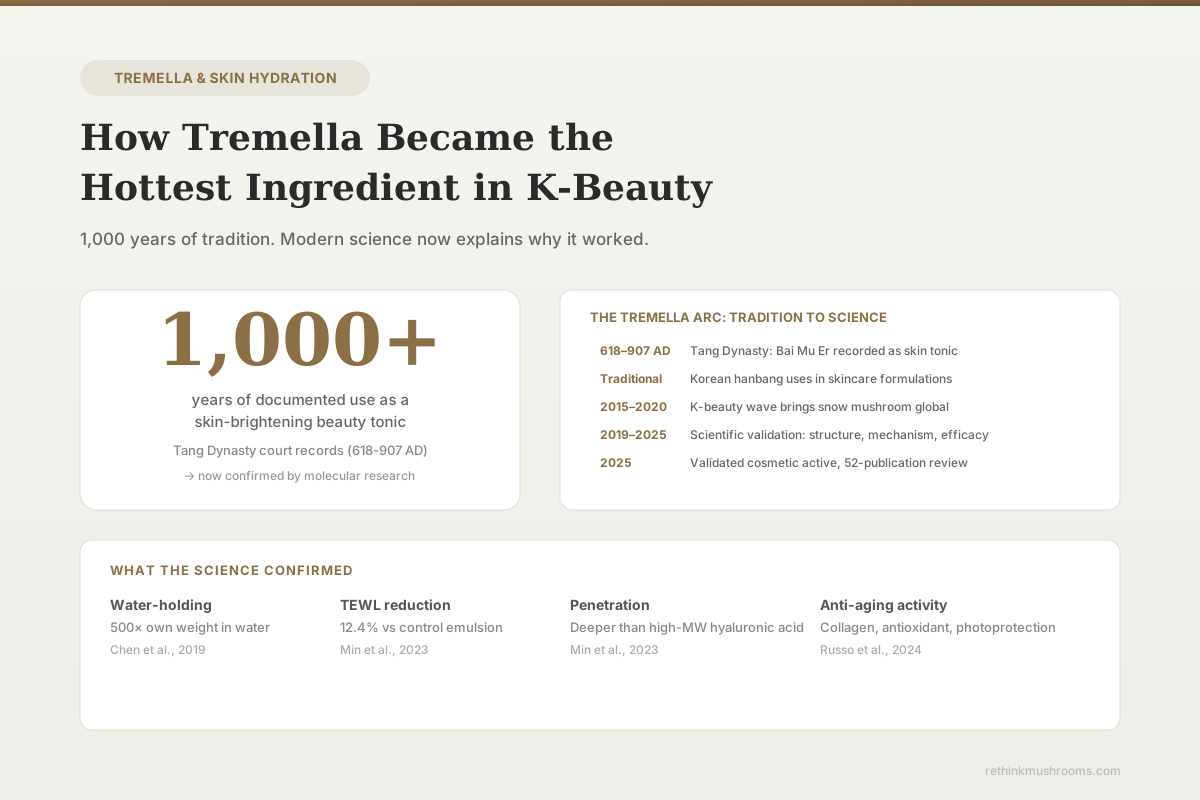
Traditional Chinese medicine recorded Tremella fuciformis (snow mushroom, Bai Mu Er) as a skin tonic for over a millennium. Modern chemistry has now characterized the mechanism: analysis shows Tremella extract is structurally comparable to hyaluronic acid, built around a glucuronic acid-rich polysaccharide that makes up roughly 88% of the extract.
Galla et al., Foods, 2025
~88% HA-like
chemical characterization found the dominant polysaccharide in Tremella extract is structurally comparable to hyaluronic acid, accounting for about 87.76% of the extract by content, sharing the glucuronic acid chemistry that gives hyaluronic acid its water-binding reputation (Galla et al., Foods, 2025)
4 skin roles
a 2023 dermatology review documented Tremella extract's activity in skin anti-aging, photoprotection, wound healing, and barrier protection, while noting most evidence to date comes from in vitro and animal models (Mineroff et al., Archives of Dermatological Research, 2023)
52 studies reviewed
a 2024 review of 52 publications on macrofungal skin actives covered nine species including Tremella fuciformis, documenting moisturizing, antioxidant, and photoprotective activity across macrofungal compounds (Paterska et al., Nutrients, 2024)
Galla et al., Foods, 2025
 View as image ↗
The beauty industry moves fast, and most trends leave no trace. Snow mushroom is different. Tremella fuciformis has been prized for skin health in East Asian beauty culture for over a thousand years, referenced in imperial Chinese literature long before modern cosmetics existed. When K-beauty brought it to global attention, it arrived not as a fad but as one of the most culturally persistent beauty ingredients in recorded history; researchers in the 2020s finally characterized it rigorously enough to explain why it works.
This is the story of how Tremella made that journey: from the imperial courts of the Tang Dynasty to the ingredient lists of Korean beauty brands, and from traditional folk wisdom to peer-reviewed dermatology journals. The underlying science is covered in depth in the companion articles linked throughout; this article tells the arc.
For a scientific overview of what Tremella is and what it contains, see what is tremella mushroom: the beauty mushroom explained.
Key Takeaways
- Tremella fuciformis (snow mushroom, Bai Mu Er) has been documented in traditional Chinese medicine and East Asian beauty practice for over 1,000 years, with specific historical records associating it with the luminous skin of imperial concubines during the Tang Dynasty
- The K-beauty wave of 2015-2020 introduced snow mushroom to Western consumers as part of the broader hanbang (traditional Korean medicine ingredients) integration into modern Korean skincare formulations
- The molecular basis for Tremella's moisturizing reputation is its glucuronic acid-rich polysaccharide: chemical analysis shows Tremella extract has a structure and chemical profile comparable to hyaluronic acid, the gold-standard skin humectant, with the hyaluronic-acid-like fraction accounting for roughly 88% of the extract (Galla et al., Foods, 2025)
- A 2023 dermatology review summarized Tremella extract's documented roles in skin anti-aging, photoprotection, wound healing, and barrier protection, while emphasizing that most evidence to date comes from in vitro and animal models and that clinical trials are still needed (Mineroff et al., Archives of Dermatological Research, 2023)
- A 2024 review of 52 publications on macrofungal skin actives covered nine species including Tremella fuciformis, attributing moisturizing, antioxidant, photoprotective, and collagen- and elastin-stabilizing activity to macrofungal compounds (Paterska et al., Nutrients, 2024)
- Extraction and cultivation conditions significantly affect the molecular weight and composition of Tremella polysaccharides, so product quality varies with how the raw material is produced and processed (Ge et al., Int J Biol Macromol, 2020); a 2025 review catalogued how much the evidence base has expanded (Rui et al., Journal of Food Science, 2025)
The Tang Dynasty Beauty Secret
The most famous historical account of Tremella in Chinese beauty culture connects it to Yang Guifei, the favored concubine of Emperor Xuanzong during the Tang Dynasty (618-907 AD). Celebrated as one of the four great beauties of ancient China, Yang Guifei's flawless, glowing skin was attributed in part to her regular consumption of snow fungus (Bai Mu Er, literally "white wood ear") preparations. Whether the attribution is historically precise or mythologized over centuries matters less than what it reflects: snow mushroom had acquired cultural status as a skin-benefiting tonic at least twelve centuries ago.
Bai Mu Er, the Chinese name for Tremella fuciformis, is a distinctive-looking fungus: creamy white, gelatinous, branching in fronds that resemble neither the cap-and-stem mushrooms most Westerners recognize nor the woody bracket fungi of Chinese medicine. It grows on hardwood logs, primarily in tropical and subtropical Asia, and has a nearly neutral flavor that makes it easy to incorporate into sweet preparations.
Traditional Chinese medicine classified it as a tonic for the lungs, stomach, and skin. The preparation most associated with beauty was a sweet soup called Bai Mu Er Tang, often combined with red dates (jujube), goji berries, and rock sugar. Imperial court records and pharmaceutical texts (bencao) from the Tang through Qing dynasties document its use for "moistening dryness" and "nourishing yin," terminology that maps reasonably directly onto what modern research characterizes as hydration and barrier support.
Traditional Korean medicine (hanbang) incorporated the same ingredient, known as Baengmoggi or the white tree jelly fungus. Korean beauty culture, which long predated the global K-beauty wave, included snow fungus in fermented toners and emulsions, treating the fungal polysaccharides as skincare actives rather than simply food.
What Changed in the 2020s: The Science Arrived
For over a millennium, snow mushroom's reputation rested on accumulated tradition and observation. The molecular explanation for why it works in skin had to wait for modern biochemistry.
Wu and colleagues published a structural review of Tremella polysaccharides in 2019, cataloguing the chemical architecture responsible for the ingredient's properties.[1] Tremella polysaccharides are acidic heteropolysaccharides, meaning they carry a net negative charge. That charge comes primarily from glucuronic acid in the backbone. Glucuronic acid is the same chemical group responsible for the water-holding capacity of hyaluronic acid, the gold-standard skin moisturizer, which is why Tremella extract behaves as a strong humectant that attracts and holds water.
The chemistry underlying that comparison was made explicit in 2025, when Galla and colleagues chemically characterized a non-animal hyaluronic acid extracted from Tremella fuciformis.[6] Using NMR, FTIR, and mass spectrometry, they found the most abundant polysaccharide in the extract was hyaluronic-acid-like, accounting for roughly 88% of the material, with a molecular weight above 2,000 kDa and side chains of glucuronic acid, xylose, and fucose. In other words, the "nature's hyaluronic acid" nickname is not marketing hyperbole: the extract's dominant component is structurally comparable to hyaluronic acid itself.
The 2019 Wu review also documented that Tremella polysaccharides have multiple bioactive effects beyond simple hydration: immunomodulation, antioxidant activity, anti-aging effects, and blood sugar regulation.[1] The skin-relevant mechanisms were reviewed and extended by subsequent work.
Mineroff and colleagues published a dermatology review of Tremella's cutaneous benefits in 2023.[2] It synthesized evidence that Tremella extract supports skin anti-aging, photoprotection, wound healing, and barrier protection, while emphasizing that most of this evidence comes from in vitro and animal-model studies, with clinical trials still needed. Transepidermal water loss (TEWL) is the standard dermatological measure of barrier integrity: a lower TEWL indicates a stronger, better-sealed skin barrier, and barrier support is among the mechanisms attributed to Tremella polysaccharides.
The size and scope of the scientific literature expanded substantially between 2019 and 2025. Ge and colleagues, in 2020, showed with primary experimental data how fermentation and processing conditions shape the yield, molecular weight, and composition of Tremella polysaccharides, establishing the principle that product quality varies with how the raw material is produced and processed.[3] A 2024 cosmetics review by Paterska and colleagues surveyed 52 publications on macrofungal skin applications, covering nine species including Tremella fuciformis and documenting activity across moisturizing, antioxidant, and photoprotective endpoints for macrofungal compounds.[4]
A 2025 review by Rui and colleagues catalogued the structure, preparation methods, and biological activities of Tremella fuciformis polysaccharide across food, pharmaceutical, and cosmetic contexts, including its skin-protective properties, reflecting how much the evidence base had grown in six years.[5]
Why K-Beauty Embraced It Before Western Beauty Did
The global K-beauty wave that peaked in 2015-2020 was not just about Korean skincare products. It represented a different philosophy of skincare: preparation over correction, hydration as a foundation, and the Korean concept of "glass skin" (translucent, luminous, exceptionally smooth skin) as the ideal that hydration, not coverage, was supposed to achieve.
Within that philosophy, snow mushroom was a natural fit. Korean beauty formulations had been using it for decades before Western brands discovered it. The ingredient profile matched what K-beauty prioritized:
Intense, lasting hydration without greasiness. Tremella polysaccharides form a hygroscopic film on skin that attracts and holds water. Unlike occlusive moisturizers that seal the skin surface with oil, Tremella works primarily as a humectant: it draws water to the skin and helps hold it there. This produces the hydrated, dewy appearance central to K-beauty aesthetics without the heavy, greasy feel that Western consumers had been conditioned to associate with intense moisturization.
Compatibility with layering. K-beauty routines involve multiple product layers: toner, essence, serum, moisturizer, sunscreen. Tremella's lightweight texture and water-solubility made it workable in every layer type, from watery essences to thicker creams.
Traditional medicine credibility within Korean culture. Hanbang (Korean traditional medicine) ingredients carry cultural authority in Korea. Incorporating a medicinal mushroom with over a thousand years of recorded skin use was consistent with K-beauty's aesthetic of honoring traditional knowledge while delivering modern results.
When K-beauty became a global phenomenon, snow mushroom traveled with it. Western consumers who encountered Korean essences containing Tremella extract, and who saw improvements in their skin hydration, created the demand that drove Western beauty brands to add the ingredient to their formulations.
The Penetration Question and Hyaluronic Acid
One reason Tremella interests formulators is the way its molecular-weight profile can be tuned during processing, which bears directly on how a polysaccharide behaves in a topical product.
Hyaluronic acid is a large molecule. The high-molecular-weight forms commonly used in skincare sit mostly on the skin surface, forming a hydrating film rather than penetrating the deeper dermal layers where collagen-producing fibroblasts live. Lower-molecular-weight hyaluronic acid penetrates more readily but is more expensive to produce and can provoke mild inflammation in some formulations.
Tremella polysaccharides are not a single molecular weight. As Ge and colleagues showed, the molecular weight and composition depend heavily on how the material is produced and extracted.[3] Galla's 2025 characterization found a high-molecular-weight, hyaluronic-acid-like fraction above 2,000 kDa in a Tremella extract,[6] which behaves like surface-film hyaluronic acid. Because processing can shift that profile, formulators can, in principle, target lower-weight fractions for deeper delivery, which is part of why the ingredient is attractive for hydration-focused products. This is a formulation rationale grounded in the polysaccharide's tunable chemistry rather than a single head-to-head clinical result.
The Paterska 2024 review situates Tremella among macrofungal ingredients whose polysaccharides combine surface moisture retention with antioxidant and photoprotective activity, addressing skin health through more than one mechanism.[4]
For a detailed comparison of how Tremella polysaccharides and hyaluronic acid differ structurally and functionally, see tremella vs. hyaluronic acid: hydration power compared.
Why Not All Snow Mushroom Products Are Equal
The same research that validates Tremella also reveals a complication: not all commercial Tremella products deliver the same biological activity. Ge and colleagues' 2020 study documented that fermentation and processing conditions significantly affect the yield, molecular weight, and composition of the resulting polysaccharides.[3] Changes in temperature, pH, and processing method during production and extraction alter the polysaccharide structure, with downstream effects on water-holding capacity and biological activity.
The ingredient that Korean traditional medicine practitioners and modern formulators worked with was often the whole dried fungus or a careful hot-water extract. The ingredient in some mass-market supplements may be an aggressively processed extract that has lost structural elements responsible for biological activity.
For consumers and formulators evaluating Tremella products, the practical implication is that the raw material source and extraction method are as important as the ingredient name on the label.
For the deeper scientific picture of what the polysaccharides contain and how structure determines function, see tremella bioactive compounds: polysaccharides and their unique properties. For the skin-specific science on moisture mechanisms, see tremella polysaccharides and skin moisture retention and tremella for skin: why it's called nature's hyaluronic acid.
From Ingredient to Movement
The cultural moment Tremella occupies in the mid-2020s is a function of multiple converging forces: the global reach of K-beauty, the consumer turn toward plant-derived and traditional-medicine-rooted ingredients, the growth in functional skincare that demands science alongside aesthetics, and the actual research base that is beginning to explain what traditional users had observed for generations.
The dermatology literature that now supports Tremella's skin claims is not simply catching up to marketing. It is characterizing, with modern methods and primary measurements, the polysaccharide structure behind the snow mushroom's millennium-long reputation: a glucuronic acid-rich, hyaluronic-acid-comparable molecule with genuine water-holding chemistry and documented antioxidant and barrier-supporting activity in preclinical models. What remains thin is human clinical data, which is exactly where the reviews say the next work is needed.
The ingredient is no longer just a K-beauty trend. It is an increasingly well-characterized cosmetic active that the beauty industry happened to discover in reverse: tradition first, mechanism second.
For the evidence on using Tremella specifically for dry skin, both as a topical and an oral supplement, see tremella for dry skin: internal and topical evidence.
The Bottom Line
Tremella fuciformis (snow mushroom, Bai Mu Er) has been documented in East Asian beauty practice for over 1,000 years. The K-beauty wave of 2015-2020 brought it to global consumer awareness as a core hanbang (traditional Korean medicine) ingredient prized for hydration and "glass skin" compatibility. Modern chemistry has now validated the mechanism: Tremella's glucuronic acid-rich polysaccharide is structurally comparable to hyaluronic acid, accounting for roughly 88% of the extract in chemical characterization (Galla et al., 2025). A 2023 dermatology review documented roles in barrier support, photoprotection, wound healing, and anti-aging, while noting most evidence remains preclinical (Mineroff et al., 2023). A 2024 review of 52 publications placed Tremella among nine macrofungal species with documented cosmetic activity (Paterska et al., 2024). Because extraction and cultivation conditions significantly affect polysaccharide quality (Ge et al., 2020), not all Tremella products deliver equivalent activity.
Frequently Asked Questions
Sources & References
- 1RTHM-01140·Wu, Yu-Ji et al. (2019). “Structure, bioactivities and applications of the polysaccharides from Tremella fuciformis mushroom: A review..” International journal of biological macromolecules.Study breakdown →PubMed →↩
- 2RTHM-01754·Mineroff, Jessica et al. (2023). “The potential cutaneous benefits of Tremella fuciformis..” Archives of dermatological research.Study breakdown →PubMed →↩
- 3RTHM-01191·Ge, Xinyan et al. (2020). “Production, structure, and bioactivity of polysaccharide isolated from Tremella fuciformis XY..” International journal of biological macromolecules.Study breakdown →PubMed →↩
- 4RTHM-01965·Paterska, Maja et al. (2024). “Macrofungal Extracts as a Source of Bioactive Compounds for Cosmetical Anti-Aging Therapy: A Comprehensive Review..” Nutrients.Study breakdown →PubMed →↩
- 5RTHM-02173·Rui, Yanlin et al. (2025). “Structure, Function and Application of Tremella Fuciformis Polysaccharide: A Review..” Journal of food science.Study breakdown →PubMed →↩
- 6RTHM-02086·Galla, Rebecca et al. (2025). “Non-Animal Hyaluronic Acid from Tremella fuciformis: A New Source with a Structure and Chemical Profile Comparable to Hyaluronic Acid..” Foods (Basel.Study breakdown →PubMed →↩