King Trumpet & Bone Health
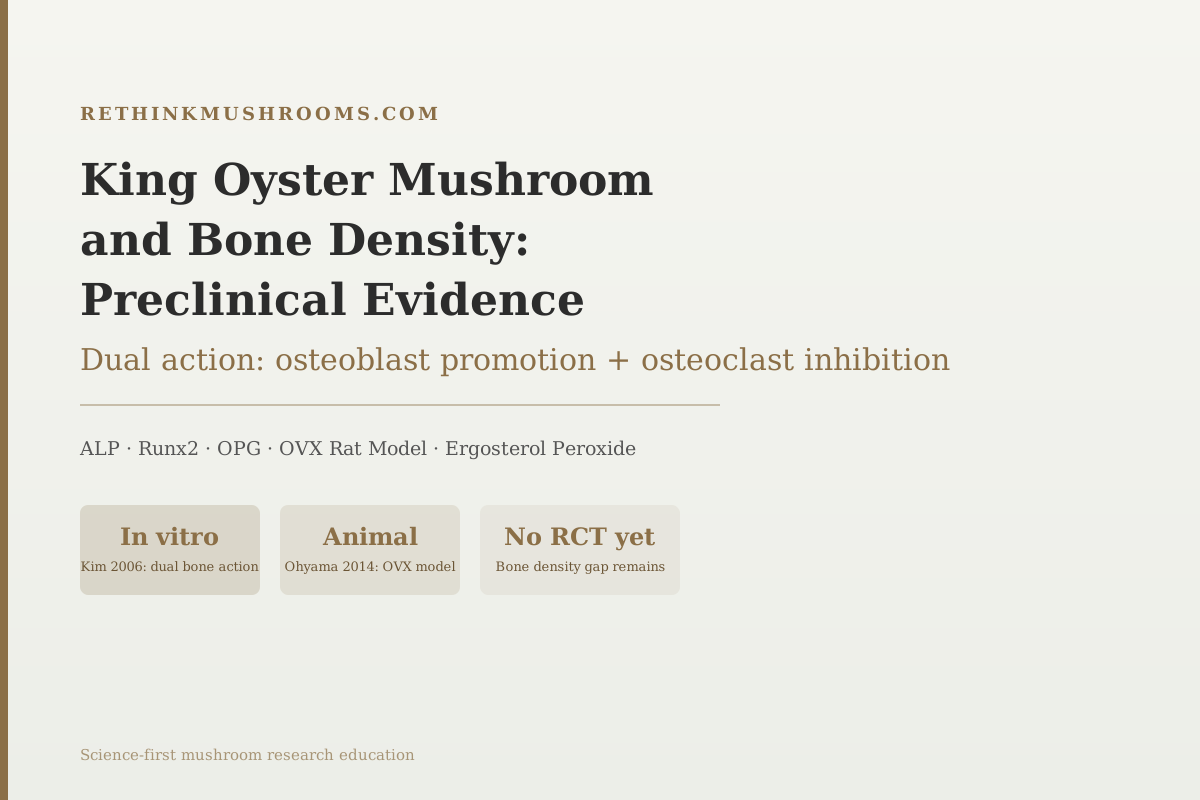
Dual action on bone remodeling
Pleurotus eryngii extracts both promote osteoblast differentiation (bone formation) and reduce osteoclast activity (bone resorption); these two mechanisms work in opposite directions to maintain bone density, according to cell culture studies.
Kim et al., Biofactors, 2006
Runx2 + OPG
key bone formation genes upregulated by P. eryngii extract in cell culture and ovariectomized rat studies; Runx2 is the master transcription factor for osteoblast differentiation, OPG blocks osteoclast activation
OVX rat model
the animal model used in Ohyama et al. (2014): ovariectomized rats mimic postmenopausal estrogen loss, the most relevant preclinical model for studying bone loss in women
No bone density RCT
the current evidence gap: no randomized controlled trial has measured bone mineral density as a primary outcome for P. eryngii supplementation in humans; a vitamin D2 RCT exists but bone density specifically has not been tested
Kim et al., Biofactors, 2006
 View as image ↗
When evaluating any health claim for a food or supplement, the type of evidence matters as much as whether evidence exists. For king oyster mushroom (Pleurotus eryngii) and bone density, there is genuine research: cell culture studies showing specific osteoblast-stimulating and osteoclast-inhibiting effects, animal model data from a postmenopausal bone loss model, and a cross-species pattern emerging across multiple edible mushrooms. What there isn't is a human clinical trial measuring bone mineral density specifically.
This article maps that evidence hierarchy. Not every claim needs a human trial to be interesting or biologically plausible, but understanding which tier each piece of evidence comes from is essential for calibrating expectations.
For the broader overview of king trumpet's bone health research, see king trumpet and bone health: osteoporosis research. For the introduction to king trumpet mushroom overall, see what is king trumpet mushroom: the meaty mushroom with health benefits.
Key Takeaways
- P. eryngii extracts increased alkaline phosphatase (ALP) activity, osteocalcin mRNA, and Runx2 gene expression in osteoblasts while reducing TRAP-positive osteoclast cells in cell culture, demonstrating a dual pro-formation/anti-resorption effect (Kim et al., Biofactors, 2006)
- Oral P. eryngii extract in ovariectomized rats (a postmenopausal bone loss model) enhanced osteoblast markers (ALP, OPG expression) and reduced osteoclast formation at the bone surface (Ohyama et al., BBB, 2014)
- Auricularia auricula-judae (wood ear mushroom) showed the same biphasic pattern in 2024: promoting osteoblast differentiation at low concentrations while inhibiting osteoclastogenesis, suggesting this dual mechanism may be common to multiple edible mushrooms (Kim et al., IJMS, 2024)
- Multiple edible mushroom species showed decreased bone resorption markers and improved bone formation in cross-species comparison, with P. eryngii among the effective species (Erjavec et al., Nutrients, 2016)
- The evidence base is entirely preclinical: strong in vitro data, supporting animal model data, and a cross-species pattern, but no randomized controlled trial measuring bone mineral density for P. eryngii supplementation
- The human evidence currently available is indirect: a 2022 RCT showed UV-irradiated P. eryngii mushrooms increase 25(OH)D2 plasma levels, which is relevant to bone health via the vitamin D pathway but not a direct measure of bone density
The Evidence Pyramid for King Oyster Mushroom and Bone
Research on any biological question typically begins with cell culture, where isolated cells can be studied in controlled conditions. When cell culture results are encouraging, researchers move to animal models, which involve living physiology and more complex interactions. Only then are human trials typically conducted.
For P. eryngii and bone health, the evidence sits at the cell culture and animal model stages, with the human evidence limited to a single trial on a related but indirect outcome (vitamin D2 levels rather than bone density).
This doesn't mean the research is unimportant. Cell culture studies can identify specific mechanisms with a precision that human trials cannot. Animal model studies can test outcomes in living systems under conditions that are hard to replicate in human trials (like surgical menopause). But it does mean that the jump from "this works in rat bone cells" to "this prevents osteoporosis in postmenopausal women" requires human evidence that doesn't yet exist.
In Vitro Evidence: What P. eryngii Does to Bone Cells
Kim and colleagues' 2006 study is the foundational paper for understanding how P. eryngii interacts with bone biology.[1] The researchers applied P. eryngii extracts to two types of bone cells in culture: osteoblasts (the cells that build new bone) and osteoclasts (the cells that break it down).
In osteoblasts, the extract produced measurable increases in three key markers:
Alkaline phosphatase (ALP) activity. ALP is an enzyme produced by active osteoblasts during bone mineralization. Higher ALP activity is a standard indicator that osteoblasts are actively forming bone rather than sitting dormant.
Osteocalcin mRNA expression. Osteocalcin is a protein produced exclusively by osteoblasts and embedded in bone matrix. Its mRNA expression indicates that osteoblasts are actively producing this bone-specific protein, a sign of differentiation into fully functional bone-forming cells.
Runx2 gene expression. Runx2 is the master transcription factor for osteoblast differentiation. When Runx2 is upregulated, bone progenitor cells are being directed toward an osteoblast fate. This is the most upstream signal in the bone formation pathway, suggesting P. eryngii is influencing the fundamental decision to become a bone-forming cell.
In osteoclast cultures, the extract reduced the number of TRAP-positive multinucleated cells (the cellular marker for active osteoclasts) and the amount of bone resorption area in culture dishes. Osteoclasts were still present but less active and less numerous.
This dual effect is the most compelling aspect of the in vitro data: the same extract both accelerated bone formation and slowed bone resorption. These are the two sides of the bone remodeling equation, and P. eryngii appears to push both in a bone-preserving direction.
Animal Evidence: The Postmenopausal Bone Loss Model
Ohyama and colleagues designed their 2014 study specifically around the most clinically relevant scenario for bone loss: postmenopausal estrogen depletion.[2] They used ovariectomized (OVX) rats, in which surgical removal of the ovaries produces an immediate and severe estrogen decline that triggers rapid bone loss. This is the standard preclinical model for postmenopausal osteoporosis, used to test interventions from bisphosphonate drugs to dietary supplements.
OVX rats received daily oral P. eryngii aqueous extract for 4 weeks. The primary findings:
ALP activity and OPG (osteoprotegerin) gene expression were higher in treated rats. OPG is notable beyond its osteoblast-marker role: it is a decoy receptor that binds RANKL, the signaling molecule that activates osteoclast differentiation. When osteoblasts secrete more OPG, they are actively blocking osteoclast formation at a molecular level. This means P. eryngii may be influencing bone remodeling through both direct osteoblast activation and this indirect osteoclast inhibition pathway.
TRAP-positive multinucleated cells and resorption areas were reduced in bone tissue from treated rats, consistent with the in vitro osteoclast findings.
The oral delivery is important: this isn't a cell exposed directly to an extract, it's a living organism eating the extract and showing bone-relevant changes throughout the skeletal system. The mechanism of action at this level is more complex than the in vitro data, but the direction is consistent.
For the specific osteoclast inhibition research including the compound ergosterol peroxide, see Pleurotus eryngii and osteoclast inhibition: a mushroom for bone density?.
The 2024 Cross-Species Pattern: Wood Ear Shows the Same Mechanism
Kim and colleagues published a 2024 cell culture study on Auricularia auricula-judae (wood ear mushroom) investigating its effects on bone homeostasis.[4] The finding was a biphasic pattern: at low concentrations, wood ear extract promoted osteoblast differentiation; simultaneously, it inhibited osteoclastogenesis. This is the same dual-direction effect as P. eryngii.
The cross-species finding matters for evaluating P. eryngii's bone effects because it suggests the mechanism is not specific to one mushroom's unusual chemistry. Multiple edible mushroom species appear to share structural or bioactive compounds that push bone remodeling in the same direction. This doesn't prove the effect is strong enough to matter clinically in any species, but it increases the biological plausibility that the effect is real rather than an artifact of one poorly-conducted study.
The 2016 Erjavec study supports this interpretation through direct comparison: researchers tested extracts from multiple mushroom species, including Pleurotus, and found that P. eryngii was among the effective species for reducing bone resorption markers and improving bone formation indicators.[3]
For the connection between king trumpet's ergothioneine content and antioxidant protection of osteoblasts, see king trumpet: the highest ergothioneine source among mushrooms.
How to Read This Evidence
The preclinical evidence for king oyster mushroom and bone density is internally consistent and mechanistically well-characterized. The cell culture studies identify specific molecular targets (Runx2, OPG, ALP) with clear relationships to bone formation. The animal model study uses the most relevant preclinical model (OVX rats mimicking postmenopausal bone loss) and shows consistent direction of effect. A cross-species pattern in 2024 data suggests the mechanism may be general to edible mushrooms rather than idiosyncratic.
What this evidence cannot establish: the size of any effect in humans, whether dietary amounts of king oyster mushroom produce sufficient compound concentrations at bone surfaces to trigger these mechanisms, or whether supplementation prevents clinically meaningful bone density loss. These questions require human trials.
For the postmenopausal context and why vitamin D2 from UV-exposed king trumpet is the most direct human evidence available, see king trumpet for postmenopausal bone loss. For the osteoblast differentiation mechanisms in more detail, see Pleurotus eryngii and osteoblast differentiation.
The Bottom Line
The preclinical evidence for king oyster mushroom (Pleurotus eryngii) and bone density sits across three evidence tiers. Cell culture (Kim et al., 2006) shows dual bone-relevant effects: upregulation of Runx2, ALP, and osteocalcin in osteoblasts alongside reduced osteoclast activity. An animal study in ovariectomized rats (Ohyama et al., 2014) confirmed oral P. eryngii extract enhanced OPG expression and reduced osteoclast markers in the postmenopausal bone loss model. A 2024 cross-species study (Kim et al., 2024) found the same biphasic osteoblast/osteoclast pattern in wood ear mushroom. No randomized controlled trial has measured bone mineral density directly for P. eryngii supplementation in humans.
Frequently Asked Questions
Sources & References
- 1RTHM-00192·Kim, Se-Won et al. (2006). “Effects of mushroom, Pleurotus eryngii, extracts on bone metabolism..” Clinical nutrition (Edinburgh.Study breakdown →PubMed →↩
- 2RTHM-00341·Ohyama, Y et al. (2014). “Effect of the ethanol extract of Pleurotus eryngii on bone metabolism in ovariectomized rats..” Climacteric : the journal of the International Menopause Society.Study breakdown →PubMed →↩
- 3RTHM-00424·Erjavec, Igor et al. (2016). “Mushroom Extracts Decrease Bone Resorption and Improve Bone Formation..” International journal of medicinal mushrooms.Study breakdown →PubMed →↩
- 4RTHM-00885·Kim, Shin-Hye et al. (2024). “The Biphasic Activity of Auricularia Auricula-Judae Extract on Bone Homeostasis through Inhibition of Osteoclastogenesis and Modulation of Osteogenic Activity..” Journal of microbiology and biotechnology.Study breakdown →PubMed →↩