King Trumpet & Bone Health
1-2% per year bone density loss
Postmenopausal women lose approximately 1-2% of bone mineral density per year in the years immediately following menopause due to estrogen-driven osteoclast activation. The ovariectomized rat model used in P. eryngii bone research was specifically designed to mimic this mechanism.
Ohyama et al., Bioscience, Biotechnology, and Biochemistry, 2014
OVX model
the animal model used to study postmenopausal bone loss: ovariectomy removes estrogen exactly as menopause does, creating rapid bone loss. P. eryngii oral extract enhanced OPG and ALP while reducing osteoclast markers in this model (Ohyama et al., 2014)
25(OH)D2 elevated
the human RCT finding: UV-irradiated P. eryngii mushrooms consumed as snacks significantly raised circulating 25(OH)D2 (active vitamin D2) in metabolically unhealthy adults, which is relevant to bone density via calcium absorption (Kleftaki et al., 2022)
3 mechanisms
through which Lindequist et al. (2021) identified P. eryngii as one of the most promising mushrooms for bone health: ergosterol/vitamin D2 pathway, polysaccharide OPG upregulation, and direct osteoclast inhibition via ergosterol peroxide
Ohyama et al., Bioscience, Biotechnology, and Biochemistry, 2014
 View as image ↗
Osteoporosis affects more than 200 million people worldwide, with postmenopausal women at the highest risk. The mechanism is estrogen: estrogen suppresses osteoclast activity, and when estrogen levels drop at menopause, osteoclasts proliferate and accelerate bone resorption. The result is a predictable, rapid decline in bone mineral density beginning in the early postmenopausal years.
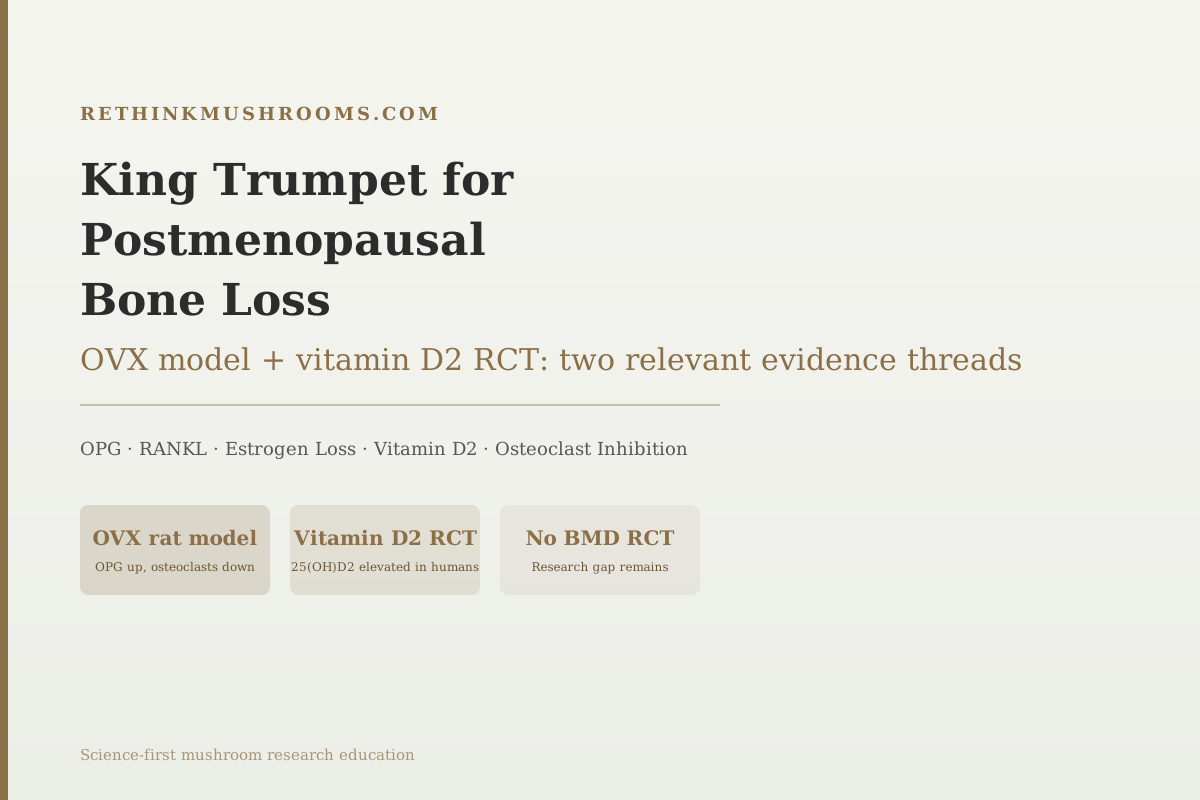
The research on king trumpet mushroom (Pleurotus eryngii) and bone health is predominantly preclinical, but it has two features that make it specifically relevant to postmenopausal bone loss: the primary animal study used the ovariectomized (OVX) rat model, which replicates postmenopausal estrogen loss through surgical ovary removal, and the human clinical data (a 2022 RCT) showed elevated vitamin D2 levels in people who ate UV-irradiated king trumpet mushrooms; vitamin D deficiency is one of the two most important nutritional factors in postmenopausal bone density after calcium.
This article explains those connections specifically.
For the full evidence pyramid across all bone health research tiers for P. eryngii, see king oyster mushroom and bone density: preclinical evidence. For the king trumpet pillar, see what is king trumpet mushroom: the meaty mushroom with health benefits.
Key Takeaways
- Ohyama et al. (2014) tested P. eryngii oral extract in ovariectomized (OVX) rats, the standard animal model for postmenopausal bone loss, and found enhanced ALP activity, elevated OPG (osteoprotegerin) gene expression, and reduced TRAP-positive osteoclast cells after 4 weeks of daily supplementation
- Osteoprotegerin (OPG) produced by osteoblasts is a decoy receptor that blocks RANKL, the signaling molecule that activates osteoclasts; P. eryngii's specific upregulation of OPG is directly relevant to the RANKL-mediated osteoclast activation that estrogen loss triggers in postmenopausal women
- UV-B irradiated mushrooms rich in vitamin D2 are associated with improved bone health markers in research (Chen et al., 2015), and a 2022 human RCT found P. eryngii specifically raised 25(OH)D2 plasma levels in metabolically unhealthy adults (Kleftaki et al., 2022)
- Lindequist et al. (2021) reviewed the complete evidence and identified P. eryngii as one of the most promising mushroom species for osteoporosis prevention, via three mechanisms: ergosterol/vitamin D2, polysaccharide-mediated OPG upregulation, and ergosterol peroxide osteoclast inhibition
- No randomized controlled trial has tested P. eryngii specifically in postmenopausal women with bone mineral density as the primary outcome
- Vitamin D deficiency is prevalent in postmenopausal women and directly reduces calcium absorption and bone mineralization; mushroom-derived vitamin D2 from UV-exposed king trumpet mushrooms represents a dietary source with clinical evidence for bioavailability
The Postmenopausal Bone Loss Problem
Estrogen has two major roles in bone metabolism. It promotes osteoblast activity (bone formation) and suppresses osteoclast formation (bone resorption). When estrogen drops at menopause, both of these effects are reduced simultaneously: less new bone is built and more existing bone is broken down.
The critical mechanism is the RANKL/OPG ratio. Osteoclasts are activated when RANKL (receptor activator of nuclear factor kappa-B ligand) binds to its receptor on osteoclast precursors, triggering them to differentiate into active bone-resorbing cells. Estrogen suppresses RANKL expression and promotes OPG (osteoprotegerin), a decoy receptor that blocks RANKL before it can activate osteoclasts. When estrogen falls, RANKL rises and OPG falls; osteoclast activity increases and bone density declines.
This is the mechanistic background against which the P. eryngii OVX rat study becomes specifically relevant. If a compound specifically upregulates OPG expression (as Ohyama 2014 found P. eryngii does), it is directly targeting the RANKL/OPG ratio that estrogen loss has disrupted. This isn't a general bone-health effect; it is a targeted intervention at the specific mechanism of postmenopausal bone loss.
The OVX Model: How P. eryngii Was Tested Against Postmenopausal Bone Loss
Ohyama and colleagues tested the postmenopausal relevance directly by using ovariectomized (OVX) rats.[1] Ovariectomy surgically removes the ovaries, eliminating estrogen production and triggering the same rapid bone loss that occurs in postmenopausal women. The OVX rat is the standard preclinical model for osteoporosis research specifically because it replicates the estrogen-loss mechanism rather than just creating generic bone fragility.
OVX rats received daily oral P. eryngii aqueous extract for 4 weeks. The primary bone-relevant findings:
ALP activity increased. Alkaline phosphatase is the marker of active osteoblast function. Its increase indicates that the estrogen-depleted bone environment was partially restored toward active bone formation.
OPG gene expression elevated. This is the most mechanistically significant finding for postmenopausal relevance. OPG is the molecule that blocks RANKL signaling. In estrogen deficiency, OPG normally falls. P. eryngii extract increased OPG expression, directly counteracting the mechanism by which estrogen loss activates excessive osteoclast activity.
TRAP-positive multinucleated cells reduced. TRAP (tartrate-resistant acid phosphatase) marks active osteoclasts. Reduced TRAP-positive cells at the bone surface means osteoclast activity declined, the direct measurable benefit of the OPG upregulation.
The study confirms that P. eryngii extract, taken orally in an estrogen-depleted animal model, produces changes at the molecular level that specifically address the mechanisms of postmenopausal bone loss. The limitation is that it's an animal study; OVX rat outcomes don't automatically predict human outcomes, and there is no guarantee that the effect size or duration would be similar in postmenopausal women.
The Vitamin D2 Pathway: Why Sun-Exposed King Trumpet Matters for Bone
The second postmenopausal relevance is through vitamin D. Postmenopausal women have higher rates of vitamin D deficiency than other demographics for several reasons: reduced skin vitamin D synthesis with age, less outdoor activity, reduced renal conversion of vitamin D to its active form, and lower intestinal vitamin D receptor responsiveness. Vitamin D deficiency directly reduces calcium absorption in the gut, calcium reabsorption in the kidneys, and bone mineralization.
King trumpet mushrooms contain ergosterol, the fungal precursor to vitamin D2. When the mushroom is exposed to UV-B radiation (either from sunlight or UV-B lamps), ergosterol converts to vitamin D2 (ergocalciferol). This is the same photochemical conversion that occurs in human skin when exposed to sunlight, but happening in the mushroom tissue.
Chen and colleagues found in 2015 that consumption of UV-B irradiated mushrooms with enhanced vitamin D2 content was associated with improved bone health markers.[2] This cohort finding established the dietary route for mushroom-derived vitamin D2 and bone health outcomes.
Kleftaki and colleagues published the human RCT data in 2022: metabolically unhealthy adults who consumed UV-irradiated P. eryngii mushroom snacks showed significantly elevated 25(OH)D2 plasma levels compared to controls.[3] The 25(OH)D2 elevation was statistically significant alongside reductions in IL-6 and oxidized LDL. This is the only published human clinical trial for P. eryngii with biomarker measurements, and it confirms that king trumpet-derived vitamin D2 is bioavailable in humans.
For postmenopausal women specifically, the relevance is straightforward: any intervention that improves vitamin D status helps maintain calcium absorption and bone mineralization. King trumpet mushrooms provide a plant-based (strictly speaking, fungal-based) dietary vitamin D2 source with human clinical evidence of bioavailability.
What the Comprehensive Review Concludes
Lindequist and colleagues published a 2021 review of medicinal mushrooms specifically for osteoporosis prevention and treatment.[4] P. eryngii was identified as one of the most promising species based on three distinct mechanisms operating simultaneously:
The ergosterol/vitamin D2 pathway provides the nutritional bone-health connection that operates through vitamin D receptor activation.
Polysaccharide-mediated OPG upregulation (the mechanism documented in the OVX rat study) provides the anti-resorptive effect directly relevant to postmenopausal osteoclast overactivation.
Ergosterol peroxide, a specific compound isolated from P. eryngii, inhibits osteoclast differentiation directly by up to 62% in cell culture, providing a pharmacological anti-resorptive mechanism independent of the OPG pathway.
The presence of three mechanistically distinct pathways in a single food species is notable. Most functional foods act through one mechanism. P. eryngii has vitamin D2 for calcium absorption, polysaccharide-driven OPG upregulation for RANKL blockade, and ergosterol peroxide for direct osteoclast inhibition.
The Research Gap: What Honest Assessment Requires
No randomized controlled trial has specifically enrolled postmenopausal women and measured bone mineral density as the primary outcome after P. eryngii supplementation. The Kleftaki 2022 RCT measured vitamin D2 bioavailability and metabolic markers in metabolically unhealthy adults, not bone density in postmenopausal women. The Ohyama 2014 OVX rat study is the closest model of postmenopausal bone biology, but animal models don't reliably predict human outcomes.
For postmenopausal women considering king trumpet mushrooms for bone health, the honest framing is:
The mechanisms are highly relevant. OPG upregulation directly counters RANKL-driven osteoclast activation from estrogen loss. Vitamin D2 from UV-exposed mushrooms improves a nutrient commonly deficient in this population. Three distinct pathways work toward the same goal.
The clinical confirmation is not yet available. An RCT in postmenopausal women with bone mineral density as the primary endpoint would be the definitive study. That research has not been published.
King trumpet mushrooms as a dietary food (particularly UV-exposed varieties) represent a plausible contribution to bone health maintenance in postmenopausal women based on the available evidence. This is not the same as a proven therapeutic intervention.
The Bottom Line
The postmenopausal bone health case for P. eryngii rests on two evidence threads. Ohyama et al. (2014) tested oral P. eryngii in OVX rats (the standard postmenopausal bone loss model) and found specific OPG upregulation alongside ALP increases and osteoclast reduction, addressing the RANKL/OPG imbalance caused by estrogen loss. Kleftaki et al. (2022) confirmed in a human RCT that UV-irradiated P. eryngii mushrooms raise circulating 25(OH)D2, supporting the vitamin D pathway for calcium absorption and bone mineralization. Lindequist et al. (2021) identified P. eryngii as one of the most promising mushroom species for osteoporosis via three distinct mechanisms. No postmenopausal bone mineral density RCT has been published for P. eryngii.
Frequently Asked Questions
Sources & References
- 1RTHM-00341·Ohyama, Y et al. (2014). “Effect of the ethanol extract of Pleurotus eryngii on bone metabolism in ovariectomized rats..” Climacteric : the journal of the International Menopause Society.Study breakdown →PubMed →↩
- 2RTHM-00677·Chen, Shin-Yu et al. (2015). “Consumption of vitamin D2 enhanced mushrooms is associated with improved bone health..” The Journal of nutritional biochemistry.Study breakdown →PubMed →↩
- 3RTHM-00771·Kleftaki, Stamatia-Angeliki et al. (2022). “A Randomized Controlled Trial on Pleurotus eryngii Mushrooms with Antioxidant Compounds and Vitamin D2 in Managing Metabolic Disorders..” Antioxidants (Basel.Study breakdown →PubMed →↩
- 4RTHM-00701·Lindequist, Ulrike et al. (2021). “Medicinal Mushrooms for Prevention and Therapy of Osteoporosis (Review)..” International journal of medicinal mushrooms.Study breakdown →PubMed →↩