King Trumpet / King Oyster: Culinary & Nutrition
130°C+ dry surface temperature — the threshold for Maillard browning that makes king trumpet scallops work
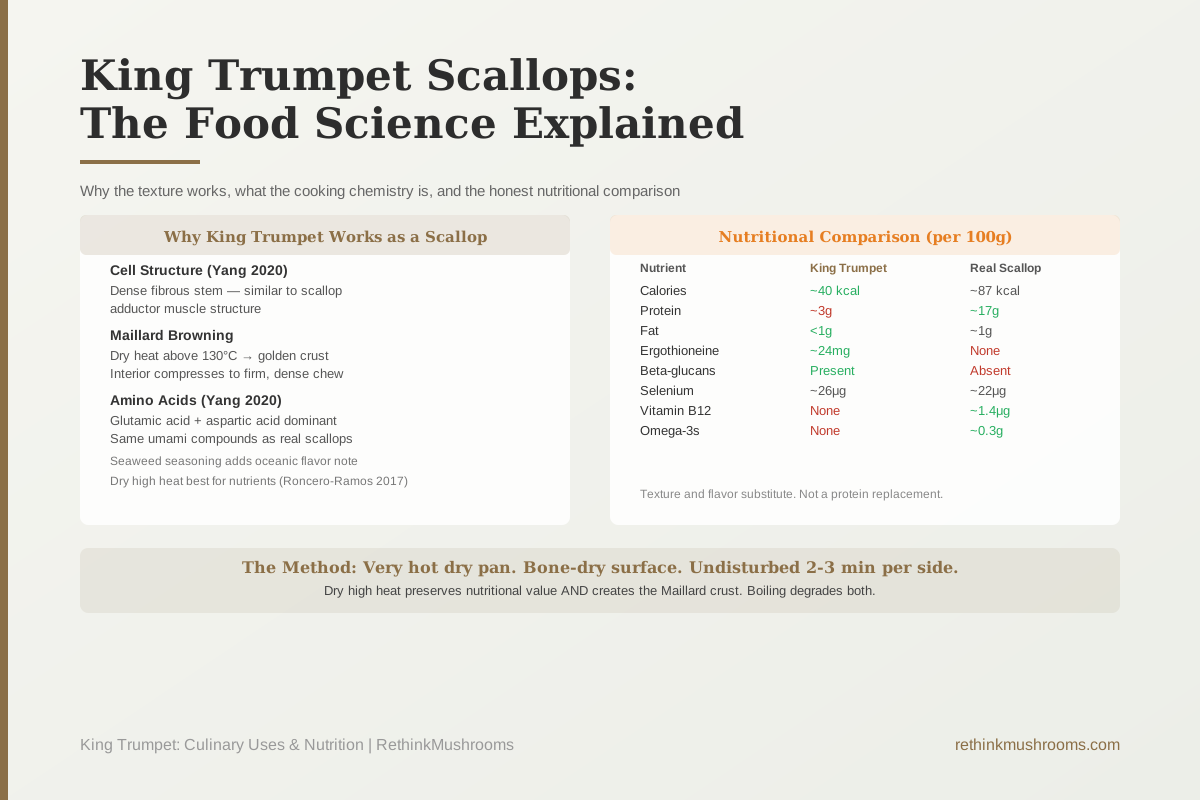
King trumpet works as a plant-based scallop substitute because of cell structure: its dense fibrous stem browns under dry high heat and compresses to a firm chew resembling scallop adductor muscle — backed by documented food science.
Yang et al., Scientific Reports, 2020; Roncero-Ramos et al., Int J Food Sci Nutr, 2017
glutamic acid
dominant free amino acid in P. eryngii (Yang 2020) — same umami compound that makes real scallops taste savory
40 kcal vs 87 kcal
king trumpet vs. real scallops per 100g — texture match, not calorie match
3g vs 17g protein
king trumpet vs. real scallops per 100g — a texture substitute, not a protein replacement
Yang et al., Scientific Reports, 2020; Roncero-Ramos et al., Int J Food Sci Nutr, 2017
 View as image ↗
The claim that king trumpet mushroom makes a convincing plant-based scallop circulates widely in food media. What is almost never explained is why: specifically, what properties of the mushroom create the effect, what cooking method is required, and what the realistic comparison to real scallops looks like nutritionally.
The answer involves cell biology, the Maillard reaction, amino acid chemistry, and an honest acknowledgment that texture is not the same as nutrition. The king trumpet scallop works well as a culinary substitute. It does not replace seafood from a protein standpoint.
For a broader introduction to king trumpet mushroom, see What Is King Trumpet Mushroom? The Meaty Mushroom with Health Benefits.
Key Takeaways
- King trumpet mushrooms (Pleurotus eryngii) work as a plant-based scallop substitute because their dense fibrous stem structure, when seared at high dry heat, compresses and browns in a way that resembles the firm bite of seared scallop adductor muscle
- Yang and colleagues (Scientific Reports, 2020) showed that P. eryngii's free amino acid profile is dominated by glutamic acid and aspartic acid — the same umami-driving compounds prominent in real scallops, explaining the flavor similarity
- Roncero-Ramos and colleagues (Int J Food Sci Nutr, 2017) confirmed that grilling and other dry high-heat methods preserve the most nutritional value and antioxidant activity in Pleurotus mushrooms; boiling and frying significantly degrade both texture and bioactive compounds
- Per 100g, king trumpet has approximately 40 kcal and 3g protein; real scallops have approximately 87 kcal and 17g protein — king trumpet scallops are a texture and flavor substitute, not a protein replacement
- King trumpet provides ergothioneine (~24mg/100g) and beta-glucans that scallops do not contain; scallops provide B12, omega-3 fatty acids, and complete protein that king trumpet does not — the nutritional exchange goes both ways
- A 2025 comprehensive review of edible mushrooms as meat and seafood analogues confirmed that Pleurotus species have documented sensory and nutritional properties that distinguish them as effective plant-based alternatives
Why King Trumpet Works as a Scallop Substitute: The Food Science
Most content promoting king trumpet as a vegan scallop moves directly to the recipe without explaining what makes the substitution work. The answer is rooted in cell structure and heat chemistry.
A real scallop's texture comes from its adductor muscle: a dense, fibrous mass of tightly packed protein fibers. When seared, the surface proteins undergo the Maillard reaction — browning at temperatures above 130°C — forming a caramelized crust, while the interior fibers contract and firm up to a dense, moist chew.
King trumpet's stem has a cell wall structure that behaves similarly under the right conditions. Yang and colleagues (2020) published a full microstructure characterization of Pleurotus eryngii and documented dense, fibrous cell arrangements in the stem tissue — distinct from the more open, spongy structure of mushroom caps.[1]
Under dry high heat, two things happen to the king trumpet stem:
First, the high water content in the mushroom's cells evaporates rapidly from the cut surface. When that moisture is gone from the surface, the surface temperature rises above 100°C into the 130-150°C range where Maillard browning begins. A crust forms. A wet or damp mushroom surface cannot achieve this — evaporating water keeps the surface temperature below the browning threshold.
Second, the dense fibrous cell walls compress as interior moisture leaves. The texture shifts from springy to firm and slightly chewy, resembling the bite of a seared scallop more than any other plant-based ingredient.
A 2025 comprehensive review of edible mushrooms as meat and seafood analogues confirmed that Pleurotus species have specific texture properties that distinguish them from other candidates and support their use as functional food replacements for animal protein.[4]
The Flavor Chemistry: Why King Trumpet Tastes Umami Like Seafood
The second reason king trumpet works as a scallop substitute is flavor, and the explanation is amino acid chemistry.
Yang and colleagues (2020) characterized the free amino acid profile of Pleurotus eryngii in detail.[1] Free amino acids (amino acids not bound in protein chains, but dissolved in the mushroom tissue) are primary contributors to taste. The dominant free amino acids in king trumpet were glutamic acid and aspartic acid.
Glutamic acid is the compound responsible for umami taste. It is the same molecule that makes MSG produce its savory effect (MSG is monosodium glutamate — the sodium salt of glutamic acid). Aspartic acid has a similar character. Both are present in real scallops and other seafood at high concentrations, which is part of why seafood registers as distinctively savory.
In king trumpet, the same amino acids appear in high concentrations. When the mushroom is cooked and some moisture evaporates, these free amino acids concentrate in the remaining tissue and the glutamate-driven umami flavor intensifies. The result tastes oceanic-savory in the same way that scallops do, even though the source is entirely plant-based.
This is not coincidence or marketing language — it is amino acid chemistry, and it explains why king trumpet is significantly more convincing as a scallop substitute than tofu, jackfruit, or other common plant proteins that do not share this amino acid profile.
The Cooking Method: What the Research Supports
The cooking method matters for both texture success and nutritional preservation. Roncero-Ramos and colleagues (2017) tested multiple cooking methods on cultivated mushrooms including Pleurotus species, measuring effects on nutritional value and antioxidant activity.[2]
Grilling and microwaving preserved the most nutritional value and antioxidant activity. Frying significantly reduced protein content. Boiling was the worst method for nutrient preservation: water-soluble compounds including B vitamins, beta-glucans, and phenolics leached into the cooking water and were lost.
Tan and colleagues (2015) confirmed similar findings for phenolic content and antioxidant activity in oyster mushrooms: high-heat dry cooking methods outperformed boiling and steaming for bioactive compound retention.[3]
For king trumpet scallops, the cooking science and culinary technique align exactly. The method that creates the best texture (dry, very hot pan, no added liquid) is also the method that best preserves the mushroom's nutritional content. Boiling or steaming king trumpet produces the opposite result: soft texture, no browning, and leaching of both nutrients and flavor compounds into the liquid.
How to Cook King Trumpet Scallops
The method is specific. The variables that most commonly prevent success are moisture on the surface and insufficient heat.
Preparation:
- Cut the king trumpet stem into rounds 2-3 cm thick. Thinner rounds overcook before browning; thicker rounds may remain raw in the center.
- Pat cut surfaces completely dry with paper towels. This is the most important step.
- Score a shallow crosshatch 1-2 mm deep into each cut surface (optional but increases browning surface area).
- Do not salt before cooking. Salt draws moisture to the surface and delays or prevents browning.
Cooking:
- Heat a heavy pan (cast iron or stainless steel) over high heat for at least 1-2 minutes before adding anything.
- Add a small amount of oil or butter only when the pan is already very hot.
- Place rounds cut-side down. Do not move them. Press gently with a spatula to improve surface contact.
- Leave undisturbed for 2-3 minutes. A correctly seared round will release cleanly from the pan when the crust has formed; forcing it before the crust forms tears the surface.
- Flip and repeat.
The indicator of success: a deep golden-brown crust on both cut surfaces, with a firm but cooked-through interior.
Nutritional Comparison: King Trumpet vs. Real Scallops
The honest nutritional picture of the substitution:
| Nutrient | King Trumpet (100g raw) | Real Scallops (100g raw) |
|---|---|---|
| Calories | ~40 kcal | ~87 kcal |
| Protein | ~3g | ~17g |
| Fat | <1g | ~1g |
| Carbohydrates | ~7g | ~4g |
| Ergothioneine | ~24mg | Negligible |
| Beta-glucans | Present | Absent |
| Selenium | ~26μg | ~22μg |
| Vitamin B12 | None | ~1.4μg |
| Omega-3 fatty acids | None | ~0.3g |
The protein gap is large and should not be minimized. Scallops provide 17g of high-quality complete protein per 100g. King trumpet provides 3g. Replacing scallops with king trumpet creates a satisfying texture and flavor experience but does not replicate the protein content.
The nutrient exchange runs in both directions. King trumpet provides ergothioneine at ~24mg/100g, a concentration scallops do not contain at all, along with beta-glucans and phenolic antioxidants absent from seafood. For people concerned about oxidative stress or immune health, king trumpet offers compounds that actual scallops do not.
For anyone using plant-based scallops to reduce seafood consumption while maintaining protein intake, pairing king trumpet with a protein-dense element (legumes, tofu, whole grains, tempeh) is the practical way to compensate.
Enhancing the Oceanic Flavor
King trumpet's glutamate-rich amino acids create a savory umami base that parallels scallops. Adding compounds with specifically marine or oceanic flavor profiles can extend the resemblance further.
Seaweed-derived ingredients — dulse flakes, nori strips, kelp powder — contain compounds including trimethylamine oxide precursors and ocean-specific amino acids that the palate registers as distinctly marine. A small amount added to a finishing butter sauce or sprinkled onto the cooked rounds noticeably shifts the flavor profile toward seafood territory.
This is flavor composition, not nutritional substitution. But for the culinary goal of producing something that tastes like scallops, the combination of Maillard-browned king trumpet plus seaweed-derived seasoning is the most effective plant-based approximation currently available.
What King Trumpet Cannot Match
The honest accounting of what the substitution does not replicate:
Protein density. At 3g protein per 100g, king trumpet cannot substitute for scallops in a high-protein diet without compensating from other sources.
Vitamin B12. Scallops contain B12; king trumpet does not. For plant-based diets where B12 is already a common gap, this matters.
Omega-3 fatty acids. Scallops and other seafood provide EPA and DHA; mushrooms do not contain these in meaningful quantities.
Zinc and phosphorus. Scallops are notably high in both; king trumpet is not.
The case for king trumpet scallops is culinary and contextual: the texture works, the umami flavor works, it provides its own distinctive micronutrient profile unavailable in seafood (ergothioneine, beta-glucans), and it is substantially lower in calories per serving. It does not protein-replace scallops.
For broader context on how king trumpet performs as a meat substitute, see King Oyster Mushroom as a Meat Substitute: Texture and Nutrition. For the complete nutritional profile of king trumpet, see King Trumpet Nutritional Profile: Complete Breakdown.
The Bottom Line
King trumpet mushrooms (Pleurotus eryngii) work as a plant-based scallop substitute through two food science mechanisms: a dense fibrous stem that Maillard-browns under dry heat above 130°C and compresses to a firm chew, and a free amino acid profile dominated by glutamic acid and aspartic acid (Yang 2020) — the same umami compounds that make scallops taste savory. Dry high-heat cooking (searing, grilling) preserves both texture and nutritional content; boiling degrades both (Roncero-Ramos 2017, Tan 2015). Nutritionally, king trumpet provides 40 kcal and 3g protein per 100g versus scallops' 87 kcal and 17g protein. The substitution works for texture and flavor; it is not a protein replacement.
Frequently Asked Questions
Sources & References
- 1RTHM-00665·Yang, Rui-Lin et al. (2020). “Physicochemical properties, microstructures, nutritional components, and free amino acids of Pleurotus eryngii as affected by different drying methods..” Scientific reports.Study breakdown →PubMed →↩
- 2RTHM-00488·Roncero-Ramos, Irene et al. (2017). “Effect of different cooking methods on nutritional value and antioxidant activity of cultivated mushrooms..” International journal of food sciences and nutrition.Study breakdown →PubMed →↩
- 3RTHM-00403·Tan, Yee-Shin et al. (2015). “Influence of customized cooking methods on the phenolic contents and antioxidant activities of selected species of oyster mushrooms (Pleurotus spp.)..” Journal of food science and technology.Study breakdown →PubMed →↩
- 4. Source details for this reference are not yet available.