King Trumpet Nutrition
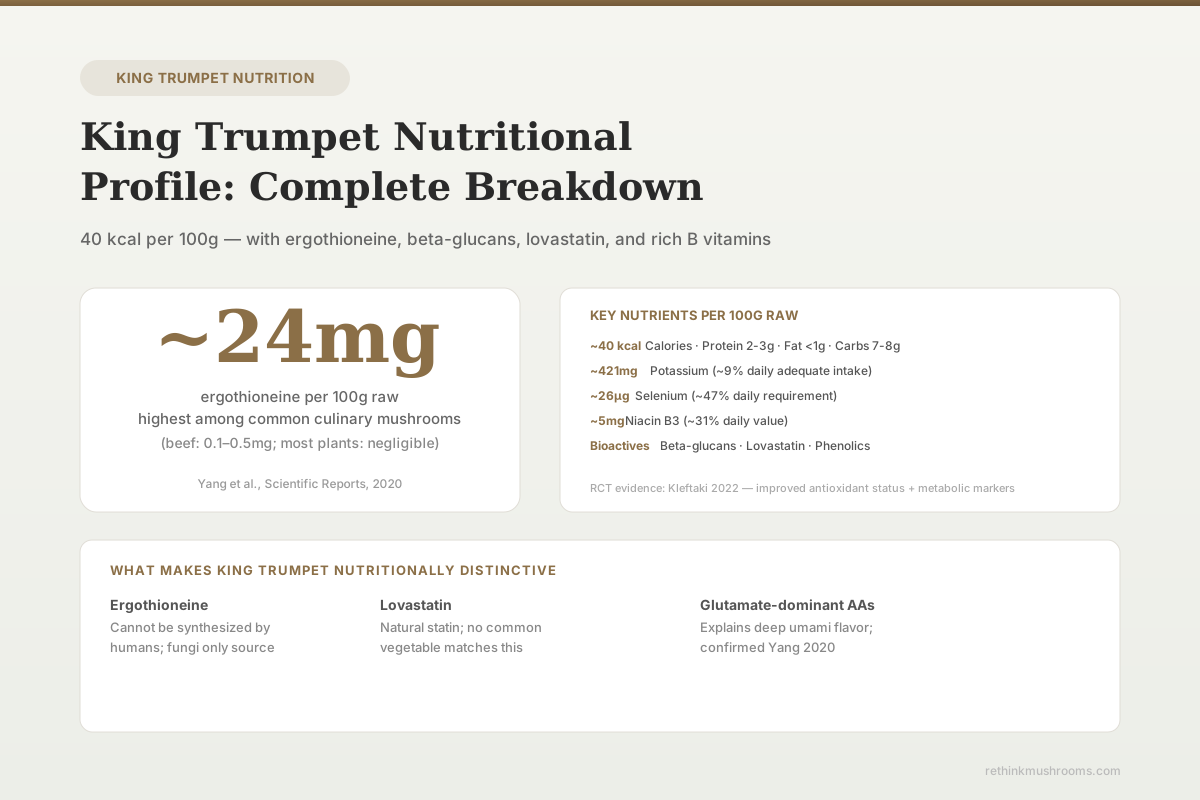
~24mg ergothioneine per 100g
King trumpet contains roughly 24mg of ergothioneine per 100g of fresh mushroom, making it one of the highest concentrations among common culinary mushrooms for this compound the human body cannot synthesize.
Yang et al., Scientific Reports, 2020
40 kcal
per 100g raw; low calorie density with significant micronutrient payload
Glutamate-rich
dominant free amino acid explaining king trumpet's deep umami character (Yang 2020)
RCT confirmed
Kleftaki 2022: PE supplementation improved antioxidant status in metabolic disorder patients
Yang et al., Scientific Reports, 2020
 View as image ↗
Most mushroom nutritional profiles stop at calories, protein, and a brief list of vitamins. King trumpet's profile is worth examining more carefully. It contains around 40 calories per 100g of fresh mushroom, which puts it in the category of very low-energy foods. But what makes king trumpet (Pleurotus eryngii) nutritionally distinctive isn't the calorie count; it's what arrives alongside those calories: roughly 24mg of ergothioneine (a free-radical scavenger that the human body cannot produce), beta-glucan fiber, naturally occurring lovastatin, and a free amino acid profile dominated by glutamic acid, which explains its unusually deep savory flavor.
This article presents king trumpet's complete nutritional profile using data from published research, including a 2020 characterization study that mapped its amino acid composition and a 2022 randomized controlled trial demonstrating metabolic health effects in humans. For the broader introduction to what king trumpet is and how it grows, see what is king trumpet mushroom.
Key Takeaways
- King trumpet contains approximately 40 kcal per 100g raw, with 2-3g protein, 7-8g carbohydrates, and under 1g fat
- Ergothioneine content of roughly 24mg per 100g makes king trumpet one of the most concentrated dietary sources of this compound among common culinary mushrooms
- Yang et al. (2020) found glutamic acid and aspartic acid are the dominant free amino acids in P. eryngii, providing the biochemical basis for its umami character
- Beta-glucans (beta-1,3 and beta-1,6 fractions), naturally occurring lovastatin, and phenolic compounds add bioactive value beyond standard macronutrients
- Grilling and microwaving preserve the most antioxidant activity; frying and boiling significantly reduce protein and bioactive content (Roncero-Ramos et al., 2017)
- Kleftaki et al. (2022) RCT: P. eryngii supplementation improved antioxidant status and metabolic markers in patients with metabolic disorders
The Macro Picture: What 100g of Raw King Trumpet Contains
King trumpet has a low caloric density combined with a nutritional profile that includes meaningful concentrations of several micronutrients and bioactive compounds. The figures below represent raw, fresh mushroom per 100g.
| Nutrient | Per 100g (raw) |
|---|---|
| Calories | ~40 kcal |
| Protein | 2-3g |
| Carbohydrates | 7-8g |
| Dietary fiber | ~2g |
| Fat | Under 1g |
| Ergothioneine | ~24mg |
| Potassium | ~421mg |
| Selenium | ~26µg |
| Niacin (B3) | ~5mg |
| Riboflavin (B2) | ~0.4mg |
The protein content of 2-3g per 100g raw is modest by the standards of protein-dense foods. However, mushrooms have high water content, typically 85-92%, which dilutes all nutrients on a fresh weight basis. On a dry weight basis, protein content in P. eryngii is substantially higher, typically ranging from 15-30% of dry matter, which is competitive with many plant protein sources. The distinction matters for how king trumpet should be positioned nutritionally: it is not a high-protein food in typical serving portions, but it is a protein-dense food when water is factored out.
The 2g of dietary fiber per 100g includes both insoluble fiber (primarily chitin, the structural polysaccharide of fungal cell walls) and soluble fiber fractions including beta-glucans. The digestibility of mushroom fiber depends on how the cells are broken down during cooking. Cooked or processed mushrooms release more of their nutrients than raw mushrooms because heat breaks down the tough chitin cell walls.
The Standout Micronutrients: Ergothioneine, Selenium, and B Vitamins
Ergothioneine is the nutrient that most distinguishes king trumpet from other common foods. It is a sulfur-containing amino acid derivative synthesized only by fungi and certain bacteria; humans and other animals cannot produce it and must obtain it entirely through diet. After consumption, it is absorbed in the small intestine via a dedicated transporter protein (called the ergothioneine transporter or ETT) and accumulates in tissues that experience high oxidative stress, particularly red blood cells, the liver, kidneys, and eyes.
The approximately 24mg per 100g of fresh king trumpet places it among the highest dietary sources. For comparison, beef (which acquires ergothioneine by eating soil fungi) contains around 0.1-0.5mg per 100g, and most plant foods contain negligible amounts. Other mushroom species also contain ergothioneine, but king trumpet is consistently among the highest for common culinary varieties. For a detailed comparison of ergothioneine content across foods and species, see ergothioneine in king oyster vs. other foods.
Selenium content of approximately 26µg per 100g is notable. The recommended dietary intake for selenium is 55µg per day for adults, meaning a 100g serving of king trumpet provides roughly half the daily requirement. Selenium functions as a component of selenoproteins, which include glutathione peroxidase (an enzyme that reduces oxidative damage) and thyroid hormone metabolism enzymes.
Potassium at around 421mg per 100g represents approximately 9% of the daily adequate intake (4,700mg). Potassium's primary role in the diet is maintaining fluid balance and supporting normal blood pressure. King trumpet's potassium content is substantial relative to its caloric density.
B vitamins present in meaningful concentrations include niacin (B3) at approximately 5mg per 100g (about 31% of the daily value) and riboflavin (B2) at roughly 0.4mg per 100g (about 31% of the daily value). Niacin participates in energy metabolism and DNA repair. Both niacin and riboflavin are better retained with dry cooking methods than boiling.
Vitamin D is notable by its potential rather than its standard content. Raw cultivated mushrooms grown without UV exposure contain little vitamin D. However, when mushrooms are exposed to ultraviolet light (either during commercial UV treatment or home sun-drying), ergosterol in the mushroom cell walls converts to ergocalciferol (vitamin D2). The conversion is substantial: UV-exposed mushrooms can contain 100-400 IU of vitamin D2 per 100g depending on UV intensity and duration.
The Umami Science: Glutamate, Aspartate, and Why King Trumpet Tastes Rich
Yang and colleagues (2020) conducted a thorough characterization of P. eryngii's nutritional composition, including a detailed free amino acid profile.[1] Their analysis found that glutamic acid and aspartic acid are the dominant free amino acids in king trumpet.
This finding has direct culinary implications. Glutamic acid is the compound behind umami flavor: the savory, mouth-filling quality associated with aged cheese, cured meats, tomatoes, and fermented products. Free glutamic acid (glutamate) stimulates umami receptors on the tongue at very low concentrations. Aspartic acid contributes a related, slightly more complex savory quality. In plain terms: king trumpet's amino acid profile is why it tastes meaty and why it works as a culinary substitute for meat or seafood in ways that most other vegetables do not.
The Yang 2020 study also documented how drying methods affect nutritional composition in P. eryngii.[1] Freeze-drying best preserved the free amino acid profile, while hot air drying at high temperatures degraded some amino acid content. This has practical implications for supplement manufacturers who dry and powder king trumpet for extraction; the processing method affects how much of the amino acid profile and associated nutritional value survives.
Beyond free amino acids, king trumpet contains a full essential amino acid profile in its total protein, including lysine, leucine, and threonine, though at concentrations that make it a supplement to dietary protein rather than a replacement.
Bioactive Compounds: Beta-Glucans, Lovastatin, and Phenolics
Standard nutritional tables don't capture the compounds that most distinguish king trumpet from conventional vegetables. Three categories of bioactive compounds are relevant:
Beta-glucans: King trumpet contains both beta-1,3-glucan and the structurally distinct beta-1,6-glucan, which has been shown to modulate immune function and gut microbiota through different mechanisms than the beta-1,3 form. Beta-glucans are classified as dietary fiber but also have pharmacological activity at immune receptors in the gut wall. The immune-modulating properties of PE beta-glucans are covered in detail in king oyster polysaccharides and immune modulation.
Lovastatin: Pleurotus eryngii naturally produces lovastatin, the same compound used pharmaceutically as a cholesterol-lowering drug under the names Mevacor and Altocor. The concentration in mushrooms is substantially lower than therapeutic pharmaceutical doses, but the compound is biologically active and contributes to the cholesterol-modulating effects documented in animal studies. The mechanism is inhibition of HMG-CoA reductase, the rate-limiting enzyme in cholesterol synthesis. No culinary vegetable or common plant food contains a naturally occurring statin at comparable concentrations.
Phenolic compounds: King trumpet contains a range of phenolic acids and flavonoids that function as antioxidants. The 2025 comprehensive review of edible mushrooms as meat analogues confirmed that P. eryngii's phenolic content contributes meaningfully to its antioxidant profile alongside ergothioneine.[5] The specific phenolics include gallic acid, caffeic acid, and chlorogenic acid among others, with concentrations varying by cultivation conditions and post-harvest treatment.
How Cooking Changes the Nutritional Profile
The method used to cook king trumpet significantly affects which nutrients and bioactive compounds survive to the plate. Roncero-Ramos and colleagues (2017) compared the effect of different cooking methods on nutritional value and antioxidant activity in cultivated mushrooms, including Pleurotus species.[3]
Their findings were clear on method effects: grilling and microwaving preserved the most antioxidant activity and nutritional content. Frying and boiling significantly reduced protein content and antioxidant compound concentrations. The mechanism for boiling is intuitive: water-soluble vitamins (B vitamins), phenolics, and ergothioneine can leach into the cooking water and be discarded. Frying introduces high temperatures that can degrade heat-sensitive compounds while also adding fat and calories.
Grilling works well for king trumpet specifically because its dense stem structure allows dry heat to concentrate surface flavors through Maillard browning (the same browning chemistry that creates crust on seared meat) while the interior retains moisture and nutrients. This is also why grilling produces the texture most similar to meat.
Microwaving preserves nutrients through speed: the rapid heating minimizes time at high temperature, reducing thermal degradation. For nutrient retention without the texture benefits of grilling, microwaving is the most efficient method.
The Tan et al. (2015) analysis of cooking effects on phenolic content in Pleurotus species confirmed these findings: different cooking methods produce substantially different phenolic compound retention rates.[6] This matters because phenolics are significant contributors to king trumpet's antioxidant capacity alongside ergothioneine.
Amerikanou and colleagues (2023) analyzed king trumpet chips (a processed snack format) and found that even in this heavily processed form, significant nutritional value was retained.[4] The chip format involved dehydration and high-heat processing, yet meaningful concentrations of bioactive compounds remained. This suggests king trumpet's nutritional profile is somewhat robust to processing, at least in terms of its antioxidant and fiber components.
For the specific question of how high-heat cooking methods affect ergothioneine retention, see how cooking affects ergothioneine in king trumpet.
What a Human Clinical Trial Found
The most clinically grounded evidence for king trumpet's nutritional benefits comes from a 2022 randomized controlled trial by Kleftaki and colleagues, published in Antioxidants.[2] The trial enrolled patients with metabolic disorders and tested P. eryngii supplementation, measuring effects on antioxidant status and metabolic markers.
The results showed that PE supplementation produced beneficial effects on both antioxidant status and metabolic parameters in this patient population. An RCT is a stronger form of evidence than in vitro studies or animal models because it tests the actual food or supplement in humans, controls for confounding variables, and directly measures outcomes in the population of interest.
This is the human clinical evidence anchor for king trumpet's health effects. The trial's focus on metabolic disorder patients is particularly relevant because the population was one where oxidative stress and metabolic dysfunction were already present, making any antioxidant and metabolic effects measurable rather than speculative.
The biological mechanism linking king trumpet's nutritional profile to these outcomes is likely multifactorial: ergothioneine provides antioxidant support, beta-glucans modulate immune and inflammatory pathways, and the polyphenol fraction contributes additional antioxidant capacity. These compounds act through different pathways and their combination in the whole food likely produces effects greater than any single isolated compound.
The Protein Question: Accurate Expectations
King trumpet is frequently promoted in plant-based food contexts as a meat substitute. On protein content alone, this framing requires qualification. Raw king trumpet provides 2-3g of protein per 100g. Chicken breast provides approximately 31g per 100g cooked. Ground beef provides approximately 26g per 100g cooked. King trumpet cannot match meat for protein in a serving-for-serving comparison.
Where the meat substitute claim does hold is texture and flavor, both of which come from king trumpet's cell structure and amino acid profile rather than its protein quantity. The umami depth provided by glutamate and aspartate creates a satisfying savory experience that most vegetables cannot replicate. The dense stem structure, under dry high heat, produces a texture that many people find comparable to meat's chew.
The honest nutritional case for using king trumpet as part of a meat reduction strategy is not protein replacement but rather: substantial reduction in saturated fat and calories, addition of ergothioneine and beta-glucans that have no animal-food equivalent, and maintenance of savory flavor experience that supports adherence to plant-forward diets. When paired with adequate protein from other plant sources (legumes, tofu, tempeh), king trumpet contributes a distinctive nutritional payload that no animal product provides. For how king trumpet compares nutritionally in the meat substitute context, see king oyster mushroom as a meat substitute.
The Bottom Line
King trumpet mushroom's nutritional profile is defined by its combination of low caloric density and high bioactive compound concentration, particularly ergothioneine (~24mg/100g), beta-glucans, naturally occurring lovastatin, and a glutamate-rich amino acid profile documented by Yang et al. (2020). A 2022 RCT (Kleftaki) confirmed beneficial effects on antioxidant status and metabolic markers in humans. Cooking method matters: grilling and microwaving preserve the most nutritional value, while boiling and frying significantly degrade both antioxidant compounds and protein content.
Frequently Asked Questions
Sources & References
- 1RTHM-00665·Yang, Rui-Lin et al. (2020). “Physicochemical properties, microstructures, nutritional components, and free amino acids of Pleurotus eryngii as affected by different drying methods..” Scientific reports.Study breakdown →PubMed →↩
- 2RTHM-00771·Kleftaki, Stamatia-Angeliki et al. (2022). “A Randomized Controlled Trial on Pleurotus eryngii Mushrooms with Antioxidant Compounds and Vitamin D2 in Managing Metabolic Disorders..” Antioxidants (Basel.Study breakdown →PubMed →↩
- 3RTHM-00488·Roncero-Ramos, Irene et al. (2017). “Effect of different cooking methods on nutritional value and antioxidant activity of cultivated mushrooms..” International journal of food sciences and nutrition.Study breakdown →PubMed →↩
- 4RTHM-00813·Amerikanou, Charalampia et al. (2023). “Pleurotus eryngii Chips-Chemical Characterization and Nutritional Value of an Innovative Healthy Snack..” Foods (Basel.Study breakdown →PubMed →↩
- 5. Source details for this reference are not yet available.
- 6RTHM-00403·Tan, Yee-Shin et al. (2015). “Influence of customized cooking methods on the phenolic contents and antioxidant activities of selected species of oyster mushrooms (Pleurotus spp.)..” Journal of food science and technology.Study breakdown →PubMed →↩