King Trumpet / King Oyster Immunity
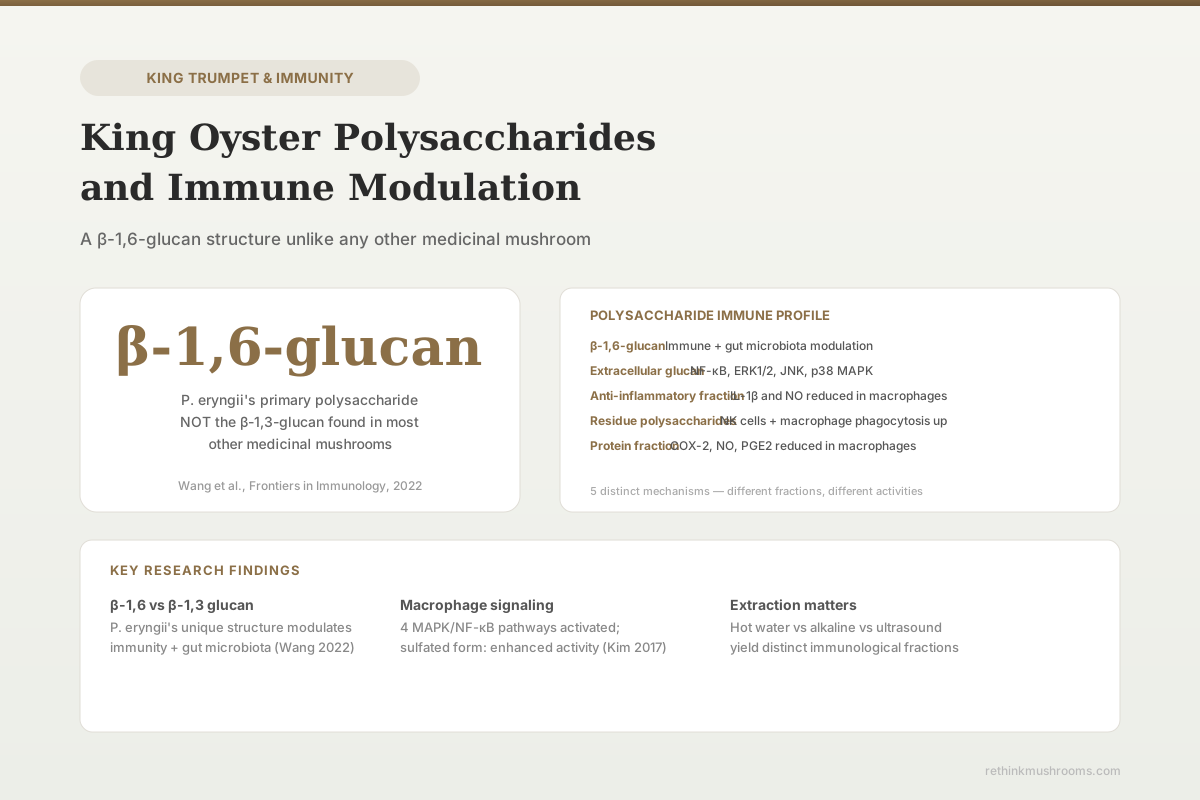
β-1,6-glucan: king oyster's structurally unique polysaccharide
Wang and colleagues documented in a 2022 Frontiers in Immunology study that Pleurotus eryngii produces β-1,6-glucan, structurally distinct from the β-1,3-glucan that most medicinal mushrooms use as their primary immune compound. This β-1,6-glucan modulates both immune function and gut microbiota composition.
Wang et al., Frontiers in Immunology, 2022
NF-κB + MAPK
the signaling pathways activated by P. eryngii β-glucan in macrophages: NF-κB, ERK1/2, JNK, and p38 MAPK; the sulfated derivative showed enhanced immunostimulatory activity (Kim et al., IJMM, 2017)
Protein fraction too
a novel protein isolated from P. eryngii reduced NO, PGE2, and COX-2 in LPS-stimulated macrophages, an anti-inflammatory effect distinct from polysaccharide-mediated immune activation (Yuan et al., Food & Function, 2017)
Waste still works
polysaccharides from P. eryngii processing residue inhibited tumor growth and upregulated NK cell activity and macrophage phagocytosis in mouse models (Ma et al., Carbohydrate Polymers, 2014)
Wang et al., Frontiers in Immunology, 2022
 View as image ↗
When people discuss beta-glucans in medicinal mushrooms, they almost always mean beta-1,3-glucan, the polysaccharide backbone found in reishi, turkey tail, lion's mane, and most other species studied for immune effects. It binds to Dectin-1 receptors on macrophages and initiates the innate immune cascade.
King oyster mushroom (Pleurotus eryngii) works differently. A 2022 study in Frontiers in Immunology documented that P. eryngii's primary polysaccharide fraction is not beta-1,3-glucan but beta-1,6-glucan, a structurally distinct polymer with a different branching pattern, different receptor affinity, and an immune profile that includes effects on gut microbiota composition in addition to the standard immune cell activation.[1]
This structural distinction is unknown to essentially all consumer health content on king oyster mushroom. The practical implications are still being researched, but the finding establishes that P. eryngii's polysaccharide immune mechanism is not simply a copy of what other medicinal mushrooms do.
For the pillar overview of king oyster's general profile, see what is king trumpet mushroom: the meaty mushroom with health benefits. For the broader immune health context, see king trumpet and the immune system: research review.
Key Takeaways
- Wang and colleagues documented in 2022 that Pleurotus eryngii produces β-1,6-glucan as a primary polysaccharide fraction, structurally distinct from the β-1,3-glucan that most medicinal mushrooms use as their immune-active compound; this β-1,6-glucan modulates both immune function and gut microbiota composition (Wang et al., Front Immunol, 2022)
- Kim and colleagues showed in 2017 that extracellular β-glucan from P. eryngii activated macrophage signaling pathways including NF-κB, ERK1/2, JNK, and p38 MAPK; a sulfated derivative showed enhanced immunostimulatory activity, suggesting that chemical modification affects potency (Kim et al., IJMM, 2017)
- A newly characterized polysaccharide fraction from P. eryngii showed anti-inflammatory activity in THP-1 macrophages, reducing IL-1β and NO production, demonstrating that P. eryngii polysaccharides can both activate immunity and reduce inflammatory markers depending on the specific fraction (Ma et al., J Food Sci, 2020)
- Polysaccharides extracted from P. eryngii processing residue (not the main fruiting body) inhibited tumor growth in mouse models and upregulated NK cell activity, macrophage phagocytosis, and splenocyte proliferation, confirming the immune activity extends to the whole mushroom (Ma et al., Carbohydrate Polymers, 2014)
- A novel protein (not a polysaccharide) isolated from P. eryngii reduced NO, PGE2, and COX-2 in LPS-stimulated macrophages, showing P. eryngii has anti-inflammatory protein components independent of its polysaccharide fraction (Yuan et al., Food & Function, 2017)
- Zhang and colleagues' 2020 comprehensive review of P. eryngii polysaccharides confirmed that extraction method significantly affects which polysaccharide fractions are recovered, with hot-water extraction, alkaline extraction, and ultrasound-assisted methods yielding fractions with distinct immunological activity profiles (Zhang et al., Int J Biol Macromol, 2020)
The β-1,6-Glucan Discovery: What Makes This Structurally Different
In most medicinal mushrooms with documented immune effects, the active polysaccharide has a β-1,3-glycosidic backbone: glucose units connected at the 1-3 positions of the ring, often with β-1,6-linked branches. This structure is recognized by the pattern recognition receptor Dectin-1 on macrophages and dendritic cells, triggering the downstream cascade of innate immune activation.
P. eryngii's primary immune-active polysaccharide, as characterized by Wang and colleagues in 2022, has a β-1,6-linked backbone instead.[1] In a β-1,6-glucan, the glucose units are connected at the 1-6 positions, producing a more flexible, less rigid chain with different three-dimensional geometry and, consequently, different receptor binding properties.
The Wang 2022 paper also documented that this β-1,6-glucan does not just activate immune cells; it also positively modulates gut microbiota composition. This second action connects the immunomodulatory effects to the gut-immune axis, a pathway through which gut bacteria influence systemic immune function. This dual effect has not been documented for the β-1,3-glucans in most other medicinal mushrooms in the same study context.
The structural difference matters for understanding why P. eryngii's immune effects may not be identical to those of reishi, turkey tail, or lion's mane despite all being "mushroom beta-glucans." The receptor binding differences translate into potentially different downstream immune profiles.
The Macrophage Signaling Cascade
Kim and colleagues characterized the macrophage signaling response to P. eryngii's extracellular β-glucan in 2017, using a well-established macrophage cell line to map which signaling pathways were activated.[2]
The extracellular β-glucan fraction activated four signaling pathways in macrophages:
NF-κB (Nuclear Factor kappa B): The master transcription factor for innate immunity. NF-κB activation triggers expression of pro-inflammatory cytokines, adhesion molecules, and immune-activating enzymes. It is a central switch for macrophage activation.
ERK1/2 (Extracellular signal-Regulated Kinases): Part of the MAPK (mitogen-activated protein kinase) family. ERK1/2 activation promotes cell survival, proliferation, and cytokine production in macrophages.
JNK (c-Jun N-terminal Kinase): Another MAPK family member. JNK activation is involved in macrophage responses to stress and inflammatory stimuli, contributing to pro-inflammatory cytokine production.
p38 MAPK: The third MAPK pathway activated. p38 coordinates inflammatory responses and cytokine production alongside NF-κB.
All four pathways being activated simultaneously reflects comprehensive macrophage activation rather than a narrow or partial response. The study also tested a sulfated form of the β-glucan, in which sulfate groups are chemically added to the polysaccharide backbone. The sulfated derivative showed enhanced immunostimulatory activity compared to the parent compound, suggesting that chemical modification can further tune the immune response.
For how P. eryngii's macrophage activation compares to other species, see how medicinal mushrooms activate macrophages.
Anti-Inflammatory Alongside Immunostimulatory: The Same Mushroom, Different Fractions
An apparent paradox in P. eryngii research is that its polysaccharides appear to be both immunostimulatory (activating macrophages, NK cells) and anti-inflammatory (reducing inflammatory markers in macrophages). This seems contradictory until you recognize that different polysaccharide fractions from the same mushroom can have different activities.
Ma and colleagues characterized a specific polysaccharide fraction from P. eryngii in 2020 and tested it in THP-1 cells, a human macrophage cell line.[3] This fraction reduced the production of IL-1β (a pro-inflammatory cytokine) and nitric oxide (a reactive molecule produced during inflammation) in LPS-stimulated macrophages, demonstrating anti-inflammatory rather than pro-inflammatory activity.
The key word is "fraction." P. eryngii contains a complex mixture of polysaccharides with different structures and different biological targets. The β-1,6-glucan documented by Wang 2022 has immunomodulatory activity affecting immune cells and gut microbiota. The fraction characterized by Ma 2020 has anti-inflammatory activity in macrophages stimulated by bacterial signals. The extracellular β-glucan characterized by Kim 2017 activates the macrophage MAPK cascade.
Zhang and colleagues' comprehensive review of P. eryngii polysaccharide research in 2020 documented this complexity explicitly: extraction method determines which fractions are recovered, and different fractions have distinct immunological activities.[4] Hot-water extraction, alkaline extraction, and ultrasound-assisted methods yield structurally different polysaccharides with different biological profiles.
This is why statements like "king oyster beta-glucans boost immunity" are incomplete. The activity depends on which fraction is being discussed.
The Protein Fraction: Immune Effects Beyond Polysaccharides
A 2017 study by Yuan and colleagues identified a novel protein isolated from P. eryngii fruiting bodies with significant anti-inflammatory activity in macrophages.[5]
This protein reduced the production of:
- Nitric oxide (NO), a signaling molecule involved in inflammation
- Prostaglandin E2 (PGE2), a lipid mediator that amplifies pain and inflammation
- COX-2 (cyclooxygenase-2), the enzyme that produces prostaglandins from arachidonic acid
COX-2 inhibition is the mechanism of non-steroidal anti-inflammatory drugs (NSAIDs) like ibuprofen. A protein from P. eryngii that reduces COX-2 activity in macrophages represents an anti-inflammatory mechanism that operates independently of the polysaccharide fractions.
The finding establishes that P. eryngii's immune and anti-inflammatory effects involve at least two distinct molecular classes: polysaccharides (beta-glucans) and proteins. This matters for how supplements are evaluated: a product that contains only extracted polysaccharides will lack the protein fraction's activity, while a whole-mushroom powder retains both.
NK Cell Activation and Tumor Models
The in vivo tumor model data for P. eryngii polysaccharides extends the macrophage findings into a more complex biological context.
Ma and colleagues investigated polysaccharides derived from P. eryngii processing residue (the parts of the mushroom typically discarded after commercial processing) in 2014.[6] These residue-derived polysaccharides, fed to tumor-bearing mice, inhibited tumor growth and significantly upregulated NK cell activity, macrophage phagocytosis, and splenocyte proliferation.
Two findings stand out. First, the immune-active polysaccharides are present throughout the mushroom, not concentrated only in the cap or stipe. Processing waste retains meaningful bioactive content. Second, the NK cell activation in this model connects the in vitro macrophage findings to actual anti-tumor immune activity in a living system.
For how NK cell activation by P. eryngii polysaccharides compares mechanistically to NK cell activation by other medicinal mushrooms, see Pleurotus eryngii polysaccharides and NK cell activation and royal sun mushroom and NK cell enhancement in cancer patients.
What the Evidence Adds Up To
The polysaccharide immune picture for P. eryngii involves at minimum three layers: (1) direct innate immune activation through macrophage NF-κB and MAPK signaling, (2) NK cell and CTL priming via cytokine elevation, and (3) gut microbiota modulation through the unique β-1,6-glucan structure. A separate protein fraction contributes anti-inflammatory activity via COX-2 inhibition.
All of this evidence is preclinical. The macrophage signaling data is from cell culture experiments. The tumor model data is from mice. There is one human RCT for a related Pleurotus species (P. ostreatus, Tamogitake) showing a Th1 immune shift; the nearest human evidence but from a different species. Human clinical trials specifically for P. eryngii immune effects have not been conducted.
For the full human evidence picture and how P. eryngii compares in the evidence hierarchy, see king trumpet for immune support: evidence base and Pleurotus eryngii and macrophage activation.
The Bottom Line
King oyster mushroom (Pleurotus eryngii) produces β-1,6-glucan as a primary polysaccharide fraction, structurally distinct from the β-1,3-glucan in most medicinal mushrooms; this β-1,6-glucan modulates both immune function and gut microbiota (Wang et al., 2022). Extracellular β-glucan activates macrophage NF-κB, ERK1/2, JNK, and p38 MAPK pathways, with sulfated derivatives showing enhanced activity (Kim et al., 2017). A separately characterized polysaccharide fraction shows anti-inflammatory activity, reducing IL-1β and NO in macrophages (Ma et al., 2020). A novel P. eryngii protein reduces COX-2, NO, and PGE2 in macrophages independently of the polysaccharide fraction (Yuan et al., 2017). Processing residue polysaccharides inhibit tumor growth and activate NK cells in mouse models (Ma et al., 2014). Different extraction methods yield fractions with distinct immune activities (Zhang et al., 2020 review).
Frequently Asked Questions
Sources & References
- 1RTHM-00801·Wang, Xue et al. (2022). “β-1,6-Glucan From Pleurotus eryngii Modulates the Immunity and Gut Microbiota..” Frontiers in immunology.Study breakdown →PubMed →↩
- 2RTHM-00883·Kim, Yong Hyun et al. (2017). “Immunomodulatory Effects of Extracellular β-Glucan Isolated from the King Oyster Mushroom Pleurotus eryngii (Agaricomycetes) and Its Sulfated Form on Signaling Molecules Involved in Innate Immunity..” International journal of medicinal mushrooms.Study breakdown →PubMed →↩
- 3RTHM-01247·Ma, Gaoxing et al. (2020). “Preparation of newly identified polysaccharide from Pleurotus eryngii and its anti-inflammation activities potential..” Journal of food science.Study breakdown →PubMed →↩
- 4RTHM-01310·Zhang, Bingru et al. (2020). “Extraction, structure and bioactivities of the polysaccharides from Pleurotus eryngii: A review..” International journal of biological macromolecules.Study breakdown →PubMed →↩
- 5RTHM-00933·Yuan, Biao et al. (2017). “Isolation of a novel bioactive protein from an edible mushroom Pleurotus eryngii and its anti-inflammatory potential..” Food & function.Study breakdown →PubMed →↩
- 6RTHM-00624·Ma, Gaoxing et al. (2014). “Purification, characterization and antitumor activity of polysaccharides from Pleurotus eryngii residue..” Carbohydrate polymers.Study breakdown →PubMed →↩