King Trumpet & Immunity
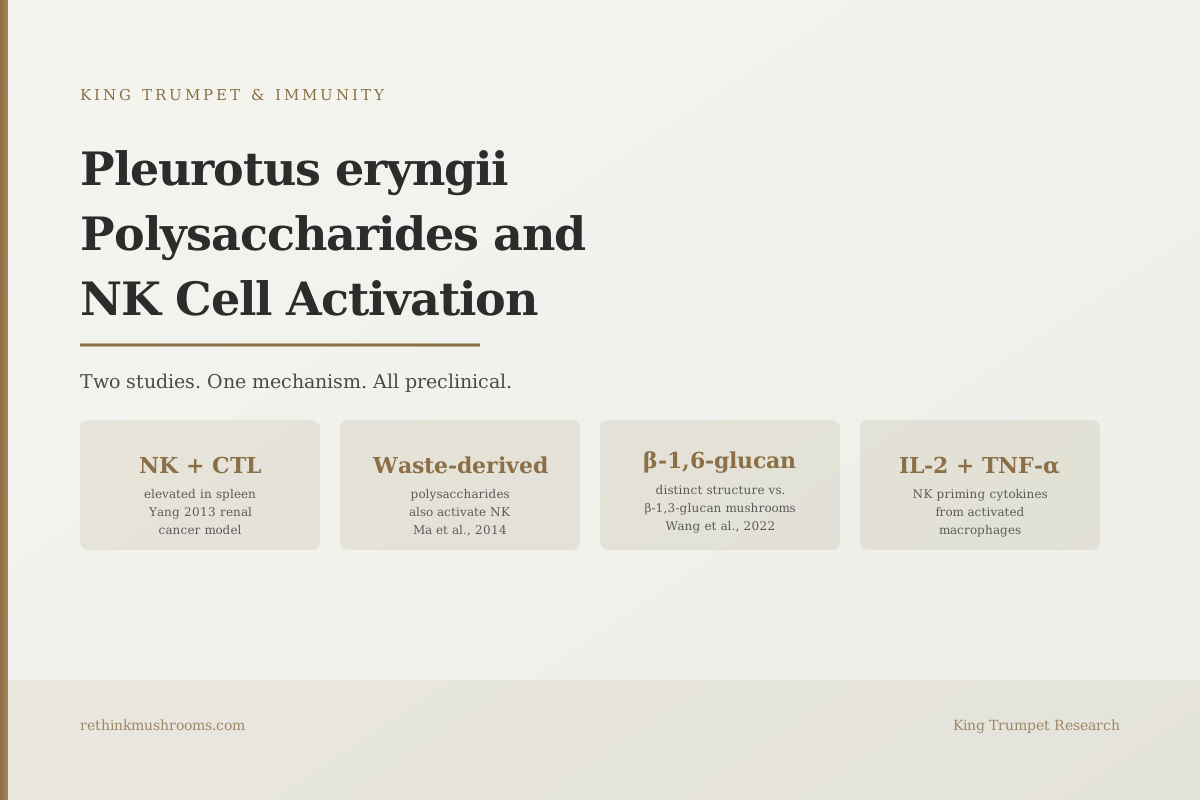
2 independent studies linking P. eryngii polysaccharides to NK cell activation
Yang et al. (2013) found significantly elevated NK cell activity and cytotoxic T lymphocyte response in tumor-bearing mice given P. eryngii polysaccharide, alongside elevated IL-2 and TNF-α. Ma et al. (2014) confirmed NK activation from waste-derived polysaccharides.
Yang et al., Carbohydrate Polymers, 2013; Ma et al., Carbohydrate Polymers, 2014
NK + CTL
both elevated alongside IL-2 and TNF-α in the Yang 2013 tumor model
β-1,6-glucan
P. eryngii's unique polysaccharide structure (Wang et al., 2022)
Residue works
processing waste-derived polysaccharides also activated NK cells (Ma, 2014)
Yang et al., Carbohydrate Polymers, 2013; Ma et al., Carbohydrate Polymers, 2014
 View as image ↗
Natural killer cells are the immune system's immediate threat response. Unlike the trained-response arm of immunity (T cells that recognize specific pathogens from past exposure), NK cells recognize and destroy abnormal cells on first contact, without needing a prior introduction. Cancer cells and virus-infected cells are their primary targets. A mushroom compound that reliably elevates NK cell activity is doing something immunologically meaningful.
Two independent animal studies show that Pleurotus eryngii polysaccharides do this. Yang and colleagues (2013) demonstrated significantly elevated NK cell activity in spleen tissue of renal cancer mice given P. eryngii polysaccharide, alongside elevated cytotoxic T lymphocytes (CTLs), IL-2, and TNF-α.[1] Ma and colleagues (2014) confirmed NK cell activation from polysaccharides extracted from mushroom processing waste, not just the main fruiting body.[2]
This article covers what those studies found, the structural basis for NK cell activation in P. eryngii's unique polysaccharide composition, how the signaling cascade connects macrophages to NK cell priming, and what the evidence honestly supports and doesn't. For the full immune profile of king trumpet, see what is king trumpet mushroom: the meaty mushroom with health benefits.
Key Takeaways
- Yang et al. (2013) found P. eryngii polysaccharide significantly increased NK cell activity and CTL response in spleen tissue of renal cancer mice, alongside elevated IL-2 and TNF-α, and reduced tumor weight
- Ma et al. (2014) showed polysaccharides from P. eryngii processing waste (mushroom residue) also significantly elevated NK cell activity and macrophage phagocytosis in a tumor mouse model
- Wang et al. (2022) identified P. eryngii's key immune-active polysaccharide as a β-1,6-glucan (distinct from the β-1,3-glucan in most medicinal mushrooms), which modulates both immunity and gut microbiota
- The NK cell activation cascade runs: polysaccharide binds macrophage receptors, macrophages produce IL-2 and TNF-α (cytokines that prime NK cells), NK cells increase cytotoxic activity
- Kim et al. (2017) documented the specific signaling cascade: NF-κB and MAPK activation in macrophages, providing the molecular foundation for cytokine production
- All NK cell evidence is from animal tumor models; no human clinical trials have measured NK cell activation from king trumpet consumption
What NK Cells Do and Why They Matter
Natural killer cells (NK cells) are a type of innate immune cell that circulates in blood and lymphoid tissue. They are called "natural killers" because they can kill abnormal cells without being specifically programmed to recognize those cells the way T cells are.
NK cells identify target cells by detecting two signals: the absence of normal "self" markers on the cell surface (which cancer cells and virus-infected cells often lose or reduce), and the presence of stress signals that abnormal cells display when damaged or transformed. When both signals align, NK cells directly contact the target cell and trigger its destruction.
NK cells are an early warning system. Before the adaptive immune response develops (which takes days to build up), NK cells can already begin clearing infected or cancerous cells. Their speed makes them particularly relevant to early-stage immune defense.
How do NK cells get activated? They depend heavily on priming signals from macrophages. When macrophages detect a threat and become activated, they release cytokines including IL-2 (interleukin-2, which stimulates NK cell proliferation and activity) and TNF-α (tumor necrosis factor alpha, which enhances NK cell cytotoxicity). A compound that activates macrophages and triggers this cytokine release indirectly primes NK cells. This is the pathway by which P. eryngii polysaccharides are proposed to enhance NK cell activity.
The Yang 2013 Study: NK and CTL Elevation in a Renal Cancer Model
Yang and colleagues published the foundational study on P. eryngii and NK cells in Carbohydrate Polymers in 2013.[1]
They administered P. eryngii polysaccharide (PEP) to mice bearing renal cell carcinoma (kidney cancer) and measured multiple immune parameters. The results across immune endpoints:
NK cell activity in spleen tissue was significantly elevated in polysaccharide-treated animals versus controls. The spleen is a primary site where NK cells and other immune cells mature and are activated, making spleen NK activity a key readout for systemic immune enhancement.
Cytotoxic T lymphocyte (CTL) activity in spleen tissue was also significantly elevated. CTLs are adaptive immune cells trained to destroy specific tumor cell types. Their elevation alongside NK cells suggests both the innate and adaptive arms of anti-tumor immunity were engaged.
Serum cytokines: IL-2 and TNF-α were both elevated in treated animals. IL-2 is a primary NK cell proliferation and activation signal. TNF-α enhances NK cell cytotoxicity and also has direct anti-tumor effects through apoptosis induction in cancer cells.
Tumor weight: reduced in the polysaccharide-treated group compared to controls.
The co-occurrence of NK elevation, CTL elevation, cytokine elevation, and tumor suppression in the same model is the study's strongest feature. These findings are consistent and mechanistically coherent: macrophage activation from polysaccharide leads to IL-2/TNF-α release, which primes NK and CTL activity, which contributes to anti-tumor immune responses.
Mushroom Processing Waste as a Source of NK-Activating Polysaccharides
The Ma 2014 study adds an important dimension: the finding that polysaccharides extracted from P. eryngii processing residue (the material left after mushroom cultivation and harvest, essentially the spent substrate and mushroom fragments not sold commercially) retain significant NK-activating activity.[2]
Ma and colleagues purified and characterized polysaccharides from this residue material and tested them in a tumor mouse model. The residue polysaccharides significantly inhibited tumor growth, upregulated NK cell activity, enhanced macrophage phagocytosis, and stimulated splenocyte proliferation.
This finding has two implications. First, it provides independent replication of P. eryngii's NK cell-activating effect through a separate polysaccharide preparation. Two independent studies using different polysaccharide sources from the same species, both showing consistent NK cell elevation, is stronger evidence than a single study.
Second, it raises an interesting sustainability question: mushroom production generates substantial waste material. If that waste retains bioactive polysaccharides at levels sufficient to produce immune effects, it represents a potential source of functional compounds that would otherwise be discarded. This doesn't change the clinical relevance for consumers, but it does suggest the polysaccharide content of king trumpet is not confined to a specific tissue fraction.
For a comparison with NK cell activation evidence in other medicinal mushroom species, see royal sun mushroom and NK cell enhancement in cancer patients.
The Structural Basis: What Makes P. eryngii's Glucan Distinctive
The immunological activity of P. eryngii polysaccharides is connected to their specific molecular structure. Wang and colleagues published a landmark structural analysis in Frontiers in Immunology in 2022, identifying the key immune-active polysaccharide in P. eryngii as a β-1,6-glucan.[3]
This is a meaningful structural distinction. Most medicinal mushrooms are characterized by their β-1,3-glucan content (with β-1,6-glucan side chains in some). Reishi, turkey tail, and lion's mane are predominantly β-1,3-glucan. P. eryngii produces a β-1,6-glucan as its primary immune-active fraction.
Beta-1,6-glucan and beta-1,3-glucan have different three-dimensional structures, which affects how they bind to immune receptors. The pattern recognition receptors on macrophages (including Dectin-1 and CR3) have binding preferences related to glucan linkage structure. β-1,6-glucan may engage different receptor conformations or binding affinities than β-1,3-glucan, potentially explaining why P. eryngii has a distinct immunological profile compared to other medicinal fungi.
Wang et al. also found that P. eryngii β-1,6-glucan modulates gut microbiota composition, adding a second mechanism through which the polysaccharide could influence immunity: the gut microbiota directly trains and regulates immune cell populations including NK cells through bacterial metabolites and microbial pattern recognition.
For the detailed structural analysis and the broader polysaccharide profile, see king oyster polysaccharides and immune modulation.
The Signaling Pathway: Macrophages as the NK Cell Primer
Kim and colleagues (2017) provided the molecular mechanism for how P. eryngii polysaccharides activate macrophages, which is the upstream event in NK cell priming.[4]
P. eryngii extracellular β-glucan activates NF-κB (the master immune activation switch in cells) and three branches of the MAPK signaling system (ERK1/2, JNK, p38) in macrophages. These activations drive production of pro-inflammatory and immunostimulatory cytokines including TNF-α and IL-2. A sulfated form of the glucan showed enhanced signaling activity.
The complete cascade from polysaccharide to NK cell activation runs:
- P. eryngii β-glucan binds Dectin-1 and related pattern recognition receptors on macrophages
- NF-κB and MAPK pathways activate inside the macrophage
- Macrophage produces TNF-α and IL-2
- IL-2 stimulates NK cell proliferation and activates NK cell cytotoxicity
- TNF-α enhances NK cytotoxic capacity against target cells
- NK cells increase killing of abnormal cells (demonstrated in the tumor models of Yang 2013 and Ma 2014)
Each step in this cascade is supported by published data. The chain connects a dietary polysaccharide to an anti-tumor immune response through well-characterized molecular intermediaries. The detailed macrophage signaling data is covered in Pleurotus eryngii and macrophage activation.
Evidence Limits: What These Studies Do and Don't Show
The NK cell evidence for P. eryngii is consistent across multiple studies and mechanistically coherent. It is also entirely preclinical.
Both Yang 2013 and Ma 2014 used tumor-bearing mice. The immune activation documented in these models occurs in the context of an existing tumor, which creates a different immune baseline than a healthy human's immune system. An already-stressed immune system responding to cancer may respond to polysaccharide-mediated NK priming differently than a healthy immune system.
The polysaccharides used in both studies were isolated, purified fractions administered in controlled doses. The dose and form differ from eating king trumpet mushrooms. How much of the NK-activating β-1,6-glucan reaches systemic circulation after oral consumption of whole mushrooms, and whether it reaches the concentrations used in these studies, is not established.
No human clinical trial has measured NK cell activity before and after P. eryngii consumption. The Tanaka 2016 double-blind RCT (which used related Pleurotus extract in humans and found a Th1 immune shift) provides the closest human Pleurotus immune evidence, but it did not specifically measure NK cell activity.
The honest summary for king trumpet NK cell research: consistent preclinical evidence with a coherent mechanism, and an evidence gap between animal data and human confirmation. This is the same evidentiary status as most preclinical food-immunity research, and it makes king trumpet more evidence-supported than popular claims suggest, while being less proven than clinical trial results would be.
For the full evidence synthesis across king trumpet's immune properties, see king trumpet for immune support: evidence base.
The Bottom Line
Two independent animal studies show P. eryngii polysaccharides elevate NK cell activity and CTL response in tumor models: Yang et al. (2013) using isolated polysaccharide in renal cancer mice, Ma et al. (2014) using waste-derived polysaccharide in a separate tumor model. The mechanism runs through macrophage activation (Kim et al., 2017), which releases IL-2 and TNF-α that prime NK cytotoxicity. Wang et al. (2022) identified P. eryngii's primary immune-active polysaccharide as a β-1,6-glucan (distinct from the β-1,3-glucan dominant in most medicinal mushrooms) that also modulates gut microbiota. No human clinical trials have directly measured NK cell activation from king trumpet consumption.
Frequently Asked Questions
Sources & References
- 1RTHM-00569·Yang, Zengyue et al. (2013). “Antitumor activity of a polysaccharide from Pleurotus eryngii on mice bearing renal cancer..” Carbohydrate polymers.Study breakdown →PubMed →↩
- 2RTHM-00624·Ma, Gaoxing et al. (2014). “Purification, characterization and antitumor activity of polysaccharides from Pleurotus eryngii residue..” Carbohydrate polymers.Study breakdown →PubMed →↩
- 3RTHM-00801·Wang, Xue et al. (2022). “β-1,6-Glucan From Pleurotus eryngii Modulates the Immunity and Gut Microbiota..” Frontiers in immunology.Study breakdown →PubMed →↩
- 4RTHM-00883·Kim, Yong Hyun et al. (2017). “Immunomodulatory Effects of Extracellular β-Glucan Isolated from the King Oyster Mushroom Pleurotus eryngii (Agaricomycetes) and Its Sulfated Form on Signaling Molecules Involved in Innate Immunity..” International journal of medicinal mushrooms.Study breakdown →PubMed →↩