King Trumpet / King Oyster & Immunity
Th1 immune phenotype enhanced in double-blind Pleurotus RCT (Tanaka 2016)
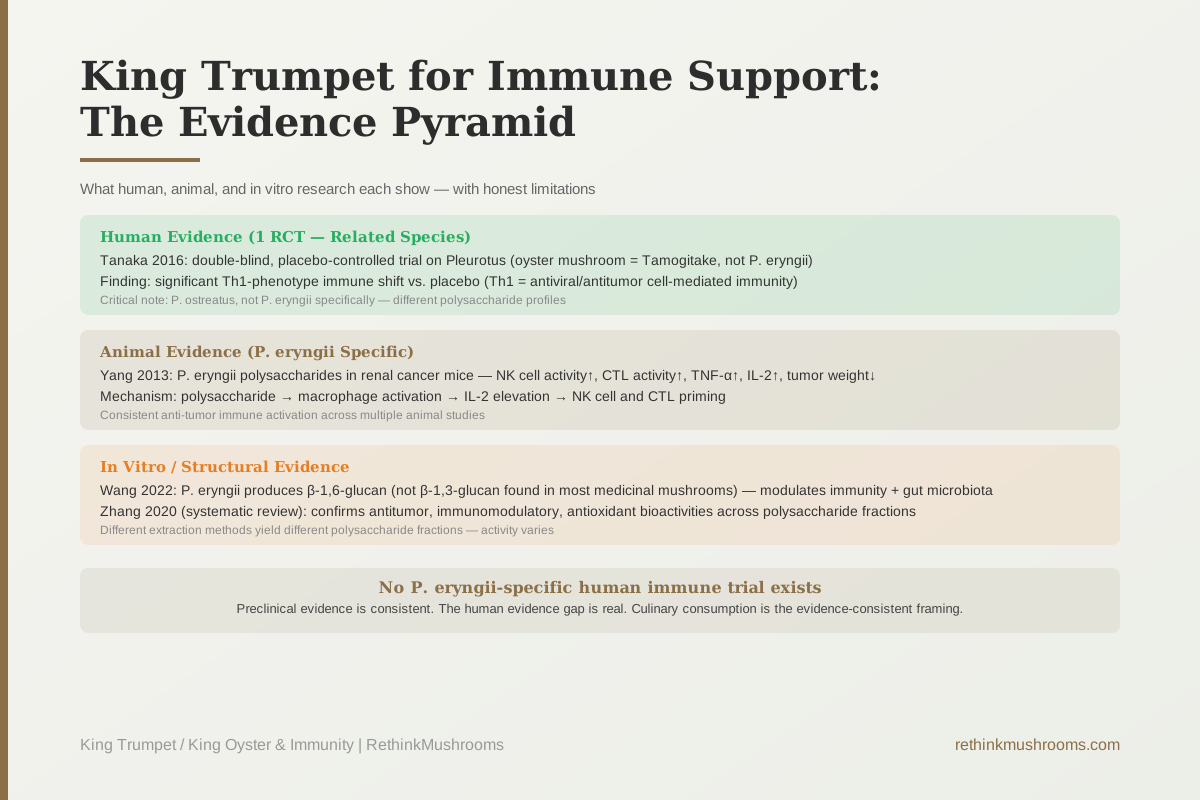
The only double-blind, placebo-controlled trial on Pleurotus extract and human immunity found a significant shift toward Th1-phenotype immune balance — the cell-mediated response associated with antiviral and antitumor defense.
Tanaka et al., Journal of Traditional and Complementary Medicine, 2016
P. ostreatus RCT
note: related Pleurotus species, not P. eryngii (king trumpet) specifically
NK cells + CTL
both activated in Yang 2013 renal cancer mouse study with P. eryngii polysaccharides
β-1,6-glucan
unique polysaccharide structure in P. eryngii — distinct from most medicinal mushrooms (Wang 2022)
Tanaka et al., Journal of Traditional and Complementary Medicine, 2016
 View as image ↗
The straightforward version of whether king trumpet mushroom supports immunity: the preclinical evidence is consistent and mechanistically interesting, the structural science reveals a polysaccharide type that most medicinal mushrooms do not produce, and the human evidence is limited to one randomized controlled trial on a related species. There are no human clinical trials specifically on Pleurotus eryngii for immune outcomes.
This matters because king trumpet is sometimes marketed with the same immune claims as Turkey Tail or Reishi, both of which have substantially deeper human evidence bases. Understanding where king trumpet actually sits in the evidence hierarchy is useful for anyone making decisions about medicinal mushrooms.
For a general overview of king trumpet mushroom and its properties, see What Is King Trumpet Mushroom? The Meaty Mushroom with Health Benefits.
Key Takeaways
- Tanaka and colleagues (Journal of Traditional and Complementary Medicine, 2016) ran a double-blind, placebo-controlled human trial on oyster mushroom extract (Tamogitake, a closely related Pleurotus species) and found a significant shift toward Th1-phenotype immunity, associated with better antiviral and antitumor defense
- Tanaka 2016 is the closest available human evidence for Pleurotus immune effects; it used P. ostreatus (common oyster mushroom), not P. eryngii (king trumpet) — the two species are related but have different polysaccharide profiles
- Yang and colleagues (Carbohydrate Polymers, 2013) found that P. eryngii polysaccharides in renal cancer mice significantly increased NK cell activity and cytotoxic T lymphocyte activity, elevated serum TNF-α and IL-2, and reduced tumor weight
- Wang and colleagues (Frontiers in Immunology, 2022) established that P. eryngii produces a β-1,6-glucan, structurally distinct from the β-1,3-glucan in most medicinal mushrooms, that modulates immune function and gut microbiota composition
- Zhang and colleagues (International Journal of Biological Macromolecules, 2020) published a comprehensive systematic review confirming antitumor, immunomodulatory, antioxidant, antidiabetic, and hypolipidemic effects across multiple P. eryngii polysaccharide fractions
- No P. eryngii-specific human clinical trial on immune outcomes has been published; immune support claims for king trumpet that imply human-level evidence are not supported by the current literature
The Evidence Summary: Where King Trumpet Actually Stands
King trumpet's immune support evidence is primarily preclinical. Animal studies consistently show NK cell activation, macrophage stimulation, and tumor suppression when P. eryngii polysaccharides are tested. The closest human evidence is a 2016 double-blind RCT on a related Pleurotus species showing Th1-phenotype immune enhancement. No king trumpet-specific human clinical trials on immune outcomes have been published.
This is the honest baseline. The sections below work through each level of evidence in detail.
The Only Human Evidence: What Tanaka 2016 Found and What It Does Not Show
The only randomized controlled trial examining immune effects of Pleurotus extract in humans was published by Tanaka and colleagues in 2016 in the Journal of Traditional and Complementary Medicine.[1]
The trial used Tamogitake extract, a Japanese term for oyster mushroom in the Pleurotus genus — specifically P. ostreatus or a closely related species, not P. eryngii (king trumpet). Participants were randomized to mushroom extract or placebo in a double-blind design.
The result: the extract group showed a significant shift toward Th1-phenotype immune balance compared to Th2.
To understand what this means, it helps to know that the immune system maintains a balance between two broad response modes. Th1 immunity is cell-mediated: it deploys cytotoxic T cells and natural killer cells to destroy infected or cancerous cells directly. Th2 immunity is antibody-mediated: it coordinates the production of antibodies and is more relevant for allergic responses. A Th1 shift in the direction measured by Tanaka and colleagues indicates the extract moved immune function toward the pattern most useful for fighting viruses and tumor cells.
Two limitations bear noting directly.
First, the study used a different Pleurotus species. P. ostreatus and P. eryngii are related, both in the genus Pleurotus, but their polysaccharide profiles differ. Wang 2022 established that P. eryngii produces a β-1,6-glucan structure not typical of P. ostreatus. The Tanaka 2016 results cannot be assumed to apply directly to king trumpet.
Second, the sample size, exact dose, and duration are not publicly available in easily accessible sources. The study provides directional human evidence but with design details that limit how firmly conclusions can be drawn.
Despite these limitations, Tanaka 2016 remains the closest thing to human immune evidence for this genus, and the direction of the finding is consistent with the broader preclinical evidence.
Animal Evidence: NK Cells, Cytotoxic T Cells, and Tumor Suppression
The strongest P. eryngii-specific immune evidence comes from animal studies. Yang and colleagues published a 2013 study in Carbohydrate Polymers testing P. eryngii polysaccharides in mice bearing renal cancer.[2]
Two immune cell populations were measured in the spleen: natural killer (NK) cells and cytotoxic T lymphocytes (CTL). NK cells are the innate immune system's first-responders against abnormal cells — they detect and destroy cancer cells or virus-infected cells without needing prior sensitization. CTL (also called CD8+ T cells) are the adaptive immune system's targeted killers: they learn to recognize specific threats and eliminate them with precision.
Both populations showed significantly increased activity in mice treated with P. eryngii polysaccharide. Serum levels of TNF-α and IL-2 were also elevated. IL-2 is a cytokine that drives the expansion and activation of both NK cells and CTL, so its elevation helps explain the amplified immune cell activity. TNF-α supports tumor cell killing by NK cells.
Tumor weight was reduced in the polysaccharide-treated animals, connecting the immune activation to an actual anti-tumor outcome in the model.
This study provides the most compelling mechanistic evidence for why P. eryngii polysaccharides are immunologically relevant: they activate the specific immune cells most important for cancer surveillance, and do so through cytokine signaling that is consistent with the broader immunology literature.
The caveat: mice are not humans, and cancer mouse models do not directly predict human immune benefits from dietary mushroom consumption. But the mechanism is pharmacologically coherent and points in the same direction as the Tanaka 2016 human data.
For more on the NK cell activation mechanism specifically, see Pleurotus eryngii Polysaccharides and NK Cell Activation.
The Structural Differentiator: King Trumpet's Unusual Beta-Glucan
Most medicinal mushrooms used for immune support — Turkey Tail, Reishi, Shiitake, Lion's Mane — contain polysaccharides built around β-1,3-glucan backbone linkages. This structure is recognized by Dectin-1, the primary immune receptor for fungal beta-glucans, and is responsible for much of the immunostimulatory activity attributed to these mushrooms.
Wang and colleagues published a 2022 paper in Frontiers in Immunology establishing that P. eryngii produces a β-1,6-glucan — a structurally distinct polymer where the backbone links at the 1,6 position rather than the 1,3 position.[3]
This structural difference has two implications.
First, β-1,6-glucan may interact with different immune receptors and signaling pathways than β-1,3-glucan. The Wang 2022 study confirmed that the P. eryngii β-1,6-glucan modulates immune function, establishing biological activity for this distinct structure. How that activity differs from β-1,3-glucan at the receptor level is an area that merits further characterization.
Second, the same study found that P. eryngii β-1,6-glucan positively altered gut microbiota composition. The gut-immune relationship is substantial: approximately 70% of the immune system resides in gut-associated lymphoid tissue, and the microbiome plays a direct role in immune calibration. A polysaccharide that simultaneously modulates immune cell activity and improves gut microbiota composition may produce additive or synergistic immune effects through two parallel pathways.
The practical implication: consumers who assume that "beta-glucan is beta-glucan" across mushroom species are missing a structural distinction that may translate to different biological activity profiles.
For more on king trumpet's polysaccharide structure and its immune mechanisms, see King Oyster Polysaccharides and Immune Modulation.
The Systematic Review: What the Full Evidence Map Shows
Zhang and colleagues published a 2020 systematic review in the International Journal of Biological Macromolecules covering extraction, structure, and bioactivities of P. eryngii polysaccharides across the published literature.[4]
The review mapped documented bioactivities into five categories: antitumor, immunomodulatory, antioxidant, antidiabetic, and hypolipidemic. Immune modulation and antitumor activity were among the most consistently documented across multiple studies.
One of the review's notable contributions is mapping the relationship between extraction method and resulting polysaccharide structure. Water extraction, alkaline extraction, and enzymatic extraction each yield different polysaccharide fractions with distinct structural features and different biological activities. The immunological activity of a P. eryngii polysaccharide preparation depends substantially on how it was produced.
This matters for supplement consumers. The extraction method used in a commercial product determines which polysaccharide fractions are present. Hot water extraction (the most common commercial method) yields water-soluble beta-glucans, but the specific molecular structure will differ from alkaline or enzymatic preparations, and the biological activity may differ correspondingly. Most supplements do not specify their extraction method.
For the macrophage activation mechanism and downstream signaling details, see Pleurotus eryngii and Macrophage Activation.
How King Trumpet Compares to Reishi and Turkey Tail
The honest comparison does not favor king trumpet from a human evidence standpoint.
Turkey Tail (Trametes versicolor) has the deepest human evidence base among medicinal mushrooms for immune support. Its polysaccharide extract PSK has been tested in multiple human clinical trials including large adjuvant oncology studies in Japan. The evidence for Turkey Tail alongside cancer treatment is the strongest in the medicinal mushroom category.
Reishi (Ganoderma lucidum) has more human evidence than king trumpet: multiple small clinical trials have examined immune markers in various populations, with results that vary by preparation and outcome.
King trumpet sits below both in human evidence depth. Its potential advantage is that it is primarily a culinary mushroom, consumed in substantial quantities as food, while Turkey Tail and Reishi are used almost exclusively as supplements at doses higher than dietary intake. Regular consumption of king trumpet as a culinary ingredient provides the immunomodulatory polysaccharides and ergothioneine documented in research without requiring supplementation.
The framing that fits: king trumpet as a functional food with immunomodulatory properties, not as a pharmaceutical-grade immune intervention.
What the Evidence Does and Doesn't Say
What it establishes:
- A double-blind human trial on a related Pleurotus species found Th1-phenotype immune enhancement (Tanaka 2016)
- P. eryngii polysaccharides activate NK cells and cytotoxic T lymphocytes in a renal cancer mouse model, with supporting cytokine data (Yang 2013)
- P. eryngii contains a structurally unique β-1,6-glucan that modulates immune function and gut microbiota composition (Wang 2022)
- Multiple polysaccharide fractions from P. eryngii show consistent immunomodulatory and antitumor activity across cell and animal studies (Zhang 2020)
What it does not establish:
- That P. eryngii (king trumpet) specifically enhances immune function in healthy humans
- That the doses used in animal studies correspond to what dietary or supplemental consumption provides
- That the Th1 shift seen in the Pleurotus RCT would replicate with P. eryngii extract
- Clinical benefit for specific immune conditions, viral illnesses, or cancer prevention in humans
King trumpet's immune evidence is more interesting than its consumer reputation reflects, and less robust than supplement marketing implies. The mechanistic story is coherent and the preclinical data is consistent. The human evidence gap is real.
For the full research review across all P. eryngii immune mechanisms, see King Trumpet and the Immune System: Research Review.
The Bottom Line
King trumpet mushroom (Pleurotus eryngii) has a consistent preclinical immune evidence base: NK cell and CTL activation in tumor-bearing mice (Yang 2013), and a structurally unique β-1,6-glucan that modulates both immune function and gut microbiota (Wang 2022). The closest human evidence is a 2016 double-blind RCT on a related Pleurotus species showing Th1-phenotype immune shift (Tanaka 2016), but no P. eryngii-specific human immune trial exists. The evidence supports king trumpet as a functional food with immunomodulatory properties; treatment-level immune claims are not supported.
Frequently Asked Questions
Sources & References
- 1RTHM-00830·Tanaka, Aiko et al. (2016). “Enhancement of the Th1-phenotype immune system by the intake of Oyster mushroom (Tamogitake) extract in a double-blind, placebo-controlled study..” Journal of traditional and complementary medicine.Study breakdown →PubMed →↩
- 2RTHM-00569·Yang, Zengyue et al. (2013). “Antitumor activity of a polysaccharide from Pleurotus eryngii on mice bearing renal cancer..” Carbohydrate polymers.Study breakdown →PubMed →↩
- 3RTHM-00801·Wang, Xue et al. (2022). “β-1,6-Glucan From Pleurotus eryngii Modulates the Immunity and Gut Microbiota..” Frontiers in immunology.Study breakdown →PubMed →↩
- 4RTHM-01310·Zhang, Bingru et al. (2020). “Extraction, structure and bioactivities of the polysaccharides from Pleurotus eryngii: A review..” International journal of biological macromolecules.Study breakdown →PubMed →↩