King Trumpet & Immunity
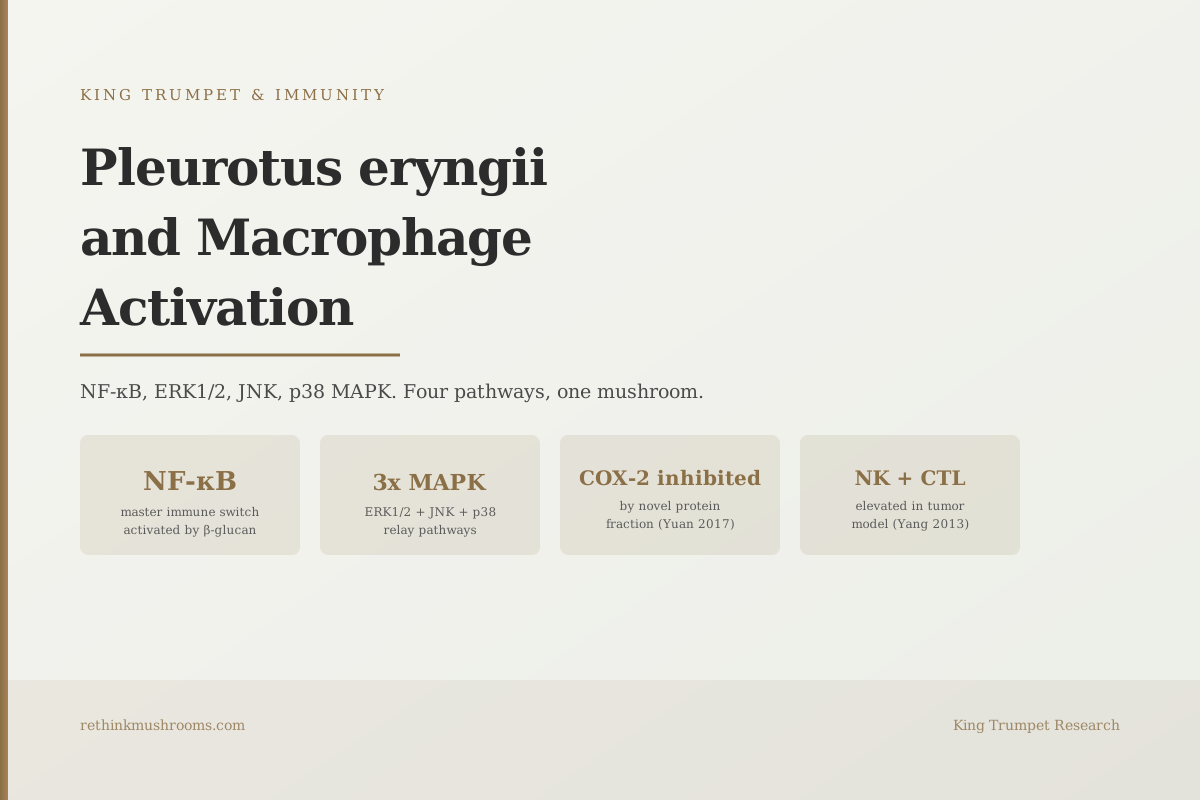
4 signaling pathways activated in macrophages
King trumpet (Pleurotus eryngii) β-glucan triggers NF-κB, ERK1/2, JNK, and p38 MAPK signaling cascades in macrophages; a separate protein fraction inhibits COX-2 through a distinct anti-inflammatory mechanism.
Kim et al., International Journal of Medicinal Mushrooms, 2017
NF-κB
master immune switch activated by P. eryngii β-glucan
Sulfated form
shows enhanced immunostimulatory activity over standard glucan
COX-2 inhibited
by a novel P. eryngii protein fraction (Yuan et al., 2017)
Kim et al., International Journal of Medicinal Mushrooms, 2017
 View as image ↗
King trumpet mushroom (Pleurotus eryngii) is one of the most widely eaten culinary mushrooms in the world, particularly in East Asian cooking. It also has a specific and well-characterized mechanism for activating a key component of the innate immune system: macrophages.
Macrophages are the patrol cells of the immune system. They circulate in blood and tissue, engulf pathogens and cellular debris, and release signaling proteins that coordinate the rest of the immune response. When β-glucan from king trumpet binds to pattern recognition receptors on macrophages, it triggers a cascade of molecular switches inside the cell that ramp up those functions. The specific switches, NF-κB and three branches of the MAPK signaling system, are among the most well-studied in immunology.
This article explains what the research shows about how king trumpet activates macrophages, what the molecular cascade looks like, and how a separate protein fraction from the same mushroom does something different: it reduces inflammation rather than stimulating it. For the broader picture of what makes king trumpet's immune profile distinctive, see what is king trumpet mushroom: the meaty mushroom with health benefits.
Key Takeaways
- Kim et al. (2017) showed that P. eryngii β-glucan activates four signaling pathways in macrophages simultaneously: NF-κB (the master immune activation switch) plus ERK1/2, JNK, and p38 MAPK (three branches of the cellular stress/activation relay system)
- A sulfated form of P. eryngii β-glucan showed enhanced immunostimulatory activity compared to unsulfated glucan, suggesting chemical modification affects receptor binding
- Ma et al. (2020) confirmed that a different polysaccharide fraction from P. eryngii reduced IL-1β and NO production in THP-1 human macrophage cells, showing P. eryngii also has anti-inflammatory effects through a separate fraction
- Yuan et al. (2017) isolated a novel protein (not polysaccharide) from P. eryngii that inhibits COX-2, PGE2, and NO in LPS-stimulated macrophages, a second distinct anti-inflammatory mechanism
- Yang et al. (2013) demonstrated in a renal tumor mouse model that P. eryngii polysaccharides elevated NK cell activity and cytotoxic T lymphocyte activity in spleen, connecting macrophage activation to downstream anti-tumor immune responses
- All evidence is preclinical (cell culture and animal models); the macrophage signaling mechanisms have not been verified in human clinical trials
Macrophages: The Innate Immune System's First Responders
The immune system has two layers. The adaptive immune system (T cells, B cells, antibodies) is specific: it recognizes particular pathogens and builds memory. The innate immune system is non-specific: it responds immediately to any foreign or damaged material using pattern recognition rather than learned specificity.
Macrophages are central to innate immunity. They patrol tissues in every organ, engulfing and destroying pathogens and cellular debris through a process called phagocytosis (literally, "cell eating"). They also release cytokines, the signaling proteins that communicate to other immune cells and trigger inflammation, fever, and other systemic responses. When the innate system detects a threat, macrophages are often the first cells to respond and the ones that recruit the adaptive immune response.
What makes macrophages recognizable to researchers studying mushroom compounds is their surface receptors. Macrophages carry pattern recognition receptors designed to detect common features of pathogens, including a receptor called Dectin-1 that specifically recognizes beta-glucan, the structural component of fungal cell walls. Beta-glucan from a mushroom can bind Dectin-1 and activate macrophages without the presence of an actual pathogen.
This is the starting point for understanding how king trumpet mushroom interacts with the immune system: its beta-glucan is recognized as a fungal cell wall component, which triggers a real macrophage activation response.
The NF-κB and MAPK Cascade: What Kim 2017 Found
The most detailed mechanistic study of P. eryngii and macrophages was published by Kim and colleagues in the International Journal of Medicinal Mushrooms in 2017.[1]
They isolated extracellular β-glucan from P. eryngii and also prepared a sulfated derivative (the same glucan with sulfate groups chemically attached). They then measured which molecular signaling pathways each form activated in macrophage cells.
The results mapped out four specific activation pathways:
NF-κB is the master switch for immune activation in cells. When NF-κB is activated, it moves from the cytoplasm into the cell nucleus and turns on genes for cytokine production, inflammation mediators, and immune effector proteins. It is the key decision point between "rest" and "active immune state" in macrophages. P. eryngii β-glucan activated NF-κB.
ERK1/2 (Extracellular signal-Regulated Kinase 1/2) is one branch of the MAPK (Mitogen-Activated Protein Kinase) signaling system. In macrophages, ERK1/2 activation is associated with cell survival, proliferation, and inflammatory cytokine production. P. eryngii β-glucan activated ERK1/2.
JNK (c-Jun N-terminal Kinase) is a second MAPK branch, associated with stress responses, apoptosis (programmed cell death in diseased or damaged cells), and inflammatory gene expression. P. eryngii β-glucan activated JNK.
p38 MAPK is the third MAPK branch activated. p38 is particularly important for producing inflammatory cytokines (TNF-α, IL-1β, IL-6) in response to pathogens or stress signals. P. eryngii β-glucan activated p38.
The sulfated form of the glucan showed enhanced immunostimulatory activity across these pathways compared to the standard unsulfated form. This suggests that the precise chemical structure of the glucan, not just its presence, determines the strength of receptor engagement and downstream activation. Different extraction and processing methods for king trumpet produce glucan with different structural properties, which may influence potency.
The Human Macrophage Data: Anti-Inflammatory Effects From a Second Fraction
The Kim 2017 study established an immunostimulatory mechanism. A 2020 study by Ma and colleagues added an important counterpoint: a different polysaccharide fraction from P. eryngii shows anti-inflammatory effects.[2]
Ma and colleagues used THP-1 cells, a human macrophage cell line derived from a human leukemia patient and widely used as a laboratory model for human macrophage behavior. They characterized a newly identified polysaccharide fraction from P. eryngii and exposed LPS-stimulated THP-1 macrophages to it. LPS (lipopolysaccharide) is a bacterial cell wall fragment that triggers a strong inflammatory response. It is the standard tool for creating an inflammatory state in macrophage experiments.
The P. eryngii polysaccharide significantly reduced IL-1β (interleukin-1 beta, a pro-inflammatory cytokine that drives fever and immune activation) and NO (nitric oxide, a reactive inflammatory mediator) production in the stimulated macrophages.
This creates a more nuanced picture than the Kim 2017 data alone: P. eryngii contains multiple polysaccharide fractions. Some fractions activate macrophages (the immunostimulatory NF-κB/MAPK pathway described by Kim). Other fractions reduce macrophage inflammatory output (the anti-inflammatory effect described by Ma). This dual profile (immune activation from one fraction, inflammatory modulation from another) is consistent with the category of "immunomodulatory" rather than simply "immune stimulating."
The THP-1 cell line distinction also matters: while this is still an in vitro model, it uses human-derived cells rather than mouse or rat cells, making the finding somewhat more relevant to human biology than purely animal-based mechanistic data.
A Novel Protein Fraction: COX-2 Inhibition Through a Separate Mechanism
What makes P. eryngii's immune profile more interesting than most medicinal mushrooms is a 2017 discovery by Yuan and colleagues: a novel bioactive protein isolated from king trumpet mushroom with anti-inflammatory activity that operates through a completely different mechanism from the polysaccharide effects described above.[3]
Yuan's team isolated and characterized a protein (not a polysaccharide) from P. eryngii fruiting bodies and tested it in LPS-stimulated macrophages. The protein significantly reduced:
- NO (nitric oxide): a reactive molecule produced by macrophages that has both defensive and tissue-damaging roles depending on context
- PGE2 (prostaglandin E2): a key inflammatory signaling molecule that drives pain, fever, and inflammation
- COX-2 (cyclooxygenase-2): the enzyme that produces prostaglandins; COX-2 inhibition is the mechanism of common anti-inflammatory drugs like ibuprofen and naproxen
COX-2 inhibition is pharmacologically significant. The major anti-inflammatory drug class (NSAIDs, including ibuprofen and aspirin) works by inhibiting COX enzymes. Finding a dietary protein in king trumpet that reduces COX-2 expression in macrophages through a natural pathway is a meaningful finding, even if the effect size from dietary mushroom consumption is almost certainly far smaller than pharmaceutical doses of NSAIDs.
The protein fraction and the polysaccharide fractions appear to operate in parallel but independently. This means P. eryngii has at least two distinct anti-inflammatory mechanisms (the polysaccharide fraction reducing IL-1β/NO per Ma 2020, and the protein fraction reducing COX-2/PGE2/NO per Yuan 2017) alongside the immunostimulatory polysaccharide mechanism (NF-κB/MAPK activation per Kim 2017).
For a comparison of how macrophage activation from P. eryngii compares to the mechanisms described for other medicinal mushrooms, see how medicinal mushrooms activate macrophages.
From Macrophage Activation to Anti-Tumor Outcome: Yang 2013
The mechanistic cell-culture data becomes more meaningful when placed alongside in vivo evidence showing that these signaling cascades produce functional immune outcomes.
Yang and colleagues published a 2013 study in Carbohydrate Polymers testing P. eryngii polysaccharide (PEP) in mice bearing renal cell carcinoma.[4]
The key immune findings in treated mice:
- Significantly elevated NK cell activity in spleen tissue
- Significantly elevated cytotoxic T lymphocyte (CTL) activity in spleen tissue
- Elevated serum levels of TNF-α and IL-2 (cytokines that prime and sustain NK cell activity)
- Reduced tumor weight compared to untreated controls
NK cells are innate immune cells that recognize and destroy cancer cells and virus-infected cells without needing prior exposure; they act on first contact. CTLs are adaptive immune cells trained to kill specific tumor cell types. Both are critical to anti-tumor immunity.
The connection to macrophage activation is direct: macrophages activated by P. eryngii polysaccharide produce TNF-α and IL-2 (as predicted by the NF-κB/p38 MAPK activation in Kim 2017), and these cytokines prime NK cells and CTLs for enhanced cytotoxic activity. The cell-culture signaling cascade leads to a measurable in vivo anti-tumor immune response.
One important caveat: this was a mouse model of renal cell carcinoma. The immune system interactions in a tumor-bearing animal model differ from a healthy human's immune system. Anti-tumor effects in these models don't translate directly to cancer prevention or treatment in humans without clinical trial evidence. The Yang 2013 study establishes a plausible mechanism and an in vivo proof of principle, not a clinical finding.
For the NK cell activation evidence in more detail, see Pleurotus eryngii polysaccharides and NK cell activation. For the full evidence synthesis covering what this means in practice, see king trumpet for immune support: evidence base.
What This Means for a Culinary Mushroom
King trumpet is not primarily known as a medicinal supplement. It is a widely available culinary mushroom, sold fresh in most Asian grocery stores and increasingly in major supermarkets. The dense, firm stem and meaty texture make it popular for stir-fries, grilling, and as a meat substitute.
The macrophage activation research shows that the same mushroom you eat in a stir-fry contains compounds that engage real immune signaling pathways at the molecular level. The β-glucan that binds Dectin-1 on macrophages is present in the mushroom's cell walls. The protein fraction with COX-2 inhibitory activity is in the fruiting body.
What remains genuinely unknown is the dose-response relationship in humans. How much king trumpet polysaccharide reaches macrophages in meaningful concentrations after a typical meal? The Yang 2013 tumor study used isolated polysaccharide administered to mice in controlled doses. The Kim 2017 and Ma 2020 studies used purified fractions in cell culture. Whether eating 100g of fresh king trumpet mushroom produces macrophage activation effects at the level shown in these studies has not been tested.
Compared to other medicinal mushrooms with specific immunological claims, king trumpet's evidence is deeper than most consumer content suggests, but shallower than the polysaccharide literature for turkey tail or reishi in terms of human clinical data. For the full comparison of how the Pleurotus genus differs in immune profiles across species, see king oyster polysaccharides and immune modulation and king trumpet and the immune system: research review.
The Bottom Line
Pleurotus eryngii activates macrophages through two compound classes and multiple signaling pathways. The β-glucan fraction activates NF-κB and three MAPK branches (ERK1/2, JNK, p38) that drive macrophage cytokine production and phagocytic activity (Kim et al., 2017), while a separate polysaccharide fraction reduces IL-1β and NO in human macrophage models (Ma et al., 2020). A novel protein fraction (Yuan et al., 2017) independently inhibits COX-2 and PGE2. In a renal cancer mouse model, polysaccharide treatment elevated NK cell activity, CTL activity, and TNF-α/IL-2, correlating with reduced tumor weight (Yang et al., 2013). All evidence is preclinical; human clinical data on P. eryngii macrophage effects does not currently exist.
Frequently Asked Questions
Sources & References
- 1RTHM-00883·Kim, Yong Hyun et al. (2017). “Immunomodulatory Effects of Extracellular β-Glucan Isolated from the King Oyster Mushroom Pleurotus eryngii (Agaricomycetes) and Its Sulfated Form on Signaling Molecules Involved in Innate Immunity..” International journal of medicinal mushrooms.Study breakdown →PubMed →↩
- 2RTHM-01247·Ma, Gaoxing et al. (2020). “Preparation of newly identified polysaccharide from Pleurotus eryngii and its anti-inflammation activities potential..” Journal of food science.Study breakdown →PubMed →↩
- 3RTHM-00933·Yuan, Biao et al. (2017). “Isolation of a novel bioactive protein from an edible mushroom Pleurotus eryngii and its anti-inflammatory potential..” Food & function.Study breakdown →PubMed →↩
- 4RTHM-00569·Yang, Zengyue et al. (2013). “Antitumor activity of a polysaccharide from Pleurotus eryngii on mice bearing renal cancer..” Carbohydrate polymers.Study breakdown →PubMed →↩