Chicken of the Woods Research
MIC 0.31 mg/mL vs S. aureus
Laetiporus sulphureus ethanol extract showed a minimum inhibitory concentration of 0.31 mg/mL against Staphylococcus aureus, the gold standard measure of antimicrobial potency, with rosmarinic acid identified as the primary phenolic antioxidant responsible for activity.
Petrovic et al., Food and Function, 2014
Selective antibiofilm
the key finding from Jovanovic et al. (2023): L. sulphureus extracts disrupted Staphylococcus aureus and Candida albicans biofilms while leaving probiotic bacterial cultures unaffected, suggesting a therapeutic window for selective pathogen targeting
LSL lectins
the aerolysin-family pore-forming lectins in Laetiporus that cause GI reactions when consumed raw; they are also being studied as selective anticancer tools, because their membrane-disrupting activity preferentially targets cancer cells at sub-toxic doses (Mancheño et al., 2010)
40+ compounds
the number of bioactive compounds identified in the Laetiporus genus across a 2022 systematic review, including polysaccharides, triterpenes, phenolics, and lectins with antioxidant, antimicrobial, anti-inflammatory, antitumor, and immunomodulatory activities (Duan et al., 2022)
Petrovic et al., Food and Function, 2014
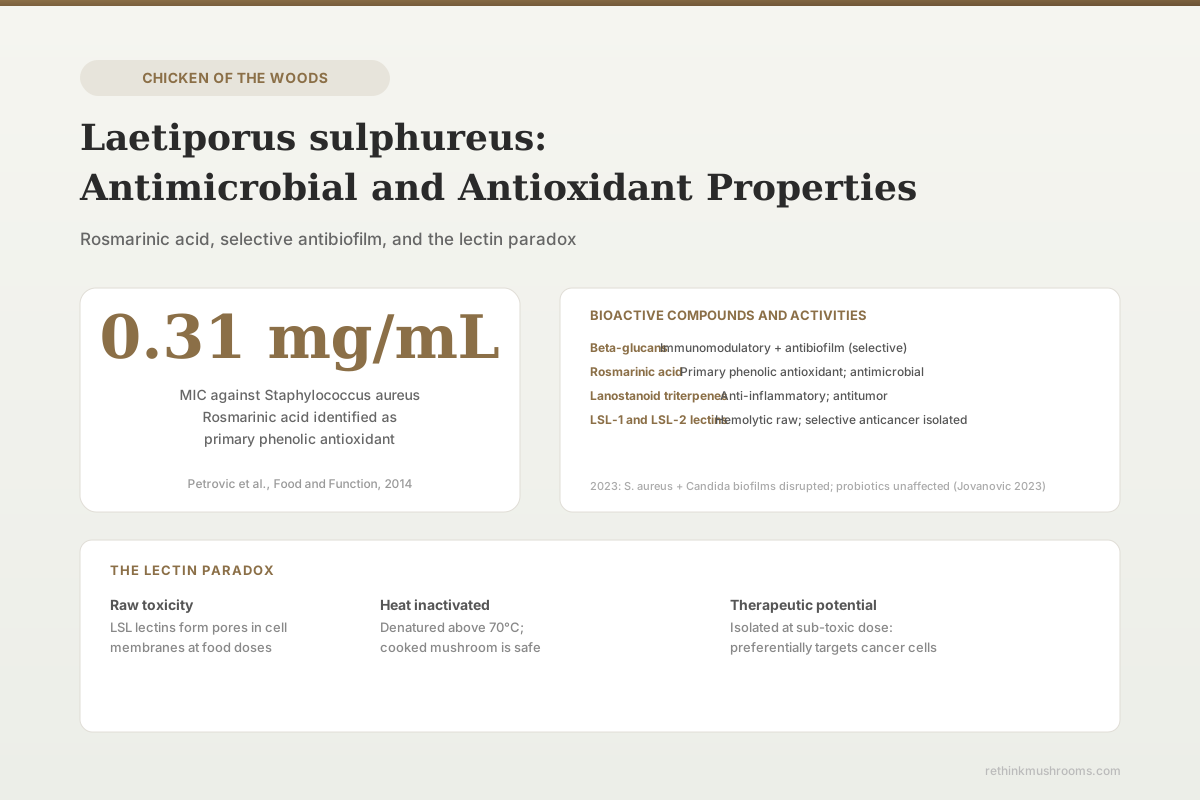 View as image ↗
Chicken of the woods (Laetiporus sulphureus) is known primarily as a forager's prize: bright orange-yellow, impossible to misidentify, and culinary-grade when cooked. Its medicinal research is less well-publicized but has accelerated significantly in recent years. A 2022 systematic review documented over 40 distinct bioactive compounds across the Laetiporus genus, and 2023 research added new data on antibiofilm activity and anticancer potential.
The most interesting scientific story in this species is a paradox: the compounds that make raw consumption risky (hemolytic lectins) are the same molecules now being investigated as potential selective anticancer agents. Understanding the chemistry behind this paradox is the most compelling angle in L. sulphureus research.
For the edibility and safety overview including the hemolytic lectin food safety mechanism, see what is chicken of the woods? edibility and health research.
Key Takeaways
- Rosmarinic acid was identified as the primary phenolic antioxidant in L. sulphureus ethanol extract, notable because rosmarinic acid is better known from herbs like rosemary and sage, not mushrooms (Petrovic et al., Food and Function, 2014)
- L. sulphureus ethanol extract showed potent antioxidant activity (IC50 215 µg/mL DPPH, 11.4 µg/mL for hydroxyl radical scavenging) and strong antimicrobial activity against S. aureus (MIC 0.31 mg/mL) (Petrovic et al., 2014)
- 2023 research found L. sulphureus extracts disrupted Staphylococcus aureus and Candida albicans biofilms selectively without affecting probiotic cultures, suggesting a therapeutic window for targeted antimicrobial action (Jovanovic et al., Food Science and Nutrition, 2023)
- The same extract showing antibiofilm activity also showed antimigratory activity on cancer cells, combining antimicrobial and anticancer properties in a single preparation (Jovanovic et al., 2023)
- The hemolytic lectins (LSL-1 and LSL-2) that cause raw-consumption GI reactions share structural homology with bacterial pore-forming toxins; at sub-toxic doses, they preferentially disrupt cancer cell membranes and are being studied as selective anticancer tools (Mancheño et al., 2010)
- Submerged-cultivated L. sulphureus mycelium retains a similar antioxidant profile to fruiting bodies, confirming that cultivation (not just wild harvesting) is viable for research and food applications (Lung et al., 2013)
Rosmarinic Acid: The Unexpected Primary Antioxidant
When researchers analyze the phenolic profile of Laetiporus sulphureus, the primary compound they find is not a mushroom-typical polyphenol but rosmarinic acid, a compound most people associate with Mediterranean herbs like rosemary, sage, and oregano.
Petrovic and colleagues' 2014 analysis of L. sulphureus ethanol extract identified rosmarinic acid as the dominant phenolic antioxidant and measured its activity with specific IC50 values.[4] The extract showed an IC50 of 215 µg/mL in the DPPH radical scavenging assay and a notably potent 11.4 µg/mL for hydroxyl radical scavenging. The antioxidant activity correlated directly with total phenolic content across extracts.
Rosmarinic acid is well-characterized in its own right: it inhibits lipid oxidation, shows anti-inflammatory properties, and has documented antimicrobial activity. Finding it as the primary phenolic compound in a polypore mushroom is unusual and adds a layer of known bioactivity to L. sulphureus beyond its beta-glucan and triterpene fractions.
Lung and colleagues confirmed in 2013 that submerged-cultivated L. sulphureus mycelium maintains a comparable antioxidant profile to wild fruiting bodies, with phenolic content strongly predicting radical scavenging activity.[5] This is practically significant: it means cultivated mycelium (far more accessible than wild-harvested specimens) is a valid source for L. sulphureus antioxidant compounds.
Antimicrobial Action: Targeting Gram-Positive Bacteria
The antimicrobial properties of L. sulphureus are concentrated against Gram-positive bacteria, particularly Staphylococcus aureus. Gram-negative bacteria are generally more resistant to mushroom extracts because their outer membrane provides an additional barrier against lipophilic compounds.
Petrovic et al.'s 2014 analysis found an MIC (minimum inhibitory concentration) of 0.31 mg/mL against S. aureus for the L. sulphureus ethanol extract.[4] This is a clinically relevant level of potency, comparable to some conventional antibiotics, for a natural food-derived extract. The study also explored food preservation applications: L. sulphureus extract added to meat products extended shelf life and reduced bacterial load in preliminary trials.
This food preservation angle is not merely academic. The 2023 review by Adamska and colleagues specifically addressed the viability of L. sulphureus as a natural food industry antimicrobial, noting its potential for meat preservation without synthetic additives.[2]
The Antibiofilm Discovery: Selective Pathogen Disruption
The most practically significant recent finding comes from Jovanovic and colleagues' 2023 study on Serbian L. sulphureus material.[3]
Biofilms are organized communities of bacteria or fungi that adhere to surfaces and encase themselves in a protective matrix. Biofilms are notoriously resistant to antibiotics; they can withstand concentrations 100-1,000 times higher than what kills planktonic (free-floating) bacteria. S. aureus biofilms are a major clinical problem in wound infections and implanted medical devices; Candida albicans biofilms cause persistent oral and vaginal infections.
Jovanovic et al. found that polysaccharide-rich aqueous extracts of L. sulphureus showed significant antibiofilm activity against both S. aureus and Candida albicans. Crucially, when the same extracts were tested against probiotic bacteria (Lactobacillus strains commonly found in the gut); the probiotic cultures were unaffected.
This selectivity is the finding's most clinically interesting aspect. Many antimicrobial compounds that disrupt pathogen biofilms also harm beneficial bacteria. An extract that selectively targets S. aureus and Candida biofilms while leaving Lactobacillus intact represents a narrow therapeutic window that warrants further investigation.
The same L. sulphureus extracts also showed antimigratory activity on cancer cell lines in the same study. Cell migration is the process by which cancer cells spread to new locations; compounds that inhibit this movement could theoretically reduce metastatic potential. The combined antibiofilm and antimigratory activities in a single polysaccharide-rich extract from L. sulphureus is the most specific recent research finding for this species.
The Lectin Paradox: Dangerous Raw, Potentially Therapeutic Isolated
This is the most intellectually unusual aspect of L. sulphureus chemistry. The same lectins (LSL-1 and LSL-2) that make raw chicken of the woods potentially dangerous are being studied as selective anticancer tools.
Mancheño and colleagues characterized the structural biology of LSL lectins in 2010, establishing their membership in the aerolysin family of pore-forming proteins, the same structural class as bacterial toxins like Clostridium perfringens epsilon toxin.[6] These proteins work by binding to cell membrane receptors and inserting themselves to form pores that disrupt membrane integrity and cell function.
In raw mushroom, ingested LSL lectins can act on intestinal cells and potentially red blood cells (hence "hemolytic lectins"), causing the GI reactions some raw consumers experience. This is why heat-treating at above 70°C is important: cooking denatures the protein structure and eliminates this activity.
But cancer cells have different membrane receptor profiles than normal cells. LSL lectins show preferential binding to cancer cell membranes at concentrations below the level that damages normal cells. At sub-toxic doses in controlled settings, they may specifically target malignant cells through the same pore-forming mechanism that causes toxicity at higher doses. This selective targeting is being explored as a potential therapeutic approach.
The practical takeaway for consumers: cook L. sulphureus thoroughly, which inactivates the lectins. In the context of research, the same compounds may eventually be useful as isolated, controlled-dose therapeutic tools rather than dietary ingredients.
For more on mushroom lectins broadly, see mushroom lectins: the underappreciated bioactive compounds.
The Full Bioactive Compound Profile
The Duan 2022 systematic review documented the full breadth of bioactive compounds in the Laetiporus genus, establishing it as a chemically complex species group with over 40 identified compounds.[1]
| Compound Class | Key Representative | Primary Activity |
|---|---|---|
| Polysaccharides | Beta-glucans | Immunomodulatory, antibiofilm |
| Phenolics | Rosmarinic acid | Antioxidant, antimicrobial |
| Triterpenes | Lanostanoid triterpenes, ergosterol peroxide | Anti-inflammatory, antitumor |
| Lectins | LSL-1 and LSL-2 | Hemolytic (raw), selective anticancer (controlled dose) |
| Vitamins | Vitamin C | Antioxidant |
| Minerals | Potassium, selenium | Metabolic support |
The compound diversity explains why L. sulphureus shows activity across multiple biological systems. Different extract types (aqueous versus ethanol versus enzymatic) access different compound fractions, which is why study results vary depending on extraction methodology.
All of the antimicrobial and antitumor data discussed is preclinical. No human clinical trials have been conducted for Laetiporus sulphureus medicinal applications. The research positions it as an interesting candidate for further investigation, not an established therapeutic agent.
The Bottom Line
Laetiporus sulphureus contains a diverse array of bioactive compounds including rosmarinic acid (primary phenolic antioxidant, identified by Petrovic et al. 2014), beta-glucan polysaccharides with antibiofilm selectivity, and hemolytic lectins with both toxicity and selective anticancer potential. Antimicrobial activity is strongest against Gram-positive bacteria (S. aureus MIC 0.31 mg/mL). Jovanovic et al. (2023) found L. sulphureus extracts disrupted S. aureus and Candida biofilms while leaving probiotic cultures unaffected, alongside antimigratory activity on cancer cells. Mancheño et al. (2010) characterized the LSL lectins as aerolysin-family pore-formers with potential selective anticancer applications at sub-toxic doses. All evidence is preclinical.
Frequently Asked Questions
Sources & References
- 1RTHM-00756·Duan, Yingce et al. (2022). “Bioactive components of Laetiporus species and their pharmacological effects..” Applied microbiology and biotechnology.Study breakdown →PubMed →↩
- 2RTHM-00812·Adamska, Iwona (2023). “The Possibility of Using Sulphur Shelf Fungus (Laetiporus sulphureus) in the Food Industry and in Medicine-A Review..” Foods (Basel.Study breakdown →PubMed →↩
- 3RTHM-00832·Jovanović, Milena M et al. (2023). “Anticancer assessment and antibiofilm potential of Laetiporus sulphureus mushroom originated from Serbia..” Food science & nutrition.Study breakdown →PubMed →↩
- 4RTHM-00347·Petrović, Jovana et al. (2014). “Study on chemical, bioactive and food preserving properties of Laetiporus sulphureus (Bull.: Fr.) Murr..” Food & function.Study breakdown →PubMed →↩
- 5RTHM-00298·Lung, Ming-Yeou et al. (2013). “Antioxidant potential and antioxidant compounds of extracts from the medicinal sulphur polypore, Laetiporus sulphureus (Higher Basidiomycetes) in submerged cultures..” International journal of medicinal mushrooms.Study breakdown →PubMed →↩
- 6RTHM-00193·Mancheño, José Miguel et al. (2010). “Laetiporus sulphureus lectin and aerolysin protein family..” Advances in experimental medicine and biology.Study breakdown →PubMed →↩