Bioactive Compounds in Mushrooms
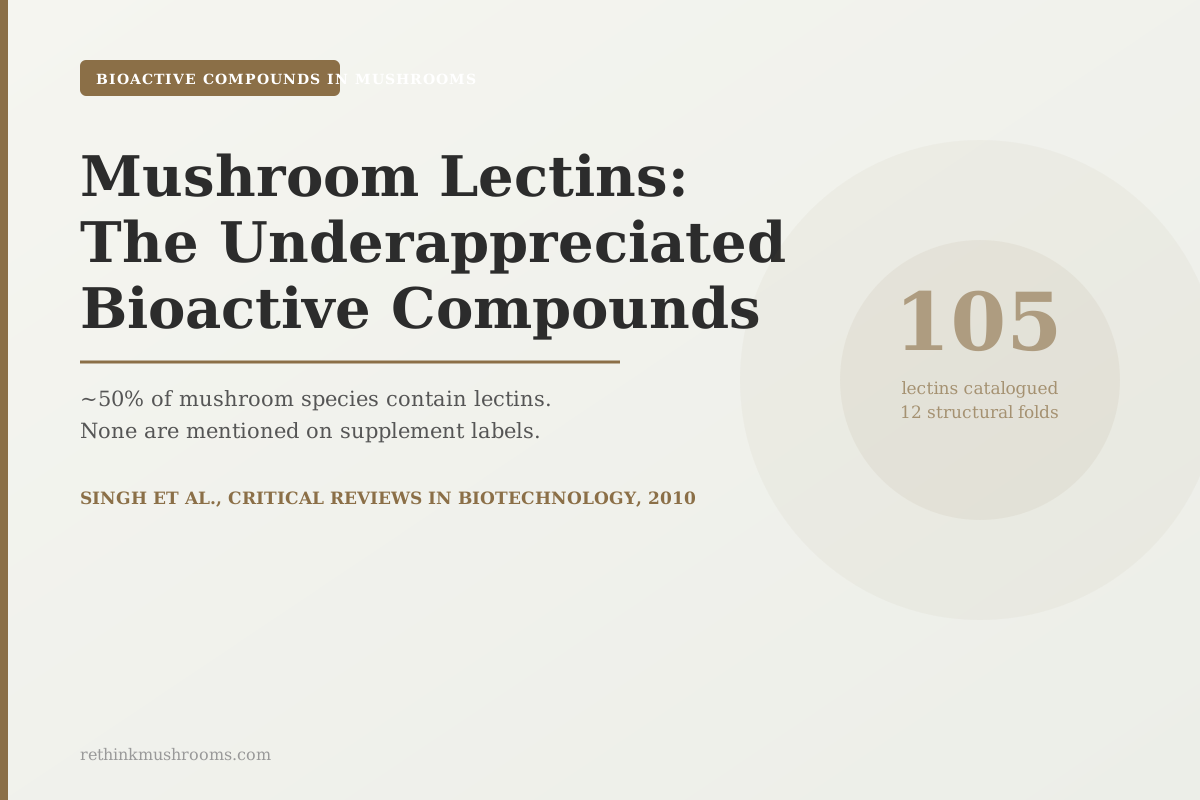
~50% of mushroom species contain lectins
About half of all mushroom species contain lectins, carbohydrate-binding proteins with documented antitumor, antiviral, and immune-activating properties. Despite this, lectins barely appear in mushroom supplement marketing or consumer health content.
Singh et al., Critical Reviews in Biotechnology, 2010
105
distinct mushroom lectins catalogued across 12 structural folds in the most comprehensive review (Hassan et al., 2015)
~10%
of the estimated 140,000 mushroom species have been characterized for lectins; most remain unexplored
6 mechanisms
by which mushroom lectins fight cancer cells: cell cycle arrest, apoptosis, anti-metastasis, immune activation, and more (Singh et al., 2016)
Singh et al., Critical Reviews in Biotechnology, 2010
 View as image ↗
Mushroom supplements are marketed almost entirely on beta-glucan content. Occasionally ergothioneine or hericenones make the label. But there is an entire class of biologically active proteins in mushrooms that consumer health content barely mentions: lectins. A comprehensive review found that approximately half of all mushroom species contain lectins: carbohydrate-binding proteins with documented antitumor, antiviral, immunomodulatory, and antimicrobial properties.[1] This article covers what mushroom lectins are, how they differ from the plant lectins that nutrition media treats as problematic, what their biological functions are, and why this compound class remains largely absent from mainstream discussions of mushroom health benefits. This article is part of a broader look at bioactive compounds in medicinal mushrooms and what distinguishes them.
Key Takeaways
- Approximately 50% of mushroom species contain lectins, carbohydrate-binding proteins with antitumor, antiviral, and immunomodulatory properties (Singh et al., Critical Reviews in Biotechnology, 2010)
- The most comprehensive structural review catalogued 105 distinct mushroom lectins across 12 structural folds, most of which are not found in plant lectins (Hassan et al., International Journal of Molecular Sciences, 2015)
- Only about 10% of the estimated 140,000 mushroom species have been characterized for lectins, meaning most of this compound class remains unexplored (Hassan et al., 2015)
- Mushroom lectins are structurally distinct from problem plant lectins; a 2024 review specifically categorized edible mushroom lectins as generally immunomodulatory and beneficial, not gut-irritating (Konozy et al., Heliyon, 2024)
- Fungal immunomodulatory proteins (FIPs), a lectin-like protein class unique to fungi, produce interferon-gamma, activate T cells, and have shown anti-tumor activity in animal models
- Reishi (Ganoderma lucidum) contains a lectin called GLL-M with mitogenic and antiproliferative properties; this compound dimension of reishi appears in no supplement marketing (U et al., 2011)
What Lectins Are (and Why Mushrooms Contain So Many of Them)
A lectin is a protein that recognizes and binds to specific carbohydrate structures. Carbohydrates in this context are not just sugars you eat. They include the complex sugar-based molecular patterns on the outside of every cell, called glycans, that function as a kind of biochemical identification system. Lectins read this system.
Lectins exist throughout biology: in plants, bacteria, animals, and fungi. Each organism evolved lectins for its own ecological reasons. Plant lectins often serve as defense molecules against insect or pathogen attack. Mushroom lectins appear to serve multiple functions: defense, communication between fungal cells, and regulation of mushroom development and maturation.
Singh and colleagues reviewed the mushroom lectin literature in 2010 and documented that lectins are found in roughly half of all mushroom species studied, with diverse carbohydrate specificities and a wide range of biological activities including antitumor, immunomodulatory, antiviral, and mitogenic effects.[1] The 2015 review by Hassan and colleagues went further, cataloguing 105 distinct mushroom lectins across 12 different structural fold types.[2] The fact that mushroom lectins fall into 12 distinct structural categories, compared to the smaller set of well-characterized folds used by plants, reflects how independently mushrooms evolved this protein class.
One detail from the Hassan review is especially significant: only about 10% of the estimated 140,000 total mushroom species have been characterized for lectins at all. The researchers called mushrooms an "enormous unexplored source" of novel lectins. What we currently know represents a fraction of what exists.
A complementary 2015 review by Singh and colleagues catalogued 144 lectins from edible mushroom species alone, covering molecular weights from 10 to 190 kDa, carbohydrate specificities, and diverse bioactivities.[3] Edible mushrooms consumed regularly for food or sold as supplements contain lectins. These are not exotic compounds found only in rare species.
Are Mushroom Lectins the Same as the Ones in Anti-Lectin Diet Books?
The short answer is no, and the distinction is not marketing-speak. It is biochemistry.
The anti-lectin movement, associated with authors like Steven Gundry, argues that lectins in foods like legumes, grains, and nightshades cause inflammation, gut irritation, and a range of chronic conditions. The evidence for these claims is contested, but the specific lectins cited in anti-lectin arguments are primarily plant-derived types, notably phytohemagglutinin (PHA) from kidney beans, wheat germ agglutinin (WGA) from wheat, and related plant-specific lectin families.
Mushroom lectins are in a different structural category. The Hassan 2015 review documented that mushroom lectins have structural folds not present in problematic plant lectins, and attributed the similarities that do exist to horizontal gene transfer events (in which genetic material moves between unrelated organisms rather than through parent-to-offspring inheritance) rather than to common evolutionary origin.[2]
A 2024 review by Konozy and colleagues examining the full landscape of dietary lectins across plant and fungal sources specifically distinguished between lectin types that tend to drive inflammation (certain plant lectins at high concentrations or in unprocessed states) and lectins that support immune regulation and healthy function.[7] Edible mushroom lectins were categorized in the beneficial immunomodulatory group.
One exception is worth noting for honesty: Laetiporus sulphureus (chicken-of-the-woods mushroom) contains hemolytic lectins that are harmful when the mushroom is eaten raw. These lectins belong to the aerolysin protein family and have structural homology to bacterial toxins. They explain why raw Laetiporus causes reactions in some individuals, and they are inactivated by cooking. This is an accurate counterpoint that supports the conclusion rather than undermines it: the chemistry determines the safety, not the word "lectin," and the lectins in most edible medicinal mushrooms are not of this type.
Where Lectins Fit Among Mushroom's Bioactive Proteins
Lectins are one of several classes of bioactive proteins in mushrooms. Understanding the full landscape clarifies what makes lectins distinct.
Zhou and colleagues published a 2019 review categorizing mushroom bioactive proteins into five main classes: fungal immunomodulatory proteins (FIPs), ribosome-inactivating proteins (RIPs), ribonucleases, laccases, and lectins.[6] Each class has distinct mechanisms.
FIPs deserve special attention in the context of lectins because they are often discussed together and their effects overlap. Fungal immunomodulatory proteins are lectin-like proteins found in species like enoki mushroom (Flammulina velutipes) and reishi (Ganoderma lucidum). They share some structural features with lectins and produce similar immune effects: activating T cells, inducing interferon-gamma, stimulating NK cell activity. The FIP from enoki mushroom, known as FVE or FIP-fve, is the most-studied mushroom immunomodulatory protein in the literature.
Lectins proper are distinguished by their sugar-binding specificity. They recognize particular carbohydrate structures (some bind galactose, some N-acetylglucosamine, some complex glycan chains) and their biological effects flow from these binding events.
A 2016 systematic review by Singh and colleagues documented that mushroom lectins exert anticancer effects through multiple pathways: arresting cells in the G1 phase of the cell cycle (preventing them from copying their DNA to divide), inducing programmed cell death via the caspase cascade (an orderly self-destruction process), downregulating telomerase (the enzyme that lets cancer cells divide indefinitely), inhibiting blood vessel formation into tumor tissue, and activating immune cells to target the tumor.[5] These are not single-mechanism compounds.
What Mushroom Lectins Actually Do in the Body
The biomedical applications reviewed in the Singh 2020 comprehensive update span five main activity categories: antitumor, antiviral, immunomodulatory, antidiabetic, and antimicrobial.[4]
The antitumor activity, documented across dozens of species, works primarily through glycan recognition. Cancer cells alter the carbohydrate structures on their outer surface as part of their transformation from normal cells, and these altered glycan patterns can serve as recognition targets for lectins that bind those specific structures. Singh 2020 noted that lectins' ability to recognize aberrant glycans makes them potentially superior cancer-targeting agents compared to conventional drugs that target cancer's internal pathways. A lectin that reads the cell's surface is not affected by the internal mutations that often cause resistance to conventional chemotherapy.
The antiviral activity is less commonly discussed but is well-documented in the review literature. El-Maradny and colleagues catalogued mushroom lectin activity against HIV, hepatitis C virus, hepatitis B virus, herpes, and influenza in a 2021 review, with specific IC50 values (the concentration needed to inhibit 50% of viral activity) in some cases reaching the low-nanomolar range, a potency comparable to antiviral drug candidates.
Two unexpected examples from the brief's study set illustrate how broadly this compound class operates.
Reishi (Ganoderma lucidum), one of the most-studied medicinal mushrooms in the world, contains a lectin called GLL-M isolated from its mycelium.[9] U and colleagues isolated and characterized GLL-M in 2011 and found it had potent mitogenic activity on immune cells and antiproliferative activity against tumor cells. Reishi's fame rests almost entirely on its polysaccharides and triterpenoids. The existence of a biologically active lectin in the same mushroom represents a compound dimension that reishi supplement marketing does not address.
Agrocybe aegerita, a gourmet edible mushroom known as poplar mushroom or black poplar mushroom, contains a lectin called AAL that was found to serve ecological functions in mushroom development while also showing antiviral activity against plant viruses.[10] This dual role (ecological function inside the mushroom's life cycle and biomedical potential in the laboratory) is characteristic of how lectins operate across the mushroom kingdom. They evolved for the mushroom's own purposes, and those purposes happen to intersect with human therapeutic targets.
For readers interested in the cancer-specific mechanisms in more detail, how mushroom lectins fight cancer covers each pathway with specific study examples. For the species-by-species breakdown of which lectins are found in which mushrooms, lectins from medicinal mushrooms by species provides the full guide. For readers who came to this article via concerns about lectins in food, mushroom lectins vs. plant lectins addresses the structural biology difference directly.
The Research Gap: Why Most Mushroom Lectins Haven't Been Characterized Yet
The fact that only about 10% of mushroom species have been examined for lectins is not a minor limitation. Mushrooms represent one of the largest uncharacterized reservoirs of novel proteins in nature.
The reasons for the gap are practical. Polysaccharides like beta-glucan are structurally simpler to isolate and characterize than proteins. Proteins must be extracted, purified, and sequenced under conditions that preserve their native structure. This process is more labor-intensive than carbohydrate chemistry, and it doesn't lend itself to the kind of large-scale analytical chemistry that supplement manufacturers can run in-house.
Lectins also face a commercial development problem: they are proteins, not small molecules. Developing a protein as a pharmaceutical requires specialized manufacturing, stability testing, and delivery systems that simple mushroom polysaccharide extracts don't require. This doesn't affect their presence in whole mushroom foods, but it means pharmaceutical investment in lectin-specific development has been limited.
Nandi and colleagues' 2024 review framed the broader mushroom compound landscape as an emerging "mycomedicine" category for integrative oncology, covering all classes of mushroom anticancer metabolites including lectins and documenting both preclinical and available clinical data.[8] The review positioned mushroom proteins alongside polysaccharides as legitimate therapeutic candidates, a framing that remains absent from most consumer-facing mushroom supplement discussion.
The practical takeaway for consumers: eating whole mushrooms delivers lectins alongside beta-glucan and other compounds. The mushrooms with the best-characterized lectins include enoki (FVE/FIP-fve), oyster (POL), button mushroom (ABL), reishi (GLL-M), porcini (BEL), and wood ear (Auricularia lectin). None of these lectins are currently on supplement labels, but they are part of what you get from regular mushroom consumption. For a practical look at how enoki's specific lectin-related proteins affect cancer biology, flammulin and tumor inhibition in enoki mushrooms covers that specific species in depth. And for context on how mushroom consumption relates to cancer risk at the population level, daily mushroom consumption and cancer risk reduction covers the epidemiological data.
The Bottom Line
Mushroom lectins are carbohydrate-binding proteins found in roughly half of all mushroom species, with documented antitumor, antiviral, and immunomodulatory properties across dozens of species. They are structurally distinct from the plant lectins associated with anti-lectin diets, and a 2024 review categorized edible mushroom lectins as generally beneficial and immunomodulatory. Despite this, they are almost entirely absent from supplement marketing and consumer health content. About 10% of estimated mushroom species have been characterized for lectins, meaning most of this compound class remains unexplored. Whole mushroom consumption delivers lectins alongside beta-glucan and other compounds, regardless of whether supplement labels acknowledge them.
Frequently Asked Questions
Sources & References
- 1RTHM-00363·Singh, Ram Sarup et al. (2010). “Mushroom lectins: current status and future perspectives..” Critical reviews in biotechnology.Study breakdown →PubMed →↩
- 2RTHM-00689·Hassan, Mohamed Ali Abol et al. (2015). “Mushroom lectins: specificity, structure and bioactivity relevant to human disease..” International journal of molecular sciences.Study breakdown →PubMed →↩
- 3RTHM-00643·Singh, Senjam Sunil et al. (2014). “Lectins from edible mushrooms..” Molecules (Basel.Study breakdown →PubMed →↩
- 4RTHM-01287·Singh, Ram Sarup et al. (2020). “Mushroom lectins in biomedical research and development..” International journal of biological macromolecules.Study breakdown →PubMed →↩
- 5RTHM-00825·Singh, Ram Sarup et al. (2016). “Mushroom Lectins as Promising Anticancer Substances..” Current protein & peptide science.Study breakdown →PubMed →↩
- 6RTHM-01156·Zhou, Rong et al. (2019). “Research Progress of Bioactive Proteins from the Edible and Medicinal Mushrooms..” Current protein & peptide science.Study breakdown →PubMed →↩
- 7RTHM-01919·Konozy, Emadeldin H E et al. (2024). “From inflammation to immune regulation: The dual nature of dietary lectins in health and disease..” Heliyon.Study breakdown →PubMed →↩
- 8RTHM-01956·Nandi, Sudeshna et al. (2024). “A review for cancer treatment with mushroom metabolites through targeting mitochondrial signaling pathway: In vitro and in vivo evaluations, clinical studies and future prospects for mycomedicine..” Fitoterapia.Study breakdown →PubMed →↩
- 9RTHM-00439·U Girjal, Vinay et al. (2011). “Ganoderma lucidum: a source for novel bioactive lectin..” Protein and peptide letters.Study breakdown →PubMed →↩
- 10RTHM-00122·Sun, Hui et al. (2003). “A lectin with mycelia differentiation and antiphytovirus activities from the edible mushroom Agrocybe aegerita..” Journal of biochemistry and molecular biology.Study breakdown →PubMed →↩