Mushroom Bioactive Compounds
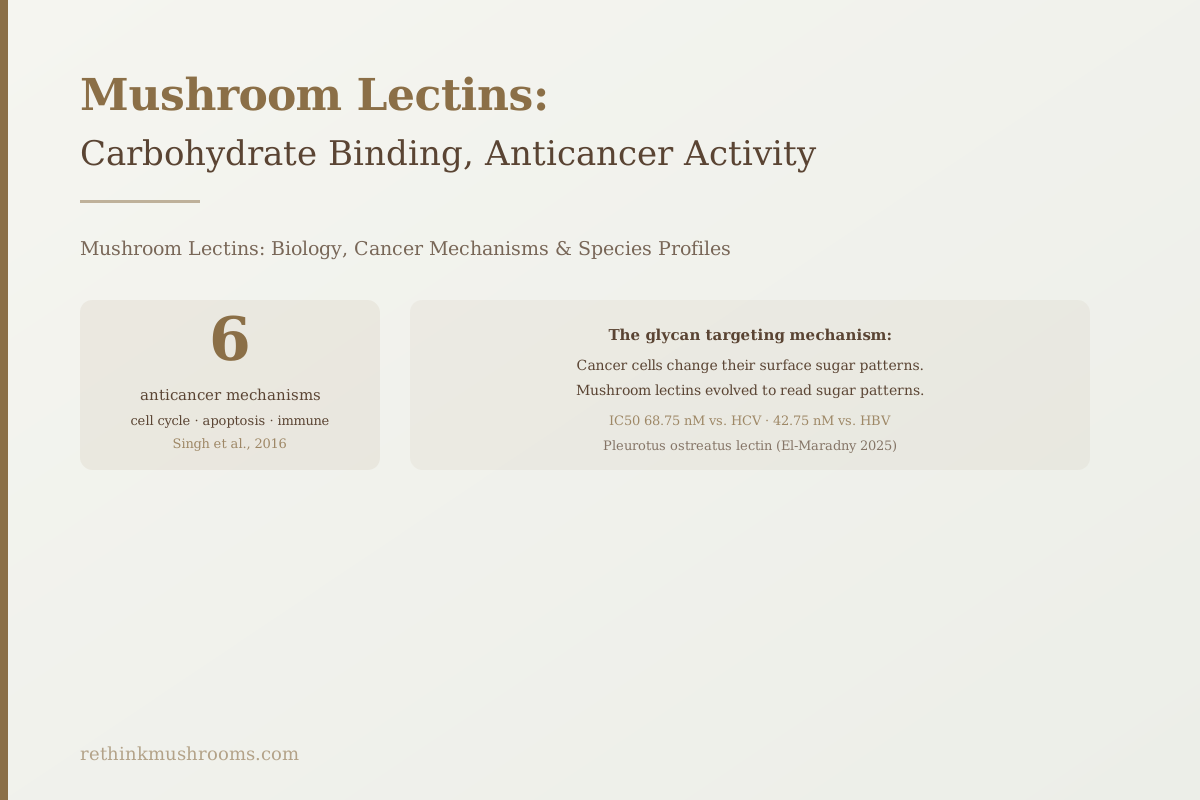
6 anticancer mechanisms
Mushroom lectins fight cancer through at least six independent mechanisms including glycan recognition on tumor cell surfaces, cell cycle arrest, caspase-mediated apoptosis, and angiogenesis inhibition.
Singh et al., Current Protein & Peptide Science, 2016
IC50 68.75 nM
antiviral potency of Pleurotus ostreatus lectin against HCV, among the strongest published for a dietary lectin (El-Maradny 2025)
2 binding sites
in Agaricus bisporus lectin, each targeting a different cancer-overexpressed sugar structure (Ismaya 2020)
~50%
of mushroom species contain lectins with documented bioactivities including anticancer effects (Singh 2010)
Singh et al., Current Protein & Peptide Science, 2016
 View as image ↗
Every cell in the body is coated in a layer of sugar structures called glycans. Healthy cells wear one glycan pattern. Cancer cells wear a different one. As tumors develop, they systematically alter the sugars on their surface in ways that help them evade immune detection, invade surrounding tissue, and resist conventional treatment. This alteration of the cell's sugar code is called the cancer glycome, and it's one of the distinguishing molecular features of malignancy.
Lectins are proteins that read sugar structures. They evolved in mushrooms as ecological tools, binding to carbohydrate patterns on the surfaces of pathogens, parasites, and competing organisms. The carbohydrate specificity that made mushroom lectins useful for fungal defense may also make them naturally pre-adapted to recognize cancer's altered glycan signature, because the sugar structures that cancer cells overexpress overlap with the patterns mushroom lectins evolved to detect.[1]
This is the scientific basis for the research interest in mushroom lectins as anticancer agents. It's not simply that they're toxic to cells. It's that their molecular architecture may give them an inherent cancer selectivity that conventional chemotherapy doesn't have. This article covers how that selectivity works structurally, what the full spectrum of anticancer mechanisms looks like, and where the evidence stands for antiviral applications of the same proteins. For the broader context of bioactive compound classes in medicinal mushrooms, see what are beta-glucans? The most important compound in medicinal mushrooms.
Key Takeaways
- Cancer cells display altered sugar patterns (glycans) on their surfaces that healthy cells don't have; mushroom lectins evolved to recognize specific sugar structures, potentially giving them inherent tumor cell selectivity
- Singh et al. (2016) documented six independent mechanisms by which mushroom lectins fight cancer: G1 and G2/M cell cycle arrest, caspase cascade activation, telomerase downregulation, angiogenesis inhibition, glycan recognition-mediated apoptosis, and immune activation
- Three lectins have been structurally characterized at atomic resolution, revealing distinct carbohydrate-binding architectures: Yang 2009 (AAL from Agrocybe aegerita), Ismaya 2020 (ABL from Agaricus bisporus, two binding sites), and Perduca 2020 (POL from Pleurotus ostreatus, beta-trefoil fold)
- PVL lectin from Psathyrella velutina specifically targets GlcNAc (N-acetylglucosamine), a sugar overexpressed on cancer cell surfaces, giving it potential as both a cancer-fighting compound and a diagnostic tool (Machon 2020)
- El-Maradny et al. (2025) found Pleurotus ostreatus lectin showed antiviral potency against HCV (IC50 68.75 nM) and HBV (IC50 42.75 nM) through multi-step viral life cycle disruption, including CD81 receptor binding
- All anticancer data on mushroom lectins is currently preclinical (cell culture and animal models); no human clinical trial has tested lectins as a standalone cancer treatment, though Nandi et al. (2024) reviews the full clinical translation landscape
How Lectins Read the Sugar Code on Tumor Cells
To understand why mushroom lectins may target cancer cells specifically, it helps to understand what those cells have changed about their surface.
Glycans are the sugar molecules attached to proteins and lipids on the cell surface. They form a dense, complex layer called the glycocalyx that mediates virtually every interaction a cell has with its environment: immune cell recognition, viral attachment, cell-to-cell adhesion, and growth factor signaling all happen through this sugar interface.
In cancer, the glycan profile is systematically remodeled. Certain sugar structures become overexpressed: T-antigen (Thomsen-Friedenreich antigen), Tn antigen, sialyl-Tn, and N-acetylglucosamine (GlcNAc) are consistently elevated across multiple cancer types. Other structures that healthy cells display are underexpressed. This altered glycan pattern helps cancer cells hide from immune surveillance and promotes metastatic behavior.
Lectins evolved to recognize specific sugar structures. A lectin that binds GlcNAc will bind much more avidly to a cancer cell surface overexpressing GlcNAc than to a healthy cell with normal GlcNAc levels. This concentration difference creates a selectivity window: the lectin is pulled toward cancer cells and indifferent to healthy cells in the same way a targeting missile homes on a specific signal.[1]
This glycan-targeting mechanism is fundamentally different from how most chemotherapy drugs work. Most cytotoxic drugs interfere with cell division processes that are common to all dividing cells, which is why they damage healthy dividing tissues (hair follicles, gut lining, bone marrow) alongside cancer cells. A lectin that binds to cancer-specific glycan patterns doesn't face this same specificity challenge. In laboratory models, this selectivity has been documented: lectins that kill cancer cells at concentrations that leave adjacent normal cells relatively unaffected.
For the comparison between mushroom lectins and their plant counterparts, see mushroom lectins vs. plant lectins: different biology, different effects.
Six Mechanisms: How Mushroom Lectins Attack Cancer from Multiple Angles
Singh and colleagues published a systematic review in 2016 specifically cataloging the anticancer mechanisms documented for mushroom lectins across the research literature. They identified six distinct routes through which mushroom lectins fight cancer.[2]
G1 phase cell cycle arrest. Some lectins prevent cancer cells from progressing past the G1 checkpoint, the quality-control gate before DNA replication begins. Cancer cells arrested at G1 cannot divide.
G2/M phase arrest. Other lectins stop cells at the later G2/M checkpoint, preventing mitosis from completing. This is the point where chromosomes segregate into daughter cells.
Caspase cascade activation. Caspases are the molecular scissors that execute programmed cell death. Mushroom lectins can trigger both the intrinsic pathway (through the mitochondria) and the extrinsic pathway (through surface death receptors), causing cancer cells to self-destruct through two independent apoptotic routes.
Telomerase downregulation. Cancer cells maintain their immortality by activating telomerase, an enzyme that rebuilds the protective caps on chromosome ends. Shortening telomeres normally limits how many times a cell can divide. Some mushroom lectins reduce telomerase activity, restoring the cellular division limit that cancer cells had bypassed.
Angiogenesis inhibition. Tumors stimulate new blood vessel growth (angiogenesis) to supply themselves with nutrients. Some lectins suppress this process, effectively starving the tumor.
Immune activation leading to cancer killing. Some mushroom lectins, particularly the fungal immunomodulatory protein class (FIPs), stimulate natural killer cells, cytotoxic T cells, and macrophages to recognize and destroy cancer cells. This immune-mediated mechanism is distinct from direct cytotoxicity.
Hassan and colleagues' 2015 review of 105 mushroom lectins across 12 structural folds confirmed that different structural families tend toward different mechanisms, meaning the diversity of mushroom lectins provides mechanistic diversity in anti-cancer activity.[3] Wang and colleagues demonstrated in 2000 that Pleurotus ostreatus lectin showed potent activity against human hepatoma and sarcoma cell lines, establishing that the mechanisms documented in cell models were present in commonly eaten oyster mushrooms.[4]
The Structural Evidence: Three Lectins With Crystal-Clear Anticancer Activity
The strongest evidence for how mushroom lectins fight cancer comes from studies that resolved their three-dimensional structures at atomic resolution, allowing researchers to map exactly which sugar patterns each lectin binds and how binding triggers cell death.
Yang and colleagues solved the crystal structure of the Agrocybe aegerita lectin (AAL) in 2009. AAL has a galectin-like fold, the same architectural family as some human immune lectins, with a carbohydrate-binding pocket shaped specifically for galactose-related sugars that are overexpressed on cancer cell surfaces. The crystal structure explained precisely how AAL induces apoptosis: when the lectin crosslinks surface glycoproteins by binding multiple sugar chains simultaneously, it clusters and activates the death receptor complexes that trigger the extrinsic apoptotic pathway.[5]
Ismaya and colleagues characterized the Agaricus bisporus lectin (ABL) structurally in 2020. ABL is unusual among mushroom lectins in having two distinct carbohydrate-binding sites in a single protein: one specific for T-antigen and one specific for GlcNAc. Both T-antigen and GlcNAc are overexpressed on cancer cell surfaces. This dual targeting architecture may explain why ABL was the first mushroom lectin demonstrated to inhibit proliferation of cancerous human colon epithelial cells, and why it shows selectivity for cancer cells over healthy epithelial cells.[6]
Perduca and colleagues solved the structure of the Pleurotus ostreatus lectin (POL) in 2020. POL adopts a beta-trefoil fold, a distinctive protein architecture where three similar structural units wrap around a central axis to create a carbohydrate-binding cleft. POL's cleft is shaped for complex glycans, including the branched sugar structures that cancer cells display. The beta-trefoil fold gives POL a large surface area for glycan engagement, potentially enabling it to crosslink and cluster multiple surface receptors simultaneously.[7]
Bovi and colleagues characterized the Boletus edulis lectin (BEL) in 2011, finding another beta-trefoil-fold lectin from a commonly eaten wild mushroom, with antiproliferative activity against human cancer cell lines. Porcini mushroom, in other words, has an anti-cancer lectin that had never been structurally characterized before that study.[8]
A 2021 study by Liu and colleagues found a newly characterized lectin from Auricularia auricula (wood ear mushroom) that inhibited lung cancer cell proliferation and, in a finding no competitor content has covered, simultaneously improved pulmonary microbiome diversity in the experimental model.[9] The dual cancer-inhibiting and microbiome-supporting effect points toward mechanisms that extend beyond direct cytotoxicity. For the enoki mushroom lectins and their tumor-fighting properties, see flammulin and tumor inhibition: how enoki fights cancer cells.
The GlcNAc Story: A Lectin So Precise It Can Identify Cancer Cells
Machon and colleagues published the characterization of PVL (Psathyrella velutina lectin) in 2020, and it represents one of the most striking examples of lectin precision.
PVL is the founding member of a novel fungal lectin family with a seven-bladed beta-propeller fold. Its carbohydrate-binding site is shaped for one specific sugar structure: terminal N-acetylglucosamine (GlcNAc). This selectivity is important because GlcNAc is systematically overexpressed on the surfaces of multiple cancer types, including breast, colon, and lung cancer. Healthy cells have GlcNAc in their glycan patterns, but cancer cells concentrate it at the terminal positions of their surface glycoproteins in a way that PVL's binding site recognizes preferentially.[10]
This precision has made PVL not just an anticancer candidate but a research tool. Its exquisite GlcNAc specificity means researchers can use purified PVL to label and identify cancer cells in tissue samples, distinguishing them from healthy cells by their surface GlcNAc overexpression. PVL is used in cancer glycobiology research as a lectin histochemistry reagent.
The practical implication: this level of molecular precision, where a single protein distinguishes cancer cells from healthy cells based on a single sugar structure, is exactly the kind of targeting specificity that drug development aims for. Whether PVL or similar lectins can be developed into therapeutic agents depends on solving delivery and stability challenges that are common to all protein-based drugs, including how to get the protein to the tumor intact after oral administration.
Beyond Cancer: The Antiviral Applications of Oyster Mushroom Lectins
The same glycan-reading mechanism that makes mushroom lectins cancer-selective also gives them potential antiviral applications, because viruses are also coated in glycan structures that they need to interact with cell surface receptors.
El-Maradny and colleagues published a comprehensive review in 2021 of antiviral mechanisms for mushroom lectins, documenting activity against HIV, HCV, HBV, herpes, and influenza. Lectins from Pleurotus citrinopileatus inhibited HIV-1 reverse transcriptase at IC50 values of 0.93 µM, a highly specific antiviral mechanism that targets the viral replication machinery rather than just blocking cell entry.[11]
The most recent and specific antiviral data came in 2025, when El-Maradny and colleagues published a full biochemical characterization of Pleurotus ostreatus lectin (POL) specifically for antiviral potency. Against HCV (hepatitis C virus), POL showed IC50 values of 68.75 nM for blocking viral attachment and 52.13 nM for neutralizing virus. Against HBV (hepatitis B virus), IC50 values were 42.75 nM for treatment and 14.88 nM for blocking. The study documented that POL binds the CD81 receptor, a surface protein that HCV requires to enter liver cells, with 58.8% binding capacity, interfering with a key step in the viral life cycle at nanomolar concentrations.[12]
IC50 values in the nanomolar range represent drug-candidate level potency. Most antiviral compounds in clinical use operate in the nM-to-µM range. POL's HBV data in particular puts it in the same potency tier as established antivirals, though all these measurements are from cell culture models and the path to a clinical antiviral application involves substantial additional research.
For the convergent story of how shiitake's lentinan activates many of the same immune targets through a different mechanism, see how lentinan enhances anti-tumor immunity. For Reishi's complementary anticancer compound class, see ganoderic acids and cancer: specific anti-tumor research.
Where the Clinical Evidence Stands
Rezvani and colleagues clarified the classification landscape in 2020, distinguishing mushroom lectins from the related but distinct protein classes they're often grouped with: fungal immunomodulatory proteins (FIPs), ribosome-inactivating proteins (RIPs), and laccases all appear in the anticancer mushroom literature. Lectins specifically act through glycan recognition triggering immune activation and apoptosis; FIPs primarily work through cytokine induction; RIPs through direct ribosome inactivation.[13]
Nandi and colleagues' 2024 review of "mycomedicine" provides the most current assessment of the clinical translation status. The review covers all classes of mushroom anticancer metabolites including lectins, examining both in vitro, animal, and clinical evidence. The clinical trial evidence that exists is primarily for polysaccharide-protein complexes (PSK, lentinan) rather than for isolated lectins specifically. No phase II or phase III clinical trial has tested a purified mushroom lectin as a standalone cancer treatment.[14]
The preclinical evidence for lectin anticancer activity is well-documented across dozens of cell culture and animal studies. The gap between this evidence base and clinical use is where the science currently sits. The mechanistic story is compelling and structurally grounded. The translation pathway requires solving protein delivery, stability, and dosing questions that remain areas of active research.
The Bottom Line
Mushroom lectins target cancer cells through their natural ability to recognize the altered glycan patterns that tumors display on their surface. This cancer-selective binding mechanism, combined with at least six documented anticancer pathways (cell cycle arrest, apoptosis, immune activation, telomerase downregulation, and angiogenesis inhibition), makes mushroom lectins a scientifically grounded area of drug development interest. Three lectins have been structurally characterized at atomic resolution, each revealing a distinct carbohydrate-binding architecture adapted for cancer glycan recognition. The PVL lectin from Psathyrella is precise enough to serve as a cancer cell diagnostic tool. The 2025 Pleurotus lectin antiviral data shows IC50 values in the nanomolar range for HCV and HBV. All evidence to date is preclinical; no clinical trial has tested purified mushroom lectins for cancer or antiviral treatment in humans.
Frequently Asked Questions
Sources & References
- 1RTHM-01287·Singh, Ram Sarup et al. (2020). “Mushroom lectins in biomedical research and development..” International journal of biological macromolecules.Study breakdown →PubMed →↩
- 2RTHM-00825·Singh, Ram Sarup et al. (2016). “Mushroom Lectins as Promising Anticancer Substances..” Current protein & peptide science.Study breakdown →PubMed →↩
- 3RTHM-00689·Hassan, Mohamed Ali Abol et al. (2015). “Mushroom lectins: specificity, structure and bioactivity relevant to human disease..” International journal of molecular sciences.Study breakdown →PubMed →↩
- 4RTHM-00074·Wang, H et al. (2000). “A new lectin with highly potent antihepatoma and antisarcoma activities from the oyster mushroom Pleurotus ostreatus..” Biochemical and biophysical research communications.Study breakdown →PubMed →↩
- 5RTHM-00322·Yang, Na et al. (2009). “Structural basis for the tumor cell apoptosis-inducing activity of an antitumor lectin from the edible mushroom Agrocybe aegerita..” Journal of molecular biology.Study breakdown →PubMed →↩
- 6RTHM-01207·Ismaya, Wangsa Tirta et al. (2020). “Lectins from the Edible Mushroom Agaricus bisporus and Their Therapeutic Potentials..” Molecules (Basel.Study breakdown →PubMed →↩
- 7RTHM-01275·Perduca, Massimiliano et al. (2020). “Structure and properties of the oyster mushroom (Pleurotus ostreatus) lectin..” Glycobiology.Study breakdown →PubMed →↩
- 8RTHM-00381·Bovi, Michele et al. (2011). “Structure of a lectin with antitumoral properties in king bolete (Boletus edulis) mushrooms..” Glycobiology.Study breakdown →PubMed →↩
- 9RTHM-00706·Liu, ZhenDong et al. (2021). “A New Lectin from Auricularia auricula Inhibited the Proliferation of Lung Cancer Cells and Improved Pulmonary Flora..” BioMed research international.Study breakdown →PubMed →↩
- 10RTHM-01248·Machon, Oriane et al. (2020). “Expression, Purification, and Applications of the Recombinant Lectin PVL from Psathyrella velutina Specific for Terminal N-Acetyl-Glucosamine..” Methods in molecular biology (Clifton.Study breakdown →PubMed →↩
- 11RTHM-01347·El-Maradny, Yousra A et al. (2021). “Lectins purified from medicinal and edible mushrooms: Insights into their antiviral activity against pathogenic viruses..” International journal of biological macromolecules.Study breakdown →PubMed →↩
- 12RTHM-02079·El-Maradny, Yousra A et al. (2025). “Biochemical characterization of a novel purified lectin extracted from Pleurotus ostreatus mushroom for its antiviral activity..” Scientific reports.Study breakdown →PubMed →↩
- 13RTHM-01282·Rezvani, Vala et al. (2020). “Anticancer potentiality and mode of action of low-carbohydrate proteins and peptides from mushrooms..” Applied microbiology and biotechnology.Study breakdown →PubMed →↩
- 14RTHM-01956·Nandi, Sudeshna et al. (2024). “A review for cancer treatment with mushroom metabolites through targeting mitochondrial signaling pathway: In vitro and in vivo evaluations, clinical studies and future prospects for mycomedicine..” Fitoterapia.Study breakdown →PubMed →↩