Bioactive Compounds in Mushrooms
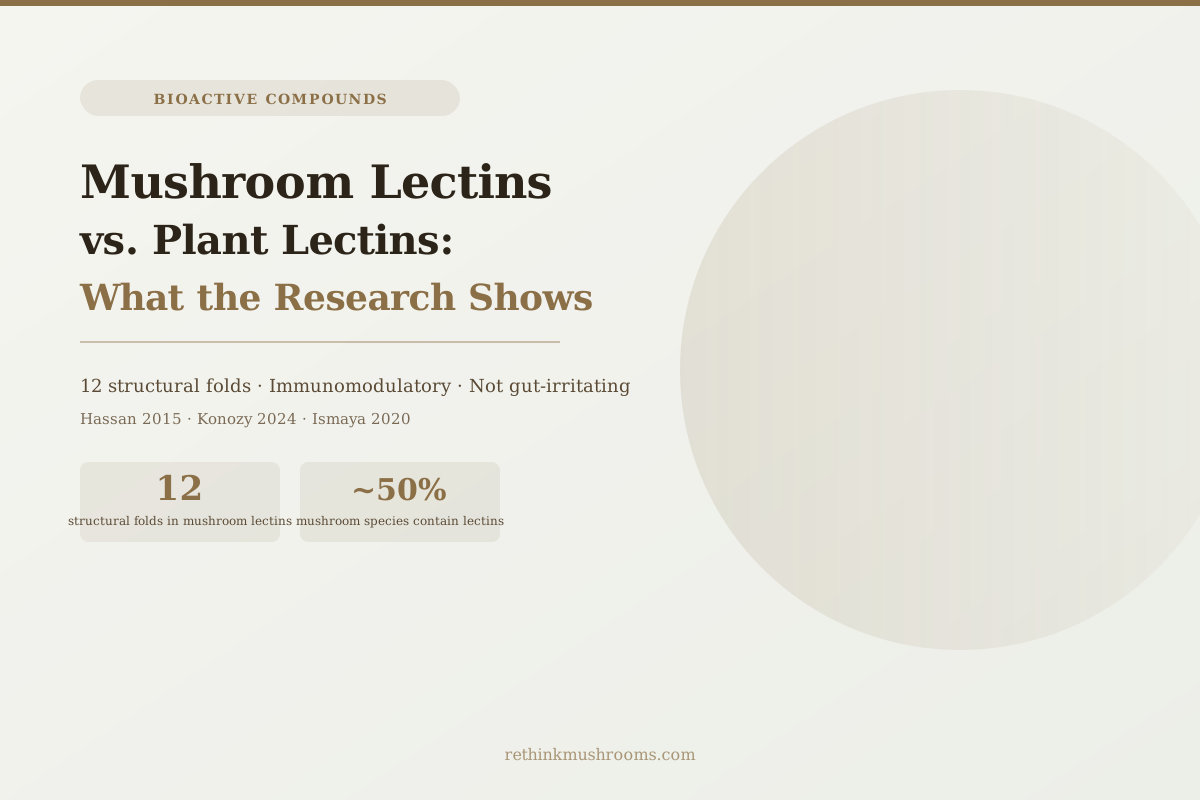
12 structural folds
Mushroom lectins occur in 12 distinct structural configurations not found in plant lectins. This structural uniqueness, documented across 105 characterized mushroom lectins, explains why mushroom and plant lectins produce fundamentally different biological effects.
Hassan et al., Int J Mol Sci, 2015
~50% of species
approximately half of mushroom species contain lectins with bioactive properties
HGT origin
Agaricus bisporus lectin acquired plant-like structure via horizontal gene transfer but acts as a cancer-fighter
Processing-stable
FIP proteins in enoki and reishi retain immunomodulatory activity after cooking and freeze-drying
Hassan et al., Int J Mol Sci, 2015
 View as image ↗
The anti-lectin movement has made "lectin" synonymous with "gut irritant" in parts of the wellness community. The concern has a real basis for specific plant lectins: phytohaemagglutinin in undercooked kidney beans can cause acute gastrointestinal reactions, and certain legume lectins resist digestion and may irritate the gut lining at high doses. But this framing rarely distinguishes between plant lectins and mushroom lectins, two categories that are structurally distinct and produce fundamentally different effects in the human body. This article addresses that distinction directly, using what the structural biology and recent research show about mushroom lectins vs. plant lectins.
For the broader picture of mushroom bioactive compounds, including beta-glucans and other protein classes, What Are Beta-Glucans? The Most Important Compound in Medicinal Mushrooms provides the foundational overview.
Key Takeaways
- Mushroom lectins are carbohydrate-binding proteins found in approximately half of all mushroom species, but they are structurally distinct from the problematic plant lectins most people are warned about
- Hassan and colleagues characterized 105 mushroom lectins across 12 distinct structural folds, none of which correspond to the problematic lectin families (PHA, ricin B, legume-type) in plants
- A 2024 review by Konozy and colleagues explicitly distinguished edible mushroom lectins from problematic plant lectin types, classifying them in the beneficial immunomodulatory category
- The Agaricus bisporus (button mushroom) lectin acquired a plant-like structural architecture via horizontal gene transfer from plants, yet functions as a cancer-fighter against human colon cancer cells
- Laetiporus sulphureus (chicken-of-the-woods) is an honest counterpoint: it contains hemolytic lectins in the aerolysin protein family that can cause reactions raw, and must be thoroughly cooked
- FIP (fungal immunomodulatory protein) lectin-like proteins from enoki and reishi retain immunomodulatory activity after cooking, freeze-drying, and other food processing
The Anti-Lectin Narrative Has a Mushroom-Shaped Blind Spot
In books and supplement marketing influenced by the anti-lectin narrative, lectins are framed as anti-nutrients: plant defense chemicals that damage gut lining, contribute to inflammation, and cause autoimmunity. The evidence base for this varies considerably by lectin type. Phytohaemagglutinin in raw red kidney beans is genuinely toxic in quantity. Gluten proteins share some biochemical properties with lectins. Wheat germ agglutinin can irritate gut cells at concentrations used in laboratory studies.
But mushroom lectins are not in these categories. Singh and colleagues established in their foundational 2010 review that approximately 50% of mushroom species contain lectins with diverse bioactivities including antitumor, immunomodulatory, antiviral, and mitogenic effects.[1] These are not defensive compounds trying to damage intestinal cells. They are carbohydrate-binding proteins that have evolved different ecological roles than plant lectins and that produce different effects in biological systems.
The structural biology makes the distinction rigorous rather than just narrative. Mushroom lectins and plant lectins do share the property of binding carbohydrate molecules, which is what puts them in the same broad category. But sharing a biochemical property does not mean sharing a structure, a mechanism, or an effect on human health. That is the distinction this article explores.
Twelve Structural Folds, Not One: Why Mushroom Lectins Are a Different Protein Category
The strongest structural argument for treating mushroom lectins separately from plant lectins comes from Hassan and colleagues' 2015 comprehensive review in the International Journal of Molecular Sciences.[2]
Hassan cataloged approximately 105 mushroom lectins and found they distribute across 12 distinct structural folds: beta-trefoil, beta-propeller, beta-sandwich, Ricin B-like, and eight others. This structural diversity across mushroom species has no parallel in plant lectin families, which cluster around a smaller number of characteristic folds (jacalin-like, legume lectin, hevein-type, and a few others).
The significance of structural folds is not academic. Protein structure determines function. A carbohydrate-binding protein with a beta-trefoil fold recognizes different sugar patterns than one with a beta-propeller fold, triggers different cellular receptors, and activates different downstream pathways. The 12-fold diversity of mushroom lectins explains why they produce such a range of effects: antitumor in some species, antiviral in others, immunostimulatory in others, and with some showing all three.
Hassan also noted that with only approximately 10% of the estimated 140,000 mushroom species characterized for lectin content, mushrooms represent what the authors called "an enormous unexplored source" of novel lectins with potential therapeutic properties.[2]
The evolutionary reason mushroom lectins look different from plant lectins also tells us something important: they evolved independently, under different selective pressures. Plants evolved lectins primarily as seed and leaf defenses against insects and herbivores. Mushrooms evolved lectins primarily for different ecological functions: recognizing and manipulating carbohydrate structures in their environment, which in fungi means wood, leaf litter, and soil organic matter. The same biochemical property (carbohydrate binding), different evolutionary context, different structural solutions, different effects.
The Agaricus Case: When a Mushroom Lectin Looks Like a Plant Lectin but Fights Cancer
The most scientifically interesting case bridging the plant and mushroom lectin categories involves the Agaricus bisporus lectin (ABL), from the common button mushroom that most people eat regularly.
Ismaya and colleagues characterized ABL in a 2020 review and found something unexpected: ABL has a structural architecture that resembles plant lectins, likely acquired through horizontal gene transfer from plants at some point in evolutionary history.[3] Horizontal gene transfer is the process by which genetic material moves between species outside of reproduction. In this case, a fungal ancestor appears to have acquired plant lectin gene sequences.
Yet despite this plant-like structural origin, ABL functions as a cancer-fighter. It was the first mushroom lectin demonstrated to inhibit proliferation of cancerous human epithelial colon cells in laboratory studies. Its unique architecture includes two distinct carbohydrate-binding sites, one for T-antigen and one for N-acetylglucosamine, both of which are carbohydrate patterns overexpressed on the surface of cancer cells.
This case dismantles a simple "mushroom lectins vs. plant lectins" binary: a mushroom lectin that structurally resembles a plant lectin still produces fundamentally different effects because its binding site specificity evolved to target cancer-associated sugar patterns. The structural ancestry does not determine the functional effect.
The Honest Counterpoint: Laetiporus Lectins That Are Genuinely Harmful Raw
Building credibility requires acknowledging the exception rather than overstating the case.
Laetiporus sulphureus, commonly called chicken-of-the-woods, contains lectins that belong to the aerolysin superfamily: pore-forming proteins that can disrupt cell membranes. Mancheño and colleagues characterized these lectins and established their structural homology to bacterial toxins.[4] This is why eating raw or undercooked chicken-of-the-woods can cause gastrointestinal distress or, in some cases, allergic-type reactions.
This is a real limitation, and it matters for honesty. Not all mushroom lectins are benign. The Laetiporus case is structurally distinct from the problematic plant lectin classes (it belongs to an entirely different protein family), but the practical effect for someone eating raw chicken-of-the-woods is unpleasant in a similar way.
The relevant detail: the Laetiporus hemolytic lectins are heat-labile. Thorough cooking inactivates them. The edible and well-regarded culinary species (Pleurotus, Agaricus, Flammulina, Lentinula, Ganoderma) do not contain hemolytic lectins of this type. The Laetiporus exception does not generalize to the mushrooms that appear in most supplement products.
How Cooking Affects Mushroom Lectins
If hemolytic Laetiporus lectins are inactivated by cooking, the question naturally arises: what happens to the beneficial lectins in edible mushrooms when they are cooked or processed?
Tong and colleagues addressed this directly in a 2008 study specifically examining the processing tolerance of immunomodulatory proteins from enoki and reishi mushrooms.[5] The finding: FIP (fungal immunomodulatory protein) proteins from both species retained full immunomodulatory activity after cooking, freeze-drying, and other standard food processing methods.
This matters for two practical reasons. First, it means that cooking edible mushrooms does not destroy their immunomodulatory lectin-like proteins. Second, it means that mushroom supplements produced through drying, extraction, or spray-drying processes likely retain lectin activity.
The contrast with Laetiporus is illuminating: some mushroom lectins are heat-stable and remain active through cooking; others (the hemolytic type) are heat-labile and inactivated by cooking. The edible, well-known culinary and medicinal mushrooms fall into the heat-stable category for their beneficial proteins.
The 2024 Research That Finally Addresses the Comparison Directly
Until recently, the comparison between mushroom and plant lectins required the reader to synthesize evidence from multiple separate bodies of literature. A 2024 review by Konozy and colleagues, published in Heliyon, assembled this comparison explicitly.[6]
Konozy examined how dietary lectins from both plant and fungal sources can either drive inflammation or support immune regulation, depending on the source, dose, and preparation. The review's direct conclusion: edible mushroom lectins fall in the beneficial immunomodulatory category, in contrast to some plant lectins that can trigger inflammatory responses.
The key variables Konozy identified:
- Source matters. Lectins from well-established edible mushrooms (Pleurotus, Flammulina, Ganoderma, Agaricus) show consistent immunomodulatory and anticancer profiles in research. The problematic plant lectins (PHA from kidney beans, ricin from castor beans, wheat germ agglutinin at high doses) come from plant seed and leaf tissue where evolutionary pressure produced defensive proteins.
- Dose matters. Plant lectins that cause harm generally do so at higher concentrations than occur in normally cooked food. Mushroom FIP proteins are active at nanomolar concentrations in laboratory settings, suggesting potency that may not require high doses.
- Preparation matters. Cooking inactivates the hemolytic Laetiporus lectins entirely while leaving the immunomodulatory FIP proteins from other species intact.
| Feature | Problematic Plant Lectins | Edible Mushroom Lectins |
|---|---|---|
| Common examples | PHA (kidney bean), WGA (wheat germ), ricin (castor) | FIP-fve (enoki), GLL-M (reishi), POL (oyster) |
| Structural families | Legume lectin, jacalin, ricin B | 12 distinct folds; beta-trefoil, beta-propeller |
| Primary evolutionary role | Seed/leaf defense against herbivores | Ecological carbohydrate recognition |
| Effect on gut | Can irritate epithelium at high doses | Generally immunomodulatory; no gut-irritating class identified in edible species |
| Heat sensitivity | Variable; many are reduced by cooking | FIP proteins heat-stable; hemolytic (Laetiporus) inactivated by cooking |
| Cancer research | Generally not studied for anticancer properties | Extensive in vitro and animal evidence for apoptosis, cell cycle arrest, immune activation |
For readers interested in the anti-cancer mechanisms specifically, How Mushroom Lectins Fight Cancer: Mechanisms of Action covers how lectins selectively target tumor cells. Mushroom Lectins: The Underappreciated Bioactive Compounds provides the broad overview of what makes lectins an underexplored compound class. And for lectins species by species, Lectins from Medicinal Mushrooms: A Species-by-Species Guide covers enoki, oyster, reishi, button mushroom, and others individually.
For the cancer epidemiology context, Daily Mushroom Consumption and Cancer Risk Reduction covers the population-level data, where lectin-rich species like enoki appear prominently in the literature.
The Bottom Line
Mushroom lectins are structurally distinct from problematic plant lectins: Hassan 2015 identified 12 structural folds across 105 characterized mushroom lectins, none corresponding to the PHA, ricin B, or legume-type families responsible for plant lectin concerns. A 2024 review by Konozy directly classified edible mushroom lectins as beneficial immunomodulatory compounds. The honest exception is Laetiporus sulphureus (chicken-of-the-woods), which contains hemolytic lectins that require cooking to inactivate. FIP proteins from enoki and reishi retain their immunomodulatory activity after all standard cooking and processing methods.
Frequently Asked Questions
Sources & References
- 1RTHM-00363·Singh, Ram Sarup et al. (2010). “Mushroom lectins: current status and future perspectives..” Critical reviews in biotechnology.Study breakdown →PubMed →↩
- 2RTHM-00689·Hassan, Mohamed Ali Abol et al. (2015). “Mushroom lectins: specificity, structure and bioactivity relevant to human disease..” International journal of molecular sciences.Study breakdown →PubMed →↩
- 3RTHM-01207·Ismaya, Wangsa Tirta et al. (2020). “Lectins from the Edible Mushroom Agaricus bisporus and Their Therapeutic Potentials..” Molecules (Basel.Study breakdown →PubMed →↩
- 4RTHM-00193·Mancheño, José Miguel et al. (2010). “Laetiporus sulphureus lectin and aerolysin protein family..” Advances in experimental medicine and biology.Study breakdown →PubMed →↩
- 5RTHM-00278·Tong, Man-Hua et al. (2008). “High processing tolerances of immunomodulatory proteins in Enoki and Reishi mushrooms..” Journal of agricultural and food chemistry.Study breakdown →PubMed →↩
- 6RTHM-01919·Konozy, Emadeldin H E et al. (2024). “From inflammation to immune regulation: The dual nature of dietary lectins in health and disease..” Heliyon.Study breakdown →PubMed →↩
- 7RTHM-01287·Singh, Ram Sarup et al. (2020). “Mushroom lectins in biomedical research and development..” International journal of biological macromolecules.Study breakdown →PubMed →↩