Bioactive Compounds in Mushrooms
6 anticancer mechanisms
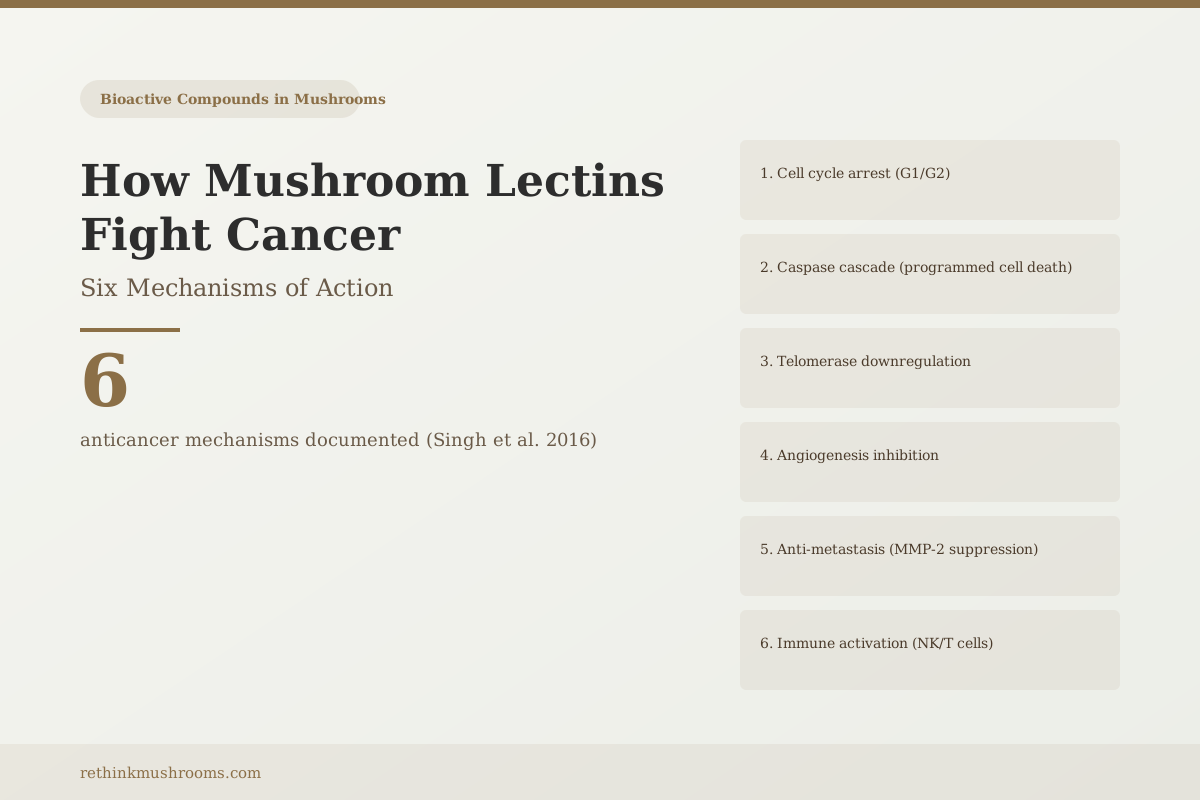
Singh et al. (2016) identified six distinct mechanisms through which mushroom lectins attack cancer cells, from cell cycle arrest and caspase-triggered cell death to telomerase suppression and immune activation.
Singh et al., Current Protein & Peptide Science, 2016
105
distinct mushroom lectins mapped across 12 structural folds (Hassan et al. 2015)
12
unique structural fold types found in mushroom lectins, distinct from plant lectins
0
human clinical trials specifically testing mushroom lectins for cancer treatment to date
Singh et al., Current Protein & Peptide Science, 2016
 View as image ↗
Cancer cells are covered in molecular sugar. These sugars form the glycan coatings that sit on the outer surface of every cell in the body. Cancer cells display abnormal glycan patterns. These patterns differ from healthy cells in ways that are specific and consistent across cancer types.
Lectins are proteins that evolved to read exactly this kind of molecular sugar structure with high precision. Mushroom lectins have demonstrated anti-cancer activity in cell culture and animal studies across multiple cancer types, and the match between what lectins recognize and what cancer cells display may explain why fungi have been biochemically engaged with cancer-like uncontrolled growth in their ecological environments for hundreds of millions of years.
The broader landscape of bioactive compounds in medicinal mushrooms covers the full range of studied compounds. Lectins are among the least discussed in consumer health content despite having a substantial preclinical research base. This article covers the mechanisms, the strongest evidence, and what remains unproven.
Key Takeaways
- Singh et al. (2016) documented six anticancer mechanisms of mushroom lectins: G1/G2 cell cycle arrest, caspase cascade activation (programmed cell death), telomerase downregulation, angiogenesis inhibition, apoptosis induction, and immune activation
- Cancer cells display abnormal glycan patterns (altered molecular sugar coatings) that healthy cells do not — lectins selectively bind these aberrant patterns, creating a natural cancer-targeting selectivity
- Wang et al. (2000) isolated a lectin from Pleurotus ostreatus (oyster mushroom) with potent antihepatoma and antisarcoma activity against human cancer cell lines in vitro
- Ding et al. (2009) showed that FIP-fve from enoki mushroom, when combined with a tumor antigen, significantly enhanced anti-tumor immune response in mice — suggesting cancer vaccine adjuvant potential
- Liu et al. (2021) found a newly characterized Auricularia auricula lectin that inhibited lung cancer cell proliferation AND improved pulmonary microbiome diversity
- All available cancer evidence for mushroom lectins is preclinical; Nandi et al. (2024) note that no human clinical trials have specifically tested mushroom lectins for cancer treatment
Why Cancer Cells Are Vulnerable to Lectins: The Glycan Recognition Story
Every cell in the body is covered with a dense layer of complex sugars called glycans. These molecular sugar chains serve as identity tags, cell communication tools, and recognition signals for the immune system. Normal cells display predictable, well-organized glycan patterns. Cancer cells don't.
As a tumor develops, cancer cells alter the structure of their surface glycans. Some sugar chains are truncated. Others are added in abnormal quantities. The resulting surface profile — called a tumor-associated glycan pattern — is distinct from any surface pattern that healthy adult cells display. This altered glycan landscape is one of the ways cancer cells evade immune recognition, because the immune system sometimes fails to identify these patterns as foreign.
Lectins are proteins that evolved specifically to bind sugar structures. A lectin from one organism can recognize and bind to glycan patterns on other organisms with high specificity. Hassan and colleagues' 2015 comprehensive structural review in the International Journal of Molecular Sciences documented 105 mushroom lectins across 12 distinct structural fold types, noting that mushrooms have evolved an unusually diverse set of carbohydrate-reading proteins, many with no equivalent in plant or animal biology.[2]
The cancer vulnerability follows from this structural diversity. Some mushroom lectins bind with high affinity to glycan patterns that are overexpressed on cancer cell surfaces. When a lectin binds to a cancer cell's surface sugar, it can trigger a chain of consequences: the cell receives a signal it was not expecting, its internal chemistry changes, and it may activate its own self-destruction program.
This is not a deliberate evolutionary design for fighting human cancer. It is the application of a molecular recognition system, evolved for fungal survival in complex microbial environments, to a human disease context that happens to share some of the same molecular signatures.
Six Mechanisms: How Lectins Attack Tumor Cells
Singh and colleagues published the most systematic documentation of mushroom lectin anticancer mechanisms in Current Protein and Peptide Science in 2016.[1] The review cataloged six distinct pathways through which lectins from different mushroom species exert anticancer effects.
1. G1 phase cell cycle arrest. Before a cell can divide, it must pass through a series of checkpoints. G1 is the first checkpoint. Lectins that halt the cell cycle at G1 prevent cancer cells from progressing toward division. The cell is stopped but not necessarily killed immediately.
2. G2/M phase arrest. G2 is a later checkpoint, immediately before cell division (mitosis). Arrest at this stage also prevents division and typically leads to cell death. Singh 2016 identified lectins from multiple species capable of arresting cancer cells at both checkpoints.
3. Caspase cascade activation. Caspases are the self-destruction enzymes inside cells. When a cell activates the caspase cascade — the chain reaction of enzymes that carry out programmed cell death (apoptosis) — it commits to a controlled process of dismantling itself. Yang and colleagues provided the structural explanation for how one mushroom lectin triggers this cascade in a 2009 paper in the Journal of Molecular Biology.[4] Their crystal structure of the Agrocybe aegerita lectin (AAL) revealed a galectin-like carbohydrate-binding pocket — a molecular shape that fits the surface sugars of cancer cells and triggers the downstream apoptosis program upon binding.
4. Telomerase downregulation. Telomerase is an enzyme that rebuilds chromosome ends after each cell division, effectively extending a cancer cell's lifespan by preventing the molecular aging signal that limits normal cell division cycles. Cancer cells overexpress telomerase. Lectins that suppress telomerase activity shorten cancer cells' replicative lifespans.
5. Angiogenesis inhibition. Tumors need a blood supply to grow beyond a small size. They achieve this by secreting chemical signals that cause new blood vessels to grow into the tumor (angiogenesis). Lectins that suppress these chemical signals — or block the molecular steps involved in blood vessel formation — can restrict tumor growth by cutting off the supply line.
6. Immune activation. Not all lectin anticancer effects are direct. Some lectins prime the immune system to attack tumors by activating immune cells that were suppressed or insufficiently recruited. This sixth mechanism is covered in depth in the next section.
Rezvani and colleagues' 2020 review in Applied Microbiology and Biotechnology further distinguished lectin-mediated apoptosis from FIP (fungal immunomodulatory protein) mediated cytokine induction and ribosome-inactivating protein effects, clarifying which protein classes operate through which primary mechanisms.[8]
The Immune Activation Pathway: Training the Body to Fight Cancer
The immune pathway deserves separate attention because it represents a different category of anti-tumor mechanism from direct cytotoxicity.
FIP-fve is a lectin-like immunomodulatory protein isolated from the enoki mushroom (Flammulina velutipes). Wang and colleagues demonstrated in 2004 that FIP-fve activates the p38 MAPK pathway inside immune cells — a cellular signaling protein that relays activation signals from the cell surface to the nucleus, triggering the production of interferon-gamma.[11] Interferon-gamma is a messenger protein the immune system releases to coordinate anti-viral and anti-tumor responses. It activates macrophages and natural killer cells, two front-line immune cell types that identify and destroy tumor cells.
Gu and colleagues extended this picture in 2022 in Frontiers in Nutrition, showing that FIP-fve activates the MAP2K3/p38 signaling pathway in T cells specifically — stimulating the release of interleukin-2 (IL-2), a messenger protein that drives T cell proliferation.[12] More T cells means more cells capable of recognizing and attacking tumor tissue.
Chang and colleagues demonstrated that this immune activation translates to measurable anti-tumor effects in 2010, showing that oral administration of FVE (the same FIP-fve protein) activated both innate and adaptive immunity in mice and produced measurable anti-tumor activity against liver cancer.[6] Critically, the protein was delivered orally — confirming that FIP lectins survive digestion well enough to reach systemic circulation and activate immune responses.
The most striking demonstration of the immune pathway's potential came from Ding and colleagues in 2009.[5] When FIP-fve was combined with a tumor-associated antigen and administered to mice, the combination produced a significantly enhanced anti-tumor immune response compared to the antigen alone. The lectin protein was acting as a vaccine adjuvant — a component that amplifies the immune response to the specific cancer target presented alongside it. This finding suggests that mushroom lectin proteins could be incorporated into cancer vaccine formulations, not just used as standalone compounds.
The lentinan immune mechanism research covers a parallel immune activation pathway from a different mushroom compound class — the beta-glucan polysaccharides — to compare how two distinct compound classes from fungi converge on immune activation as an anti-tumor mechanism.
The 2021 Discovery: A Lectin That Fights Cancer and Improves the Microbiome
In 2021, Liu and colleagues published an unusual finding in BioMed Research International: a newly characterized lectin from Auricularia auricula (wood ear mushroom) that inhibited lung cancer cell proliferation AND improved pulmonary microbiome diversity.[7]
The direct lung cancer inhibition is notable on its own. The microbiome finding is unexpected and mechanistically interesting. The microbiome in the lungs and airways plays roles in immune regulation, and dysbiosis (disruption of normal bacterial composition) is associated with worse cancer outcomes. A compound that simultaneously inhibits tumor growth and improves the local microbial environment where that tumor grows suggests a dual mechanism that goes beyond what direct cytotoxicity alone can explain.
This study is not conclusive. It is in vitro and represents an early finding for a specific lectin from a mushroom species not commonly included in the mushroom lectin literature. But it illustrates what the brief of this research area looks like: highly specific, structurally distinctive proteins with multiple simultaneous effects that often exceed what a single mechanism would predict.
Which Cancer Types Have Been Studied
The cancer types documented across mushroom lectin studies span multiple tissue types:
Hepatocellular carcinoma (liver cancer). Wang and colleagues' 2000 study used human liver cancer cell lines against the Pleurotus ostreatus (oyster mushroom) lectin and found potent antihepatoma activity.[3] Chang et al.'s 2010 oral FVE mouse study also used a liver cancer model.
Sarcoma. Wang 2000 also tested the oyster mushroom lectin against sarcoma cells, finding antisarcoma activity comparable to its antihepatoma effects.
Lung cancer. Chang and colleagues' 2013 study demonstrated that FIP-fve from enoki blocked lung cancer cell migration and proliferation — specifically by suppressing MMP-2, an enzyme that breaks down the protein scaffolding around cells and enables cancer to invade neighboring tissue.[10] Liu et al.'s 2021 Auricularia lectin also used lung cancer models.
Colon and colorectal cancer. This is where the Agaricus bisporus lectin (ABL) was first shown to be active — against human epithelial colon cells, the first cancerous cell line the ABL lectin was tested against.
Cervical cancer and others. Singh 2016's review documented lectin activity across cervical, breast, and gastric cancer models from multiple species.
The flammulin research in enoki mushrooms covers the tumor inhibition angle for enoki specifically, including how the protein relates to the FIP-fve class covered here.
What Clinical Evidence Exists
Nandi and colleagues' comprehensive 2024 review in Fitoterapia covered all classes of mushroom anticancer metabolites — including lectins — and noted their positioning within the emerging framework of "mycomedicine," or evidence-based therapeutic applications of fungal compounds.[9] The review included clinical trial data where available.
The honest picture: no human clinical trial has specifically tested a mushroom lectin or FIP protein for cancer treatment efficacy. The clinical evidence for mushroom compounds in oncology comes primarily from polysaccharides — PSK (Turkey Tail extract) and lentinan (Shiitake extract) — which have pharmaceutical-grade histories in Japan. Lectin research is substantially less clinically advanced.
This does not negate the preclinical evidence. The mechanisms identified — glycan recognition, caspase cascade activation, immune amplification — are all mechanistically sound. The question of whether they operate at the concentrations achievable through dietary mushroom consumption or standard supplements has not been answered. The daily mushroom consumption and cancer risk research covers the epidemiological picture that these mechanisms are meant to explain.
The Bottom Line
Mushroom lectins fight cancer through at least six distinct mechanisms including cell cycle arrest, programmed cell death (apoptosis), telomerase suppression, anti-angiogenesis, and immune activation. The glycan-recognition principle — lectins selectively binding the abnormal sugar patterns cancer cells display — provides the biological logic for why mushroom lectins show intrinsic cancer selectivity in preclinical models. All available evidence is preclinical; no human clinical trials have tested mushroom lectins specifically for cancer treatment.
Frequently Asked Questions
Sources & References
- 1RTHM-00825·Singh, Ram Sarup et al. (2016). “Mushroom Lectins as Promising Anticancer Substances..” Current protein & peptide science.Study breakdown →PubMed →↩
- 2RTHM-00689·Hassan, Mohamed Ali Abol et al. (2015). “Mushroom lectins: specificity, structure and bioactivity relevant to human disease..” International journal of molecular sciences.Study breakdown →PubMed →↩
- 3RTHM-00074·Wang, H et al. (2000). “A new lectin with highly potent antihepatoma and antisarcoma activities from the oyster mushroom Pleurotus ostreatus..” Biochemical and biophysical research communications.Study breakdown →PubMed →↩
- 4RTHM-00322·Yang, Na et al. (2009). “Structural basis for the tumor cell apoptosis-inducing activity of an antitumor lectin from the edible mushroom Agrocybe aegerita..” Journal of molecular biology.Study breakdown →PubMed →↩
- 5RTHM-00290·Ding, Ying et al. (2009). “Coadministration of the fungal immunomodulatory protein FIP-Fve and a tumour-associated antigen enhanced antitumour immunity..” Immunology.Study breakdown →PubMed →↩
- 6RTHM-00328·Chang, Hui-Hsin et al. (2010). “Oral administration of an Enoki mushroom protein FVE activates innate and adaptive immunity and induces anti-tumor activity against murine hepatocellular carcinoma..” International immunopharmacology.Study breakdown →PubMed →↩
- 7RTHM-00706·Liu, ZhenDong et al. (2021). “A New Lectin from Auricularia auricula Inhibited the Proliferation of Lung Cancer Cells and Improved Pulmonary Flora..” BioMed research international.Study breakdown →PubMed →↩
- 8RTHM-01282·Rezvani, Vala et al. (2020). “Anticancer potentiality and mode of action of low-carbohydrate proteins and peptides from mushrooms..” Applied microbiology and biotechnology.Study breakdown →PubMed →↩
- 9RTHM-01956·Nandi, Sudeshna et al. (2024). “A review for cancer treatment with mushroom metabolites through targeting mitochondrial signaling pathway: In vitro and in vivo evaluations, clinical studies and future prospects for mycomedicine..” Fitoterapia.Study breakdown →PubMed →↩
- 10RTHM-00513·Chang, Yu-Chi et al. (2013). “Interruption of lung cancer cell migration and proliferation by fungal immunomodulatory protein FIP-fve from Flammulina velutipes..” Journal of agricultural and food chemistry.Study breakdown →PubMed →↩
- 11RTHM-00146·Wang, Po-Hui et al. (2004). “Fungal immunomodulatory protein from Flammulina velutipes induces interferon-gamma production through p38 mitogen-activated protein kinase signaling pathway..” Journal of agricultural and food chemistry.Study breakdown →PubMed →↩
- 12RTHM-01528·Gu, Kefei et al. (2022). “FIP-fve Stimulates Cell Proliferation and Enhances IL-2 Release by Activating MAP2K3/p38α (MAPK14) Signaling Pathway in Jurkat E6-1 Cells..” Frontiers in nutrition.Study breakdown →PubMed →↩