Bioactive Compounds in Mushrooms
144 lectins cataloged across edible mushroom species (Singh et al., 2015)
Lectins are carbohydrate-binding proteins that roughly half of all mushroom species contain. Singh and colleagues cataloged 144 of them from edible species alone: a class of bioactive compound that barely appears in mainstream mushroom discussions.
Singh et al., Molecules, 2015
~50% of species
proportion of mushroom species estimated to contain lectins (Singh 2010)
FVE / FIP-fve
enoki mushroom lectin-class protein, the most-studied mushroom lectin, isolated 1995
2025 antiviral data
Pleurotus ostreatus lectin showed nanomolar-range HCV/HBV inhibition (El-Maradny 2025)
Singh et al., Molecules, 2015
 View as image ↗
When consumers and researchers discuss the bioactive compounds in medicinal mushrooms, the conversation centers on beta-glucans, triterpenes, and ergothioneine. Lectins are rarely mentioned. This is a significant omission: Singh and colleagues cataloged 144 lectins from edible mushroom species in a 2015 review, and the evidence for their anticancer, antiviral, and immunomodulatory properties is substantial.[1]
A lectin is a protein that binds specific carbohydrate (sugar) structures. In mushrooms, lectins serve ecological functions including defense and communication. In the laboratory, they show activities that plant lectins rarely demonstrate: selective targeting of cancer cell glycan signatures, antiviral mechanisms, and immune modulation without the gut irritation associated with some plant-derived lectins.
This guide covers the research for each major medicinal mushroom species, species by species. For an overview of lectins as a compound class, see Mushroom Lectins: The Underappreciated Bioactive Compounds. For the specific mechanisms by which mushroom lectins fight cancer, see How Mushroom Lectins Fight Cancer: Mechanisms of Action. For the underlying beta-glucan and polysaccharide chemistry that defines medicinal mushrooms more broadly, see What Are Beta-Glucans? The Most Important Compound in Medicinal Mushrooms.
Key Takeaways
- Singh and colleagues (Molecules, 2015) cataloged 144 lectins across edible mushroom species, covering molecular weights from 10 to 190 kDa, diverse carbohydrate specificities, and bioactivities from antitumor to antiviral
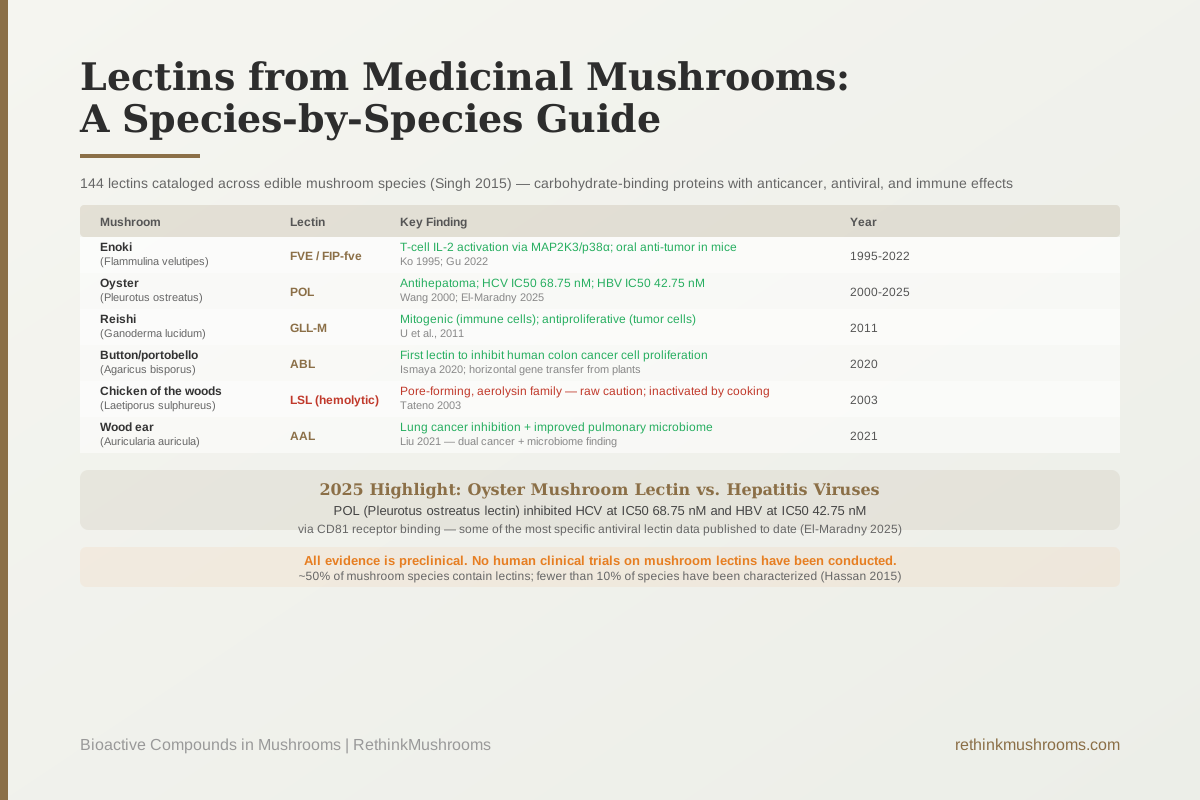
- Flammulina velutipes (enoki) contains FVE (also called FIP-fve), the most-studied mushroom lectin-class protein, isolated in 1995 and now understood to activate T-cell IL-2 production through the MAP2K3/p38α signaling pathway (Gu 2022)
- Pleurotus ostreatus (oyster mushroom) lectin (POL) showed antihepatoma and antisarcoma activity in 2000; a 2025 study found POL inhibits HCV and HBV at nanomolar concentrations through multi-step viral life cycle disruption
- Ganoderma lucidum (reishi) contains a lectin designated GLL-M isolated from mycelium with mitogenic activity on immune cells and antiproliferative activity against tumor cells, a finding largely absent from popular reishi content
- Agaricus bisporus (button, cremini, portobello) contains ABL, the first mushroom lectin shown to inhibit proliferation of human colon cancer cells in vitro
- Laetiporus sulphureus (chicken of the woods) contains hemolytic lectins structurally related to bacterial toxins. Laetiporus is the one notable exception in edible mushrooms where raw consumption can cause adverse reactions; cooking inactivates these lectins
What Are Mushroom Lectins? A Quick Definition
A lectin is any protein that binds carbohydrate structures with high specificity. Most cells display carbohydrate chains (glycans) on their surface, and lectins evolved to read those glycan patterns. In mushrooms, lectins play multiple ecological roles: they help fungi recognize and respond to their environment, defend against pathogens, and regulate developmental processes.
The following table summarizes the major medicinal mushroom species with characterized lectins.
| Mushroom | Common Name | Lectin Name | Key Activity | Evidence |
|---|---|---|---|---|
| Flammulina velutipes | Enoki | FVE / FIP-fve | Immune activation, T-cell IL-2, anti-tumor | Preclinical |
| Pleurotus ostreatus | Oyster | POL | Antihepatoma, antisarcoma, antiviral (HCV, HBV) | Preclinical |
| Ganoderma lucidum | Reishi | GLL-M | Mitogenic, antiproliferative | Preclinical |
| Agrocybe aegerita | Poplar mushroom | AAL | Antiphytovirus, anticancer (galectin-like fold) | Preclinical |
| Agaricus bisporus | Button/portobello | ABL | Colon cancer cell inhibition | Preclinical |
| Boletus edulis | Porcini | BEL | Beta-trefoil, antiproliferative | Preclinical |
| Laetiporus sulphureus | Chicken of the woods | LSL | Hemolytic (raw caution; inactivated by cooking) | Preclinical |
| Auricularia auricula | Wood ear | AAL | Lung cancer inhibition + pulmonary microbiome | Preclinical |
| Poria cocos | Fu ling | FIP-like | TLR4/TLR2 activation, Th1 immune shift | Preclinical |
| Antrodia camphorata | Bitter mushroom | FIP-like | TLR2/NF-κB, M1 macrophage polarization | Preclinical |
| Psathyrella velutina | Velvet shank | PVL | GlcNAc-specific, cancer diagnostic candidate | Preclinical |
| Tremella fuciformis | Snow fungus | Not fully named | Immunomodulatory; activity varies by strain | Preclinical |
All evidence is preclinical. No mushroom lectin has been tested in human clinical trials for any of these activities.
Flammulina velutipes (Enoki): Thirty Years of FIP Research
The most thoroughly researched mushroom lectin-class protein comes from a mushroom many people know as a salad topping: enoki.
Ko and colleagues isolated and fully sequenced FIP-fve (fungal immunomodulatory protein from Flammulina velutipes) in 1995.[2] This was the founding member of the fungal immunomodulatory protein (FIP) class, a lectin-adjacent protein family unique to fungi that has since been found in multiple species.
The subsequent research arc spans nearly three decades. Ko and colleagues subsequently cloned and expressed the FIP-fve gene, enabling mechanistic studies.[21] Wang and colleagues (2004) mapped the signaling mechanism: FIP-fve activates the p38 MAPK pathway in immune cells to stimulate interferon-gamma production, a cytokine that drives antiviral and antitumor immune responses.[3]
Tong and colleagues (2008) tested a practically important question: does FIP survive cooking and food processing?[4] FIP proteins from both enoki and reishi mushrooms retained immunomodulatory activity after cooking, freeze-drying, and other processing conditions. This finding distinguishes enoki FIP from some plant lectins that require avoidance of cooking; enoki FIP is heat-stable.
Chang and colleagues (2010) tested oral delivery in mice: oral administration of FVE (the enoki FIP protein) activated both innate and adaptive immunity and showed anti-tumor activity against liver cancer in animal models.[5] The oral delivery result matters because it suggests the protein survives the digestive process at least partially, reaching systemic immune circulation.
The most recent mechanistic advance came from Gu and colleagues (2022), who identified the precise pathway: FIP-fve activates the MAP2K3/p38α (MAPK14) signaling pathway in T cells, leading to enhanced IL-2 release.[6] IL-2 is the primary cytokine that drives T-cell proliferation and activation, a key amplifier of adaptive immune responses against both tumors and viruses.
The enoki lectin research is the most complete arc in this field: from isolation in 1995 to mechanism in 2022, with oral bioactivity, processing stability, and anti-tumor evidence accumulated along the way.
Pleurotus ostreatus (Oyster Mushroom): From Cancer to Hepatitis Viruses
The oyster mushroom lectin (POL, Pleurotus ostreatus lectin) has been studied for over two decades and recently produced the most striking antiviral data in the mushroom lectin literature.
Wang and colleagues (2000) isolated a novel lectin from Pleurotus ostreatus and found it showed potent antihepatoma and antisarcoma activity against human cancer cell lines in vitro, one of the first demonstrations of direct cancer-fighting activity from an oyster mushroom protein.[7]
Perduca and colleagues (2020) provided a high-resolution structural characterization of POL, revealing a unique beta-trefoil fold with specificity for complex glycans.[8] This structural detail matters because the glycan specificity of a lectin determines which cell surfaces it can bind; cancer cells display altered glycan patterns that POL's binding site matches.
The most recent data came in 2025. El-Maradny and colleagues published a detailed biochemical characterization of POL and its antiviral activity against hepatitis C virus (HCV) and hepatitis B virus (HBV).[9] The numbers are specific: POL inhibited HCV with an IC50 of 68.75 nM in a blocking assay and 52.13 nM in a neutralizing assay. Against HBV, IC50 was 42.75 nM in a treatment assay and 14.88 nM in a blocking assay. POL showed a 58.8% binding capacity to the CD81 receptor that HCV uses to enter cells.
To put the IC50 values in context: nanomolar-range IC50 values indicate potent activity. The 2025 POL data represents some of the most specific antiviral lectin characterization published to date and establishes oyster mushroom lectin as a candidate for antiviral drug development.
For more on how lectins bind to viral and cancer cell surfaces, see Mushroom Lectins: The Carbohydrate-Binding Proteins With Anticancer Potential.
Ganoderma lucidum (Reishi): The Lectin Most Consumers Don't Know About
Reishi (Ganoderma lucidum) is one of the world's most thoroughly marketed medicinal mushrooms, known primarily for its polysaccharides (beta-glucans) and triterpenes (ganoderic acids). Almost no consumer content mentions that reishi also contains a lectin.
U and colleagues (2011) isolated and characterized GLL-M, a novel lectin from Ganoderma lucidum mycelium.[10] GLL-M showed potent mitogenic activity on splenocytes (immune cells from the spleen) and antiproliferative activity against tumor cell lines. This was described as the first dedicated lectin study on reishi in that publication.
The GLL-M finding contributes an additional mechanism to reishi's bioactivity profile: alongside polysaccharide-mediated immune modulation and triterpene-driven anti-inflammatory effects, the lectin fraction contributes independent immune-stimulating and antiproliferative activity.
Whether GLL-M is present in supplement products depends on extraction method. Lectins are proteins, not polysaccharides; hot water extraction (the most common method for beta-glucan products) does not preferentially concentrate proteins. Mycelium-based products may contain more lectin protein than fruiting body extracts, though this specific question has not been well characterized for reishi.
Agrocybe aegerita, Agaricus bisporus, and Boletus edulis: Three More Characterized Species
Agrocybe aegerita (poplar mushroom or pioppino) contains a lectin designated AAL. Sun and colleagues (2003) first isolated this lectin and found it showed antiphytovirus activity alongside roles in mycelia differentiation, functions within the fungus itself, not just defense against external threats.[11] The structural basis for AAL's anticancer activity was established in separate work: AAL has a galectin-like fold with a carbohydrate-binding site configuration that induces apoptosis (programmed cell death) in tumor cells. The crystal structure provides the molecular blueprint explaining how binding to specific sugar patterns on cancer cells triggers cell death.
Agaricus bisporus (button mushroom, cremini, portobello) contains ABL, and its story includes an evolutionary surprise. Ismaya and colleagues (2020) reviewed the full ABL evidence base and noted that ABL was the first mushroom lectin shown to inhibit proliferation of cancerous human epithelial colon cells in vitro.[12] The structural curiosity: ABL's architecture is a tetramer with two distinct carbohydrate-binding sites that appears to have arisen through horizontal gene transfer from plants, making it evolutionarily unusual among fungal proteins. Despite looking structurally plant-like, it functions as a cancer-inhibiting protein rather than an irritating one.
Boletus edulis (porcini) contains BEL, characterized by Bovi and colleagues (2011) through crystal structure analysis.[13] The crystal structure revealed a novel beta-trefoil fold carbohydrate-binding architecture that confers antiproliferative activity against human cancer cell lines. Porcini mushrooms are widely consumed as food, and the BEL finding adds a documented anticancer protein to their bioactive profile, though porcini is rarely discussed in the functional mushroom literature.
Laetiporus sulphureus (Chicken of the Woods): A Safety Exception Worth Knowing
Most edible mushroom lectins appear to be safe and beneficial. Chicken of the woods is the exception.
Tateno and colleagues (2003) discovered that Laetiporus sulphureus contains hemolytic lectins with structural homology to bacterial toxins in the aerolysin family: pore-forming proteins that can lyse red blood cells.[14] This structural class has no parallel among common plant lectins and is unique to a subset of mushroom species.
The hemolytic activity explains the adverse reactions some people experience when eating raw or undercooked chicken of the woods. Cooking inactivates these proteins.
This finding illustrates two things. First, not all mushroom lectins are beneficial. Second, cooking is specifically relevant for L. sulphureus: heat denatures the hemolytic lectins and renders the mushroom safe. The same heat stability is NOT a universal feature of mushroom lectins: enoki FIP survives cooking (Tong 2008), while chicken-of-the-woods hemolytic lectins do not.
For a full comparison of mushroom lectins versus plant lectins from a structural biology standpoint, see Mushroom Lectins vs. Plant Lectins: Different Biology, Different Effects.
Emerging Research: Wood Ear, Poria, Antrodia, Psathyrella, and Tremella
Several additional species have produced lectin research that fills in the species map.
Auricularia auricula (wood ear mushroom): Liu and colleagues (2021) characterized a novel lectin from wood ear that inhibited lung cancer cell proliferation in vitro and, in the same study, improved pulmonary microbiome diversity.[15] The dual lung cancer and microbiome finding is unusual in lectin research. Most studies measure one outcome or the other. Wood ear is commonly consumed as a culinary ingredient in East Asian cuisines, and the lectin research adds biological context to why epidemiological data consistently includes wood ear in lists of health-associated mushroom consumption patterns.
Poria cocos (fu ling): Two studies characterize the Poria lectin-like proteins. Chang and colleagues (2009) identified a FIP-like immunomodulatory protein in Poria cocos that activates macrophages via TLR4 (Toll-like receptor 4, the same receptor that responds to bacterial signals), training innate immunity.[16] Lu and colleagues (2014) found that a lectin-like protein from Poria cocos shifted the immune response from Th2 (antibody-mediated, relevant to allergy) toward Th1 (cell-mediated, relevant to anti-tumor immunity) and reduced IgE in an allergy mouse model.[17] The Th1-Th2 rebalancing effect is the same direction documented for the Tanaka 2016 Pleurotus RCT (Th1 enhancement), suggesting convergent immune mechanisms across Pleurotus and Poria lectins.
Antrodia camphorata (bitter mushroom): Sheu and colleagues (2009) identified a lectin-like immunomodulatory protein from Antrodia camphorata that activates macrophages through TLR2/NF-κB signaling and polarizes them toward an anti-tumor M1 phenotype.[18] Antrodia camphorata is primarily researched for its hepatoprotective effects from triterpenoids; the lectin finding adds an immune mechanism that operates through a completely separate molecular pathway.
Psathyrella velutina: Machon and colleagues (2020) characterized PVL, a lectin with a novel seven-bladed beta-propeller fold and high specificity for N-acetylglucosamine (GlcNAc).[19] The significance: GlcNAc is overexpressed on cancer cell surfaces. PVL's high specificity for this sugar makes it a candidate cancer diagnostic tool rather than just a therapeutic candidate. It can be used to identify and visualize cancer cell surface patterns in laboratory settings.
Tremella fuciformis (snow fungus): Han and colleagues (2015) found that different strains of Tremella fuciformis show significantly different immunomodulatory and anticancer potencies.[20] The strain dependence finding applies to lectins and other bioactive proteins: within a single species, the lectin content and activity varies based on genetics and growing conditions. This has practical implications for supplement standardization.
What Links These Lectins and What Doesn't
The lectins documented across these species share a common theme: carbohydrate-binding specificity that targets sugar structures on cell surfaces. The mechanisms through which binding leads to biological outcomes vary substantially.
FVE from enoki activates T cells through MAP kinase signaling to produce IL-2. POL from oyster mushroom binds viral surface glycoproteins to block viral entry. GLL-M from reishi stimulates proliferation in immune cells (mitogenic activity). ABL from button mushroom inhibits colon cancer cell growth through a mechanism tied to its unusual dual binding-site architecture. The hemolytic lectins in chicken of the woods form pores in cell membranes.
These are not variations on one mechanism; they are different proteins doing structurally and functionally distinct things, grouped together by the property of carbohydrate binding.
The consistent finding across the evidence base is that roughly half of all mushroom species contain proteins with this property, and these proteins show biological activities that are almost entirely absent from mainstream discussions of why medicinal mushrooms benefit health. The beta-glucan field gets the research attention; the lectin field, with 144+ characterized proteins across edible species, is substantially underrepresented in consumer and clinical discussions.
The Bottom Line
Mushroom lectins represent an underappreciated class of bioactive proteins found in roughly half of all mushroom species. The 144 lectins cataloged from edible species (Singh 2015) include: FVE from enoki (FIP class, the most-studied, activates T-cell IL-2 via MAP2K3/p38α); POL from oyster mushroom (antihepatoma, antisarcoma, and 2025 nanomolar antiviral activity against HCV/HBV); GLL-M from reishi (mitogenic and antiproliferative); ABL from button mushroom (colon cancer cell inhibition); BEL from porcini (antiproliferative via beta-trefoil fold); and hemolytic lectins from chicken of the woods (the exception requiring thorough cooking). All evidence is preclinical.
Frequently Asked Questions
Sources & References
- 1RTHM-00643·Singh, Senjam Sunil et al. (2014). “Lectins from edible mushrooms..” Molecules (Basel.Study breakdown →PubMed →↩
- 2RTHM-00041·Ko, J L et al. (1995). “A new fungal immunomodulatory protein, FIP-fve isolated from the edible mushroom, Flammulina velutipes and its complete amino acid sequence..” European journal of biochemistry.Study breakdown →PubMed →↩
- 3RTHM-00146·Wang, Po-Hui et al. (2004). “Fungal immunomodulatory protein from Flammulina velutipes induces interferon-gamma production through p38 mitogen-activated protein kinase signaling pathway..” Journal of agricultural and food chemistry.Study breakdown →PubMed →↩
- 4RTHM-00278·Tong, Man-Hua et al. (2008). “High processing tolerances of immunomodulatory proteins in Enoki and Reishi mushrooms..” Journal of agricultural and food chemistry.Study breakdown →PubMed →↩
- 5RTHM-00328·Chang, Hui-Hsin et al. (2010). “Oral administration of an Enoki mushroom protein FVE activates innate and adaptive immunity and induces anti-tumor activity against murine hepatocellular carcinoma..” International immunopharmacology.Study breakdown →PubMed →↩
- 6RTHM-01528·Gu, Kefei et al. (2022). “FIP-fve Stimulates Cell Proliferation and Enhances IL-2 Release by Activating MAP2K3/p38α (MAPK14) Signaling Pathway in Jurkat E6-1 Cells..” Frontiers in nutrition.Study breakdown →PubMed →↩
- 7RTHM-00074·Wang, H et al. (2000). “A new lectin with highly potent antihepatoma and antisarcoma activities from the oyster mushroom Pleurotus ostreatus..” Biochemical and biophysical research communications.Study breakdown →PubMed →↩
- 8RTHM-01275·Perduca, Massimiliano et al. (2020). “Structure and properties of the oyster mushroom (Pleurotus ostreatus) lectin..” Glycobiology.Study breakdown →PubMed →↩
- 9RTHM-02079·El-Maradny, Yousra A et al. (2025). “Biochemical characterization of a novel purified lectin extracted from Pleurotus ostreatus mushroom for its antiviral activity..” Scientific reports.Study breakdown →PubMed →↩
- 10RTHM-00439·U Girjal, Vinay et al. (2011). “Ganoderma lucidum: a source for novel bioactive lectin..” Protein and peptide letters.Study breakdown →PubMed →↩
- 11RTHM-00122·Sun, Hui et al. (2003). “A lectin with mycelia differentiation and antiphytovirus activities from the edible mushroom Agrocybe aegerita..” Journal of biochemistry and molecular biology.Study breakdown →PubMed →↩
- 12RTHM-01207·Ismaya, Wangsa Tirta et al. (2020). “Lectins from the Edible Mushroom Agaricus bisporus and Their Therapeutic Potentials..” Molecules (Basel.Study breakdown →PubMed →↩
- 13RTHM-00381·Bovi, Michele et al. (2011). “Structure of a lectin with antitumoral properties in king bolete (Boletus edulis) mushrooms..” Glycobiology.Study breakdown →PubMed →↩
- 14RTHM-00063·Tateno, Hiroaki et al. (2003). “Molecular cloning, expression, and characterization of novel hemolytic lectins from the mushroom Laetiporus sulphureus, which show homology to bacterial toxins..” The Journal of biological chemistry.Study breakdown →PubMed →↩
- 15RTHM-00706·Liu, ZhenDong et al. (2021). “A New Lectin from Auricularia auricula Inhibited the Proliferation of Lung Cancer Cells and Improved Pulmonary Flora..” BioMed research international.Study breakdown →PubMed →↩
- 16RTHM-00288·Chang, Hui-Hsin et al. (2009). “A novel immunomodulatory protein from Poria cocos induces Toll-like receptor 4-dependent activation within mouse peritoneal macrophages..” Journal of agricultural and food chemistry.Study breakdown →PubMed →↩
- 17RTHM-00622·Lu, Ya-Ting et al. (2014). “Molecular cloning of a Poria cocos protein that activates Th1 immune response and allays Th2 cytokine and IgE production in a murine atopic dermatitis model..” Journal of agricultural and food chemistry.Study breakdown →PubMed →↩
- 18RTHM-00170·Sheu, Fuu et al. (2009). “Purification, cloning, and functional characterization of a novel immunomodulatory protein from Antrodia camphorata (bitter mushroom) that exhibits TLR2-dependent NF-κB activation and M1 polarization within murine macrophages..” Journal of agricultural and food chemistry.Study breakdown →PubMed →↩
- 19RTHM-01248·Machon, Oriane et al. (2020). “Expression, Purification, and Applications of the Recombinant Lectin PVL from Psathyrella velutina Specific for Terminal N-Acetyl-Glucosamine..” Methods in molecular biology (Clifton.Study breakdown →PubMed →↩
- 20RTHM-00688·Han, Chien-Kuo et al. (2015). “Comparison of Immunomodulatory and Anticancer Activities in Different Strains of Tremella fuciformis Berk..” The American journal of Chinese medicine.Study breakdown →PubMed →↩
- 21RTHM-00051·Ko, J L et al. (1997). “Molecular cloning and expression of a fungal immunomodulatory protein, FIP-fve, from Flammulina velutipes..” Journal of the Formosan Medical Association = Taiwan yi zhi.Study breakdown →PubMed →↩