Microdosing & Work Performance
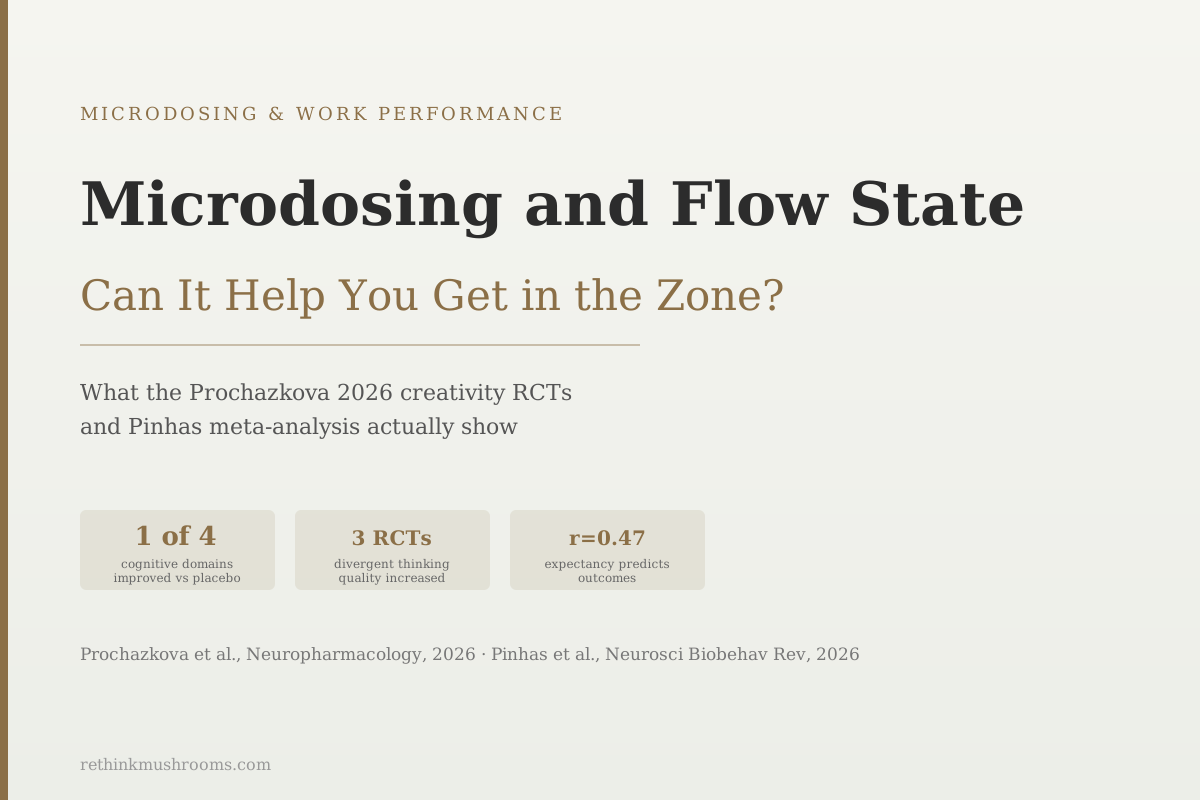
1 of 4 cognitive domains
A 2026 meta-analysis found a small benefit in only one of four cognitive domains tested: divergent thinking. Attention, convergent reasoning, and executive function showed no measurable effect over placebo.
Pinhas et al., Neuroscience & Biobehavioral Reviews, 2026
52% increase
in a synaptic connectivity marker in pig prefrontal cortex after a single psilocybin dose
3 RCTs
found divergent thinking quality improved under psilocybin microdosing vs placebo
r=0.47
correlation between expectancy and microdosing outcomes in Kaertner 2021
Pinhas et al., Neuroscience & Biobehavioral Reviews, 2026
 View as image ↗
The short answer is: one component of flow state has controlled research support. The complete experience people describe as "getting in the zone" does not.
That distinction matters, because the people who microdose for flow state (engineers, artists, writers, athletes) are often reporting something real and meaningful. The research problem is that what they describe as flow is hard to measure precisely, and the studies that do measure specific cognitive processes find more modest effects than the subjective experience suggests.
Here is what the evidence actually shows, from the most recent controlled trials.
For the bigger picture on what microdosing is and the range of effects people seek, see what is microdosing psilocybin.
Key Takeaways
- A 2026 meta-analysis of controlled studies found a small improvement in divergent thinking (the cognitive process of generating multiple original ideas) and no significant effects on attention, convergent reasoning, or executive function
- Three double-blind RCTs found that psilocybin microdosing increased the proportion of original responses in divergent thinking tasks compared to placebo
- Standard cognitive testing (CANTAB battery) showed no measurable difference between microdose and placebo groups in two RCTs, even when participants subjectively reported improved mood and creativity
- High expectancy of improvement predicted microdosing outcomes as strongly as dose, substance, or frequency in a 2021 controlled study; expectation drives much of the experience
- The self-blinding citizen science RCT found no significant difference between microdose and placebo on wellbeing, mindfulness, or attention measures
- A 2024 systematic review found microdose-specific evidence on cognitive flexibility "preliminary and inconsistent"; post-acute full-dose evidence is stronger
What Flow State Is, and Why Microdosing Proponents Think It Helps
Flow state, as described by psychologist Mihaly Csikszentmihalyi, is a mental condition of full absorption in a challenging task: effortless attention, loss of self-consciousness, distorted sense of time, and performance at the edge of one's ability. It is not simply focus. It is a specific configuration of brain activity that involves the suspension of the inner critic, heightened sensory engagement, and an unusual degree of integration between different mental processes.
The reason microdosers report flow-like experiences is intuitive: anything that quiets self-referential thinking (the "am I doing this right?" inner voice) and enhances creative ideation could plausibly induce or deepen flow. Psilocybin at full doses is well-documented to suppress the brain network responsible for self-referential thinking, the default mode network, and to increase communication between brain regions that normally don't talk to each other.
The question is whether doses too small to produce noticeable perceptual effects still produce enough of this brain state shift to meaningfully affect flow. That is where the controlled research gets interesting, and where the honest account of microdosing and flow state has to start.
For the connection between microdosing and creativity more broadly, see Silicon Valley Microdosing: Productivity Claims vs. Controlled Research.
The Brain Biology: Why Psilocybin Might Affect Flow-Related Brain States
Raval et al. (2021) measured what happens to brain structure after a single psilocybin dose in pigs.[1] Within 24 hours, a synaptic connectivity marker called synaptophysin increased by 52% in the prefrontal cortex. The prefrontal cortex handles executive function, working memory, and the kind of flexible thinking that underlies creative performance. At the same time, 5-HT2A receptor density (the receptor type that produces hallucinations at full doses) decreased by 19%.
The synaptophysin finding suggests that a single dose increases the density of synaptic connections in a brain region central to both focused performance and creative thinking. The 5-HT2A decrease suggests that the brain adapts after exposure, reducing its own sensitivity to the compound.
What this does not tell us is whether sub-perceptual doses produce the same effect. The dose used in this pig study was not equivalent to a human microdose. It was a pharmacologically active amount. Whether the smaller doses used in microdosing produce a proportionally smaller version of the same structural shift, or whether there is a threshold below which these changes do not occur, is unresolved.
The broader hypothesis is that psilocybin increases what researchers call "brain entropy" (the degree to which the brain explores flexible, unpredictable states rather than locked-in patterns). More entropic brain states are associated with creative flexibility and the kind of non-habitual thinking that flow requires. Whether microdoses induce meaningfully more brain entropy than a baseline alert state is a question current imaging technology has not clearly answered at sub-perceptual doses.
How Microdosing Might Induce Flow State: Three Proposed Mechanisms
Here is how the flow hypothesis is typically framed by those who believe it:
1. Default mode network suppression. The DMN is the brain network most active during self-referential thinking: rumination, self-criticism, social worry. At full doses, psilocybin reliably suppresses DMN activity. If microdoses partially suppress the DMN, the inner critic quiets, and absorption in a task becomes easier. This matches the subjective reports of reduced self-consciousness and "getting out of your own head" that microdosers describe.
2. Increased cross-network connectivity. Flow state involves unusual communication between brain networks that are normally segregated. Full-dose psilocybin reliably increases this connectivity. The argument for microdosing is that partial connectivity enhancement could facilitate the network integration that flow requires.
3. Facilitation of divergent thinking. Divergent thinking is the process of generating multiple possible responses to a prompt. It is distinct from convergent thinking (finding the single correct answer). One component of flow state is the sense that ideas come freely without forced effort, which maps onto the kind of divergent ideation that controlled studies have measured. This is the mechanism with the most direct controlled evidence.
Prochazkova 2026: The Best Controlled Evidence We Have
The most rigorous evidence currently available for microdosing and creative cognition comes from Prochazkova et al., who pooled data from three double-blind placebo-controlled longitudinal trials of psilocybin microdosing.[2]
The specific finding: microdosing increased the proportion of original responses in a divergent thinking task. Participants came up with more unusual, non-typical uses for objects. The quality of divergent ideation improved, not the quantity.
Crucially, convergent thinking (the Remote Associates Test, which requires finding a single connecting concept between three unrelated words) was not affected. This is a clean distinction: the kind of thinking that involves wide, associative ideation improved. The kind of thinking that requires logic and convergence to a single answer did not.
This maps onto one component of flow state, specifically the generative, non-linear creative output that flow can produce. What it does not capture is the other components: the sustained absorption, the loss of time perception, the effortless attention, the emotional engagement. Those were not the outcome measures, and the studies are not designed to test them.
The finding is real. Three controlled trials is meaningful evidence. The claim that microdosing specifically enhances divergent thinking quality, in a controlled research setting, is now supported. The broader claim that microdosing reliably produces full flow state is a different claim, and it lacks equivalent support.
The Pinhas 2026 Meta-Analysis: The Most Authoritative Summary
Pinhas et al. published a systematic review and meta-analysis of controlled microdosing studies in 2026 in Neuroscience and Biobehavioral Reviews.[3] This is the most comprehensive synthesis of controlled evidence currently available.
The result was a small effect favoring microdosing on divergent thinking only. No significant effects emerged for convergent thinking, sustained attention, or executive function versus placebo across the controlled studies reviewed.
The domain-specificity of the finding is important. People who use microdosing for flow state often describe a package of cognitive changes: sharper focus, faster processing, more fluid thinking, better access to ideas. The meta-analysis suggests that only one component of that package, creative ideation, has consistent support in controlled research. The focused attention component does not.
This does not mean microdosers are wrong that they feel more focused. It means that standard cognitive testing cannot detect a change in measurable attention performance. Whether that reflects a real absence of effect, a limitation of the tests used, or a genuinely subjective phenomenon that is unmeasured is an open methodological question.
The Feeling vs. the Test: When People Report Focus but Tests Show Nothing
Two separate findings from Prochazkova et al. make this gap concrete.
In two RCTs measuring both subjective experience and objective cognitive performance, participants who microdosed reported improvements in wellbeing, mood, and creative feeling.[4] When the same participants took the CANTAB cognitive assessment battery, a standardized test measuring processing speed, attention, working memory, and executive function, there was no measurable difference from placebo.
The Szigeti et al. self-blinding citizen science trial, which tested 191 participants using a novel design where participants could blind themselves to whether they were taking microdose or placebo, found no significant difference between groups on wellbeing, mindfulness, or paranoia measures.[5] Participants in the microdose condition had higher expectations of improvement, and those expectations correlated with the outcomes.
Together, these studies describe a situation where the subjective experience of flow-like mental states during microdosing is real and consistent. But standard cognitive tests cannot verify that the underlying processes are measurably different from placebo.
For a deeper analysis of the self-blinding study and what it proves about placebo mechanisms, see Is Microdosing Just Placebo? The Self-Blinding Studies.
How Much of the Flow Experience Is the Expectation of Flow?
Kaertner et al. measured the role of expectancy in a controlled study of 191 participants.[6] The finding: high baseline expectancy (how much improvement participants expected before taking anything) fully mediated improvements in depression and anxiety outcomes. The correlation was r=0.47, which is substantial. Expectancy predicted response more strongly than dose, frequency, or substance type.
This does not mean the experience is fake. Expectancy-driven effects are real effects. They involve actual changes in brain chemistry, attention, and motivation. A person who expects to feel creative and focused may genuinely allocate attention differently, take creative risks more readily, and persist longer on tasks. These are measurable behavioral changes, even if they do not require psilocybin's pharmacology to produce them.
The implication for flow state is that the ritual of microdosing, the intention-setting, the belief that the compound will clear mental clutter, may contribute as much to the flow-facilitating experience as the pharmacological effects of the dose. Whether that matters depends on what you are trying to understand. If you want to know whether microdosing reliably induces flow state for you personally, the pharmacology-versus-expectancy question may be irrelevant. If you want to know whether psilocybin specifically causes flow, it is the central question.
For a detailed look at how expectancy shapes the microdosing experience, see Expectancy Effects in Microdosing: How Belief Shapes Experience.
What Polito 2024 Found: Reviewing Nine Controlled Studies
Polito and Liknaitzky conducted a rapid review of nine controlled LSD and psilocybin microdosing studies in 2024.[7] Their conclusion was careful: it is not yet possible to determine whether microdosing is a placebo.
No study in their review consistently showed benefits beyond placebo for healthy individuals. Some studies showed small positive effects on sustained attention and divergent thinking in specific conditions. The pattern was inconsistent enough across protocols, doses, and populations that a clear verdict could not be reached.
This review predates the Prochazkova 2026 creativity RCTs by two years. The 2026 data from three trials adds meaningful evidence to the divergent thinking question that Polito and Liknaitzky did not have access to. For everything beyond divergent thinking, the Polito 2024 conclusion remains the honest summary: unproven at the level of controlled evidence.
What Meshkat 2024 Found About Post-Acute Cognitive Flexibility
Meshkat et al. published a systematic review of psilocybin's effects on cognitive function in 2024, covering 30 studies.[8] For full-dose psilocybin, the pattern was clear: acute impairment of episodic memory and executive function, followed by improvements in cognitive flexibility and creativity in the days to weeks after a session.
For microdose-specific evidence, the review's conclusion was "preliminary and inconsistent." The gap between the rich post-acute neuroplasticity evidence from full-dose studies and the more modest microdose-specific evidence reflects the field's fundamental challenge: full-dose research has had decades of momentum; controlled microdose research is only a few years old.
The post-acute full-dose data is relevant context for the flow hypothesis because it demonstrates that psilocybin's cognitive effects include meaningful improvements in exactly the cognitive processes that overlap with flow: flexibility, creative ideation, reduced cognitive rigidity. The question for microdosing is whether sub-perceptual doses activate the same mechanisms without requiring the full-dose experience to precede them.
The Honest Verdict on Microdosing and Flow State
Flow state is a complex cognitive and emotional phenomenon. The research measures components of it, not the whole.
What has controlled support: divergent thinking quality improves under psilocybin microdosing versus placebo in three RCTs, with a meta-analysis confirming a small but real effect. This component (the free generation of original ideas) is one element of creative flow.
What does not have controlled support: sustained attention improvements, convergent reasoning, executive function, time distortion, or the sense of effortless absorption that characterizes full flow. Standard cognitive testing cannot distinguish microdose from placebo on these measures.
What is methodologically unresolved: no controlled study has used a validated flow state measure (such as the Flow State Scale or Experience Sampling during creative tasks) as a primary outcome. The flow state hypothesis for microdosing has not been directly tested. The studies use cognitive proxies, and the proxy for divergent thinking shows a small real effect.
For people who report genuine flow-like experiences during microdosing, the most honest interpretation of the evidence is: you may be experiencing a real but modest divergent thinking effect, amplified by expectancy and ritual, in a form that your subjective experience of creativity interprets as flow.
The Bottom Line
The most controlled evidence on microdosing and flow-related cognition comes from three RCTs showing a real improvement in divergent thinking quality, confirmed by a 2026 meta-analysis. This is the one component of flow state with controlled support. Standard cognitive testing found no measurable difference from placebo on attention, executive function, or convergent reasoning. Expectancy predicted outcomes as strongly as pharmacological variables in at least one controlled study. No study has directly measured flow state as an outcome, and the broader claim that microdosing reliably induces flow remains unproven at the level of controlled research.
Frequently Asked Questions
Sources & References
- 1RTHM-00714·Raval, Nakul Ravi et al. (2021). “A Single Dose of Psilocybin Increases Synaptic Density and Decreases 5-HT2A Receptor Density in the Pig Brain..” International journal of molecular sciences.Study breakdown →PubMed →↩
- 2RTHM-00962·Prochazkova, Luisa et al. (2026). “Microdosing psilocybin and its effect on creativity: Lessons learned from three double-blind placebo controlled longitudinal trials..” Neuropharmacology.Study breakdown →PubMed →↩
- 3RTHM-00961·Pinhas, Netta et al. (2026). “Effects of psychedelic microdosing on cognitive functions: A systematic review and meta-analysis..” Neuroscience and biobehavioral reviews.Study breakdown →PubMed →↩
- 4RTHM-02243·Prochazkova, Luisa et al. (2026). “Cognitive and subjective effects of psilocybin microdosing: Results from two double-blind placebo-controlled longitudinal trials..” Neuropharmacology.Study breakdown →PubMed →↩
- 5RTHM-01441·Szigeti, Balázs et al. (2021). “Self-blinding citizen science to explore psychedelic microdosing..” eLife.Study breakdown →PubMed →↩
- 6RTHM-01371·Kaertner, L S et al. (2021). “Positive expectations predict improved mental-health outcomes linked to psychedelic microdosing..” Scientific reports.Study breakdown →PubMed →↩
- 7RTHM-00900·Polito, Vince et al. (2024). “Is microdosing a placebo? A rapid review of low-dose LSD and psilocybin research..” Journal of psychopharmacology (Oxford.Study breakdown →PubMed →↩
- 8RTHM-00894·Meshkat, Shakila et al. (2024). “Impact of psilocybin on cognitive function: A systematic review..” Psychiatry and clinical neurosciences.Study breakdown →PubMed →↩