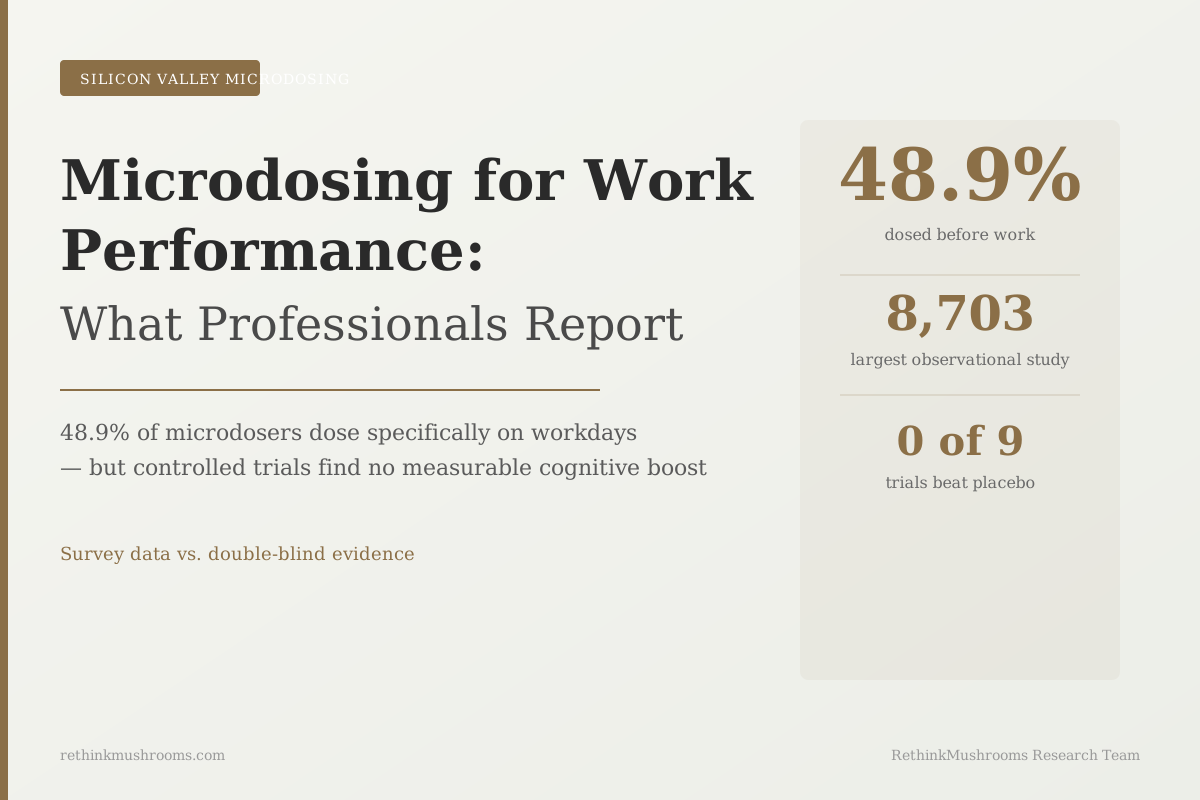
Silicon Valley Microdosing
48.9%
In a survey of 190 active microdosers, nearly half reported dosing specifically on workdays, making professional performance the most common stated context for use.
Hutten et al., Int'l Journal of Neuropsychopharmacology, 2019
36.6%
cite work performance as their primary motivation for microdosing
8,703
participants in the largest observational microdosing study to date
0 of 9
controlled trials consistently showed cognitive benefits beyond placebo
Hutten et al., Int'l Journal of Neuropsychopharmacology, 2019
 View as image ↗
Nearly half of working microdosers say they dose specifically before going to the office. That number (48.9% in Hutten and colleagues' 2019 survey of 190 active microdosers) captures something important about who is actually using psilocybin in sub-threshold amounts and why.[1] This is not a niche spiritual practice for most of its practitioners. For a substantial share of users, microdosing for work performance is the explicit goal.
The science's answer to whether that goal is being achieved is more nuanced than a simple yes or no. Professionals consistently report improvements in mood, focus, and subjective capability. Controlled trials that measure those same functions objectively find something different: people feel better, but standardized cognitive tests show no measurable advantage over placebo. Understanding that specific gap is the most useful thing this article can offer.
For a broader introduction to what microdosing is, how it's practiced, and the protocols most users follow, see our complete guide to psilocybin microdosing.
Key Takeaways
- In Hutten's 2019 survey of 190 active microdosers, 48.9% dosed specifically on workdays and 36.6% cited performance enhancement as their primary motivation
- Anderson's 2019 qualitative study of 278 microdosers found improved mood (26.6%) and improved focus (14.8%) were the most commonly reported benefits
- Rootman's 2021 study of 8,703 participants found microdosers reported significantly lower anxiety (odds ratio 0.66) and depression (odds ratio 0.54) versus non-microdosers
- Prochazkova's 2026 double-blind trials found people on psilocybin microdosing reported feeling better, but a standardized cognitive test battery (CANTAB) showed no measurable difference from placebo
- Pinhas' 2026 meta-analysis found a small effect on divergent thinking (generating original ideas) only; attention, convergent thinking, and executive function showed no significant advantage over placebo
- Kaertner's 2021 study found that a person's expectation before starting microdosing predicted their reported improvements more strongly than dose amount, frequency, or substance type (r=0.47)
Nearly Half of Working Microdosers Dose Before Going to the Office
The profile of a person who microdoses for work, based on survey data, looks like this: someone in a computer or office role who selects specific workdays to take a sub-threshold amount of psilocybin, motivated primarily by what they hope it does for their output.
In Hutten and colleagues' 2019 study of 190 active microdosers, 36.6% named performance enhancement as their primary motive.[1] The largest single occupation group was students at 31.8%, followed by computer and office workers at 29.9%. When asked about dosing context, 48.9% of participants reported microdosing on workdays specifically. This detail matters: it reflects intent, not just casual use.
What those users reported experiencing is consistent with their motivation. In Anderson and colleagues' 2019 qualitative study of 278 microdosers, the two most commonly described benefits were improved mood (reported by 26.6% of participants) and improved focus (14.8%).[2] Focus ranked below mood in raw frequency, but appearing in the top few categories among a self-selected group that came from across occupational backgrounds is notable given the breadth of the sample.
Fadiman and Korb's 2019 exploration of self-reported microdosing outcomes found similar patterns: most respondents described improved focus and mood elevation, and 87% reported intending to continue microdosing.[3] That continuation rate is high for a practice that requires logistical coordination, operates in legal grey areas, and produces no dramatic perceptual effects by definition.
Anderson's 2019 cohort study of 909 participants added a nuance that often disappears from the positive-framing narrative: microdosers scored higher on openness to experience (effect size d=0.32) and self-reported creativity compared to non-microdosers, but they also scored higher on neuroticism.[4] This matters when reading the "improved mood" self-reports. The population that chooses to microdose appears to start from a higher anxiety baseline. A reduction from that elevated baseline looks different from a baseline improvement in a lower-anxiety group.
For context on the protocols most professional microdosers use, see our article on the Fadiman Protocol, the original microdosing schedule that shaped how most tech workers and knowledge professionals approach dosing days.
The 8,703-Person Survey: What Working Microdosers Said Changed
Rootman and colleagues' 2021 study enrolled 8,703 participants, making it the largest observational dataset on microdosing available at the time of publication.[5] Of those, 4,050 identified as active microdosers. Compared to non-microdosers, the microdosing group reported significantly lower anxiety (odds ratio 0.66) and lower depression (odds ratio 0.54). Both differences reached statistical significance in the analysis.
An odds ratio of 0.66 for anxiety means the microdosing group was roughly one-third less likely to report clinically meaningful anxiety compared to the non-microdosing group. That is a substantial difference.
The study's limitation, which Rootman's team acknowledged directly, is that it cannot separate the effect of the drug from the characteristics of the people who choose to use it. People who microdose may already be more attentive to their mental states, more likely to practice other wellness behaviors, or more motivated to improve their mood than the average person who doesn't microdose. Observational data cannot resolve that confound.
Rootman and colleagues followed up in 2022 with a more controlled design, tracking 953 psilocybin microdosers against matched controls who did not microdose, over one month.[6] Microdosers showed greater improvements in mood (Cohen's d=0.34) and anxiety (d=0.18) compared to the control group. In the older adult subset, microdosers also showed improved psychomotor performance. Psychomotor performance captures how quickly and accurately the body executes physical movements.
A Cohen's d of 0.34 represents a small-to-medium effect by research convention standards. It is not negligible, but it is not transformative. The 2022 study still lacks a placebo control: participants knew what they were taking. The expectancy effects documented in later research suggest this is a meaningful limitation. The knowledge that you are microdosing may be generating some portion of the improvement that the study attributed to the drug.
The Disconnect: You Feel More Capable. The Tests Say Otherwise.
The most important single finding for understanding microdosing and work performance comes from Prochazkova and colleagues' 2026 randomized controlled trials.[7]
Prochazkova's team ran two double-blind, placebo-controlled studies in which participants microdosed psilocybin over four weeks on a controlled schedule. Neither group knew with certainty whether they were receiving the active drug or placebo.
The subjective results were positive. People on psilocybin microdosing reported improved wellbeing, better mood, and a sense of enhanced creativity compared to the placebo group. Participants described feeling meaningfully better.
The objective results told a different story. When researchers administered the CANTAB battery, a standardized computerized test used in clinical drug trials to assess memory, sustained attention, and executive function, scores for the microdosing group were not significantly different from the placebo group.
The CANTAB battery is not a casual questionnaire. It is the same tool used to detect cognitive effects of antidepressants, stimulants, and psychiatric medications in controlled pharmaceutical research. If psilocybin microdosing at the tested doses improved memory, sustained attention, or executive function in any measurable way, this tool would be expected to detect it.
It did not.
This finding doesn't make the positive subjective experience fake or clinically irrelevant. A person who feels more capable and in better mood at work may still perform better in ways that tests don't capture. But it creates a specific problem for interpreting the earlier observational data: people may genuinely feel more focused and productive without those feelings corresponding to measurable changes in cognitive performance. Those are different things, and conflating them has been a persistent issue in public discussions of microdosing.
Meshkat and colleagues' 2024 systematic review of 30 studies on psilocybin and cognition provides useful context for why this gap exists.[8] Full-dose psilocybin reliably impairs episodic memory and executive function in the hours after dosing. That is a well-established finding. In the days following a full-dose session, some creativity and cognitive flexibility improvements have been observed. For the microdose regime specifically, Meshkat's team characterized the evidence as "preliminary and inconsistent." The doses used for professional microdosing may be too small to generate the neurological changes needed to shift objective cognitive performance, even if they are large enough to shift mood.
For a detailed look at the placebo-controlled studies that have most directly tested this question, see Is Microdosing Just a Placebo? The Self-Blinding Studies.
For a claim-by-claim breakdown of each professional performance category, see Silicon Valley Microdosing: Productivity Claims vs. Controlled Research.
The One Work Performance Skill With Real Controlled Support: Generating Original Ideas
The most current synthesis of controlled microdosing research is Pinhas and colleagues' 2026 meta-analysis of studies measuring cognitive functions during microdosing protocols.[9]
The meta-analysis identified one domain where controlled evidence supports a real effect: divergent thinking. Divergent thinking is the part of the creative process that generates multiple possible answers, novel combinations, or original responses to an open-ended prompt. It is what happens during productive brainstorming when ideas appear that you wouldn't have predicted at the outset.
The effect was small but present in the controlled data. No other cognitive domain showed a statistically significant advantage over placebo. Convergent thinking (finding the single correct or best answer to a problem) was unaffected. Sustained attention was unaffected. Executive function measures were unaffected.
This matters for professional performance because most knowledge work draws on multiple types of thinking simultaneously. Writing code involves logical precision and syntax correctness. Designing a product involves generating and combining possibilities. Research involves both. If microdosing shifts divergent thinking while leaving convergent thinking and attention unchanged, the performance implications are narrow and job-dependent rather than universal.
The practical picture from the controlled data: work that is primarily open-ended idea generation is where the pharmacological signal is most plausible. Work that requires precise attention, logical execution, or working memory retrieval has no measurable controlled support at this point.
For a deeper look at how divergent thinking connects to the experience of creative flow, and what the brain science underlying that connection looks like, see our article on microdosing and flow state.
Why the Feel-Good Effect Is Real Even When Performance Tests Show No Change
The observational studies consistently show that people who microdose for work feel better about their mental performance and their mood. Those feelings appear to be genuine. But the explanation for them is more complicated than the drug acting directly on cognitive function.
Kaertner and colleagues' 2021 study enrolled 191 people who were about to begin microdosing and measured their expectations before they started: how much they believed microdosing would help them.[10] Higher baseline expectation fully accounted for the improvements in depression and anxiety that participants subsequently reported (r=0.47, p<0.001). Expectation predicted outcomes more strongly than dose amount, dosing frequency, or the specific substance being used.
A correlation of 0.47 between expectation and outcome is not a small number. It means that knowing how optimistic a person was before starting microdosing accounted for roughly a quarter of the variance in how much benefit they reported afterward. The drug's pharmacology, dose, and schedule together added relatively little predictive power on top of that.
What the Kaertner data does not do is dismiss the real experience of improvement. Expectancy effects are not purely psychological in a trivial sense: they produce measurable changes in brain activity, stress hormones, and immune function. A person who feels more focused and capable because they expect to be is genuinely experiencing a changed mental state. The mechanism is expectancy-mediated rather than pharmacologically direct.
This mechanism likely explains the pattern in Prochazkova's controlled trials: people felt better during daily life (real, partly expectancy-mediated, possibly also from low-level mood pharmacology) while their performance on standardized cognitive tasks didn't shift (suggesting the drug was not directly improving the cognitive machinery the tests measure).
To understand the expectancy mechanism in more depth, including how the Kaertner data fits into a larger picture of psychedelic response prediction, see our article on expectancy effects in microdosing.
What 9 Controlled Studies Found, and What Remains Unsettled
Polito and Liknaitzky's 2024 rapid review looked across 9 controlled studies of low-dose LSD and psilocybin, the most rigorous evidence base available on microdosing at that point.[11]
None of those 9 studies consistently showed benefits beyond placebo for healthy individuals. A few found small positive effects on sustained attention or divergent thinking in individual trials, but those findings did not replicate across the literature. The reviewers' honest conclusion: "It is not yet possible to determine whether microdosing is a placebo."
That verdict is not the same as saying microdosing does nothing. It means the research available through 2024 could not separate pharmacological drug effects from expectancy effects. Without that separation, the question of whether the drug itself is responsible for the reported benefits remained genuinely open.
The Pinhas 2026 meta-analysis and the Prochazkova 2026 controlled trials represent the best current effort to close that gap. Their contribution is real: a divergent thinking signal has emerged in controlled data. But for most of the specific performance outcomes that knowledge workers care about, including focus, memory, attention, logical precision, and task completion, the controlled evidence remains either absent or null.
What working microdosers report and what controlled trials measure have diverged consistently across multiple research groups, study designs, and years of accumulating evidence. That divergence is not a methodological accident. It is a consistent finding that the field is still working to understand and explain.
For the workplace ethics implications of these findings, including what they mean for disclosure, legality, and fairness to colleagues, see our article on the ethics of microdosing at work.
The Bottom Line
Survey and observational data consistently show that working microdosers report improvements in mood, focus, and subjective sense of capability. Those effects are likely real but at least partly driven by expectancy. Controlled trials that test objective cognitive performance, including Prochazkova's 2026 double-blind studies and Pinhas' 2026 meta-analysis, find no measurable improvements in attention, memory, or executive function versus placebo, though a small effect on divergent thinking (original idea generation) has emerged in controlled data. The gap between what microdosers feel and what standardized tests measure is the central unresolved question in this literature.
Frequently Asked Questions
Sources & References
- 1RTHM-01067·Hutten, Nadia R P W et al. (2019). “Motives and Side-Effects of Microdosing With Psychedelics Among Users..” The international journal of neuropsychopharmacology.Study breakdown →PubMed →↩
- 2RTHM-00541·Anderson, Thomas et al. (2019). “Psychedelic microdosing benefits and challenges: an empirical codebook..” Harm reduction journal.Study breakdown →PubMed →↩
- 3RTHM-01054·Fadiman, James et al. (2019). “Might Microdosing Psychedelics Be Safe and Beneficial? An Initial Exploration..” Journal of psychoactive drugs.Study breakdown →PubMed →↩
- 4RTHM-01028·Anderson, Thomas et al. (2019). “Microdosing psychedelics: personality, mental health, and creativity differences in microdosers..” Psychopharmacology.Study breakdown →PubMed →↩
- 5RTHM-00715·Rootman, Joseph M et al. (2021). “Adults who microdose psychedelics report health related motivations and lower levels of anxiety and depression compared to non-microdosers..” Scientific reports.Study breakdown →PubMed →↩
- 6RTHM-01611·Rootman, Joseph M et al. (2022). “Psilocybin microdosers demonstrate greater observed improvements in mood and mental health at one month relative to non-microdosing controls..” Scientific reports.Study breakdown →PubMed →↩
- 7RTHM-02243·Prochazkova, Luisa et al. (2026). “Cognitive and subjective effects of psilocybin microdosing: Results from two double-blind placebo-controlled longitudinal trials..” Neuropharmacology.Study breakdown →PubMed →↩
- 8RTHM-00894·Meshkat, Shakila et al. (2024). “Impact of psilocybin on cognitive function: A systematic review..” Psychiatry and clinical neurosciences.Study breakdown →PubMed →↩
- 9RTHM-00961·Pinhas, Netta et al. (2026). “Effects of psychedelic microdosing on cognitive functions: A systematic review and meta-analysis..” Neuroscience and biobehavioral reviews.Study breakdown →PubMed →↩
- 10RTHM-01371·Kaertner, L S et al. (2021). “Positive expectations predict improved mental-health outcomes linked to psychedelic microdosing..” Scientific reports.Study breakdown →PubMed →↩
- 11RTHM-00900·Polito, Vince et al. (2024). “Is microdosing a placebo? A rapid review of low-dose LSD and psilocybin research..” Journal of psychopharmacology (Oxford.Study breakdown →PubMed →↩