Mushrooms & Drug Interactions
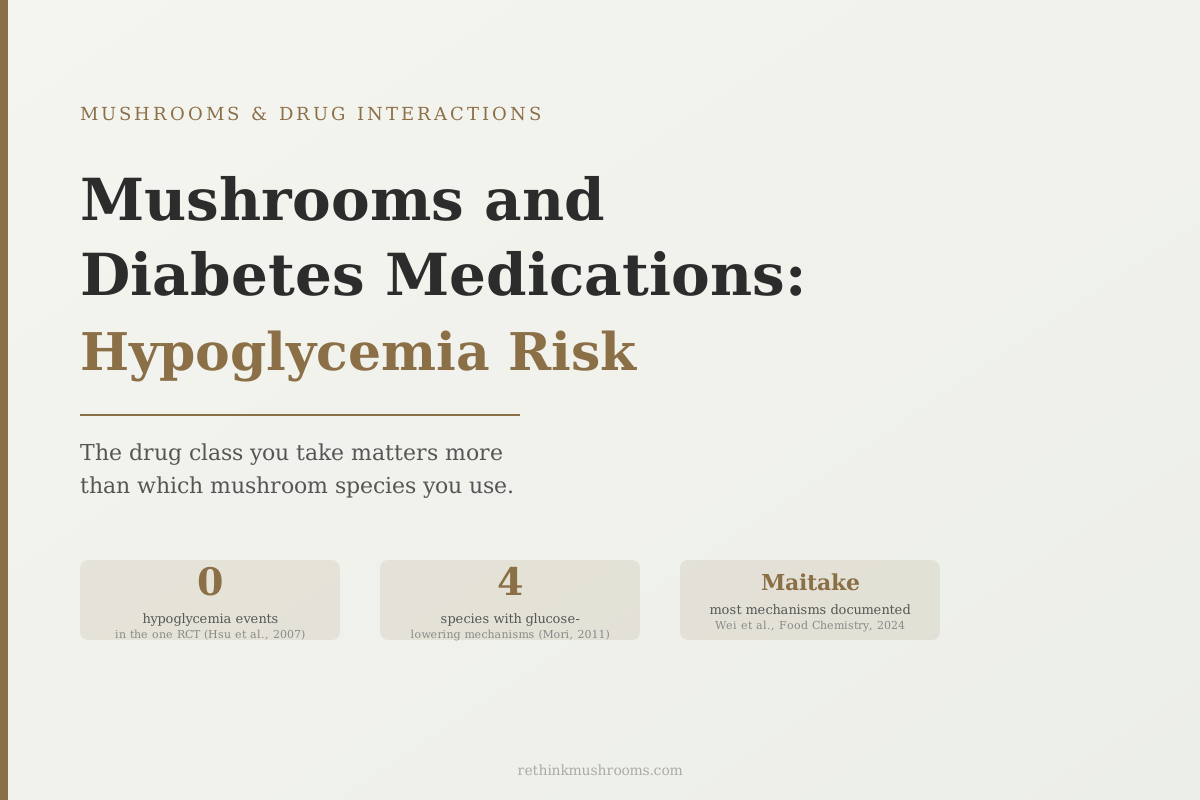
1 human trial
Exactly one randomized controlled trial has tested a mushroom supplement in people already taking diabetes medication. Agaricus blazei extract improved insulin resistance as an add-on to metformin and gliclazide over 12 weeks — but the outcomes it reported were insulin resistance and adiponectin, not hypoglycemia.
Hsu et al., Journal of Alternative and Complementary Medicine, 2007
Drug class is the variable
metformin does not cause hypoglycemia on its own; sulfonylureas and insulin do. Those two starting points create entirely different risk before any supplement enters the picture
Mostly gut-level — but not only
the best-documented mushroom mechanism slows carbohydrate absorption, like the drug acarbose. Review literature also lists increased insulin release, which is the mechanism that would genuinely compound a sulfonylurea (Lo & Wasser, Int J Med Mushrooms, 2011)
Maitake: most documented, least tested
the 2024 maitake review catalogues alpha-glucosidase inhibition and insulin-signalling effects, then calls for clinical trials to assess drug interactions in humans — trials that still have not been done (Camilleri et al., Heliyon, 2024)
Hsu et al., Journal of Alternative and Complementary Medicine, 2007
 View as image ↗
The standard guidance on mushrooms, diabetes medications, and hypoglycemia risk is accurate but not particularly useful: "these supplements may interact with blood glucose drugs." It treats a metformin user and someone on a sulfonylurea as facing the same situation, even though those two drug classes create fundamentally different hypoglycemia profiles when you add any glucose-lowering agent to them.
That drug-class distinction matters more than which mushroom species is involved. Whether you're taking maitake, Agaricus blazei, reishi, or lion's mane is a secondary question. The primary question is how your diabetes medication works, because that determines whether an additional glucose-lowering mechanism creates meaningful risk or a relatively small additive effect.
Here's where the evidence stands: one randomized controlled trial has tested a specific mushroom supplement alongside diabetes medications in humans, and it found glycemic benefit. For every other species-and-drug combination, the evidence base is preclinical. This article covers what the research actually shows, why the drug-class framework matters more than the mushroom-selection question, and — importantly — where the popular version of this story overstates how safe the combination is known to be.
This article is research summary, not medical advice. Nothing here is a reason to start, stop, or change the dose of a prescribed diabetes medication, or to add a supplement to one, without talking to the clinician who manages your diabetes.
How much bioactive compound actually reaches circulation also depends on how the mushroom was processed. For context on extraction methods and bioavailability, see Mushroom Extraction Methods: Hot Water, Alcohol, and Dual.
Key Takeaways
- The only RCT of a mushroom alongside diabetes medications found Agaricus blazei extract (1,500 mg/day, 12 weeks) reduced insulin resistance versus placebo in people already taking metformin plus gliclazide, a sulfonylurea — HOMA-IR 3.6 versus 6.6, p = 0.04 (Hsu et al., J Altern Complement Med, 2007)
- That trial's reported outcomes were insulin resistance and adiponectin. Hypoglycemia was not a reported endpoint, so it is evidence of benefit, not evidence that the combination is hypoglycemia-free
- Sulfonylureas (glipizide, gliclazide, glibenclamide) stimulate insulin release independently of blood glucose level; metformin sensitizes cells to existing insulin without triggering additional secretion. This difference creates very different hypoglycemia baselines before any supplement is added
- The best-documented mushroom glucose-lowering mechanism is alpha-glucosidase inhibition — slowing the gut enzyme that releases absorbable glucose from starches, the same target as the drug acarbose, which does not cause hypoglycemia on its own
- But that is not the only mechanism reported. A review of medicinal mushrooms for glycemic control lists "increase of insulin release" among the documented pathways (Lo & Wasser, Int J Med Mushrooms, 2011), and the 2024 maitake review describes insulin-receptor signalling leading to increased insulin secretion (Camilleri et al., Heliyon, 2024). Those are the mechanisms that could genuinely compound a sulfonylurea
- The Natural Standard systematic review of maitake evaluated interactions, adverse effects, and toxicology, and concluded there was a lack of systematic study of maitake's safety and effectiveness in humans (Ulbricht et al., J Soc Integr Oncol, 2009)
- No clinical study has characterized any mushroom supplement combined with insulin therapy; the additive concern is mechanistically plausible and entirely unquantified in humans
Why the Drug Class Matters More Than the Mushroom Species
Not all diabetes medications work the same way, and that difference is the central variable in any interaction risk assessment. Some push the pancreas to release insulin. Others reduce how much glucose the liver produces. Still others improve how efficiently cells use the insulin already in circulation. The mechanism determines whether adding a glucose-lowering supplement creates meaningful risk or a modest additive effect.
Metformin works primarily through two routes: reducing glucose production in the liver and improving the sensitivity of muscle cells to insulin. Crucially, metformin does not stimulate insulin secretion, and metformin alone does not cause hypoglycemia. If a mushroom supplement also lowers blood glucose in a metformin user, both mechanisms are acting on glucose availability rather than forcing insulin into circulation. The theoretical risk is lower because you're stacking two approaches that reduce glucose without independently pushing insulin above what the body needs.
Sulfonylureas are pharmacologically different. Drugs in this class (glipizide, gliclazide, glibenclamide, glimepiride) bind to receptors on pancreatic beta cells and trigger insulin release, regardless of what blood glucose is doing at the time. This is why sulfonylureas are associated with hypoglycemia as a class effect: they push insulin into circulation even when blood glucose is not especially elevated. Adding any further glucose-lowering effect widens the gap between circulating insulin and available glucose. The risk isn't that mushrooms are uniquely dangerous here — it's that the drug already creates a baseline where hypoglycemia is possible.
Insulin therapy presents the most direct additive concern. Injected insulin lowers blood glucose regardless of physiological context, at whatever dose was given. That dose is calibrated against expected carbohydrate absorption. If a supplement simultaneously blunts or delays post-meal glucose absorption, the net glucose reduction can exceed what the dose was calibrated for.
DPP-4 inhibitors and GLP-1 agonists include drugs like sitagliptin and semaglutide. These amplify the body's natural hormone response to eating: they boost insulin release when blood glucose is rising after a meal, but the effect is largely glucose-dependent, tapering as glucose falls. The theoretical hypoglycemia risk from adding a mushroom supplement is probably lower than with sulfonylureas — though no clinical study has characterized this combination.
Risk Stratification
The Drug Class Sets the Risk — Before Any Mushroom Is Added
A single warning that “mushrooms may interact with blood glucose drugs” treats every one of these rows as equivalent. They are not. The first question is whether the medication can drive blood glucose below normal on its own; only then does adding a second glucose-lowering agent become meaningful. Bar length is a risk ordering derived from drug-class pharmacology, not a measured event rate.
Biguanide
Lower incremental riskmetformin
How it works
Lowers hepatic glucose output and improves insulin sensitivity. Does not stimulate insulin secretion.
What adding a mushroom changes
Two glucose-lowering effects stack, but neither independently pushes insulin above what the body needs. This is the combination tested in the one human trial — as add-on to metformin plus a sulfonylurea.
Causes hypoglycemia on its own? No — metformin alone does not cause hypoglycemia
Sulfonylurea
Elevated incremental riskglipizide · gliclazide · glibenclamide · glimepiride
How it works
Binds pancreatic beta-cell receptors and triggers insulin release regardless of what blood glucose is doing at that moment.
What adding a mushroom changes
The drug already creates a state where circulating insulin can outrun available glucose. Any added glucose-lowering effect widens that gap. This is the class where the interaction question actually bites.
Causes hypoglycemia on its own? Yes — hypoglycemia is a recognised class effect
Insulin
Elevated incremental riskbasal · prandial · mixed
How it works
Injected insulin lowers blood glucose directly, independent of physiological context, at whatever dose was administered.
What adding a mushroom changes
The dose is calibrated against expected carbohydrate absorption. A supplement that blunts or delays that absorption can make a previously correct dose too large for the glucose actually arriving.
Causes hypoglycemia on its own? Yes — dose-dependent and direct
Incretin-based
Lower incremental risksitagliptin · semaglutide · liraglutide
How it works
Amplifies the natural post-meal hormone response. Insulin stimulation is largely glucose-dependent — it tapers as blood glucose falls.
What adding a mushroom changes
Because the insulin push is glucose-dependent, the theoretical additive risk is smaller than with sulfonylureas — though no study has tested this combination with any mushroom.
Causes hypoglycemia on its own? Low intrinsic risk as monotherapy
Alpha-glucosidase inhibitor
Lower incremental riskacarbose · miglitol
How it works
Slows the gut enzyme that releases absorbable glucose from starches and sugars. Shares the best-documented mushroom mechanism.
What adding a mushroom changes
The closest pharmacological analogue to how mushrooms are thought to work. Its effect is bounded by carbohydrate intake — no carbohydrate, no effect to add.
Causes hypoglycemia on its own? No — does not cause hypoglycemia as monotherapy
How to read it: the two rows shaded red are the ones where the medication itself can already push blood glucose below normal. Everything a mushroom supplement adds lands on top of that existing margin. In the three lower-risk rows, both the drug and the supplement reduce glucose availability without independently forcing insulin into circulation, which is a different and more bounded kind of stacking. Note the bottom row: acarbose works through the same enzyme most mushroom extracts are thought to inhibit, and acarbose does not cause hypoglycemia by itself — which is the strongest single argument that the mushroom contribution is modest rather than dramatic.
Drug-class mechanisms and intrinsic hypoglycemia potential reflect established pharmacology. The “what adding a mushroom changes” column is mechanistic inference, not measured data: apart from one add-on trial of Agaricus blazei alongside metformin and gliclazide (Hsu 2007 [1]), no clinical study has quantified any mushroom supplement combined with any diabetes medication in humans.
The practical result of this framework: the question to ask is not "are mushrooms safe with diabetes medications?" but "which diabetes drug do you take, and how does it work?"
Interaction Risk
ModerateSulfonylureas and insulin are the combinations that warrant real caution
Concern
Sulfonylureas and injected insulin can drive blood glucose below normal on their own. Any additional glucose-lowering agent — including a mushroom supplement with documented hypoglycemic activity — adds to an existing margin rather than creating a new one from a safe baseline. No clinical study has measured how much a mushroom supplement adds in this situation.
What the research says
The absence of data is the problem here, not evidence of harm. Because the magnitude is unquantified, the reasonable response is monitoring rather than avoidance: tell the clinician managing your diabetes before adding any mushroom supplement, and check blood glucose more frequently during the first few weeks — particularly in the hours after carbohydrate-containing meals, where an alpha-glucosidase-type effect would show up.
Particularly relevant for: People taking sulfonylureas (glipizide, gliclazide, glibenclamide, glimepiride) or any form of insulin
What to do
Do not start or stop a prescribed diabetes medication based on this article. Dose changes are a clinician's decision.
Drug-class pharmacology; no human interaction data exists for any mushroom-plus-sulfonylurea or mushroom-plus-insulin combination
The Only Controlled Trial: Agaricus Blazei, Metformin, and Gliclazide
Hsu and colleagues (2007) conducted the only published randomized controlled trial comparing a mushroom supplement against placebo in people already on diabetes medications.[1] From a population of 536 registered diabetes patients, 72 were enrolled: adults aged 20 to 75 with type 2 diabetes for more than a year, all of whom had been taking gliclazide and metformin for at least six months. They were randomized to Agaricus blazei Murill extract or cellulose placebo at 1,500 mg daily for 12 weeks, with both groups continuing their existing medications unchanged.
Sixty participants completed. The Agaricus group (n = 29) finished with a significantly lower HOMA-IR index than placebo (n = 31) — 3.6 versus 6.6, p = 0.04. Plasma adiponectin rose 20.0% in the mushroom group while falling 12.0% on placebo (p < 0.001), which the authors proposed as the mechanism behind the benefit.
Hsu et al. (2007) · Journal of Alternative and Complementary Medicine
- Population
- 72 adults with type 2 diabetes for more than one year, aged 20–75, all stable on gliclazide plus metformin for at least six months; 60 completed
- Intervention
- Agaricus blazei Murill extract, 1,500 mg daily for 12 weeks, added to existing medication
- Comparator
- Cellulose placebo, also added to existing medication
- Finding
- HOMA-IR 3.6 (SD 2.5) with Agaricus versus 6.6 (SD 7.4) with placebo (p = 0.04). Plasma adiponectin increased 20.0% in the mushroom group and decreased 12.0% on placebo (p < 0.001).
narrow-scope A genuine positive result, but narrow: one species, one drug combination, 12 weeks, 60 completers, and no independent replication. Hypoglycemia was not among the reported outcomes, so this trial cannot be read as demonstrating the combination is hypoglycemia-free.
Hsu et al., Journal of Alternative and Complementary Medicine, 2007 [1]
This result is worth reading carefully, because it is frequently overstated. Gliclazide is a drug that can cause hypoglycemia, and a supplement was added on top of it for 12 weeks in a monitored trial. That is genuinely reassuring as far as it goes. But the trial's reported outcome measures were HOMA-IR and adiponectin. Hypoglycemia was not a stated endpoint, and no hypoglycemia event data appears in the published report's summary of results. "No hypoglycemia was reported" and "hypoglycemia was measured and found not to occur" are different statements, and only the first one is supported.
Two further limitations bracket what this trial can tell us. Agaricus blazei is not among the most commonly used functional mushrooms — most people asking this question are thinking about maitake, reishi, or lion's mane, none of which have RCT-level human data in a diabetes medication context. And the trial tested a single dose of 1,500 mg/day, so it says nothing about whether a higher dose would behave differently.
It remains the only directly applicable human trial for this question.
How Mushrooms Lower Blood Sugar, and Why the Mechanism Changes the Risk Picture
Understanding the mechanism changes the interaction assessment. Lo and Wasser (2011) reviewed the evidence on medicinal mushrooms for glycemic control and catalogued the mechanisms reported across species: inhibition of glucose absorption, protection against beta-cell damage, increase of insulin release, enhancement of antioxidant defense, attenuation of inflammation, modulation of carbohydrate metabolism pathways, and regulation of both insulin-dependent and insulin-independent signalling.[2]
That list is worth reading slowly, because it does not say what supplement marketing tends to say.
Inhibition of glucose absorption is the mechanism most often invoked, and it is the most reassuring one. Alpha-glucosidase is an enzyme in the small intestine that breaks complex carbohydrates into absorbable simple sugars. Compounds from multiple mushroom species inhibit it, slowing conversion after a meal and blunting the post-meal glucose spike. The 2024 maitake review attributes this activity variously to ergosterols, pyrrole alkaloids, and unsaturated fatty acids, with the responsible constituent still unsettled.[3]
Improved insulin sensitivity is the second well-supported route, and it is also glucose-side rather than insulin-side. Xiao and colleagues (2015) found that maitake polysaccharide fractions lowered fasting serum glucose, fasting serum insulin, and HOMA-IR in diabetic rats, working through insulin receptor and IRS-1 activity and the PI3K/Akt pathway.[6] Konno and colleagues (2013) showed a comparable effect in vitro: in skeletal muscle cells made insulin-resistant by high glucose, a maitake glycoprotein fraction reactivated insulin receptor, IRS-1, and Akt signalling and restored glucose uptake.[5] Cells respond better to insulin already present; no additional insulin is produced.
Increase of insulin release is the mechanism that complicates the comfortable version of this story. It sits in Lo and Wasser's list of reported mushroom mechanisms, and the 2024 maitake review describes a proposed pathway of facilitated glucose uptake and insulin-receptor stimulation "eventually resulting in increased insulin secretion."[3] If a mushroom compound can increase insulin release, then the reassuring argument — that mushrooms only remove glucose and never add insulin, so the risk alongside a sulfonylurea is bounded — does not hold universally. This mechanism has not been isolated, dose-characterized, or confirmed in humans. It is precisely the mechanism that would matter most for hypoglycemia, and precisely the one nobody has measured.
PPARδ activation appears in maitake research as a further route. Aoki and colleagues (2018) found that a lipid-soluble extract of Grifola frondosa had PPARδ agonist activity in vitro, and that feeding it to high-fat-diet obese mice lowered total blood cholesterol, upregulated PPARδ-target genes in skeletal muscle, and improved glucose intolerance.[7] Three caveats travel with that finding and are usually dropped: the active material was a lipid-soluble fraction, not beta-glucan; a PPARδ antagonist did not abolish the effect, meaning part of it runs through a PPARδ-independent insulin signalling pathway; and the work came from a mushroom company's research laboratory.
Mechanism & Evidence Reach
Which Pathways Could Actually Contribute to a Hypoglycemic Event
Two things decide whether a proposed mechanism matters for hypoglycemia risk: how far the evidence has travelled from a petri dish toward a person, and whether the pathway can push insulin independently of blood glucose. Rows flagged insulin-side are the ones that could compound a sulfonylurea rather than simply blunt a glucose peak. Bar length reflects evidence reach, not effect size.
Slowed carbohydrate absorption (alpha-glucosidase inhibition)
Glucose-sideInhibits the intestinal enzyme that releases absorbable glucose from starches and sugars, flattening the post-meal rise. The same target as acarbose. The maitake review attributes this to several constituents — ergosterols, pyrrole alkaloids, and unsaturated fatty acids — with the responsible compound still disputed.
Enzyme-inhibition and extract studies; not measured in people on diabetes drugs
Lo & Wasser 2011 [2] · Camilleri 2024 [3]
Improved insulin sensitivity (IR / IRS-1 / PI3K–Akt signalling)
Glucose-sideMaitake polysaccharide fractions lowered fasting glucose, fasting insulin, and HOMA-IR in diabetic rodents while raising insulin-receptor activity — cells respond better to insulin already present rather than more insulin being produced.
Diabetic rodent models plus supporting cell work
Xiao 2015 [6] · Konno 2013 [5]
Increased insulin release
Insulin-sideListed directly among the mechanisms in the medicinal-mushroom glycemic-control review, and echoed in the maitake review, which describes facilitated glucose uptake and insulin-receptor stimulation "eventually resulting in increased insulin secretion". This is the mechanism that would genuinely compound a sulfonylurea, and it is the one the reassuring version of this story leaves out.
Review-level attribution; not isolated or quantified in humans
Lo & Wasser 2011 [2] · Camilleri 2024 [3] · Konno 2013 [5]
PPARδ activation
Glucose-sideA lipid-soluble maitake extract showed PPARδ agonist activity in vitro and improved glucose intolerance in high-fat-diet obese mice. Two caveats the popular retelling drops: the active material was a lipid-soluble fraction, not beta-glucan, and a PPARδ antagonist failed to abolish the effect — so the pathway is partly PPARδ-independent. The work came from a mushroom company research laboratory.
In vitro plus obese-mouse model; industry laboratory
Aoki 2018 [7]
Beta-cell protection, antioxidant and anti-inflammatory effects
Glucose-sideAdditional routes catalogued in the glycemic-control review, alongside modulation of carbohydrate-metabolism pathways and both insulin-dependent and insulin-independent signalling. Relevant to long-run glycemic control rather than to any acute hypoglycemia event.
Catalogued across species; no species-specific human confirmation
Lo & Wasser 2011 [2]
Confirmed benefit in people already on diabetes medication
Glucose-sideOne 12-week randomized, double-blind, placebo-controlled trial: Agaricus blazei extract 1,500 mg/day as an add-on to metformin plus gliclazide lowered HOMA-IR to 3.6 versus 6.6 on placebo (p = 0.04) and raised adiponectin. It is the only rung of this ladder that involves human beings taking both at once.
A single small trial, one species, one drug combination
Hsu 2007 [1]
How to read it: most of the documented activity sits on the glucose side — slowing absorption, helping cells use the insulin already circulating. That is genuinely more bounded than a drug that forces insulin out of the pancreas. But the third row is the reason this cannot be written off entirely: increased insulin release appears in the review literature as a reported mushroom mechanism, and no one has isolated or quantified it in humans. The honest position is not “mushrooms cannot contribute to hypoglycemia” — it is that the mechanism most likely to matter is the one nobody has measured.
Sources: Hsu 2007 [1]; Lo & Wasser 2011 [2]; Camilleri 2024 [3]; Konno 2013 [5]; Xiao 2015 [6]; Aoki 2018 [7]. Bar length indicates how far evidence for each mechanism has progressed from cell work toward human trials, not the magnitude of any effect.
Fact Check
The reassurance that doesn't survive contact with the reviews
The claim
“Mushrooms can't really cause hypoglycemia with diabetes drugs, because they only slow carbohydrate absorption — they never push insulin.”
A reasonable extrapolation from the acarbose comparison, which is genuinely the best-documented mushroom mechanism — repeated widely enough that it now reads as settled.
What research shows
OverstatedAlpha-glucosidase inhibition is well documented and does behave that way. But it is not the only mechanism in the literature. Lo and Wasser's review lists increase of insulin release among reported mushroom mechanisms for glycemic control, and the 2024 maitake review describes insulin-receptor stimulation eventually resulting in increased insulin secretion.
This is not a reason to treat mushroom supplements as dangerous. It is a reason to stop treating the bounded-mechanism argument as a guarantee. The insulin-side mechanisms are review-level attributions that have never been isolated or quantified in humans — so the honest summary is that the mechanism most relevant to hypoglycemia risk is also the least studied.
Lo & Wasser, Int J Med Mushrooms, 2011 [2]; Camilleri et al., Heliyon, 2024 [3]
Practical Consideration
LowIf the mechanism really is acarbose-like, ordinary table sugar is the wrong rescue
Concern
Alpha-glucosidase inhibition blocks the breakdown of sucrose (table sugar) into absorbable glucose. This is why prescribing information for acarbose specifies that hypoglycemia occurring in someone taking it — which happens when it is combined with a sulfonylurea or insulin — should be treated with oral glucose (dextrose) rather than sucrose, because sucrose will be absorbed too slowly to correct the episode promptly.
What the research says
Whether mushroom-level alpha-glucosidase inhibition is strong enough to matter here is genuinely unknown — the inhibition documented for mushroom extracts has not been compared to therapeutic acarbose doses in humans, and may well be far weaker. This is offered as a mechanistic consideration worth raising with your clinician if you take a sulfonylurea or insulin alongside a mushroom supplement, not as established clinical guidance for mushroom users.
Particularly relevant for: People combining a mushroom supplement with a sulfonylurea or insulin
What to do
Ask the clinician managing your diabetes how they want hypoglycemia treated in your specific situation.
Established acarbose prescribing guidance, extrapolated to a shared mechanism; no mushroom-specific evidence exists
Lo and Wasser were candid about the field's limits. They concluded there was insufficient evidence to draw definitive conclusions about the efficacy of individual medicinal mushrooms for diabetes, and named wide variability, the lack of production standards, and the absence of testing protocols to assess product quality as ongoing problems — calling for well-designed randomized controlled trials with long-term consumption. That assessment, from 2011, remains accurate.
Maitake Has the Most Documented Glucose-Lowering Activity, and the Thinnest Human Safety Data
Among functional mushrooms, maitake (Grifola frondosa) has accumulated the most documented glucose-lowering pathways — and, awkwardly, no human interaction data at all.
Camilleri and colleagues (2024) published the most comprehensive recent review of maitake's profile.[3] Its antidiabetic section draws together alpha-glucosidase inhibition, insulin-signalling effects, and rodent work in which maitake feeding substantially reduced serum triglyceride, cholesterol, and phospholipid levels. Multiple mechanisms affecting glucose and insulin sensitivity means more independent routes through which maitake could interact with a diabetes drug than species where only one mechanism is described.
Notably, that review closes by calling for robust clinical trials to assess potential side effects and drug interactions in human subjects — naming the gap explicitly rather than papering over it.
Ulbricht and colleagues (2009) conducted the Natural Standard systematic review of maitake, which remains the most thorough safety evaluation available.[4] Its stated scope included pharmacology, kinetics, interactions, adverse effects, toxicology, and dosing, drawing on searches across ten databases plus twenty additional journals. Diabetes was one of only three indications with enough supporting data to discuss, alongside cancer and immunostimulation. Its central conclusion was blunt: there was a lack of systematic study of maitake's safety and effectiveness in humans, and future randomized controlled trials were warranted.
Fifteen years separate those two reviews. The 2024 review added mechanistic depth; it did not close the clinical gap. No randomized trial has tested maitake with any specific diabetes drug in human subjects.
The tension is real. Maitake has more documented glucose-lowering activity than most species, it is among the more popular functional mushrooms for metabolic health, and the safety evaluation that exists concluded that systematic human study was missing. That is a meaningful gap given the mechanistic evidence, not a minor footnote.
For a deeper look at maitake's glucose-lowering mechanisms, the cell studies, and the animal data, see Maitake for Type 2 Diabetes: Clinical Evidence and Mechanisms.
What the Research Has Not Yet Tested
The honest inventory: for most combinations of functional mushroom species and diabetes medications, we don't know what the interaction looks like in clinical practice. The Hsu 2007 trial is the one exception, and it covers a single species, a single drug pairing, and a single dose. Everything else is extrapolated from animal models and cell studies.
- Cell and enzyme studiescompleted
Alpha-glucosidase inhibition and restored insulin-receptor signalling in muscle cells are well documented in vitro (Konno 2013 [5]; mechanisms catalogued in Camilleri 2024 [3])
- Animal modelscompleted
Diabetic rodent studies show reduced fasting glucose, fasting insulin and HOMA-IR with maitake polysaccharides (Xiao 2015 [6]), and improved glucose intolerance in obese mice (Aoki 2018 [7]) — none of these animals were on diabetes medication
- Small human trial, as add-on to medicationcurrent
One 12-week RCT, 60 completers: Agaricus blazei plus metformin and gliclazide improved HOMA-IR versus placebo (Hsu 2007 [1]). Insulin resistance was the endpoint; hypoglycemia was not reported
- Trials measuring hypoglycemia as an outcomemissing
No trial of any mushroom with any diabetes drug has made hypoglycemia a reported endpoint. This is the study that would actually answer the question this article asks
- Pooled interaction evidencemissing
With one trial in existence, there is nothing to pool. Both major reviews call for the trials that would make this possible (Lo & Wasser 2011 [2]; Camilleri 2024 [3])
The mechanistic and animal tiers are well populated; the human tier contains one small add-on trial that measured insulin resistance rather than hypoglycemia. The gap is not that the evidence is negative — it is that the specific question of hypoglycemia risk has never been the subject of a study.
Hsu 2007 [1]; Lo & Wasser 2011 [2]; Camilleri 2024 [3]; Konno 2013 [5]; Xiao 2015 [6]; Aoki 2018 [7]
Several specific questions remain uncharacterized.
What dose produces clinically meaningful glucose-lowering in someone already medicated? In vitro alpha-glucosidase studies typically use concentrations that may far exceed what a standard supplement delivers to the gut, and the one human trial tested a single dose. Without dose-characterization studies in people on diabetes drugs, there is no way to say whether a given supplement amount produces a significant additive effect or a negligible one.
Does the form of the extract change the risk? A concentrated extract standardized for beta-glucan content is a different product from a culinary mushroom in a meal — and the Aoki finding is a reminder that the active material for one mechanism was a lipid-soluble fraction rather than beta-glucan at all. Lo and Wasser named product standardization and the absence of quality-testing protocols as unsolved problems, and nothing since has resolved them.
What happens with the combinations people actually use? Maitake plus metformin, reishi plus insulin, lion's mane plus a GLP-1 agonist: none have been tested in humans. The mechanistic evidence points toward lower concern when an absorption-slowing agent meets metformin, and higher concern alongside sulfonylureas or insulin — but the clinical data to confirm or refute those predictions does not exist.
Fifteen years after Lo and Wasser called for well-designed long-term trials, and after the 2024 maitake review repeated the call specifically for drug-interaction studies in humans, that particular gap is exactly where it was.
For the broader picture of how medicinal mushrooms interact with other drug classes, including blood thinners and immunosuppressants, see Medicinal Mushrooms and Drug Interactions: A Complete Guide. For how mushrooms interact specifically with anticoagulant medications through platelet mechanisms, see Mushrooms and Blood Thinners: Interaction Risks.
The Bottom Line
One controlled trial has tested a mushroom alongside diabetes medications: Agaricus blazei extract improved insulin resistance over 12 weeks as an add-on to metformin and gliclazide. Its endpoints were insulin resistance and adiponectin — not hypoglycemia — so it demonstrates benefit rather than proving the combination is hypoglycemia-free. For every other species-drug pairing, the evidence is preclinical. Risk is not uniform across drug classes: sulfonylureas and insulin can drive glucose below normal on their own, so anything added lands on an existing margin, while metformin and incretin-based drugs start from a safer baseline. Most documented mushroom glucose-lowering works by slowing carbohydrate absorption — a mechanism capped by what you eat, like the drug acarbose. But review literature also reports increased insulin release as a mushroom mechanism, which is the pathway that would genuinely compound a sulfonylurea, and it is the one that has never been quantified in humans. Talk to the clinician managing your diabetes before combining the two.
Frequently Asked Questions
Sources & References
- 1RTHM-00114·Hsu, Chung-Hua et al. (2007). “The mushroom Agaricus Blazei Murill in combination with metformin and gliclazide improves insulin resistance in type 2 diabetes: a randomized, double-blinded, and placebo-controlled clinical trial..” Journal of alternative and complementary medicine (New York.Study breakdown →PubMed →↩
- 2RTHM-00418·Lo, Hui-Chen et al. (2011). “Medicinal mushrooms for glycemic control in diabetes mellitus: history, current status, future perspectives, and unsolved problems (review)..” International journal of medicinal mushrooms.Study breakdown →PubMed →↩
- 3RTHM-01862·Camilleri, Emma et al. (2024). “Unveiling the full spectrum of maitake mushrooms: A comprehensive review of their medicinal, therapeutic, nutraceutical, and cosmetic potential..” Heliyon.Study breakdown →PubMed →↩
- 4RTHM-00319·Ulbricht, Catherine et al. (2009). “Maitake mushroom (Grifola frondosa): systematic review by the natural standard research collaboration..” Journal of the Society for Integrative Oncology.Study breakdown →PubMed →↩
- 5RTHM-00533·Konno, Sensuke et al. (2013). “Possible hypoglycemic action of SX-fraction targeting insulin signal transduction pathway..” International journal of general medicine.Study breakdown →PubMed →↩
- 6RTHM-00410·Xiao, Chun et al. (2015). “Hypoglycemic effects of Grifola frondosa (Maitake) polysaccharides F2 and F3 through improvement of insulin resistance in diabetic rats..” Food & function.Study breakdown →PubMed →↩
- 7RTHM-00938·Aoki, Hana et al. (2018). “Grifola frondosa (Maitake) extract activates PPARδ and improves glucose intolerance in high-fat diet-induced obese mice..” Bioscience.Study breakdown →PubMed →↩