Mushrooms & Metabolic Health
2 human RCTs from 2024–2025
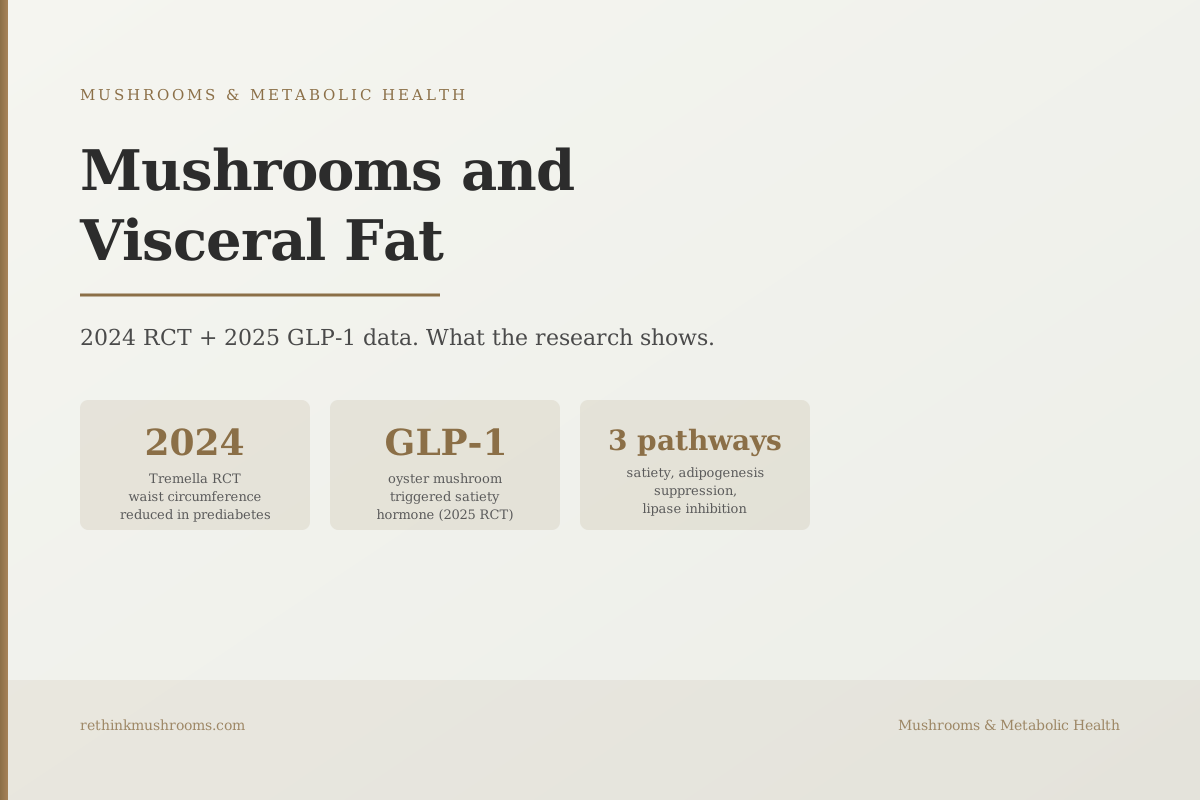
The newest clinical evidence: a 2024 Tremella RCT reduced waist circumference in prediabetes patients, and a 2025 oyster mushroom trial showed elevated GLP-1, the satiety hormone targeted by weight-loss drugs like Ozempic.
Xu et al., 2024; Dougkas et al., 2025
Waist circumference
reduced alongside HbA1c in the 2024 Tremella RCT
GLP-1
significantly increased after an oyster mushroom-fortified meal
3 mechanisms
beta-glucan satiety, adipogenesis gut shift, lipase inhibition
Xu et al., 2024; Dougkas et al., 2025
 View as image ↗
Visceral fat, the fat stored around internal organs rather than under the skin, is harder to reduce than subcutaneous fat and more dangerous metabolically. It drives the inflammation and insulin resistance that underlie type 2 diabetes, cardiovascular disease, and metabolic syndrome. Most diet interventions can reduce it given enough time. The question for mushrooms is whether any species show human clinical evidence, not just animal models or theoretical mechanisms.
There is exactly one study that directly measured it: a 2024 randomized clinical trial tested Tremella fuciformis beverage in prediabetes patients and found both reduced waist circumference and improved HbA1c compared to placebo.[1] That same year, a 2025 RCT showed that a single meal fortified with oyster mushroom powder significantly elevated GLP-1, the gut hormone responsible for the satiety and fat metabolism effects of weight-loss drugs like semaglutide.[2]
This article covers what the mushroom research on visceral fat and abdominal adiposity actually shows: the two human trials with relevant data, the mechanistic pathways that explain why these effects are plausible, and the honest gap between animal model evidence and clinical proof. For the broader context on mushrooms and blood sugar regulation, see mushrooms and type 2 diabetes: research guide by species.
Key Takeaways
- The only human RCT directly measuring visceral fat with a specific mushroom is Xu et al. (2024): Tremella fuciformis beverage reduced waist circumference and improved HbA1c in prediabetes patients
- Dougkas et al. (2025) found that a single meal fortified with oyster mushroom powder significantly increased GLP-1 response and reduced postprandial triglycerides; GLP-1 is the satiety hormone targeted by Ozempic and similar weight-loss drugs
- Mushroom compounds target fat storage through three distinct mechanisms: beta-glucans increase satiety and reduce caloric intake; polysaccharides shift gut bacteria in ways that reduce adipogenesis; triterpenoids inhibit pancreatic lipase
- A 2023 systematic review of mushroom consumption and cardiometabolic health found more consistent evidence for triglyceride and inflammation reduction than for direct fat or weight reduction
- Most mechanistic evidence for visceral fat reduction is preclinical; human trials are recent and small
- Tremella and oyster mushroom show the most specific recent human evidence for visceral fat-relevant metabolic outcomes
The Tremella RCT: The Only Human Trial to Directly Measure Belly Fat Reduction
The 2024 trial by Xu and colleagues is the most directly relevant human study to the visceral fat question.[1]
They enrolled adults with prediabetes, a population where visceral fat accumulation is both a cause and consequence of metabolic dysfunction. Participants received either a Tremella fuciformis beverage or a placebo beverage over the trial period. At the end of the intervention, the Tremella group showed two statistically significant improvements versus placebo: reduced HbA1c (a measure of average blood sugar over three months) and reduced waist circumference.
The dual outcome is what makes this study notable. Waist circumference is a direct proxy for visceral fat. The fat in the abdominal region surrounding internal organs is what drives the waist expansion that physicians use as a metabolic syndrome diagnostic criterion. An intervention that reduces both the glycemic marker and the abdominal fat marker simultaneously is making a metabolically coherent statement.
Why Tremella specifically? Tremella fuciformis contains beta-glucans and other polysaccharides that resist digestion, reach the colon intact, and are fermented by gut bacteria that in turn influence metabolic signaling. The beta-glucan content is thought to slow gastric emptying, reduce postprandial glucose spikes, and modulate the gut bacteria associated with adipogenesis (the process of forming new fat cells). All three of those effects are relevant to visceral fat accumulation.
Important caveats: the Xu et al. study does not have a published sample size reported in the available data. The trial was in prediabetes patients, a specific population where the metabolic state (elevated baseline insulin resistance, impaired glucose regulation) may amplify mushroom polysaccharide effects compared to metabolically healthy people. Whether the same effects occur in people without prediabetes is unknown.
This study also doesn't exist in a vacuum. The broader evidence for mushrooms and prediabetes intervention is examined in mushrooms for prediabetes: can early intervention prevent type 2?.
The GLP-1 Connection: Oyster Mushrooms Trigger the Same Hormone Ozempic Targets
The second significant recent study comes from Dougkas and colleagues, published in 2025.[2]
In a randomized controlled trial, adults consumed either a standard meal or a meal fortified with beta-glucan-rich oyster mushroom powder (Pleurotus ostreatus). A single fortified meal significantly increased the GLP-1 response compared to the control meal. It also reduced postprandial triglycerides.
GLP-1 (glucagon-like peptide-1) is a hormone secreted by cells in the small intestine and colon in response to food. It signals fullness to the brain, slows gastric emptying, and suppresses appetite. Over time, higher GLP-1 activity improves insulin sensitivity and reduces fat storage, particularly visceral fat. These are precisely the mechanisms targeted by GLP-1 receptor agonist drugs: semaglutide (Ozempic, Wegovy), liraglutide (Victoza), and tirzepatide (Mounjaro).
The critical distinction: GLP-1 agonist drugs bind directly to GLP-1 receptors in supraphysiological doses, producing large, sustained effects on appetite and fat metabolism. Oyster mushroom powder stimulates the gut to secrete its own GLP-1, producing a dietary-level response. These are different in magnitude. A single mushroom-fortified meal is not going to produce the weight loss seen with semaglutide injections.
What the Dougkas 2025 study shows is that the GLP-1 secretion pathway is a real mechanism through which mushroom beta-glucans exert metabolic effects in humans. For anyone interested in the broader question of whether mushrooms activate the GLP-1 pathway at meaningful levels, the dedicated article mushrooms and GLP-1: can fungi mimic the Ozempic effect? covers the complete evidence.
The reduced postprandial triglycerides are a separate benefit: elevated triglycerides after meals contribute to visceral fat accumulation over time. Blunting that postprandial triglyceride spike, meal by meal, is one plausible pathway to reduced visceral fat over weeks and months of regular consumption.
Three Ways Mushroom Compounds Target Fat Storage
The Tremella and oyster mushroom findings don't exist in isolation. A 2018 systematic review by Shao and colleagues examined anti-obesity mechanisms across medicinal and edible mushrooms and identified three distinct pathways through which mushroom compounds interfere with fat accumulation.[3]
Beta-glucans reduce caloric density and increase satiety. Beta-glucans form a viscous gel in the digestive tract that slows gastric emptying and reduces the rate at which glucose enters the bloodstream. This gel effect also increases the feeling of fullness per calorie consumed. Eating less because you feel fuller means less excess caloric intake available for visceral fat storage. This mechanism is well-established for oat beta-glucan and is supported by preclinical evidence for mushroom beta-glucans.
Polysaccharides modulate gut bacteria in ways that reduce adipogenesis. Mushroom polysaccharides reach the colon intact and selectively ferment certain bacterial taxa. Some of the bacteria promoted by mushroom polysaccharides, including Akkermansia muciniphila and SCFA-producing Bacteroidetes-associated taxa, are associated with lower rates of new fat cell formation (adipogenesis). The gut microbiome influences adipogenesis through several signaling pathways, including short-chain fatty acid production and lipopolysaccharide (LPS) reduction in the bloodstream. Less LPS means less systemic inflammation, which in turn reduces one of the primary signals for visceral fat deposition.
Triterpenoids inhibit pancreatic lipase. Pancreatic lipase is the digestive enzyme that breaks down dietary fat into absorbable fatty acids. By inhibiting it, triterpenoids (found in reishi, Chaga, and other medicinal mushrooms) reduce fat absorption from meals. This is the same mechanism as the pharmaceutical weight-loss drug orlistat. The magnitude of this effect from dietary mushroom consumption has not been tested in human clinical trials, but the preclinical data supports the mechanism's existence.
Most of the evidence reviewed by Shao et al. is preclinical (animal or in vitro). The human clinical evidence remains limited, which is why the Tremella RCT and the oyster GLP-1 study stand out.
Visceral Fat and Metabolic Syndrome: Why Abdominal Obesity Is the Central Criterion
Visceral fat isn't just a cosmetic concern. It sits at the center of metabolic syndrome, a cluster of five metabolic abnormalities that together dramatically increase cardiovascular and diabetes risk.
A 2020 review by Musso and colleagues examined how mushroom bioactives address all five criteria of metabolic syndrome simultaneously: central obesity (visceral fat), elevated triglycerides, low HDL cholesterol, elevated blood pressure, and elevated fasting glucose.[4]
Central obesity, the first criterion and the one most directly relevant here, is diagnosed by waist circumference: typically above 88 cm in women and 102 cm in men by US standards, though thresholds vary by ethnicity. Reducing visceral fat by even a few centimeters of waist circumference moves patients closer to or below the diagnostic threshold for this criterion.
Musso et al. found that mushroom polysaccharides, terpenoids, phenolics, and sterols collectively target all five metabolic syndrome criteria through distinct mechanisms. The strongest mechanistic evidence is for polysaccharide-mediated reductions in blood glucose and triglycerides. The central obesity criterion has received less clinical study, which is precisely why the Tremella 2024 RCT's waist circumference finding is significant: it provides the first direct human evidence for this criterion.
For a full breakdown of how mushroom bioactives address each metabolic syndrome criterion, see mushrooms and metabolic syndrome: targeting all five criteria. For reishi specifically and what the most rigorous human trial found, see reishi for metabolic syndrome: addressing inflammation, lipids, and glucose together.
What the 2023 Systematic Review Found (and Didn't Find)
The most comprehensive current evidence review comes from Kenyon and colleagues, published in Nutrients in 2023.[5] They systematically reviewed the human evidence for mushroom consumption and cardiometabolic disease risk factors.
Their honest conclusions, organized by metabolic marker:
Triglycerides: Some evidence for reduction. Multiple studies across different mushroom types showed triglyceride improvements, and this was the most consistent finding across the review.
Inflammation (hs-CRP): Some evidence for reduction. hs-CRP is a blood marker of systemic inflammation; lower hs-CRP is associated with reduced visceral fat and metabolic disease risk.
HbA1c: Limited evidence. The evidence for improving long-term blood sugar control (the three-month average measured by HbA1c) was inconsistent. The Tremella 2024 RCT, published after Kenyon's review cutoff, would update this assessment.
LDL cholesterol: Limited evidence. No clear pattern emerged.
Blood pressure: Limited evidence. Mushroom consumption was not consistently associated with blood pressure changes.
Body weight and visceral fat: Not specifically addressed as a primary finding in the body of evidence reviewed. The research base was too sparse for conclusions.
What this review tells the visceral fat question: the most consistently demonstrated human-level effects of mushroom consumption are for triglycerides and inflammation, not direct fat reduction. The visceral fat evidence specifically is recent and limited. The Tremella 2024 RCT is the first crack in that limitation.
The Honest Picture: Tremella and Oyster Mushroom Lead the Evidence, Most Data Is Preclinical
Here is where the evidence actually sits:
Tremella fuciformis: The only mushroom with a human RCT directly measuring visceral fat (waist circumference) as an endpoint, with positive results in prediabetes patients. Beta-glucan and polysaccharide content supports the mechanistic story. The trial is recent (2024) and small; it needs replication.
Oyster mushroom (Pleurotus ostreatus): The only mushroom with direct human evidence for GLP-1 stimulation, from a 2025 RCT. This is the most compelling mechanistic link to sustained visceral fat reduction through the satiety and fat metabolism pathway. The study was a single-meal intervention, so the chronic effects of regular consumption on body fat are not yet measured.
Other species (reishi, maitake, Chaga, enoki): Preclinical evidence for fat-related mechanisms exists for multiple species. Reishi's triterpenoids inhibit pancreatic lipase in animal and cell models. Maitake's polysaccharides reduce adipogenesis in metabolic disease animal models. None of these species have human RCTs measuring visceral fat or waist circumference as a primary endpoint.
The timeline question: Based on the Tremella trial, effects on waist circumference were measurable over the trial period with regular beverage consumption. Based on the GLP-1 study, acute effects on satiety and triglycerides occur from a single fortified meal. A chronic intervention with regular oyster mushroom or Tremella consumption, measured over 12 or more weeks with visceral fat as a primary endpoint, has not yet been published.
That trial would be the definitive test. It hasn't been done.
The Bottom Line
The strongest evidence for mushrooms and visceral fat reduction comes from two recent human trials: a 2024 RCT (Xu et al.) showing Tremella fuciformis reduced waist circumference and HbA1c in prediabetes patients, and a 2025 RCT (Dougkas et al.) showing oyster mushroom powder elevated GLP-1 response after a single fortified meal. Mechanistic reviews identify three biological pathways (beta-glucan satiety, gut microbiota shifts reducing adipogenesis, and lipase inhibition) through which mushroom compounds could reduce visceral fat. The 2023 systematic review by Kenyon et al. found the most consistent human-level evidence for triglyceride and inflammation reduction; direct visceral fat evidence is recent, limited, and concentrated in the Tremella prediabetes RCT.
Frequently Asked Questions
Sources & References
- 1. Source details for this reference are not yet available.
- 2. Source details for this reference are not yet available.
- 3. Source details for this reference are not yet available.
- 4. Source details for this reference are not yet available.
- 5. Source details for this reference are not yet available.