Mushroom Supplement Quality
54.5% of conventional samples
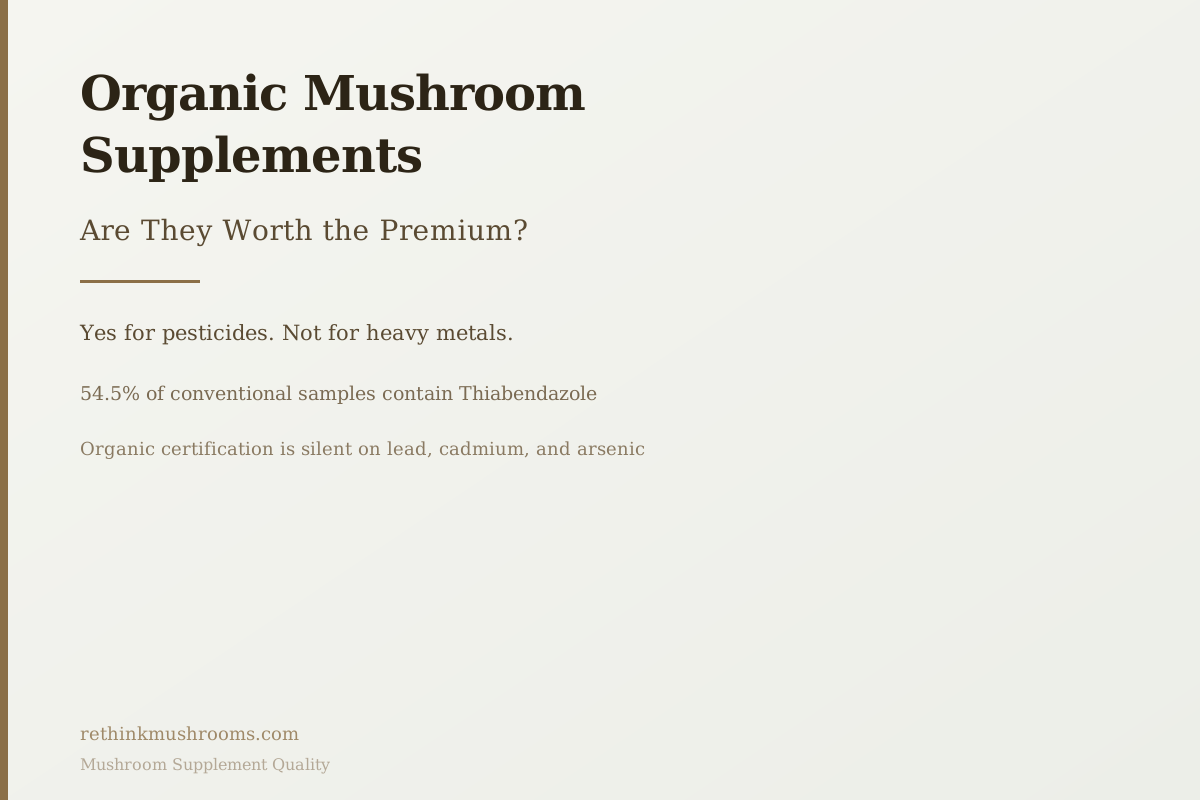
Thiabendazole, a synthetic fungicide, was detected in 54.5% of conventionally grown mushroom samples in USDA testing, versus 0% in organically grown samples. This is the strongest practical argument for organic certification in mushroom supplements.
USDA Pesticide Data Program
0%
Thiabendazole in organic mushroom samples vs. 54.5% in conventional (USDA PDP)
Does not
organic certification protect against heavy metals from contaminated substrate
2024
most recent heavy metal study from mid-western China found cadmium and lead as primary risks (Qin et al.)
USDA Pesticide Data Program
 View as image ↗
The question of whether organic mushroom supplements are worth the premium has a split answer: yes for one risk and no for another. Organic certification meaningfully reduces pesticide exposure. But it does nothing to protect against heavy metal contamination, which is the more serious and less discussed safety concern for mushroom supplements sourced from high-volume production regions.
Both risks are real. Both have research backing. The problem is that most content about organic mushroom supplements discusses only one of them, leading buyers to think the organic label solves a problem it doesn't. For the complete buyer's guide to mushroom supplement quality, see How to Choose a Mushroom Supplement: The Science-Based Buyer's Guide.
Key Takeaways
- Thiabendazole (a synthetic fungicide) was found in 54.5% of conventionally grown mushroom samples vs. 0% in organic samples in USDA Pesticide Data Program testing, representing the strongest case for choosing organic
- Organic certification reduces pesticide residues by approximately 70% but does not require or guarantee testing for heavy metals, which are the more significant risk in mushroom supplements from high-volume production regions
- Mushrooms bioaccumulate heavy metals from their growing substrate through a well-documented mechanism: substrate composition determines what metals end up in the fruiting body regardless of organic status (Ab Rhaman et al., J Fungi, 2021)
- Four independent analyses of commercial mushrooms from China's major production regions found lead and cadmium as the primary risk metals, with some species exceeding WHO safety thresholds (Zhu 2011, Liu 2015, Liu 2021, Qin 2024)
- The mislabeling problem in mushroom supplements (mycelium-on-grain sold as mushroom) affects organic and conventional products equally; organic certification addresses pesticides, not ingredient identity
- The practical minimum for a quality mushroom supplement is organic status plus a third-party certificate of analysis (COA) showing heavy metal levels, not just organic status alone
Organic Wins on Pesticides; Fails on Heavy Metals
This is the short answer that every supplement brand promoting organic mushrooms omits.
Organic certification through the USDA program prohibits the use of synthetic pesticides, synthetic fertilizers, and genetically modified organisms in the growing process. For mushrooms specifically, this matters because fungicides are used on conventionally grown mushrooms to prevent mold. Thiabendazole, a synthetic systemic fungicide, turned up in 54.5% of conventional mushroom samples tested by the USDA Pesticide Data Program. It was found in 0% of organic samples. That's a meaningful risk reduction, and it's worth paying for.
But heavy metal contamination in mushrooms works through a completely different mechanism that organic certification doesn't address. Mushrooms absorb heavy metals from their substrate: the wood, grain, straw, or soil they grow in. If the substrate contains cadmium, lead, or arsenic (from historical industrial contamination, natural geological deposits, or contaminated irrigation water), those metals move into the mushroom tissue. The organic label means no synthetic pesticides were applied during growing. It says nothing about the metal content of the substrate.
This is not a theoretical concern. Studies from major Chinese mushroom production regions have documented lead and cadmium levels in commercial mushrooms that, in some species, exceed WHO guidance thresholds. Those studies cover both wild-harvested and cultivated mushrooms.
What Thiabendazole Is and Why It Appears in Conventional Mushrooms
Thiabendazole is a systemic fungicide, meaning it's absorbed into plant tissue rather than remaining on the surface. This makes it more persistent than contact fungicides and harder to remove by washing. It was originally developed as an antiparasitic agent and is also used as a post-harvest preservative on fruit to prevent mold during storage.
In mushroom production, thiabendazole is applied to prevent contamination from competing molds during cultivation. Because mushrooms are cultivated on organic matter (wood, grain, straw), they are particularly vulnerable to mold. Conventional growers use synthetic fungicides as a management tool that organic growers cannot.
The 54.5% conventional detection rate from USDA monitoring represents routine commercial production, not accidental contamination. Most of the mushrooms tested were common edible varieties (shiitake, oyster, portobello) from commercial supply chains. Organic mushrooms from the same testing period showed zero detections.
For anyone taking a daily mushroom supplement at a therapeutic dose over months or years, reducing fungicide exposure by choosing organic is a defensible choice. The pesticide reduction benefit is real and documented.
Why Heavy Metal Risk Survives Organic Certification
The mechanism is substrate bioaccumulation, and it applies regardless of organic status.
A 2021 review of heavy metal bioaccumulation in cultivated mushrooms found that substrate composition is the primary determinant of which metals end up in the mushroom tissue.[1] Mushrooms evolved as decomposers: their mycelium secretes enzymes that break down organic matter and absorb the resulting nutrients and minerals. This biological superpower for breaking down substrates is also what makes mushrooms uniquely effective at absorbing and concentrating whatever metals are present in their growing environment.
Organic certification requires that the soil or substrate used meets organic standards, primarily meaning no synthetic inputs and no sewage sludge. It does not require testing the substrate for naturally occurring or historically deposited heavy metals. Agricultural soils in regions with long industrial histories or natural mineral-rich geology can contain elevated cadmium, lead, or arsenic at levels that would not disqualify an organic operation but that mushrooms growing on those substrates would absorb and concentrate.
This matters especially for mushroom supplements sourced from high-volume production regions where both organic and conventional operations exist on adjacent land. The organic certification protects against what was applied to the substrate. It doesn't undo what was already in the soil before farming began.
The Evidence from China's Major Production Regions
The concerns about heavy metals in mushrooms aren't hypothetical. Four independent analyses, covering different production regions and different years, have documented elevated levels in commercially available mushrooms.
Zhu and colleagues measured lead, cadmium, arsenic, mercury, and copper in wild edible mushrooms collected from Yunnan Province, one of China's major mushroom-supplying regions.[2] Concentrations varied significantly by species and collection site, confirming that location and species both influence accumulation. Yunnan is a primary source region for wild-harvested Chaga, matsutake, and other mushrooms used in supplement production.
Liu and colleagues measured lead, cadmium, copper, zinc, and iron across 21 wild mushroom species from the same region.[3] Several species showed heavy metal accumulation above WHO consumption limits. The data covered mushrooms sold commercially in markets, not marginal or rare specimens.
A separate analysis from Jilin Province, another major commercial production area, found lead, cadmium, mercury, and arsenic in edible mushrooms from commercial sources.[4] The Jilin study focused specifically on cultivated mushrooms, not wild-harvested ones, demonstrating that the heavy metal issue is not limited to wild-collection scenarios.
The most recent analysis, published in 2024, characterized heavy metals in commercial mushrooms from mid-western China and found cadmium and lead as the primary risk metals, with significant variation between species.[5] The 2024 data confirms that heavy metal monitoring remains necessary for current commercial mushroom supply chains, not just a legacy concern from historical research.
None of these studies compared organic vs. conventional mushrooms for heavy metal content. The mechanism documented in the substrate review explains why the distinction would not be reliable: the organic status of the farm doesn't control the geological and industrial history of the soil.
The Label Accuracy Problem Applies to Both Organic and Conventional
There's a second quality problem in mushroom supplements that organic certification doesn't address: the gap between what's on the label and what's actually in the product.
A 2024 comprehensive review of label compliance for botanical immune supplements, including mushrooms, documented the gap between claimed and verified ingredient contents in US products.[6] The review found that FDA enforcement capacity for dietary supplement ingredient identity is limited under the Dietary Supplement Health and Education Act of 1994 (DSHEA). Products can be sold with labeled claims that haven't been independently verified against tested content. DNA barcoding, HPLC, and beta-glucan assay methods are available for verification but are not routinely required.
The mislabeling issue that receives the most attention in mushroom supplements is mycelium-on-grain products sold as mushroom supplements. Mycelium grown on grain (typically oats or brown rice) that is dried with the grain intact produces a product with substantially lower beta-glucan content: typically 5-7% beta-glucans versus 30-40% in fruiting body extracts. In June 2023, Jeff Chilton of Nammex, a major mushroom extract supplier, filed an FDA citizen petition requesting enforcement action against products labeling mycelium-on-grain as "mushroom." As of the time of this writing, the FDA had issued an interim response indicating the petition was still under evaluation.
An organic-certified mycelium-on-grain product would correctly display the USDA Organic seal while potentially providing a fraction of the beta-glucan content of a fruiting body extract. The organic certification addresses how the grain was grown, not the nature of what's in the capsule. For more on the regulatory framework, see FDA Mushroom Supplements: DSHEA, Companies, and Claims.
What You Need Beyond the Organic Label
The practical checklist for a quality mushroom supplement involves organic status as one element, not the whole answer.
Organic certification: reduces pesticide exposure meaningfully, particularly for fungicides like Thiabendazole. Worth having as a baseline.
Certificate of analysis for heavy metals: a third-party lab report showing tested levels of lead, cadmium, arsenic, and mercury from each production batch. This is the only protection against heavy metal contamination that organic certification doesn't provide. It should come from an independent lab, not from the brand's internal testing.
Fruiting body source stated explicitly: the label should say "fruiting body" or provide a beta-glucan percentage above 25-30%. "Mycelium biomass" or "myceliated grain" indicates a different product with substantially lower active compound concentrations.
Beta-glucan percentage from a validated method: the Megazyme K-YBGL enzymatic method is the most accurate for mushroom beta-glucans. Methods designed for grain beta-glucan testing can overcount starch as beta-glucan, inflating apparent numbers. A product showing 40% beta-glucans tested by an unspecified method is not equivalent to one showing 35% from the Megazyme method.
None of these requirements are met by the organic label alone. For a systematic look at mushroom supplement quality standards, including the beta-glucan testing debate and what certifications actually verify, see North American Mushroom Quality: The Functional Mushroom Council Standards. For the supply chain picture behind these quality differences, see Where Do Most Mushroom Supplements Come From? Supply Chain Guide.
The Bottom Line
Organic mushroom supplements are worth the premium for pesticide reduction: USDA data shows Thiabendazole in 54.5% of conventional samples versus 0% of organic. But organic certification does not protect against heavy metal contamination, which is driven by substrate composition rather than synthetic inputs. Multiple analyses from China's production regions document lead and cadmium as ongoing concerns. A fully adequate mushroom supplement requires both organic certification and a third-party certificate of analysis showing heavy metal testing, not organic status alone.
Frequently Asked Questions
Sources & References
- 1. Source details for this reference are not yet available.
- 2. Source details for this reference are not yet available.
- 3. Source details for this reference are not yet available.
- 4. Source details for this reference are not yet available.
- 5. Source details for this reference are not yet available.
- 6. Source details for this reference are not yet available.