Psilocybin Species & Mycology
100+ named varieties
Over 100 named Psilocybe cubensis varieties have been cataloged, yet most represent phenotypic cultivar selections rather than genetically validated subspecies. Analytical chemistry confirms measurable psilocybin content differences between named strains.
Kurzbaum et al., Journal of Fungi, 2025.
Penis Envy
analytically confirmed higher psilocybin content via LC-MS/MS (Goff 2024)
No RCTs
no clinical trials have studied strain-specific experiential outcomes
Same strain
different batches of the same variety show substantial alkaloid variation (Gotvaldová 2021)
Kurzbaum et al., Journal of Fungi, 2025.
 View as image ↗
Note on legal status: Psilocybe cubensis is a Schedule I controlled substance in the United States and is regulated or prohibited in most other jurisdictions. This article is scientific and educational content covering mycology, analytical chemistry, and taxonomy. It does not describe acquisition, cultivation, or use.
Psilocybe cubensis is the most widely cataloged psilocybin-containing fungus in the scientific literature, with over 100 named varieties documented as of 2025. Most of these varieties emerged from decades of informal cultivator selection, not from formal mycological research programs. They are named phenotypic variants, not formally described subspecies.
That background matters before comparing Golden Teacher against Penis Envy, because it explains what the evidence can and cannot tell us. For the broader scientific overview of this species, see Psilocybe cubensis: The World's Most Cultivated Magic Mushroom.
Key Takeaways
- Over 100 named P. cubensis varieties exist, but most are cultivar selections, not formally described taxonomic subspecies (Kurzbaum et al., 2025)
- Goff and colleagues (2024) used LC-MS/MS, the gold standard analytical method, to directly measure psilocybin and psilocin across multiple named P. cubensis strains; Penis Envy showed significantly higher content
- Genetic variation in the psilocybin biosynthesis gene cluster (particularly psiH and psiM genes) explains why different varieties produce different alkaloid ratios (Dörner et al., 2022)
- Even within a single named variety, substantial alkaloid content variation exists between individual samples and harvest flushes (Gotvaldová et al., 2021)
- No clinical trial has studied a specific P. cubensis strain; all therapeutic research uses pharmaceutical-grade synthetic psilocybin, not mushroom extracts
- Community potency claims for specific strains that predate analytical chemistry data are not scientifically validated and often conflate anecdote with measurement
What "Strain" Actually Means: Most P. cubensis Varieties Are Not Formal Subspecies
In pharmaceutical or agricultural science, a strain or cultivar implies documented genetic differentiation, stable heritable traits, and reproducible characteristics under standardized conditions. The named varieties of Psilocybe cubensis generally do not meet these criteria.
Kurzbaum and colleagues' 2025 review, the most comprehensive scientific treatment of P. cubensis strain diversity published to date, documents that the majority of named varieties originated through informal selection by hobbyist cultivators over several decades, beginning in the 1970s and accelerating through the 1990s and 2000s.[2] Selection criteria were typically visual (cap size, color, stem thickness) or yield-related (prolificity, colonization speed) rather than alkaloid-content-based, because analytical chemistry tools for reliable potency measurement were not widely available to hobbyists.
What the scientific literature can confirm about named varieties: they are phenotypically recognizable (consistent visual characteristics), they often come from distinct spore or culture lineages, and they show heritable traits across generations. What the literature generally cannot confirm: that they represent genetically characterized subspecies with formally described type specimens.
Dörner and colleagues' 2022 genetic survey of psilocybin natural products provides important context here. By surveying the biosynthesis gene cluster across multiple Psilocybe species and varieties, the Hoffmeister lab confirmed that genetic variation in the cluster, particularly in the psiH and psiM genes, correlates with different alkaloid ratios between isolates.[3] This means there is a genuine genetic basis for alkaloid differences between varieties, even if most named varieties haven't had their gene clusters formally characterized.
Golden Teacher: The Most Recognized Variety in the Cultivator Literature
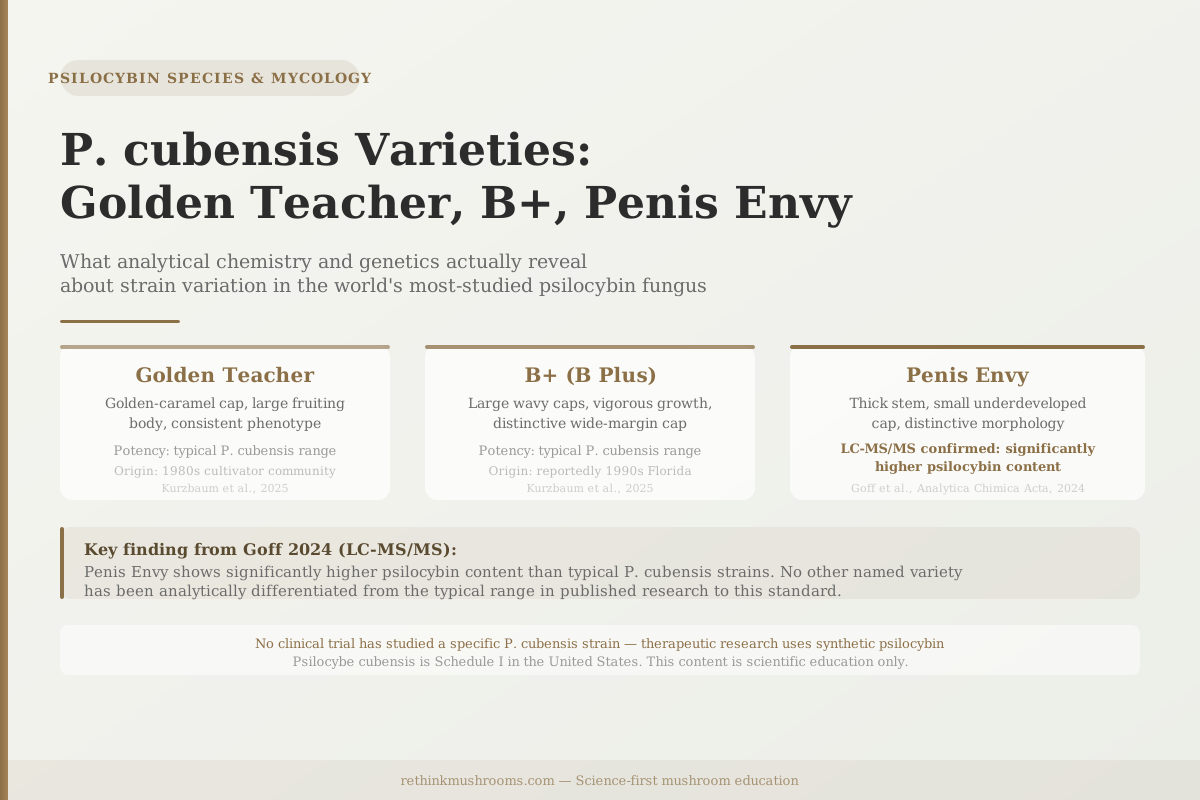
Golden Teacher is the most frequently mentioned P. cubensis variety in cultivator literature and is treated as something of a reference standard against which other varieties are compared. Kurzbaum 2025 discusses it as a variety recognized across the literature for consistent visual characteristics: the golden-caramel cap with a characteristic central raised area (umbo), large fruiting bodies, and a moderate growth rate.[2]
The origin of Golden Teacher is not formally documented in primary scientific literature. Community accounts place its emergence in the 1980s, though the specific lineage is undocumented. Its widespread adoption appears to have been driven by visual recognition and relatively consistent phenotypic expression rather than any analytically confirmed property.
In analytical chemistry terms, Golden Teacher falls within the typical P. cubensis alkaloid range. No published study has specifically singled out Golden Teacher for elevated or unusual alkaloid content relative to other standard varieties. Its significance is primarily cultural and historical within the cultivator community, not pharmacologically distinctive in the current scientific literature.
B+ (B Plus): A Wide-Capped Variety With Reported Vigor
B+ is another widely referenced variety distinguished primarily by visual features: noticeably large and wavy-edged caps, a wide fruiting body that deviates somewhat from the typical P. cubensis form. Community accounts attributed its development to a Florida-based cultivator in the 1990s under the name "Mr. G," though this is not documented in formal scientific literature.
Kurzbaum 2025 mentions B+ in the context of the broader named variety landscape but does not single it out for unusual alkaloid characteristics.[2] Like Golden Teacher, it appears to represent a visually distinctive phenotype within the typical P. cubensis alkaloid range rather than a biochemically distinct variety.
The community perception that B+ produces a visually large fruit with moderate potency is consistent with the general pattern in P. cubensis: visual size and alkaloid content are not strongly correlated. A larger fruiting body does not necessarily contain proportionally more psilocybin per gram of dry weight.
Is Penis Envy Really Stronger? What Analytical Chemistry Confirms
Penis Envy is the variety about which the strongest specific scientific claims can now be made, because of Goff and colleagues' 2024 analytical study.
Goff and colleagues used liquid chromatography coupled with tandem mass spectrometry (LC-MS/MS) to directly measure psilocybin and psilocin concentrations across multiple named P. cubensis strains. LC-MS/MS is the analytical gold standard for this type of measurement: it distinguishes between compounds at the molecular level and quantifies them precisely, eliminating the identification ambiguities that affected older analytical methods.[1]
The key finding: Penis Envy showed significantly higher psilocybin content compared to typical P. cubensis strains. This is the first rigorous analytical confirmation of a difference that the cultivator community had long reported anecdotally.
The visual profile of Penis Envy is also distinctively different from typical P. cubensis varieties. The fruiting body is dense and compact: a thick, heavy stem with a relatively small and underdeveloped cap. Crucially, the partial veil (the membrane that would typically leave a ring on the stem) does not fully develop or rupture cleanly in Penis Envy, leaving the cap partially enclosed at maturity rather than fully open. This morphological distinction appears to be associated with its unusual genetics.[2]
The DNA variation between Penis Envy and typical P. cubensis strains likely involves the biosynthesis gene cluster described by Dörner 2022, where variant psiH and psiM gene configurations produce different total alkaloid outputs and ratios.[3] A formal genetic characterization of Penis Envy's specific gene cluster configuration has not been published as of the most recent literature reviewed for this article.
Community claims that Penis Envy is two to three times more potent than typical varieties are not directly validated by a published comparison table with specific numbers. Goff 2024 confirms significantly higher content; the magnitude of that difference requires more published data to precisely quantify across a larger sample set.
Why Two Samples of the Same Strain Can Differ Substantially in Alkaloid Content
Even within a single named variety, psilocybin content is not fixed. This is one of the most practically important findings in the analytical chemistry literature and is consistently underemphasized in popular coverage of strain potency.
Gotvaldová and colleagues' 2021 study documented alkaloid content and stability in P. cubensis biomass, finding significant natural variation between samples of the same species and even the same variety.[4] The study measured five alkaloids (psilocybin, psilocin, baeocystin, norbaeocystin, and aeruginascin) and found that even under controlled storage conditions, psilocin degrades more rapidly than psilocybin over time.
Two implications follow from this:
First, the alkaloid content in any given sample is not a stable fixed property of the strain. It is a function of the strain's genetic potential, the substrate and environmental conditions under which it grew, the harvest timing (first flush typically shows highest psilocybin content, with subsequent flushes showing progressively lower levels in the same colony), and post-harvest storage conditions.
Second, community-level potency comparisons between strains, which typically rely on subjective reports rather than analytical measurements, conflate genetic differences with these environmental and storage variables. A high-potency strain measured under one set of conditions might be indistinguishable from a typical strain under different conditions.
This variability is why the pharmaceutical psilocybin research programs use synthetic psilocybin with precisely defined purity and dosage rather than mushroom preparations: the natural variability documented by Gotvaldová 2021 makes standardized clinical research impossible with raw biological material.
The Genetic Basis: Why Gene Cluster Variation Explains Alkaloid Differences
The biosynthesis of psilocybin from tryptophan in P. cubensis requires four enzymes encoded by four genes in a gene cluster: psiD (a decarboxylase), psiK (a kinase), psiM (a methyltransferase), and psiH (a hydroxylase). The four-enzyme pathway converts tryptophan through norbaeocystin and baeocystin to psilocybin.
Critically, the same gene cluster produces not just psilocybin but the entire alkaloid profile. The relative activity of psiH and psiM determines whether the pathway produces more psilocybin, more baeocystin, or different ratios of minor alkaloids. Dörner and colleagues' 2022 genetic survey confirmed that sequence variation in these genes across Psilocybe species and varieties correlates with different alkaloid output ratios.[3]
For named P. cubensis varieties, this means that a variety with a variant psiH gene might produce a different ratio of psilocybin to baeocystin, or a variant psiM gene might produce a different ratio of psilocybin to norbaeocystin. These genetic-level differences are the likely explanation for the measurable alkaloid content differences that Goff 2024 documented between strains.
A formal genetic characterization of the major named varieties (Golden Teacher, B+, Penis Envy) has not been published with complete gene cluster sequencing for each. This is a research gap that Kurzbaum 2025 identified explicitly: the community has hundreds of named varieties with no corresponding genetic voucher specimens or fully characterized gene cluster sequences.[2]
What the Strain Evidence Cannot Tell You
The analytical chemistry data (Goff 2024, Gotvaldová 2021) tells us about psilocybin and psilocin content. The genetics data (Dörner 2022) explains the mechanism of content variation. What the current evidence base cannot support are specific claims about subjective experiential differences between strains.
Subjective differences in the character of the experience (often described in community literature as "visual vs. introspective," "energetic vs. cerebral," and similar qualitative distinctions) are not documented in any peer-reviewed clinical or preclinical research. No human trial has compared the subjective effects of Golden Teacher against Penis Envy in a controlled setting. No animal pharmacology study has compared the behavioral pharmacology profile of different P. cubensis varieties.
This does not mean these differences don't exist. It means they are not scientifically documented. The analytical chemistry confirms that psilocybin content varies. Whether the alkaloid composition differences produce qualitatively different experiences in humans remains an open question. Kurzbaum 2025 identifies this as a major research gap in the strain literature.[2]
For the deeper look at psilocybin content measurement across samples, including the five-alkaloid profile and the stability data, see Psilocybin Content in P. cubensis: How Much Is Actually There?. For the evolutionary and biological context behind the species, see The Biology of Psilocybe cubensis: Growth, Habitat, and Identification.
For the specific three-way comparison of Golden Teacher, B+, and Penis Envy with the Goff 2024 data presented directly, see Psilocybe cubensis Varieties: Golden Teacher, B+, and Penis Envy Compared. For the deeper discussion of whether minor alkaloids like baeocystin and aeruginascin alter the experience, see The Entourage Effect in Magic Mushrooms: Do Minor Tryptamines Matter?.
The Bottom Line
Over 100 named Psilocybe cubensis varieties exist, but most are phenotypic cultivar selections rather than formally characterized subspecies with voucher specimens or sequenced gene clusters. Analytical chemistry (Goff 2024) confirms measurable psilocybin content differences between named strains, with Penis Envy showing significantly higher content than typical varieties. Genetic variation in the psilocybin biosynthesis gene cluster (Dörner 2022) provides the molecular explanation for these differences. Even within a single named variety, substantial alkaloid variation exists between samples and harvest flushes (Gotvaldová 2021). No clinical trial has studied a specific P. cubensis strain; all therapeutic research uses synthetic psilocybin. Community claims about strain-specific experiential qualities are not validated by controlled research.
Frequently Asked Questions
Sources & References
- 1RTHM-00879·Goff, Roman et al. (2024). “Determination of psilocybin and psilocin content in multiple Psilocybe cubensis mushroom strains using liquid chromatography - tandem mass spectrometry..” Analytica chimica acta.Study breakdown →PubMed →↩
- 2RTHM-00932·Kurzbaum, Eyal et al. (2025). “Exploring Psilocybe cubensis Strains: Cultivation Techniques, Psychoactive Compounds, Genetics and Research Gaps..” Journal of fungi (Basel.Study breakdown →PubMed →↩
- 3RTHM-00755·Dörner, Sebastian et al. (2022). “Genetic Survey of Psilocybe Natural Products..” Chembiochem : a European journal of chemical biology.Study breakdown →PubMed →↩
- 4RTHM-00688·Gotvaldová, Klára et al. (2021). “Stability of psilocybin and its four analogs in the biomass of the psychotropic mushroom Psilocybe cubensis..” Drug testing and analysis.Study breakdown →PubMed →↩