Psilocybin Species & Mycology
1.68% psilocybin max (dry weight)
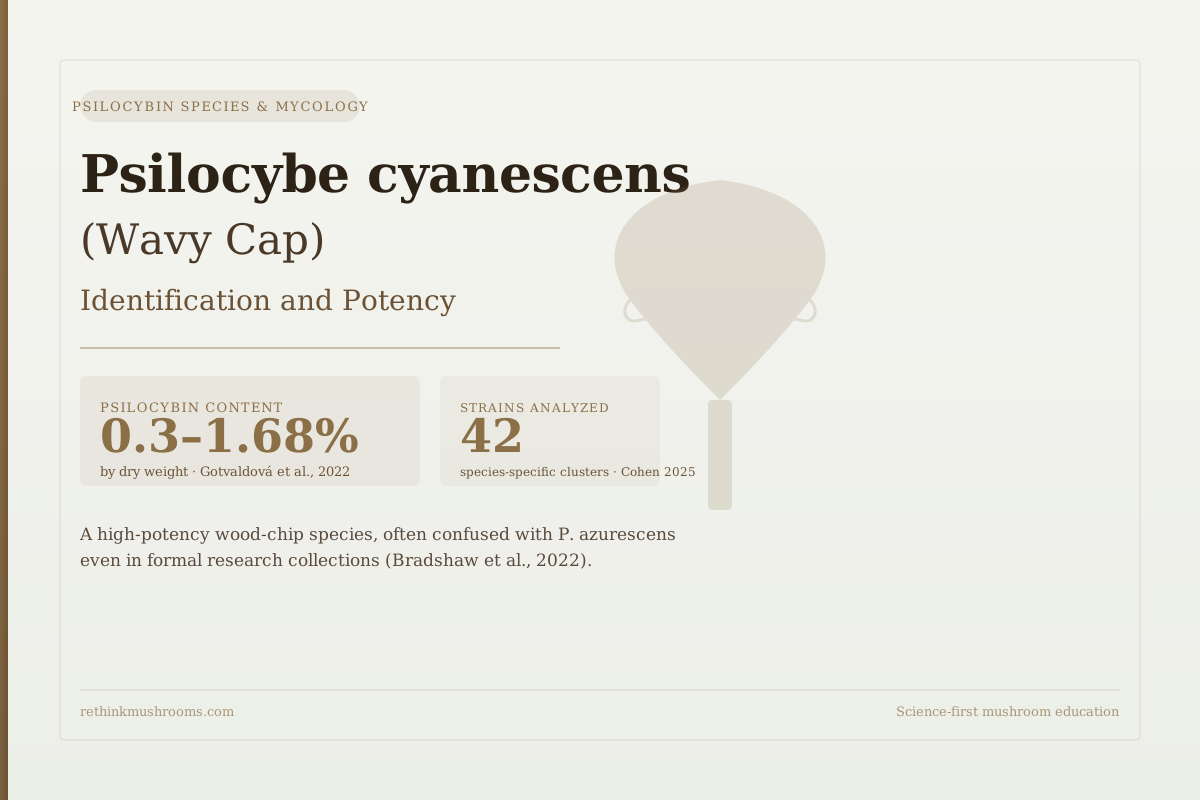
Psilocybe cyanescens reaches up to 1.68% psilocybin by dry weight in multi-species alkaloid profiling — putting it firmly in azurescens territory and well above typical cubensis.
Gotvaldová et al., Int J Mol Sci, 2022
0.3–1.68%
psilocybin range by dry weight
>50%
herbarium specimens misdetermined in research collections (Bradshaw 2022)
42
fungal strains showed species-specific alkaloid clusters (Cohen 2025)
Gotvaldová et al., Int J Mol Sci, 2022
 View as image ↗
For a long time, Psilocybe cyanescens sat in the shadow of its more famous neighbors. Psilocybe cubensis got the cultivation guides. Psilocybe azurescens got the "world's most potent" headlines. Wavy cap was described as "very potent" in foraging guides without many numbers behind the claim.
The numbers exist. Gotvaldová and colleagues ran systematic tryptamine analysis across a large collection of psychotropic mushrooms in 2022, and cyanescens appeared in the dataset with psilocybin concentrations ranging from 0.3 to 1.68 percent by dry weight.[1] That upper end is comparable to P. azurescens, the species most often called the most potent in the world. Typical P. cubensis samples measure between 0.14 and 0.42 percent psilocybin. Wavy cap frequently sits well above that range.
What makes cyanescens worth understanding closely is not just the potency data. It is the identification problem. Bradshaw and colleagues published DNA authentication analysis in 2022 and found widespread misdeterminations even in formal herbarium collections, with specimens labeled as one species often testing as another upon DNA sequencing.[3] Azurescens and cyanescens, two species with overlapping Pacific Northwest ranges, similar appearance, and comparable potency, are among the most commonly confused. Visual identification alone cannot reliably tell them apart.
This article covers what the research shows: the features that define Psilocybe cyanescens, the alkaloid data behind its potency, and the reasons why identification is more uncertain than most field guides acknowledge.
For broader context on the genus, see Psilocybe cubensis: The World's Most Cultivated Magic Mushroom.
Key Takeaways
- Psilocybe cyanescens contains 0.3–1.68% psilocybin by dry weight; at the high end, this is comparable to P. azurescens, per Gotvaldová et al. 2022 multi-species tryptamine profiling
- The undulating cap margin is the most distinctive visual feature, but cyanescens and azurescens are difficult to distinguish by appearance alone, particularly where both grow in the Pacific Northwest
- Bradshaw et al. 2022 found widespread misdetermination in formal herbarium collections; DNA sequencing (ITS barcoding) is the only reliable species confirmation
- Gotvaldová 2022 documented meaningful baeocystin and norbaeocystin alongside psilocybin in cyanescens; the alkaloid profile is not psilocybin alone
- Cohen et al. 2025 found species-specific metabolite clustering across 42 fungal strains, confirming cyanescens has a distinct chemical signature from cubensis
- Within-species potency variation is real: Bigwood and Beug's 1982 data and Goff et al. 2024 both show that a range, not a single number, is the accurate way to describe species potency
The One Visual Feature That Actually Sets Wavy Cap Apart
Psilocybe cyanescens has a cap margin that waves and folds as the mushroom matures. This is the feature that gives it the common name. No other psilocybin-containing species commonly encountered in temperate climates develops this consistent undulation in the same way.
For identification purposes, the undulating margin works best on mature caps that have fully opened. Young buttons do not yet show the wave. Partially dried caps can distort in ways that mimic the wavy margin. The feature is reliable when the mushroom is mature and fresh.
Several other features appear consistently alongside the wavy margin.
The cap color is hygrophanous, meaning it shifts dramatically with moisture. When wet, the cap is rich caramel or chestnut brown. As it dries, it fades to pale buff or off-white starting at the margin while the center stays darker, creating a two-toned appearance. This makes field identification easier for fresh specimens and harder for specimens that have been drying for hours.
The bluing reaction is strong. When the flesh is broken or the stem is bent, the wound turns blue-green within seconds. This reaction results from the oxidation of psilocin when exposed to air. It is useful for ruling out non-bluing toxic species, but several unrelated toxic species also blue, and the bluing reaction by itself does not confirm a specific species.
The spore print is dark purple-brown to near-black. Gills attach to the stem directly or with a small notch and darken as the spores mature. The stem is pale and fibrous. A partial veil leaves a fibrous zone on the upper stem rather than a persistent ring.
Habitat is one of the most diagnostic features of cyanescens. It grows on wood debris, specifically decomposing wood chips and woody mulch in gardens, parks, and landscaped urban areas. It does not grow in dung-enriched grasslands like cubensis, nor in upland acidic pastures like P. semilanceata. When a potent Psilocybe appears in a suburban wood chip bed in the temperate Pacific Northwest or in a UK park border, cyanescens is the first species to consider.
For safety context on toxic species that can resemble wood-substrate Psilocybe, see Deadly Mushroom Lookalikes: Identification Guides That Could Save Your Life.
The Potency Data: 0.3 to 1.68 Percent Is a Wide Range for a Reason
The 2022 study by Gotvaldová and colleagues analyzed five tryptamine alkaloids, including psilocybin, psilocin, baeocystin, norbaeocystin, and aeruginascin, across a systematic collection of psychotropic mushrooms covering multiple species and genera.[1] Cyanescens specimens in that dataset ranged from 0.3 to 1.68 percent psilocybin by dry weight.
That is more than a fivefold difference between the lowest and highest measured specimen, both from correctly identified P. cyanescens.
For reference, typical P. cubensis samples measure 0.14 to 0.42 percent psilocybin. The most widely cited figure for P. azurescens is approximately 1.78 percent. At its upper end, cyanescens enters that same territory. It is not consistently the most potent Psilocybe species, but it clearly belongs in the high-potency group alongside azurescens rather than the mid-range group occupied by most cubensis samples.
Cohen and colleagues analyzed 42 psilocybin-producing fungal strains in 2025 and found species-specific metabolite clustering: each species had a characteristic alkaloid signature that was distinct from other species even when raw psilocybin content overlapped.[2] The overall chemical profile of cyanescens, meaning what compounds are present and in what ratios, differs from cubensis in consistent, species-specific ways.
For a broader comparison of psilocybin concentration across species, see Psilocybin Content by Species: A Comprehensive Potency Guide.
Why Azurescens and Cyanescens Get Confused Even in Academic Collections
Psilocybe azurescens and P. cyanescens are the two most potent Psilocybe species found in the Pacific Northwest of North America. Their geographic ranges overlap. Their appearance is similar enough that experienced foragers regularly misidentify one as the other.
The herbarium data confirms how deep this problem runs. Bradshaw and colleagues examined Psilocybe specimens in formal research collections in 2022 using DNA barcoding of the ITS region, a short stretch of ribosomal DNA used for fungal species identification.[3] They found widespread misdeterminations: specimens labeled as one species frequently came back as a different species when sequenced. The metabolite profiles of mislabeled specimens also differed from what the label predicted, which explains why potency data attributed to specific species in older literature is sometimes unreliable.
The practical implication: visual inspection cannot reliably distinguish azurescens from cyanescens. The two species can fruit in the same wood chip bed in the same week. The features most commonly cited in field guides, including cap shape, color, size, and even bluing intensity, show enough overlap between the two species that they cannot serve as definitive separators.
Bradshaw and colleagues published phylogenomic analysis of the entire Psilocybe genus in 2024, placing both species within the broader evolutionary tree.[4] They are genuinely distinct species with separate evolutionary histories, but they share the gene cluster responsible for psilocybin synthesis and share enough visual features that the identification problem persists.
DNA sequencing of the ITS region is the only currently reliable confirmation method. This is not a practical field tool, but it is the standard used in research settings. For how this applies to supplement quality and species verification, see DNA Testing for Mushroom Supplements: Verifying Species Identity.
The Alkaloid Mix Beyond Psilocybin
Cyanescens does not contain psilocybin alone. Gotvaldová's 2022 multi-species analysis found meaningful concentrations of baeocystin and norbaeocystin alongside psilocybin in cyanescens specimens, as well as psilocin.[1]
Baeocystin is structurally similar to psilocybin. It is the same basic molecule with one fewer methyl group on the terminal nitrogen. Whether baeocystin produces psychoactive effects in humans at the concentrations present in mushroom tissue is an open question. Norbaeocystin has one fewer methyl group still. Research on both compounds remains at the preclinical stage, meaning the human pharmacology is not yet characterized.
Psilocin, the compound psilocybin converts to in the body and the one that directly activates serotonin receptors, was also present in cyanescens samples. Gotvaldová and colleagues examined the stability of psilocybin and its analogs in dried mushroom biomass in 2021 and found that psilocybin was the most stable compound while psilocin degraded fastest.[6] Specimens dried and stored for extended periods will have lower psilocin content than fresh specimens regardless of the original amount present at harvest.
Dörner and colleagues published a genetic survey of the psilocybin biosynthetic gene cluster across Psilocybe species in 2022.[5] They found variation in the enzyme sequences encoded by the cluster, and that this variation correlates with differences in alkaloid ratios between species. The reason cyanescens produces a somewhat different alkaloid ratio than cubensis is not purely environmental. It is partly encoded in the gene cluster sequence itself.
For more on baeocystin and norbaeocystin pharmacology, see Baeocystin and Norbaeocystin: Do These Minor Tryptamines Affect the Experience?. Aeruginascin, a compound with distinct pharmacology found in some Inocybe and Panaeolus species, appears at low concentrations in cyanescens but is not a primary component of its alkaloid profile. For species where aeruginascin is a major alkaloid, see Aeruginascin: The Compound That May Make Some Mushrooms 'Friendlier'.
Why Any Potency Figure Is an Estimate, Not a Number
The 0.3 to 1.68 percent range for cyanescens is wide, and that width reflects something real about how Psilocybe potency works.
Bigwood and Beug published the foundational study on within-species potency variation in 1982.[8] They analyzed psilocybin and psilocin levels across multiple flushes of the same mushroom, meaning different harvests from the same mycelium. They found significant variation both between individual sporocarps and between flushes. First-flush specimens showed different alkaloid content than second- and third-flush specimens from the same source.
Goff and colleagues published LC-MS/MS quantification of psilocybin and psilocin across multiple P. cubensis strains in 2024.[7] Even within the same strain, specimens that are genetically nearly identical, alkaloid content varied substantially. Growing conditions including light exposure, substrate composition, temperature, and harvest timing all influence alkaloid expression.
Cohen 2025's 42-strain analysis confirmed that species-specific metabolite clusters are real, but also that the variation within a species is large enough that species name alone cannot predict the alkaloid content of a specific specimen.[2]
For cyanescens, the 1.68 percent figure is a real measurement from a real specimen. It is not an average, and it is not a guarantee. A different cyanescens specimen from a different location, flush, or growing condition could measure at 0.4 percent. The range captures what has been measured; it does not predict where any given specimen will fall.
For a deeper look at the mechanisms behind this variation, see Why Psilocybin Potency Varies So Much Between Mushrooms and Why Psilocybin Content Varies 4x Between Identical-Looking Mushrooms.
Wood Chips, Not Fields: Where Cyanescens Actually Grows
Psilocybe cyanescens has a substrate preference that distinguishes it ecologically from most other potent psilocybin species. It grows on decomposing wood, specifically wood chip mulch used in gardens and urban landscaping. It does not grow in dung-enriched agricultural fields like cubensis. It does not grow in upland acidic grassland like semilanceata. Woody, lignin-rich substrate is the condition it requires to fruit.
Its original geographic range runs through the Pacific Northwest coast of North America and parts of Western and Central Europe. In North America, established populations run through coastal Oregon, Washington, and northern California. In Europe, cyanescens has long been present in the UK, Germany, the Netherlands, and Scandinavia.
What has changed is the geographic spread. Van Court and colleagues noted in their 2022 review of psilocybin-containing fungi that decorative wood chip mulch, now used extensively in suburban gardens, parks, and urban landscaping across temperate regions worldwide, has facilitated the spread of cyanescens well beyond its original range.[9] Established populations now exist in Australia, New Zealand, and across temperate Europe outside the original distribution.
This substrate preference also means cyanescens tends to fruit in clusters. A single wood chip bed can produce dozens of fruiting bodies simultaneously in autumn and early winter. Fruiting follows cooler temperatures and rain.
The Bottom Line
Psilocybe cyanescens contains 0.3–1.68% psilocybin by dry weight, with an alkaloid profile that includes baeocystin and norbaeocystin alongside psilocybin and psilocin. At its upper end, this potency range is comparable to P. azurescens. Bradshaw et al. 2022 found widespread misdetermination even in formal herbarium collections, making visual-only identification unreliable, particularly between cyanescens and azurescens in the Pacific Northwest where both grow. Dörner 2022 traced the species-specific alkaloid ratios partly to variation in the psilocybin gene cluster itself. Within-species variability is documented across multiple studies, meaning any single potency figure represents a measured specimen, not a typical one.
Frequently Asked Questions
Sources & References
- 1. Source details for this reference are not yet available.
- 2. Source details for this reference are not yet available.
- 3. Source details for this reference are not yet available.
- 4. Source details for this reference are not yet available.
- 5. Source details for this reference are not yet available.
- 6. Source details for this reference are not yet available.
- 7. Source details for this reference are not yet available.
- 8. Source details for this reference are not yet available.
- 9. Source details for this reference are not yet available.