Poria (Fu Ling) Research
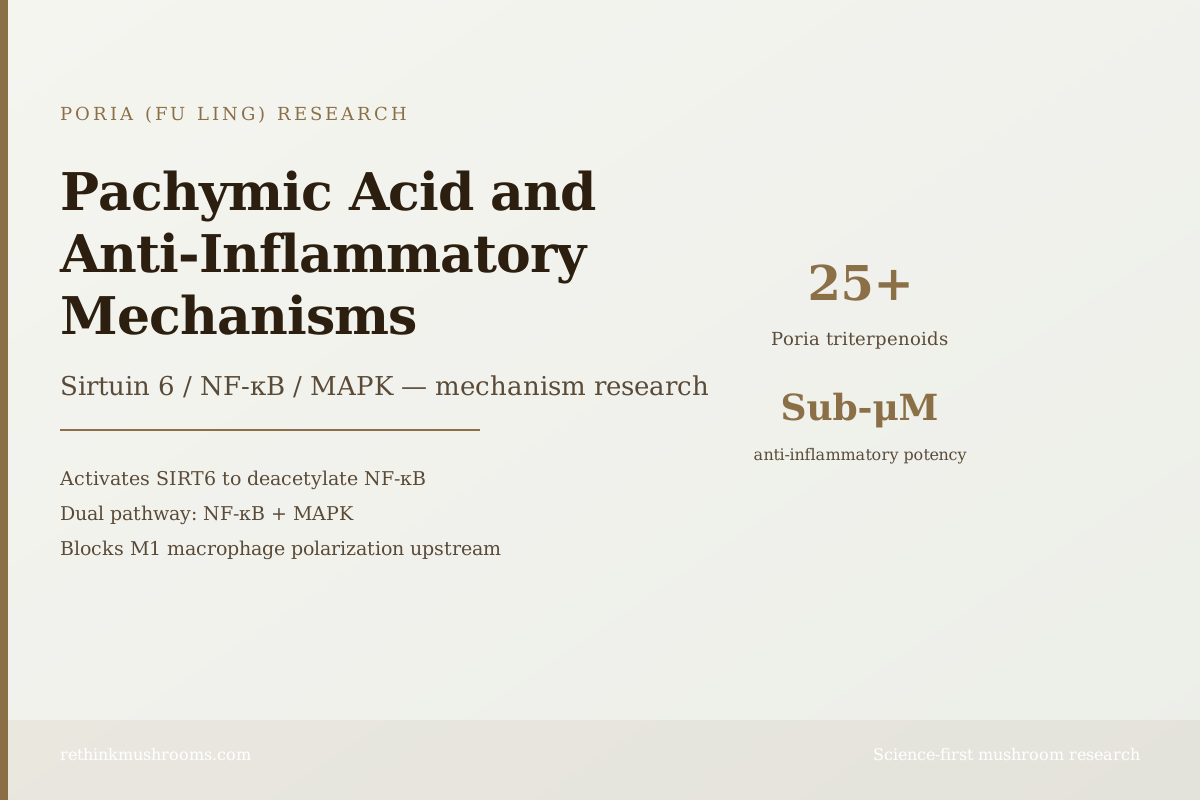
Sub-micromolar anti-inflammatory activity (Ding 2017)
Bioactivity-guided isolation found that Poria triterpenoids, including pachymic acid, suppress TNF-α and IL-6 production in macrophages at sub-micromolar concentrations, a level of potency comparable to pharmaceutical reference compounds.
Ding H et al., Bioorganic & Medicinal Chemistry Letters, 2017
SIRT6/NF-κB
the specific epigenetic mechanism identified by Wu 2023, the first study to map this pathway for pachymic acid
Dual pathway
pachymic acid simultaneously inhibits NF-κB and MAPK (p38 + ERK1/2) in inflammatory models
2026 review
most current Poria pharmacology synthesis confirms NF-κB as the central anti-inflammatory mechanism
Ding H et al., Bioorganic & Medicinal Chemistry Letters, 2017
 View as image ↗
Poria cocos, the mushroom known in traditional Chinese medicine as Fu Ling, contains more than 25 distinct compounds in the triterpenoid class. Pachymic acid is the most abundant and most pharmacologically studied among them for pachymic acid anti-inflammatory effects. A 2026 narrative review published in Frontiers in Nutrition, covering the full pharmacological profile of Poria cocos across multiple disease domains, confirmed that NF-κB pathway inhibition is the central mechanism for Poria triterpenoids' anti-inflammatory activity.[1] Three independent studies published in 2021–2023 have now mapped this mechanism to a precision that consumer health writing has not covered: pachymic acid blocks NF-κB through an epigenetic protein called Sirtuin 6, simultaneously suppresses a parallel inflammatory pathway called MAPK, and works upstream by preventing macrophages from entering the pro-inflammatory state in the first place. The broader overview of Poria cocos and its compound profile is at the what is Poria guide.
Key Takeaways
- Pachymic acid is a lanostane-type triterpenoid and the primary anti-inflammatory bioactive in Poria cocos, one of more than 25 compounds in the same structural class
- Its core NF-κB mechanism runs through Sirtuin 6 activation: Sirtuin 6 removes a chemical tag from NF-κB that it needs to activate inflammatory genes, blocking production of TNF-α, IL-1β, IL-6, and COX-2 (Wu et al., 2023)
- In an LPS-induced pneumonia model, pachymic acid simultaneously inhibited NF-κB p65 and both branches of the MAPK pathway (p38 and ERK1/2), reducing inflammatory cytokines and cell death markers (Guo et al., 2021)
- Pachymic acid blocks M1 macrophage polarization (the process by which macrophages shift into their pro-inflammatory state), working upstream of cytokine production (Liu et al., 2023)
- Bioactivity-guided isolation of seven Poria triterpenoids found sub-micromolar anti-inflammatory activity for the most potent compounds, suppressing TNF-α and IL-6 in macrophages at very low concentrations (Ding et al., 2017)
- A 2025 review identified a separate kidney-protection mechanism: pachymic acid activates Nrf2/GPX-4 signaling to protect kidney cells against ferroptosis (iron-driven oxidative cell death)
What Pachymic Acid Is (and What It Isn't)
Pachymic acid is not the same as Poria cocos. It is one specific compound extracted from Poria cocos, belonging to a large structural family called lanostane-type triterpenoids. Think of the relationship like this: Poria cocos is the mushroom, and pachymic acid is one of the active molecules inside it, the way curcumin is in turmeric.
Poria cocos contains three primary bioactive classes, identified in a foundational 2011 review by Zhao: lanostane triterpenoids (the class containing pachymic acid and more than 25 related compounds), beta-glucan polysaccharides, and ergosterols.[6] These compound classes have distinct mechanisms. The triterpenoids, including pachymic acid, work on inflammation primarily by suppressing inflammatory signaling proteins. The polysaccharides work on immunity primarily through pattern-recognition receptors that activate the body's innate immune response.
Pachymic acid is the most abundant and most studied of the triterpenoids. It is a large molecule built on a four-ring carbon scaffold, chemically related to steroids and to compounds found in other medicinal plants. What makes it pharmacologically interesting is its selectivity: it targets specific proteins in the inflammatory cascade at concentrations that don't appear to cause general cell toxicity, which is why bioactivity-guided studies keep returning to it as the most promising compound in the Poria triterpene family.
Pachymic acid is present in Poria cocos extract products, but concentration varies significantly by extraction method. Hot-water extracts are better suited for polysaccharide concentration; ethanol or other solvent extracts are needed to obtain meaningful triterpenoid content. This distinction matters for anyone choosing a Poria supplement based on the anti-inflammatory evidence.
How Pachymic Acid Reduces Inflammation: The Snippet Answer
Pachymic acid reduces inflammation through two main signaling pathways. First, it activates a protein called Sirtuin 6, which removes a chemical activation tag from NF-κB (the cell's master inflammatory switch), preventing NF-κB from turning on inflammatory genes. Second, it separately inhibits the MAPK pathway, specifically the p38 and ERK1/2 branches, which also drive production of TNF-α, IL-1β, IL-6, and other inflammatory mediators. These two actions reduce inflammatory cytokine production through independent but complementary routes.
The NF-κB Master Switch: What It Is and Why Blocking It Matters
To understand what pachymic acid does, it helps to understand what NF-κB is.
NF-κB is a protein that sits in cells throughout the body waiting to respond to stress signals. When a cell senses damage, infection, or inflammatory signals, NF-κB gets activated and travels from the cell fluid into the nucleus, where it turns on dozens of genes that produce inflammatory molecules: TNF-α (a key pro-inflammatory signaling protein), IL-1β (another inflammatory messenger), IL-6 (a signaling protein involved in acute inflammation and many chronic conditions), COX-2 (the enzyme that produces inflammatory prostaglandins and is the target of ibuprofen), and iNOS (which produces inflammatory nitric oxide).
This system is necessary for fighting infection and healing injury. The problem in chronic inflammatory conditions is that NF-κB stays activated when it shouldn't be, producing a sustained low-level inflammatory state that damages tissue over time. Osteoarthritis, inflammatory bowel disease, kidney fibrosis, and many other conditions involve dysregulated NF-κB activation as a core mechanism.
Pharmaceutical researchers have spent decades looking for safe NF-κB inhibitors. Most candidates that block NF-κB effectively are also toxic to cells. Pachymic acid's mechanism is notable because it doesn't block NF-κB directly; it works through a regulatory protein that naturally modulates NF-κB.
The Sirtuin 6 Mechanism: The Most Precise Anti-Inflammatory Pathway Identified for Pachymic Acid
In 2023, Wu and colleagues published a study in International Immunopharmacology testing pachymic acid in an osteoarthritis model.[2] This study produced the most mechanistically precise data available for pachymic acid's anti-inflammatory action.
The key finding involves a protein called Sirtuin 6, or SIRT6. SIRT6 is an enzyme that removes acetyl groups (small chemical tags) from other proteins. One of its targets is NF-κB. When SIRT6 removes the acetyl group from NF-κB, it inactivates NF-κB and prevents it from entering the nucleus to activate inflammatory genes. In the unstimulated resting cell, this is how NF-κB stays quiet. In inflammation, something disrupts this regulation.
Pachymic acid, in the Wu 2023 model, activated SIRT6. Higher SIRT6 activity meant NF-κB spent more time in the inactivated, deacetylated state. The result: significantly reduced COX-2, iNOS, TNF-α, IL-1β, and IL-6 production in inflamed chondrocytes (the cells that make up joint cartilage). Cartilage degradation in the osteoarthritis model was also significantly reduced.
This is a more sophisticated mechanism than simple direct NF-κB blocking. Pachymic acid is working through the body's own natural regulatory system, enhancing what SIRT6 already does rather than imposing an external block on a pathway the cell needs.
Osteoarthritis is a condition of chronic joint inflammation and cartilage breakdown, driven substantially by NF-κB activity in chondrocytes. The Sirtuin6/NF-κB mechanism makes pachymic acid directly mechanistically relevant to this condition, which is why the Wu 2023 data appears in the deeper explanation of can pachymic acid help with arthritis.
Upstream Action: Blocking Macrophages Before They Go Inflammatory
Macrophages are the body's primary inflammatory response cells. When they encounter an injury signal, a pathogen, or an inflammatory stimulus, they switch into a pro-inflammatory state called M1 polarization. In M1 mode, macrophages produce large amounts of TNF-α, IL-1β, and IL-6, and release reactive oxygen species that amplify local tissue damage. Most anti-inflammatory interventions target the downstream products of this process: the cytokines themselves.
Pachymic acid appears to work further upstream. Liu and colleagues in 2023 tested pachymic acid in a hemorrhagic shock model in International Immunopharmacology.[3] The result: pachymic acid blocked M1 macrophage polarization by inhibiting NF-κB p65 nuclear translocation, preventing NF-κB from entering the nucleus before the macrophage had switched into its inflammatory state.
The downstream consequence was reduced TNF-α and IL-1β alongside increased IL-10, an anti-inflammatory signaling molecule. Working upstream at the macrophage polarization step means pachymic acid potentially reduces the full downstream cascade rather than targeting individual cytokines after they are already produced.
This macrophage mechanism is a significant finding that does not appear in any consumer content on Poria cocos. It changes the framing from "Poria reduces inflammation" to "Poria prevents macrophages from entering inflammatory mode through a specific molecular switch."
The Dual Pathway: NF-κB and MAPK Together
In 2021, Guo and colleagues published a study in Allergologia et Immunopathologia testing pachymic acid in an LPS-induced pneumonia model.[4] LPS (lipopolysaccharide) is a bacterial cell wall component that reliably triggers a strong acute inflammatory response in animals, making it a standard model for testing anti-inflammatory compounds.
Pachymic acid, in this model, simultaneously reduced NF-κB p65 expression AND inhibited both p38 and ERK1/2, the two main arms of the MAPK pathway. The MAPK pathway (mitogen-activated protein kinase) is a separate but parallel inflammatory signaling cascade. It activates independently of NF-κB in many inflammatory contexts, which means blocking NF-κB alone leaves MAPK-driven inflammation intact. Compounds that block both pathways simultaneously provide broader anti-inflammatory coverage.
The LPS pneumonia model showed reduced TNF-α, IL-1β, IL-6, and reduced apoptosis (cell death) markers in lung tissue. Pachymic acid produced these effects without causing general cell toxicity, an important distinction that the Guo 2021 paper addressed directly.
The 2026 Frontiers review synthesized evidence from across the pachymic acid literature and confirmed that this dual NF-κB/MAPK inhibition is a consistent finding across multiple study contexts, not an artifact of one model.[1]
Structure-Activity Relationships: Which Triterpenoids Are Most Active?
Poria cocos contains more than 25 triterpenoids in the lanostane class. Not all of them have equal anti-inflammatory potency. Ding and colleagues in 2017 conducted a bioactivity-guided isolation study in Bioorganic and Medicinal Chemistry Letters, testing seven purified lanostane triterpenoids from Poria cocos sclerotium for anti-inflammatory activity in macrophages.[5]
The most potent compounds suppressed LPS-induced TNF-α and IL-6 production in macrophages at sub-micromolar concentrations, meaning in extremely small amounts. The study established structure-activity relationships showing which features of the lanostane backbone contribute most to anti-inflammatory activity. Pachymic acid was among the most potent compounds in the comparison.
This structural specificity has practical implications. It means that the anti-inflammatory potency of a Poria cocos product depends on its specific triterpenoid content, not just the total amount of Poria extract. Products that standardize for total polysaccharide content may have variable triterpenoid levels. For the anti-inflammatory mechanisms specifically, a product standardized for triterpenoid content, not just beta-glucan percentage, is more likely to deliver meaningful doses of pachymic acid and related compounds.
An Additional Mechanism: Kidney Protection via Nrf2/GPX-4
Beyond the NF-κB and MAPK pathways, a 2025 review by Zhao and colleagues in the Journal of Ethnopharmacology identified a distinct additional mechanism for pachymic acid specifically in kidney tissue.[7]
This mechanism involves a cellular defense system built around a protein called Nrf2. Nrf2 is the cell's antioxidant master switch; when activated, it turns on genes that produce protective antioxidant enzymes, including GPX-4 (glutathione peroxidase 4). GPX-4 is specifically protective against a form of cell death called ferroptosis. Ferroptosis occurs when iron accumulates inside cells and drives oxidative damage to cell membranes, rupturing them. This type of cell death is particularly relevant to kidney injury, where iron accumulation and oxidative damage are common features of both acute and chronic disease.
Pachymic acid, in kidney cell models, activated the Nrf2/GPX-4 protective pathway, reducing ferroptotic cell death. This mechanism is completely separate from the NF-κB/MAPK anti-inflammatory action and represents pachymic acid's role in a specific cellular stress pathway relevant to kidney health. The kidney-specific inflammation evidence is covered in more depth in Fu Ling and kidney inflammation.
What the Evidence Doesn't Show Yet
All of the mechanistic evidence for pachymic acid's anti-inflammatory effects comes from animal models and cell studies. No human clinical trials have tested pachymic acid specifically for inflammatory outcomes. The Guo 2021 LPS model, the Wu 2023 osteoarthritis model, and the Liu 2023 hemorrhagic shock model are all controlled laboratory contexts, not clinical studies in people.
The 2026 Frontiers narrative review is honest about this gap: the mechanistic evidence is detailed and consistent, and the compound's activity at sub-micromolar concentrations in multiple models is pharmacologically meaningful, but the translation to human doses and clinical outcomes has not been formally tested.[1]
For context on how pachymic acid and broader Poria evidence applies to specific chronic conditions, the companion article on Poria for chronic inflammatory conditions covers osteoarthritis, ulcerative colitis, hyperuricemia, and gut barrier inflammation with the condition-specific mechanistic studies. The NF-κB-specific pathway article is at Poria and inflammation: NF-κB pathway research. The compound profile for Poria as a whole is at Poria bioactive compounds.
The Bottom Line
Pachymic acid is the primary anti-inflammatory compound in Poria cocos, working through two main pathways: activating Sirtuin 6 to block NF-κB (the master inflammatory switch) through deacetylation, and suppressing the parallel MAPK pathway (p38 and ERK1/2). It also works upstream by blocking macrophages from entering their pro-inflammatory M1 state. A 2025 review identified a separate Nrf2/GPX-4 mechanism for kidney protection against ferroptosis. Bioactivity-guided studies confirm sub-micromolar potency for the most active triterpenoids. The mechanistic evidence is well-characterized in preclinical research; no human clinical trials for anti-inflammatory outcomes have been published.
Frequently Asked Questions
Sources & References
- 1. Source details for this reference are not yet available.
- 2RTHM-01823·Wu, Yifan et al. (2023). “Pachymic acid suppresses the inflammatory response of chondrocytes and alleviates the progression of osteoarthritis via regulating the Sirtuin 6/NF-κB signal axis..” International immunopharmacology.Study breakdown →PubMed →↩
- 3RTHM-01740·Liu, Zhenfeng et al. (2023). “Pachymic Acid Prevents Hemorrhagic Shock-Induced Cardiac Injury by Suppressing M1 Macrophage Polarization and NF-[Formula: see text]B Signaling Pathway..” The American journal of Chinese medicine.Study breakdown →PubMed →↩
- 4. Source details for this reference are not yet available.
- 5. Source details for this reference are not yet available.
- 6. Source details for this reference are not yet available.
- 7. Source details for this reference are not yet available.