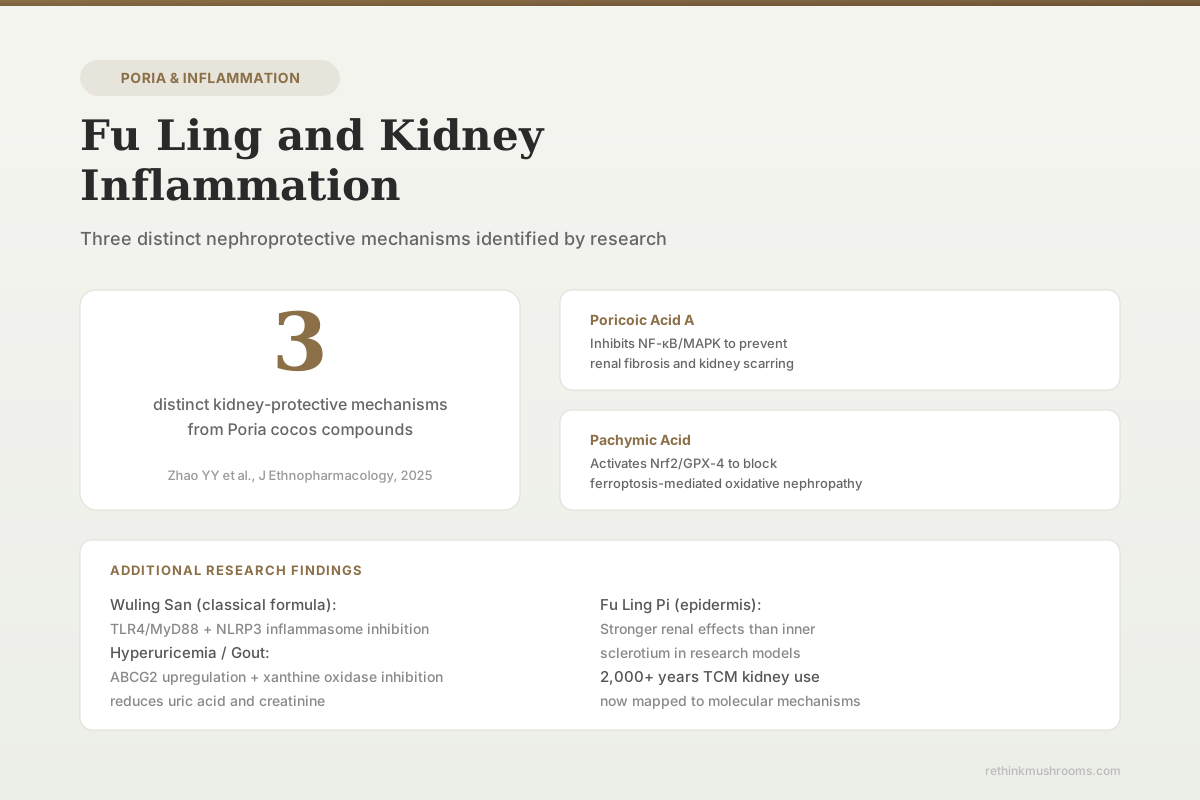
Poria & Inflammation
3 distinct kidney-protective mechanisms
Modern research has identified three separate pathways through which Poria cocos compounds protect kidney tissue: poricoic acid A prevents renal fibrosis, pachymic acid blocks oxidative nephropathy, and polysaccharides suppress TLR4-driven kidney inflammation.
Zhao YY et al., Journal of Ethnopharmacology, 2025
Poricoic Acid A
prevents renal fibrosis via NF-κB/MAPK inhibition
Pachymic Acid
activates Nrf2/GPX-4 to block kidney cell ferroptosis
Fu Ling Pi
epidermis shows stronger renal effects than inner sclerotium
Zhao YY et al., Journal of Ethnopharmacology, 2025
 View as image ↗
Fu ling has been the primary herb in Chinese medicine for kidney support for over 2,000 years. It appears in Wuling San, one of the most prescribed classical formulas for urinary and kidney complaints, and in Ba Wei Di Huang Wan, used for aging-related kidney decline. For most of that history, the rationale was empirical: fu ling works for kidney issues, and generations of clinical observation confirmed it.
What modern research has added is mechanism. A 2025 review in the Journal of Ethnopharmacology mapped the specific molecular pathways through which Poria cocos compounds protect kidney tissue, identifying three distinct routes that correspond to three different types of kidney damage.[1] The research does not prove that fu ling supplementation treats kidney disease in humans. It does explain, at the molecular level, why the traditional application has biological plausibility across several different kidney pathologies.
This article covers what the nephroprotective research shows, how the three mechanisms work, and what the evidence limitations are. For the broader Poria cocos overview and its history in TCM, see what is Poria (Fu Ling): one of the most important mushrooms in TCM.
Key Takeaways
- Poricoic acid A (PAA), a triterpenoid from the Poria cocos epidermis (fu ling pi), prevents renal fibrosis by inhibiting NF-κB and MAPK signaling, reducing the inflammatory cascade that triggers progressive kidney scarring (Zhao YY et al., J Ethnopharmacology, 2025)
- Pachymic acid protects kidney cells from ferroptosis-mediated oxidative nephropathy by activating Nrf2/GPX-4, a mechanism distinct from its NF-κB anti-inflammatory action (Zhao YY et al., 2025)
- The Poria cocos epidermis (fu ling pi) shows stronger renoprotective effects than the inner sclerotium in research models, a distinction that is absent from commercial supplement labeling (Zhao YY et al., 2025)
- Wuling San, the classical TCM formula containing Poria cocos, protects kidney function by specifically inhibiting TLR4/MyD88 signaling and blocking NLRP3 inflammasome activation (Liu YH et al., J Ethnopharmacology, 2015)
- Poria cocos extract reduced serum uric acid and creatinine in hyperuricemic mice by upregulating the ABCG2 urate transporter and inhibiting xanthine oxidase, with documented reduction in kidney inflammatory infiltration (Zhong Y et al., Food & Function, 2021)
- Urinary and renal metabolomic studies confirm that Poria cocos epidermis normalizes amino acid, TCA cycle, and purine metabolic disruptions in early renal injury animal models (Li et al., 2013; Zhao YY et al., 2013)
Three Ways Fu Ling Protects the Kidney: A Framework
The kidney is a complex organ with multiple distinct failure modes. Renal fibrosis, oxidative nephropathy, and inflammasome-driven acute inflammatory injury are three different processes, and they respond to different therapeutic mechanisms. What the 2025 Zhao review establishes is that Poria cocos contains three separate active compounds that address three of these processes through different pathways.[1]
The 2026 Frontiers in Nutrition comprehensive review of Poria cocos pharmacology confirms nephroprotection as one of its established research domains, alongside anti-inflammatory, antitumor, and gut health effects.[6]
Poricoic acid A targets inflammatory fibrosis via NF-κB and MAPK pathway inhibition.
Pachymic acid targets oxidative nephropathy via Nrf2/GPX-4 activation, blocking a form of cell death called ferroptosis.
Polysaccharides (as formulated in Wuling San) target TLR4/MyD88-driven inflammatory kidney injury and NLRP3 inflammasome activation.
These are not redundant mechanisms working on the same target. They are different compounds addressing different aspects of kidney injury, which may explain why fu ling has broad traditional utility across multiple kidney presentations.
Poricoic acid A and pachymic acid are both lanostane triterpenoids found in the Poria cocos sclerotium, particularly concentrated in the epidermis. For more on these compound classes, see Poria bioactive compounds: pachymic acid, triterpenoids, and beta-glucans.
Poricoic Acid A: Preventing Renal Fibrosis
Renal fibrosis is the process by which healthy kidney tissue is progressively replaced by scar tissue following injury or chronic inflammation. It is the common endpoint of many forms of chronic kidney disease and is largely what turns early kidney damage into progressive CKD. Once established, fibrosis is difficult to reverse.
Poricoic acid A (PAA) prevents this process by acting on the NF-κB and MAPK signaling pathways that trigger the inflammatory cascade leading to fibrotic remodeling.[1] NF-κB (the master switch for inflammatory gene expression) and MAPK (particularly p38 and ERK1/2) are both upstream activators of the cytokine production and myofibroblast differentiation that drive fibrosis. PAA inhibits both.
Critically, the Zhao 2025 review notes that Poria cocos epidermis (fu ling pi) shows stronger renoprotective effects than the inner sclerotium in research models. This distinction is not reflected in most commercial supplements, which typically use the whole sclerotium without specifying epidermis content. In traditional Chinese medicine, fu ling pi (the outer layer) and fu ling (the whole sclerotium) are classified as distinct medicinal materials with different primary applications, and the research supports this distinction for renal effects.
The NF-κB/MAPK pathway connection also links poricoic acid A to the broader anti-inflammatory mechanisms of Poria's triterpenoids. For the full pathway discussion, see Poria and inflammation: NF-κB pathway research.
Pachymic Acid: Blocking Ferroptosis-Mediated Kidney Damage
The second mechanism is distinct and less widely known. Pachymic acid, the most pharmacologically studied Poria triterpenoid, protects kidney cells through a different pathway: activation of Nrf2 and GPX-4, which together suppress ferroptosis.[1]
Ferroptosis is a form of iron-dependent cell death driven by lipid peroxidation, where the accumulation of oxidized lipids in cell membranes kills the cell. It is distinct from classical apoptosis and is increasingly recognized as a driver of kidney damage in conditions involving oxidative stress, including ischemia-reperfusion injury, cisplatin nephrotoxicity, and acute tubular injury.
GPX-4 (glutathione peroxidase 4) is the primary enzyme that neutralizes lipid peroxides before they trigger ferroptosis. Nrf2 (nuclear factor erythroid 2-related factor 2) is the transcription factor that upregulates GPX-4 and other antioxidant enzymes. Pachymic acid activates this Nrf2/GPX-4 axis, preserving kidney cell survival under oxidative stress.
This mechanism is entirely separate from pachymic acid's NF-κB inhibition. The same compound appears to target inflammation via one pathway and oxidative cell death via another, suggesting it has broader nephroprotective utility than either mechanism alone would provide.
For more on pachymic acid's anti-inflammatory mechanism across different conditions, see pachymic acid and anti-inflammatory mechanisms and the pharmacology of Wolfiporia extensa: how Poria works.
Wuling San and the TLR4/NLRP3 Mechanism
Wuling San is one of the oldest and most prescribed classical TCM formulas. It contains Poria cocos alongside Alisma orientale (ze xie), Polyporus umbellatus (zhu ling), Atractylodes macrocephala (bai zhu), and Cinnamomum cassia (gui zhi). The formula is indicated in classical texts for "water metabolism disorders," a TCM framework encompassing edema, dysuria, and kidney-related fluid retention.
Liu and colleagues tested Wuling San in a kidney dysfunction model and identified the specific molecular target: TLR4/MyD88 signaling and NLRP3 inflammasome activation.[3]
TLR4 (Toll-like receptor 4) is a pattern recognition receptor on immune cells that detects signals of tissue damage and infection. When activated, TLR4 recruits MyD88 as an adaptor protein, triggering a cascade that culminates in NF-κB activation and, in the kidney context, NLRP3 inflammasome assembly. NLRP3 then activates caspase-1, which processes and releases IL-1β and IL-18, both potent pro-inflammatory cytokines that drive acute kidney injury.
Wuling San blocked this entire cascade, protecting kidney function by preventing the initial TLR4/MyD88 signal from progressing to NLRP3-mediated inflammation.
The practical significance of this study is that it connects a 2,000-year-old clinical observation (fu ling helps kidney function) to a specific and measurable molecular mechanism. The formula works not by vague "kidney tonification" but by interrupting a defined inflammatory signaling pathway at the receptor level.
The Hyperuricemia Connection: Gout and Kidney Inflammation
One of the most searchable and practically relevant aspects of the fu ling kidney research involves hyperuricemia (elevated uric acid) and gout. Gout is caused by uric acid crystal deposition, and chronic hyperuricemia causes kidney inflammation and progressive nephropathy independent of acute gout attacks.
Zhong and colleagues found that Poria cocos extract reduced serum uric acid and creatinine levels in hyperuricemic mice through a dual mechanism.[2] First, it upregulated ABCG2, a urate transporter in the kidney that increases uric acid excretion. Second, it inhibited xanthine oxidase, the enzyme responsible for uric acid production from purines. Both mechanisms reduce the total uric acid burden.
Beyond the uric acid reduction, Poria cocos treatment reduced inflammatory infiltration in the kidney tissue, suggesting it also directly addresses the kidney inflammation that hyperuricemia causes rather than just lowering the circulating urate levels that trigger it.
Gout and hyperuricemia represent a practical patient population where the traditional TCM use of fu ling for kidney and urinary complaints connects most directly to a searchable modern condition with measurable biomarkers.
Metabolomic Validation: What Kidney Profiles Show
Two studies from the same research group used metabolomic methods to characterize what Poria cocos epidermis does to renal biochemistry in early kidney injury models, providing a complementary lens to the mechanistic pathway research.
Li and colleagues used UPLC mass spectrometry to profile kidney metabolites in adenine-induced chronic kidney injury rats treated with Poria cocos epidermis.[4] The metabolite profiles showed normalization of amino acid metabolism, TCA cycle intermediates, and nucleotide metabolic pathways that had been disrupted by kidney injury.
Zhao and colleagues complemented this with urinary metabolomic analysis, finding that Poria cocos epidermis treatment improved creatinine clearance and normalized urinary markers of purine metabolism and TCA cycle function that had been elevated in chronic renal injury.[5]
These studies do not identify specific single mechanisms. What they provide is a functional readout: when you give Poria cocos epidermis to animals with early kidney injury and look at the biochemical fingerprint of their kidney tissue and urine, it looks more like healthy kidney biochemistry. The metabolomic approach validates the direction of effect at a systems level, complementary to the pathway-specific mechanistic studies.
Evidence Limits and Safety Context
Every study described in this article is from animal models or cell culture. No human randomized controlled trial has tested Poria cocos or fu ling specifically for kidney inflammation outcomes. The human evidence that exists is largely observational, from the traditional clinical use context rather than controlled trials.
This matters for interpreting the research. The mechanistic evidence is strong and multi-pronged. The animal data consistently shows effects in the right direction. But preclinical evidence does not guarantee human efficacy, and the specific doses and preparations used in animal models frequently do not correspond to commercially available supplements.
The safety note from the studyNotes deserves specific mention: people with severe or established chronic kidney disease (CKD) should exercise caution. While Poria cocos appears nephroprotective in models of early renal injury, patients with significantly reduced kidney function have altered drug and supplement metabolism, and any supplementation in this context warrants physician consultation.
For the broader chronic inflammatory condition context, including how Poria's mechanisms apply to conditions beyond the kidney, see Poria for chronic inflammatory conditions and Poria and gut barrier function: reducing intestinal permeability.
The Bottom Line
Modern research identifies three distinct nephroprotective mechanisms in Poria cocos: poricoic acid A prevents renal fibrosis via NF-κB/MAPK inhibition, pachymic acid blocks ferroptosis-mediated oxidative nephropathy via Nrf2/GPX-4 activation, and polysaccharides (as formulated in Wuling San) suppress TLR4/MyD88 and NLRP3 inflammasome-driven kidney inflammation. A hyperuricemia model shows the same compound reduces uric acid via ABCG2 upregulation and xanthine oxidase inhibition, with direct reduction in kidney inflammatory infiltration. Metabolomic studies confirm Poria cocos epidermis normalizes disrupted kidney biochemistry in early injury models. All evidence is preclinical; no human RCTs exist for kidney-specific outcomes.
Frequently Asked Questions
Sources & References
- 1. Source details for this reference are not yet available.
- 2. Source details for this reference are not yet available.
- 3. Source details for this reference are not yet available.
- 4. Source details for this reference are not yet available.
- 5. Source details for this reference are not yet available.
- 6. Source details for this reference are not yet available.