Psilocybin vs. SSRIs for Depression
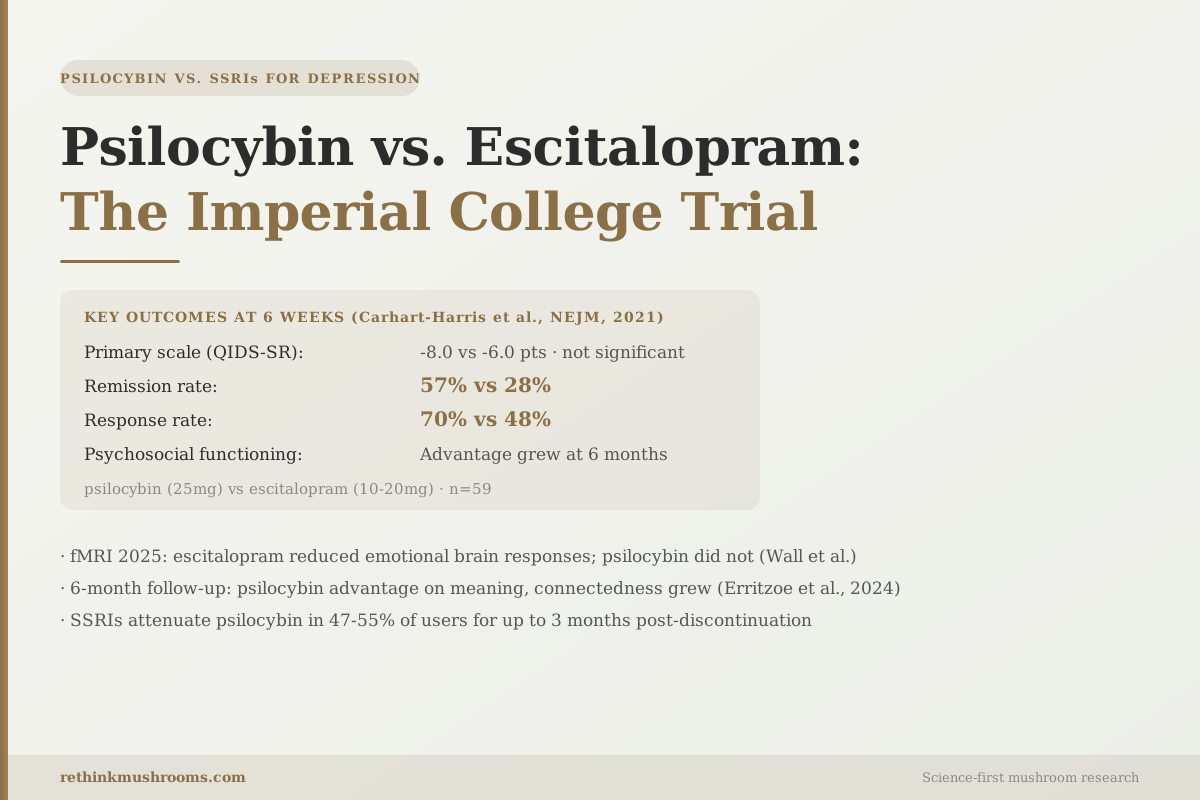
57% psilocybin remission rate vs 28% for escitalopram
The 2021 Imperial College trial found no statistically significant difference on its primary depression scale, but secondary outcomes told a substantially different story.
Carhart-Harris et al., New England Journal of Medicine, 2021
70% vs 48%
response rate: psilocybin vs escitalopram
6-month advantage grew
psilocybin psychosocial gains increased over time (Erritzoe 2024)
fMRI substudy 2025
escitalopram reduced emotional brain responses; psilocybin did not (Wall)
Carhart-Harris et al., New England Journal of Medicine, 2021
 View as image ↗
The 2021 Imperial College trial published in the New England Journal of Medicine was the first direct comparison of psilocybin-assisted therapy and an SSRI antidepressant in the same clinical trial. Its headline result, described as "no significant difference" between the two treatments on the primary depression scale, became the most widely misread finding in recent psychedelic research.[1]
What that headline missed: on every secondary outcome measured, psilocybin performed substantially better than escitalopram. Remission at six weeks was 57% for psilocybin versus 28% for escitalopram. Response rates were 70% versus 48%. Improvements in well-being, emotional functioning, and psychological connectedness all favored psilocybin. These numbers appeared in the same paper as the "no significant difference" result. Most coverage ignored them.
This article is a complement to the overview of the Imperial College head-to-head trial. It goes deeper into trial design, why the primary outcome behaved the way it did, and what three subsequent studies published in 2024 and 2025 revealed about the original findings. Both articles sit within the broader psilocybin for depression evidence base.
Key Takeaways
- The primary depression scale showed no statistically significant difference (-8.0 vs -6.0 points), but the trial had only 59 participants, not enough to confirm a 2-point difference as statistically significant (Carhart-Harris et al., 2021)
- Every secondary outcome favored psilocybin: remission 57% vs 28%, response 70% vs 48%, and greater improvements in well-being, emotional functioning, and psychological connectedness
- Both groups received psilocybin; the control was 1mg, not a placebo: a 25mg psychedelic experience cannot be credibly blinded against an inactive pill
- At 6-month follow-up, the psilocybin advantage on psychosocial functioning and meaning in life grew more pronounced over time, not less (Erritzoe et al., 2024)
- A 2025 fMRI substudy found escitalopram reduced emotional brain responses to facial expressions across multiple brain regions including the amygdala; psilocybin produced no such reduction (Wall et al., 2025)
- SSRIs attenuate psilocybin effects in 47-55% of users, with the dampening persisting up to 3 months after stopping the SSRI (Gukasyan et al., 2023)
Why the Control Group Got Psilocybin Too, and What That Did to the Headline Result
The trial enrolled 59 people with moderate-to-severe major depressive disorder.[1] One group received two doses of 25mg psilocybin alongside daily placebo capsules. The other received two doses of 1mg psilocybin alongside daily 10-20mg escitalopram capsules.
Both groups received psilocybin. The 1mg dose was chosen as the active control because a 25mg psilocybin dose produces a distinctive, unmistakable experience. Blinding a participant who has just spent several hours in an altered state against someone who took an inactive sugar pill is not credible. The researchers needed a comparator that created a similar experience of receiving what appeared to be psilocybin therapy, while delivering a dose low enough that most participants would not experience meaningful psychedelic effects.
This design choice has a consequence that most coverage ignores. The 1mg control group was not an inactive placebo group. Sub-threshold psilocybin doses may carry mild pharmacological activity in some participants. If the control group experienced any benefit from even a small amount of psilocybin, that would reduce the observable gap between groups on the primary scale, making a statistically significant difference harder to detect.
Additionally, participants in the escitalopram arm were restarting an antidepressant they may have previously tried and found insufficient. Beginning escitalopram in a trial context primarily focused on psilocybin is a different psychological experience from being prescribed it as a fresh first-line treatment. These contextual differences are standard challenges in any psychotherapy-adjacent clinical trial. The authors acknowledge them.
Both factors pull in the same direction: compressing the measurable difference between groups on the primary scale. Understanding this is essential before interpreting any of the outcomes.
The Primary Outcome Said 'No Significant Difference.' Here Is What That Actually Means.
The primary endpoint was change in QIDS-SR-16 score from baseline to six weeks. This is a self-reported 16-item depression scale scored from 0 to 27. The psilocybin group improved by 8.0 points. The escitalopram group improved by 6.0 points. The difference was not statistically significant.[1]
"Not statistically significant" does not mean "the same." It means the study lacked sufficient participants to rule out chance as an explanation for the observed 2-point gap. With 59 participants, the trial had statistical power to detect a roughly 5-point difference between groups. A 2-point difference in a 59-person trial is real but unconfirmable with that sample. A larger trial could find a 2-point difference clearly significant.
The trial was explicitly a Phase 2 proof-of-concept study. Phase 2 trials are not designed to prove superiority or equivalence. They are designed to test whether a treatment shows sufficient promise to justify a larger, fully powered Phase 3 study. The primary outcome in a Phase 2 trial is a signal, not a verdict.
Reading "no significant difference" as "the two treatments are equivalent" is applying a Phase 3 interpretation to a Phase 2 result. The paper does not make that claim. The data do not support it.
The 57% vs 28% Remission Gap That Most Coverage Buried
While the primary scale attracted most of the attention, the secondary outcomes told a clearer story.[1]
Remission means no longer meeting the diagnostic threshold for depression. In this trial, 57% of psilocybin participants reached remission at six weeks. In the escitalopram group, 28% did. That is a 29-percentage-point gap in full recovery rates.
Response, defined as at least 50% improvement from baseline, was 70% for psilocybin versus 48% for escitalopram.
For context, SSRI remission rates in standard head-to-head antidepressant trials typically range from 25-50%. The escitalopram group in this trial sat within that range. The psilocybin group exceeded it substantially.
These remission and response numbers were also not statistically significant, subject to the same sample size constraint as the primary outcome. But effect size and statistical significance are different things. A 29-percentage-point remission gap in a 59-person trial does not become clinically meaningless because it didn't reach p less than 0.05. It becomes a high-priority question for a larger trial to answer definitively.
The secondary outcomes also covered well-being, emotional intensity, connection to self and others, and meaning in life. On all of these, psilocybin outperformed escitalopram by margins that were not observed in either direction for the primary depression scale.
Three Studies Published After the Trial That Changed What the Original Results Mean
The 2021 paper captured a six-week snapshot. Three subsequent analyses extended that picture into 2024 and 2025.
The six-month follow-up, published by Erritzoe and colleagues in 2024,[2] tracked both groups after the trial ended. Both groups maintained antidepressant improvements at six months. The psilocybin group's advantage on psychosocial functioning, meaning in life, and psychological connectedness became more pronounced at six months than at six weeks. An SSRI comparison study would not typically produce this trajectory; conventional antidepressants tend to show similar outcome curves after treatment ends, not growing divergence.
A 2025 fMRI substudy by Wall and colleagues at Imperial College[3] used brain imaging to measure responses to emotional faces in participants from both groups. Escitalopram reduced brain responses to emotional faces, including happy faces, fearful faces, and neutral faces, across cortical regions including the amygdala. Psilocybin produced no reduction in emotional brain responses. For neutral faces, psilocybin actually showed slight increases in response.
This is the most direct neuroimaging evidence to date for what clinicians call emotional blunting. Both treatments reduced depression scores on the QIDS-SR by similar amounts. But the QIDS-SR cannot distinguish between someone who feels genuinely better and someone whose emotional sensitivity has been broadly dampened. The Wall 2025 data shows these two treatments achieved similar primary scale scores through mechanisms that produce different emotional brain profiles.
A second 2025 analysis by Martens and colleagues[4] examined how both treatments affected negative affective bias, the tendency in depression to interpret ambiguous emotional signals as threatening or negative. Both psilocybin and escitalopram reduced this negativity bias to comparable degrees. But escitalopram reduced overall emotional responding in the process. Psilocybin reduced the negativity without dampening the emotional response more broadly. Same destination for the bias; different effect on the broader emotional system.
The article on psilocybin and emotional reconnection vs. SSRI emotional blunting covers this distinction in detail, and the article on psilocybin and emotional processing: the opposite of blunting goes deeper into the neurobiological mechanism.
The Underpowered Problem: n=59 Cannot Prove Two Treatments Are Equal
Statistical power is the probability that a trial will detect a real difference, given the sample size and the expected effect size. The 2021 trial had 59 participants. This gives adequate power to detect large between-group differences. It does not give adequate power to confirm equivalence, or to detect a 2-point QIDS difference as statistically significant.
This is by design. Phase 2 trials are not equivalence studies. The Imperial College trial was asking: does psilocybin show enough of a signal to justify investing in a larger trial? The answer from the data was yes, specifically because the secondary outcomes showed a consistent pattern of psilocybin advantage across multiple different measures.
A separate consideration involves the SSRI interaction with psilocybin. Survey data published by Gukasyan and colleagues[5] found that current or recent SSRI use reduced psilocybin's subjective effects in 47% of cases for SSRIs and 55% of cases for SNRIs. The dampening persisted for up to three months after stopping the medication, because chronic serotonin system stimulation from SSRIs causes compensatory downregulation of 5-HT2A receptors. These are the same receptors psilocybin activates to produce its effects. Stopping an SSRI does not immediately restore receptor density to baseline.
In the Imperial College trial, participants tapered off prior SSRIs before enrollment. Some participants may have had insufficient washout time for full receptor recovery. If their 5-HT2A receptor density was still reduced from prior SSRI use, psilocybin's effects in those participants would have been attenuated. This would compress the observable gap between groups, pushing the primary outcome further away from significance.
For more on the SSRI interaction question, the article on switching from SSRIs to psilocybin therapy: what the research shows covers the Gukasyan 2023 data and the clinical implications.
What Phase 3 Trials Now Need to Answer
The Imperial College trial answered its Phase 2 question: does psilocybin show enough promise to justify a definitive larger trial? The evidence, including the remission gap, the response gap, the psychosocial advantage, and the six-month trajectory, points clearly toward yes.
Phase 3 trials with larger samples are now underway at multiple sites. What they need to produce: adequate statistical power to confirm or disconfirm the remission and response differences as real. With a sample size ten times larger, a 29-percentage-point remission gap would be straightforwardly significant if it holds. It would be disconfirmed if it shrinks in a larger population.
Phase 3 trials also need to address questions the 2021 study was not designed for: what is the optimal psilocybin dose? Which patient profiles respond best? How does the quality and duration of psychological support affect outcomes? And how does psilocybin compare not just against escitalopram but against other SSRIs, SNRIs, and evidence-based psychotherapies?
The safety database also needs to scale. In 59 participants, the safety profile of psilocybin was broadly comparable to escitalopram on most measures. This needs confirmation across thousands of participants before regulatory agencies can act.
For patients and practitioners watching this research, the Imperial College trial is most accurately understood as what it was: a well-designed Phase 2 proof-of-concept study that produced a consistent signal across multiple secondary outcomes, found a new neuroimaging distinction with clinical implications (Wall 2025), and demonstrated an advantage that grew rather than faded over six months. That is what Phase 2 trials are supposed to do. The definitive answer comes next.
The article on why psilocybin might work better than SSRIs for some patients covers which patient profiles the existing evidence most clearly supports. The article on how psilocybin helps when antidepressants fail covers the treatment-resistant population specifically.
The Bottom Line
The 2021 Imperial College trial (n=59) was the first head-to-head comparison of psilocybin and an SSRI. Its primary depression scale showed no statistically significant difference, but this reflects the trial's sample size, not proven equivalence. Secondary outcomes substantially favored psilocybin: 57% vs 28% remission, 70% vs 48% response, and greater improvements in well-being and psychosocial functioning. Three subsequent analyses found the psilocybin advantage grew at six months (Erritzoe 2024), that escitalopram reduced emotional brain responses in ways psilocybin did not (Wall 2025), and that both treatments reduced negative affective bias through different mechanisms (Martens 2025). Phase 3 trials are now underway to test these findings with adequate statistical power.
Frequently Asked Questions
Sources & References
- 1. Source details for this reference are not yet available.
- 2. Source details for this reference are not yet available.
- 3. Source details for this reference are not yet available.
- 4. Source details for this reference are not yet available.
- 5. Source details for this reference are not yet available.