Psilocybin & Emotional Processing
46% of SSRI users report emotional blunting
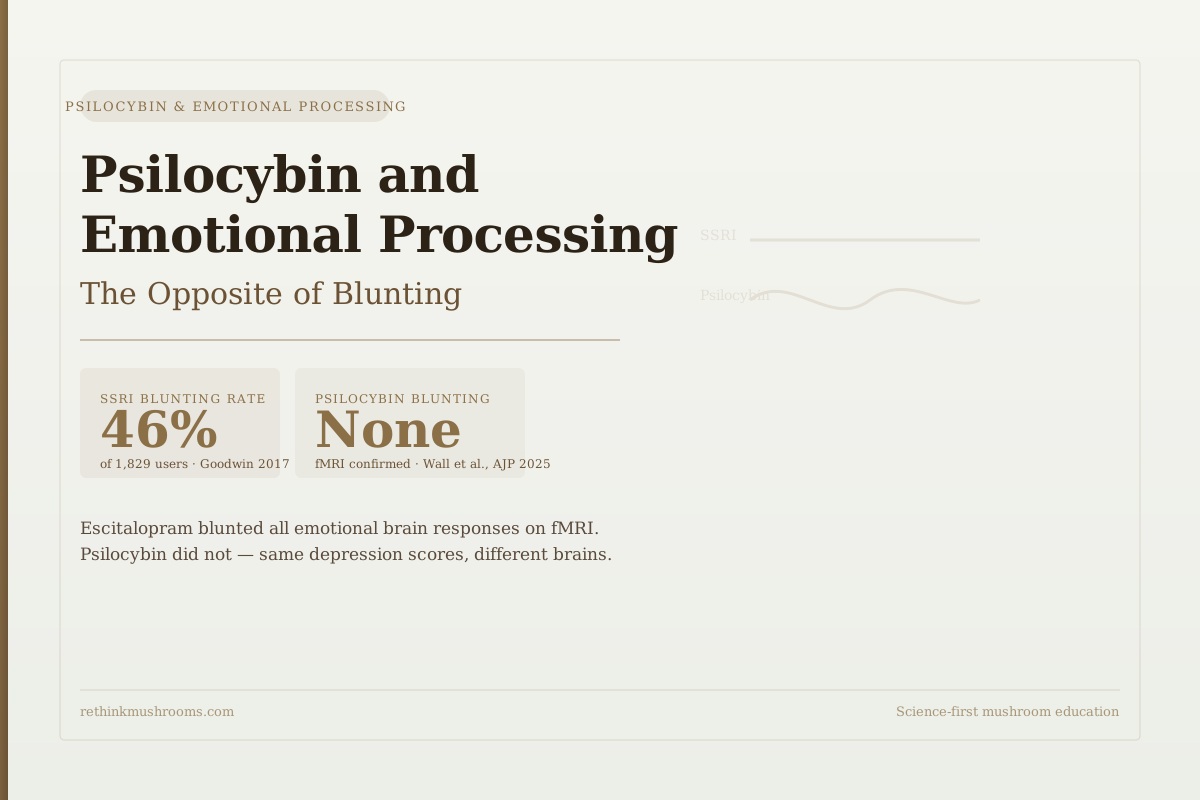
A survey of 1,829 antidepressant users found 46% reported emotional blunting. A 2025 AJP fMRI study showed psilocybin does the opposite — maintaining brain responses to emotional stimuli that escitalopram suppresses.
Goodwin et al., J Affect Disord, 2017 / Wall et al., Am J Psychiatry, 2025
1,829
antidepressant users surveyed; 46% reported emotional blunting (Goodwin 2017)
43 patients
psilocybin increased global brain integration; escitalopram did not (Daws 2022, Nature Medicine)
6 months
psilocybin emotional gains held; escitalopram group declined after stopping (Erritzoe 2024)
Goodwin et al., J Affect Disord, 2017 / Wall et al., Am J Psychiatry, 2025
 View as image ↗
In a 2017 survey of 1,829 people taking antidepressants, Goodwin and colleagues found that 46 percent reported emotional blunting.[1] The most common description was not numb sadness but numb everything: reduced pleasure, flattened reactions to good news, difficulty crying, a muted quality to experiences that should feel significant. Across individual SSRIs — citalopram, paroxetine, escitalopram, fluoxetine — prevalence ranged from 43 to 47 percent. Other surveys put the figure even higher, with 71 percent of respondents reporting they felt emotionally numbed.
This is not a rare side effect buried in a prescribing leaflet. It is the most common experience of about half of everyone on an SSRI.
In 2025, Wall and colleagues published the first direct fMRI comparison of escitalopram and psilocybin specifically measuring what each drug does to emotional brain responsiveness.[2] Escitalopram significantly reduced brain responses to all types of emotional stimuli, whether the faces shown were happy, fearful, or neutral. Psilocybin showed no such reduction. For some stimuli, it showed slight enhancement.
The difference is measurable on a brain scan. It is not a difference in clinical depression scores, which were similar between the two treatments at week six in the underlying trial. It is a difference in what happens to a person's emotional brain while they are feeling better.
This article explains what that difference is, what it means, and how it builds on eight years of neuroimaging research that points in the same direction.
For the full clinical picture of psilocybin for depression, see Psilocybin for Major Depression: The Clinical Evidence.
Key Takeaways
- 46% of 1,829 antidepressant users reported emotional blunting in Goodwin et al.'s 2017 survey, with prevalence consistent across individual SSRIs (43–47%)
- Wall et al. 2025 (Am J Psychiatry): escitalopram significantly reduced brain BOLD responses to all emotional stimuli on fMRI; psilocybin showed no blunting
- Harding et al. 2025 (Molecular Psychiatry): escitalopram reduced hedonic response to musical surprises and reduced vitality; psilocybin preserved both
- Mertens et al. 2020 found that amygdala and prefrontal connectivity changes were the direct neurobiological mediator of psilocybin's antidepressant response
- Daws et al. 2022 (Nature Medicine): psilocybin significantly increased global brain integration in 43 patients; escitalopram showed the opposite trend; integration magnitude correlated with depression reduction
- Barrett et al. 2020: positive affect remained elevated one month post-psilocybin while negative affect returned to baseline — recalibration, not permanent euphoria
The 46% Problem: SSRI Emotional Blunting Is More Common Than Most Patients Are Told
Emotional blunting from antidepressants has been documented in clinical literature since the early 1990s, but it has received limited attention in prescribing conversations and official guidance relative to how often it occurs.
Goodwin and colleagues surveyed 1,829 patients across five countries who were taking antidepressants for depression.[1] They asked specifically about emotional blunting: reduced positive emotions, reduced sadness, reduced caring about others, reduced sexual feelings. Forty-six percent reported experiencing it. The prevalence was nearly identical across the most commonly prescribed SSRIs, which suggests this is a class effect of serotonin reuptake inhibition rather than a quirk of any individual molecule.
What makes the blunting clinically significant is that it often persists alongside antidepressant efficacy. Patients can have reduced depression scores and still feel emotionally flattened. In Goodwin's survey, many patients who reported blunting also said their antidepressant was helping their depression. They were less depressed but also less present in their emotional lives.
The mechanism most often proposed is that broad serotonin enhancement reduces emotional signal-to-noise ratio. The same serotonergic action that dampens negative emotional reactivity also dampens positive emotional reactivity. The brain becomes quieter in general.
For a detailed examination of what the research shows about reversibility, see Can Psilocybin Reverse SSRI-Induced Emotional Numbness?.
What Emotional Blunting Looks Like on a Brain Scan: The 2025 AJP Landmark
Brain imaging has given researchers a direct way to measure what SSRIs and psilocybin each do to emotional processing, beyond what patients report on surveys.
Wall and colleagues published the most direct comparison yet in 2025.[2] Using fMRI data from the Imperial College London Phase 2 trial, they measured brain BOLD responses — a proxy for neural activity — to different types of emotional faces (happy, fearful, neutral) in participants treated with either escitalopram or psilocybin. BOLD stands for blood-oxygen-level-dependent, and it reflects how much a brain region activates in response to a stimulus.
Escitalopram significantly reduced BOLD responses across all face types. The brain became less reactive to emotional signals generally, regardless of whether the emotion was positive, negative, or neutral. Psilocybin showed no such across-the-board blunting. For some stimuli, responses were maintained or slightly enhanced. The amygdala, a region central to emotional processing, showed contrasting patterns between the two treatments.
Both treatments produced comparable depression score reductions at week six. The clinical scores were similar. The brains were doing something fundamentally different.
This distinction matters because it addresses a question that observational and subjective data alone cannot: is SSRI emotional blunting a real neurobiological phenomenon, not just a reporting artifact? Wall 2025 answers yes, it is visible on a brain scan.
SSRIs reduce brain responsiveness to emotional stimuli — measurable on fMRI. Wall et al. 2025 found brain responses to emotional faces significantly reduced across all types with escitalopram, but maintained or slightly increased with psilocybin. Psilocybin's emotional processing profile involves restoration of responsiveness, not suppression of it.
The Music Test: Hedonic Response, Preserved vs. Blunted
The most accessible evidence for the emotional processing difference comes not from brain scans but from a music experiment.
Harding and colleagues analyzed data from the same Imperial College trial cohort in 2025.[3] They measured something called surprise-related hedonic response: how much pleasure participants felt from unexpected good moments in music, specifically the emotional lift from harmonic surprises and resolved tension that makes certain passages of music feel rewarding. This is a behavioral measure of hedonic capacity — the ability to experience pleasure from positive stimuli.
Escitalopram reduced this hedonic response. Participants on escitalopram showed blunted pleasure spikes from the good parts of the music. They also showed reduced vitality, a measure of how alive and engaged they felt. Psilocybin participants showed neither effect: their hedonic response to musical surprises was maintained, and their vitality scores were preserved or improved.
What makes this finding striking is that both groups were equally better from a depression score perspective. The drug that reduced depression scores more cleanly on self-report was also reducing the pleasure response to music.
The music finding is the behavioral complement to the brain imaging: the hedonic circuits that SSRIs partially suppress are the same circuits psilocybin leaves intact.
For a deeper look at psilocybin specifically for anhedonia, the clinical inability to feel pleasure, see Psilocybin and Anhedonia: Restoring the Ability to Feel Pleasure.
Why the Amygdala Is Central to Both the Problem and the Solution
The amygdala is the brain's primary threat-and-reward detection region. It processes emotional signals from the environment and communicates with the prefrontal cortex, which regulates and contextualizes emotional responses. In depression, this system typically becomes dysregulated: the amygdala over-responds to negative stimuli while the prefrontal cortex loses its moderating influence. In people on long-term SSRIs, the amygdala becomes blunted across the board.
Carhart-Harris and colleagues published the first fMRI study of psilocybin in treatment-resistant depression in 2017, following 19 patients through treatment.[4] Post-treatment decreases in cerebral blood flow in the amygdala correlated with reduced depressive symptoms. Forty-seven percent of patients responded at five weeks. Patients themselves described the experience as "emotional release" — something coming loose that had been stuck.
The picture from amygdala imaging became more complex when Roseman and colleagues published their results in 2018.[5] They found that psilocybin increased right amygdala responses to emotional faces — both fearful and happy — in treatment-resistant depression patients. How much the amygdala woke up to fearful faces at one week post-treatment directly predicted how much clinical improvement patients showed. More amygdala reactivity predicted better outcomes.
This seems to contradict the Carhart-Harris finding until the mechanism becomes clear: the depressed brain has often blunted all emotional processing as a defensive adaptation. The SSRI keeps it blunted, just less painfully so. Psilocybin recalibrates it — the amygdala becomes appropriately responsive again, which is what healthy emotional processing looks like.
Mertens and colleagues formalized this in 2020 with 17 treatment-resistant depression patients.[6] They found that increased amygdala response to fearful stimuli correlated directly with clinical improvement, and that prefrontal-amygdala connectivity normalized during emotional processing after psilocybin. Their key conclusion: emotional function changes are not a side effect of psilocybin's antidepressant action. They are the mechanism. Emotional reconnection is how it works.
For the amygdala research in depth, see Psilocybin and Amygdala Reactivity: What Brain Scans Reveal About Depression Relief.
Same Depression Score, Different Brains: The Network Divergence
The Imperial College Phase 2 trial assigned 59 patients to either two doses of psilocybin with daily placebo capsules, or inactive psilocybin doses with daily escitalopram.[7] At six weeks, depression scores on the primary measure were similar between groups. The trial's primary outcome did not show a significant difference between psilocybin and escitalopram.
Secondary outcomes told a different story: wellbeing, anhedonia, emotional acceptance, and work and social functioning all favored psilocybin. These differences became the subject of several follow-up analyses that revealed what the primary score was hiding.
Daws and colleagues analyzed brain network data from the same trial in 2022.[8] Published in Nature Medicine, the study found that psilocybin significantly increased global brain integration: the degree to which different brain networks communicated across their normal boundaries. Escitalopram showed the opposite trend, slightly decreasing global integration. The magnitude of integration increase with psilocybin directly correlated with the magnitude of depression reduction. Networks that normally stay in separate functional compartments began connecting more freely.
Martens and colleagues examined affective bias in 2025, using secondary analysis from the same trial cohort.[9] Both treatments reduced negative affective bias in depression, which is the tendency to interpret ambiguous information negatively. But the neural route was different: psilocybin maintained or increased sensory and emotional integration; escitalopram showed reduced neural activation in affective brain regions. The destination was the same clinical score. The brain reached it by opposite paths.
The Gattuso and colleagues 2023 systematic review of 25 studies on psychedelics and the default mode network adds the ruminative angle.[12] Psychedelics consistently suppressed activity in the default mode network, the brain's self-referential circuit that tends toward repetitive, negative self-focused thinking in depression. Suppression of this network correlated with reduced emotional rigidity across the studies.
For a broader look at the fMRI evidence base, see What Psilocybin Does to the Depressed Brain: fMRI Studies.
One Month and Six Months: How Long the Emotional Shift Lasts
A common question about any acute pharmacological effect is whether it persists. The psilocybin experience is time-limited; the question is whether changes in emotional processing outlast the drug.
Barrett and colleagues tracked emotional measures one month after a single high dose of psilocybin in a controlled setting.[10] Positive affect remained significantly elevated at one month while negative affect had returned to baseline. Trait anxiety was also still reduced. This pattern — sustained positive affect, normalized negative affect — describes emotional recalibration, not a prolonged high. The emotional system had reset to a state where positive experiences registered more fully while distress had returned to a more proportionate level.
Erritzoe and colleagues published a six-month follow-up of the Imperial College Phase 2 trial in 2024.[11] The pattern was direct: psilocybin participants maintained their antidepressant effects at six months. Escitalopram participants who had stopped their medication after the trial period showed deterioration. On anhedonia specifically, psilocybin was significantly superior to escitalopram at six months. The ability to feel pleasure — which escitalopram had partially preserved while also blunting emotional range — held in the psilocybin group without continuous medication.
This durability difference is relevant to interpreting the emotional processing comparison. Escitalopram's blunting was present while the drug was active. Psilocybin's recalibration remained after the drug had fully metabolized. These are not the same type of intervention even when their short-term depression score reductions look comparable.
All of this evidence comes from clinical research settings with supervised psilocybin sessions and structured therapeutic support. The trials involved careful screening, preparation sessions before dosing, and integration sessions afterward. The research context, meaning the set and setting of the therapeutic environment, is part of what the studies measured.
The Bottom Line
The emotional processing difference between psilocybin and escitalopram is not a subjective impression. It is measurable on fMRI (Wall 2025: escitalopram blunted brain responses to all emotional stimuli; psilocybin did not), in behavioral tasks (Harding 2025: escitalopram blunted hedonic response to music; psilocybin preserved it), and in network architecture (Daws 2022: psilocybin increased global brain integration; escitalopram showed the opposite). The underlying mechanism, identified by Mertens 2020, involves amygdala and prefrontal recalibration as the direct mediator of antidepressant response. These effects persisted at six months in the Erritzoe 2024 follow-up. Goodwin 2017's survey finding that 46% of SSRI users report emotional blunting provides the clinical context for why this distinction matters.
Frequently Asked Questions
Sources & References
- 1RTHM-00872·Goodwin, G M et al. (2017). “Emotional blunting with antidepressant treatments: A survey among depressed patients..” Journal of affective disorders.Study breakdown →PubMed →↩
- 2. Source details for this reference are not yet available.
- 3. Source details for this reference are not yet available.
- 4RTHM-00463·Carhart-Harris, Robin L et al. (2017). “Psilocybin for treatment-resistant depression: fMRI-measured brain mechanisms..” Scientific reports.Study breakdown →PubMed →↩
- 5. Source details for this reference are not yet available.
- 6. Source details for this reference are not yet available.
- 7. Source details for this reference are not yet available.
- 8. Source details for this reference are not yet available.
- 9. Source details for this reference are not yet available.
- 10RTHM-01169·Barrett, Frederick S et al. (2020). “Emotions and brain function are altered up to one month after a single high dose of psilocybin..” Scientific reports.Study breakdown →PubMed →↩
- 11. Source details for this reference are not yet available.
- 12. Source details for this reference are not yet available.