Psilocybin & Emotional Processing
59 patients
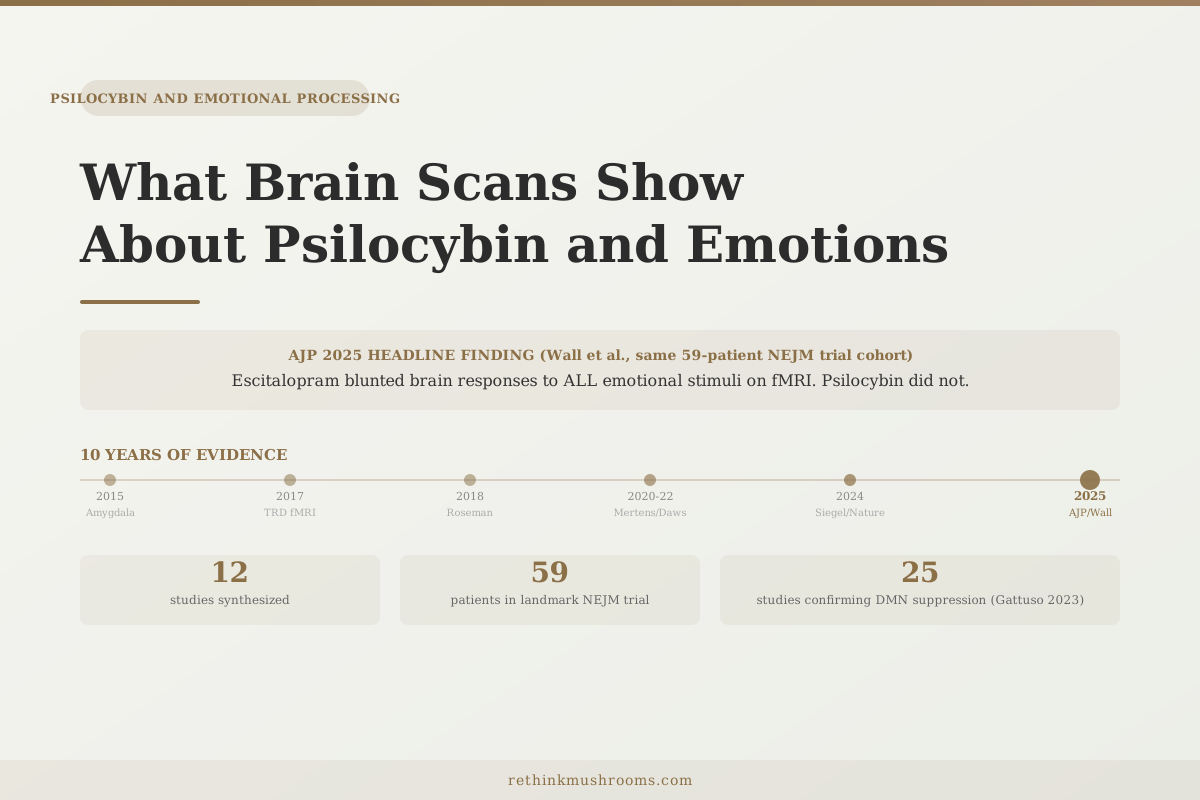
The NEJM trial cohort that generated three landmark 2025 studies. The AJP finding: escitalopram reduced brain responses to all emotional stimuli on fMRI. Psilocybin showed no such blunting, and for some stimuli, slightly enhanced them.
Wall MB et al. Am J Psychiatry. 2025
12
neuroimaging studies synthesized here, from 2015 to 2025
25
studies in the 2023 systematic review confirming consistent DMN suppression by psilocybin
43
patients in the Nature Medicine study where psilocybin but not escitalopram increased global brain integration
Wall MB et al. Am J Psychiatry. 2025
 View as image ↗
In 2025, a study published in the American Journal of Psychiatry answered a question that had been building for ten years in the brain imaging literature. Using the same 59 patients from the landmark NEJM psilocybin vs. escitalopram trial, Wall and colleagues put participants back into a brain scanner and measured their neural responses to emotional stimuli: happy faces, fearful faces, and neutral faces.
Escitalopram reduced brain responses to all of them. Every category of emotional stimulus produced a smaller neural signal in the escitalopram group compared to their pre-treatment baseline. Psilocybin produced no such blunting, and for some stimuli, responses slightly increased.[1]
This is the 2025 headline. But to understand what it means and why it matters, the story starts ten years earlier.
For the clinical context of psilocybin for major depression, see Psilocybin for Major Depression: The Clinical Evidence. For the question of whether psilocybin can reverse SSRI-induced emotional numbness specifically, see Can Psilocybin Reverse SSRI-Induced Emotional Numbness?. For what fMRI shows about psilocybin and brain connectivity in the broader context, see What Psilocybin Does to the Depressed Brain: fMRI Studies.
Key Takeaways
- Wall et al. (AJP, 2025): escitalopram significantly reduced brain responses to all emotional stimuli on fMRI; psilocybin did not, and slightly enhanced some responses. This is direct neural evidence of SSRI emotional blunting
- Kraehenmann 2015: first neuroimaging evidence that psilocybin acutely reduces amygdala reactivity to negative stimuli, correlating with increased positive affect
- Roseman 2018 paradox: amygdala INCREASES to emotional faces after psilocybin for depression; depression had blunted all emotional response; psilocybin restores it; the increase to fearful faces at one week predicts clinical improvement
- Mertens 2020: emotional function changes are the direct mediator of antidepressant response. Not a side effect. The mechanism itself
- Daws 2022 (Nature Medicine): psilocybin increased global brain integration in 43 patients; escitalopram showed no comparable change; magnitude of integration predicted depression reduction
- Siegel 2024 (Nature): psilocybin desynchronizes the brain's normally locked patterns, dismantling the rigid synchronized activity that characterizes emotional rigidity in depression
The 2025 Headline: Escitalopram Blunts the Brain, Psilocybin Does Not
Wall and colleagues published their 2025 American Journal of Psychiatry study using the Phase 2 double-blind RCT cohort from the 2021 New England Journal of Medicine trial.[1] This was not a new trial but a nested neuroimaging analysis using fMRI data collected from participants already enrolled in the original comparison.
The scanner measures what is called the BOLD signal, which is a proxy for neural activity based on the magnetic properties of oxygenated blood flowing to active brain regions. When the brain responds to an emotional stimulus, BOLD signals increase in regions that process that stimulus.
In the escitalopram group, BOLD responses decreased across all face types compared to baseline: happy, fearful, and neutral faces all generated smaller neural signals post-treatment. The amygdala, which is the brain's primary processing region for emotionally significant signals (especially threats and social cues), showed a distinct response pattern compared to psilocybin. The result was a blunted emotional brain across the board.
Psilocybin showed no such suppression. For some stimuli, responses were slightly enhanced. The two treatments produced equivalent clinical improvement on the primary depression score, but their effects on emotional brain architecture were measurably opposite.
Martens and colleagues published a parallel 2025 analysis in Translational Psychiatry, examining the same cohort for negative affective bias, which is the tendency to interpret ambiguous information negatively and a core feature of depressed thinking.[8] Both treatments reduced negative affective bias comparably. But the brain pathways through which they achieved this were different: psilocybin maintained and in some cases increased sensory-emotional integration; escitalopram reduced neural activation in affective regions. Same destination, fundamentally different route.
The First Clue: Psilocybin and the Amygdala in 2015
The story begins with Kraehenmann and colleagues in 2015, who published the first neuroimaging study examining how psilocybin affects amygdala responsiveness to emotional stimuli.[11]
In healthy volunteers given psilocybin acutely (while in the scanner), amygdala reactivity to negative stimuli decreased significantly. Importantly, this decrease correlated directly with enhanced positive affect during the experience. Less amygdala response to threatening content, more positive emotional experience.
This was the first imaging evidence connecting psilocybin's amygdala effects to its emotional consequences. But it also raised an immediate question: if psilocybin reduces amygdala reactivity, is it just a different kind of emotional blunting? Is this fundamentally different from what SSRIs do?
The answer turned out to be yes, but it required several more studies to establish why.
The First Depressed Brains in the Scanner: 2017 TRD Data
Carhart-Harris and colleagues published the first fMRI study of psilocybin in people with treatment-resistant depression (depression that had failed at least two medications) in Scientific Reports in 2017, involving 19 patients.[6]
The key finding: post-treatment decreases in cerebral blood flow (a measure of brain activity) in the amygdala correlated with reduced depressive symptoms. 47% of patients showed a clinical response at 5 weeks. The researchers noted in their analysis that patients described something they termed "emotional release," meaning a sense of being able to access emotional states that depression had suppressed.
What was also notable: the dose-dependent change in network integrity and segregation documented by Madsen and colleagues in 2021 confirmed that blood psilocin levels tracked with both brain network changes and subjective experience intensity, establishing the pharmacokinetic-brain-experience chain.[9]
The Apparent Paradox: Why Amygdala Increases Predict Recovery
A year after the 2017 study, Roseman and colleagues published what appears to be a contradictory finding in Neuropharmacology: after psilocybin treatment for depression, the amygdala showed increased responses to emotional faces, specifically to fearful faces.[5]
Increased amygdala reactivity after treatment, when the 2015 Kraehenmann study had shown decreased reactivity during treatment? The paradox resolves when you understand the starting point.
Depression consistently blunts emotional reactivity. The amygdala of a person with major depressive disorder does not respond normally to emotional stimuli. It shows reduced reactivity across the board, blunting both positive and negative content. This is different from healthy brain function, where the amygdala responds vigorously to emotionally salient content.
What psilocybin appears to do is restore this reactivity, waking the amygdala back up. The acute psilocybin experience may quiet the amygdala's noise around threatening stimuli while the brain is recalibrating. After treatment, the amygdala responds again: to fearful faces, to positive content, to the full emotional spectrum.
The clinical significance: the degree to which the amygdala increased its response to fearful faces one week after treatment predicted how much the patient's depression improved. Greater amygdala reactivation, better clinical outcome. Emotional processing improvement was not a byproduct of clinical improvement. It was driving it.
Emotional Function as the Mechanism, Not a Side Effect
Mertens and colleagues provided the most direct demonstration of this principle in a 2020 Journal of Psychopharmacology study of 17 patients with treatment-resistant depression.[4]
They examined connectivity between the amygdala and the prefrontal cortex, which is the brain region responsible for regulating emotional responses. In depression, the prefrontal cortex and amygdala often show dysregulated connectivity. The regulation circuit stops working effectively.
After psilocybin, connectivity between these two regions normalized. The amygdala became more appropriately responsive, and the prefrontal cortex regained its regulatory relationship with it. The clinical improvement in depression severity correlated directly with these connectivity changes.
The critical interpretive step: emotional function changes were not a secondary outcome that happened to track depression improvement. They were the neurobiological mediator: the mechanism through which psilocybin produced antidepressant effects. Psilocybin improved depression because it normalized emotional processing. The two are not separable.[4]
For a deeper treatment of the amygdala's role specifically, see Psilocybin and Amygdala Reactivity: What Brain Scans Reveal About Depression Relief.
Network-Level Evidence: What Daws 2022 Added
Where Mertens focused on the amygdala-prefrontal relationship, Daws and colleagues in their 2022 Nature Medicine paper zoomed out to the whole-brain level.[3]
They measured global brain integration (how much of the brain is communicating across its normally segregated network boundaries) in 43 patients who received either psilocybin therapy or escitalopram in a randomized trial. Psilocybin significantly increased global integration. Escitalopram did not.
The magnitude of integration increase after psilocybin correlated with antidepressant benefit at six months. The brain's network segregation (rigid boundaries between different functional networks) decreased; communication across those boundaries increased. Depression is associated with excessive segregation, particularly excessive self-referential activity in the default mode network (the brain circuit for rumination and self-focused thinking) disconnected from external emotional processing.
The default mode network pattern was addressed comprehensively in Gattuso and colleagues' 2023 systematic review in the International Journal of Neuropsychopharmacology, which analyzed 25 studies on psychedelic effects on DMN function.[7] The finding was consistent across studies: psychedelics suppress the default mode network's hyperactive, self-referential state, reducing the ruminative thought patterns that characterize depression. DMN suppression correlated with therapeutic outcomes including reduced emotional rigidity.
For the detailed default mode network discussion, see Psilocybin and Default Mode Network Changes in Depression.
Desynchronization: The 2024 Nature Paper
The most recent landmark in the imaging literature is Siegel and colleagues' 2024 Nature paper, which introduced the concept of "desynchronization" as psilocybin's primary brain mechanism.[2]
In dense-sampling fMRI (where participants are scanned many times to capture individual brain dynamics rather than just group averages), psilocybin caused widespread reduction in normally synchronized brain activity. Brain regions that typically fire in lockstep began firing independently. The entrenched patterns of synchronized activity that characterize the depressed brain's emotional rigidity were dismantled.
The analogy that makes this accessible: think of the depressed brain as music stuck on repeat, the same ruminative loop playing over and over. The neural regions involved in processing that loop fire together repeatedly, strengthening the pattern. Psilocybin breaks the synchrony. The regions stop firing together, the loop disrupts, and new patterns can emerge.
The intensity of desynchronization correlated with the subjective intensity of the psychedelic experience. Greater pattern disruption, more profound experience. The brain's rigid emotional structures and the subjective sense of dissolving emotional barriers are two descriptions of the same neurological event.[2]
Prediction: Who Responds and Why
Copa and colleagues published a 2024 Journal of Affective Disorders study examining whether baseline fMRI patterns could predict who would respond to psilocybin for depression before any treatment was administered.[10]
The finding: patients with greater baseline emotional network dysregulation showed the largest therapeutic response. Those whose emotional processing circuits were most disrupted by depression had the most to gain from psilocybin's normalizing effect on those same circuits. This is consistent with the Mertens 2020 finding that the degree of amygdala normalization drives clinical improvement: the more broken the system, the more room there is to improve.
This suggests a potential precision psychiatry application: baseline fMRI patterns may eventually help identify which patients are most likely to benefit from psilocybin therapy. The predictive work is at an early stage, but the finding is directionally consistent with the rest of the evidence.
Durability: Emotional Changes That Persist
Barrett and colleagues published a 2020 Scientific Reports study tracking emotional and brain function changes over time after a single high dose of psilocybin in healthy volunteers.[12]
At one month post-treatment, positive affect remained significantly elevated compared to baseline. Negative affect had returned to pre-treatment levels. Trait anxiety was still reduced. The pattern was not one of permanent euphoria but of emotional recalibration: the capacity for positive emotional experience was elevated while the emotional system as a whole functioned more normally.
This durability evidence matters for the clinical question of why psilocybin produces lasting antidepressant benefit from limited exposure. The brain imaging data across these studies points toward a single coherent mechanism: acute desynchronization breaks the brain's rigid locked patterns, amygdala-prefrontal connectivity normalizes, global integration increases, and the resulting emotional recalibration persists because it represents a genuine change in network architecture rather than a pharmacological suppression.
The Bottom Line
Ten years of brain imaging research converges on a consistent finding: psilocybin restores emotional brain responsiveness in depression rather than suppressing it. The foundational arc runs from Kraehenmann 2015 (amygdala quieted during acute experience) through Roseman 2018 (amygdala reactivated post-treatment, reactivation predicts recovery) to Mertens 2020 (emotional function is the mechanism) to Daws 2022 Nature Medicine (global integration, opposite of escitalopram) to Siegel 2024 Nature (desynchronization of rigid patterns) to Wall 2025 AJP (direct fMRI comparison showing SSRI blunting vs. psilocybin preservation in the same 59-patient RCT). The brain imaging evidence explains why patients describe "feeling again" after psilocybin: the emotional circuitry that depression had suppressed becomes active and appropriately responsive.
Frequently Asked Questions
Sources & References
- 1. Source details for this reference are not yet available.
- 2. Source details for this reference are not yet available.
- 3. Source details for this reference are not yet available.
- 4. Source details for this reference are not yet available.
- 5. Source details for this reference are not yet available.
- 6RTHM-00463·Carhart-Harris, Robin L et al. (2017). “Psilocybin for treatment-resistant depression: fMRI-measured brain mechanisms..” Scientific reports.Study breakdown →PubMed →↩
- 7. Source details for this reference are not yet available.
- 8. Source details for this reference are not yet available.
- 9. Source details for this reference are not yet available.
- 10. Source details for this reference are not yet available.
- 11. Source details for this reference are not yet available.
- 12RTHM-01169·Barrett, Frederick S et al. (2020). “Emotions and brain function are altered up to one month after a single high dose of psilocybin..” Scientific reports.Study breakdown →PubMed →↩